AI Contract Analysis Tools Comparison 2026: AI Review vs Manual — 90 Min → 2 Min
15-page contract reviewed in 2 min vs 90 min. Real cost and accuracy data comparing AI contract analysis tools in 2026. See which approach wins.
 MinjiLee · Strategic Lead February 17, 2026 9 min read
AI vs. Traditional Contract Review: Speed, Cost, and Accuracy Compared
Contract review is one of the most important and least efficient processes in modern business. Every organization signs contracts — with vendors, clients, employees, partners, landlords, and service providers. Each contract contains obligations, risks, and opportunities that directly affect the bottom line. Yet for most businesses, the review process has not fundamentally changed in decades: a human reads the document, identifies concerns, and provides feedback.
Artificial intelligence is now capable enough to challenge this paradigm. AI contract review tools can analyze agreements in minutes, identify risk patterns across thousands of clauses, and flag deviations from standard terms with remarkable consistency. But AI is not magic, and it does not make lawyers obsolete. The real question is not whether AI or human review is better — it is how to combine them for optimal results.
This article provides an honest, data-driven comparison of AI and traditional contract review across five critical dimensions: speed, cost, accuracy, scalability, and consistency. We will examine where each approach excels, where it falls short, and how modern businesses are building hybrid workflows that leverage the best of both.
How Much Faster Is AI Contract Review Compared to Manual?
The speed difference between AI and human contract review is the most dramatic and least debatable advantage.
Traditional Review Speed
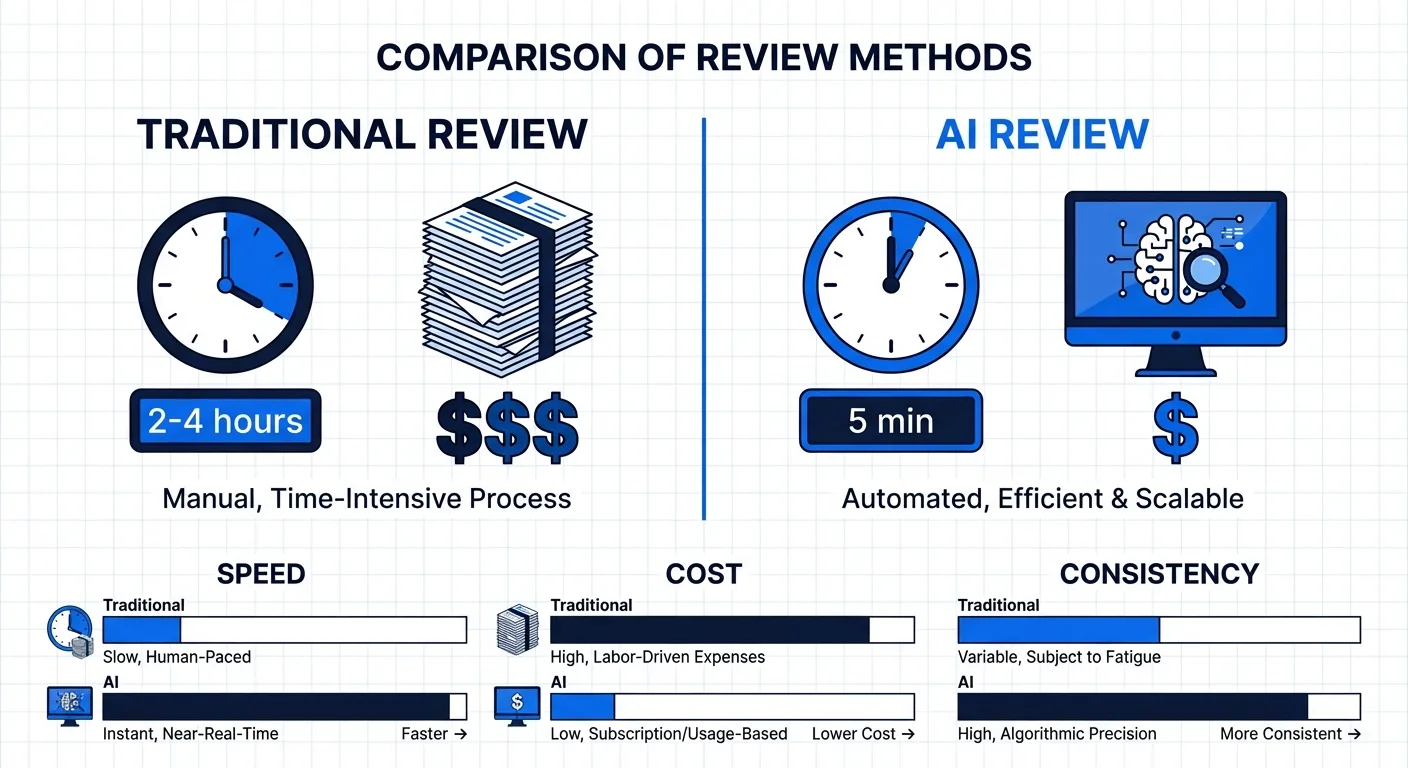
An experienced attorney reviewing a standard commercial contract — say, a 15-page software licensing agreement — typically requires 60 to 90 minutes for a thorough analysis. Complex agreements such as M&A documents, multi-party joint ventures, or international distribution agreements can take 4 to 8 hours or more. Enterprise agreements with hundreds of pages of terms, schedules, and exhibits may require days of review across multiple attorneys.
These timelines assume the attorney is available immediately. In practice, contracts often sit in a review queue while legal teams handle competing priorities. A study by the Corporate Legal Operations Consortium found that the average turnaround time from contract submission to completed legal review is 3.4 business days in organizations with dedicated legal departments — and significantly longer in companies that rely on outside counsel.
AI Review Speed
AI contract analysis tools process documents in a fundamentally different way. Rather than reading linearly from page one to the end, AI models evaluate all clauses simultaneously against a comprehensive risk and compliance framework. A 15-page contract that takes an attorney 90 minutes typically completes AI analysis in 1 to 3 minutes. Complex agreements take 5 to 10 minutes. Even massive document sets can be processed in under an hour.
This speed advantage compounds when you consider volume. If your legal team reviews 50 contracts per month and each review takes 90 minutes, that is 75 hours of attorney time. AI processes the same 50 contracts in roughly 2.5 hours of computing time, freeing those 75 hours for higher-value legal work.
The Real-World Impact
Speed is not just about efficiency — it directly affects deal velocity. When a prospective client sends you a contract and expects a response within 24 hours, spending three days in a legal review queue is not just slow, it is a competitive disadvantage. Companies using AI for initial contract analysis can respond the same day, accelerating negotiations and demonstrating operational competence.
Cost: $6/Month vs. $300+/Hour
The cost comparison between AI and traditional review is where the accessibility argument becomes most compelling.
Traditional Review Costs
Attorney rates for contract review vary by market and seniority, but the numbers are consistently substantial. Junior associates at mid-size firms typically bill $200 to $350 per hour. Senior associates bill $350 to $500. Partners at major firms bill $500 to $1,000 or more. Even in-house counsel, while not billing hourly, represent a fully loaded cost of $150,000 to $300,000 per year in salary, benefits, and overhead.
For a single contract review at average rates, the math is straightforward. A standard commercial agreement at 90 minutes of review time at $350 per hour costs approximately $525. A complex agreement at 4 hours costs $1,400. If your business reviews 20 contracts per month at an average of $500 each, you are spending $10,000 per month — $120,000 per year — on contract review alone.
Small businesses and startups face an impossible choice: pay these rates and strain limited budgets, or skip legal review and accept unknown risks. Most choose the latter, which is how problematic contract terms go undetected until they cause real damage.
AI Review Costs
AI contract review platforms have made sophisticated analysis accessible at price points that were unimaginable five years ago. AiDocX, for example, provides AI-powered contract analysis starting with its free tier and expanding significantly on the Basic plan at $6 per month. Even enterprise-grade AI review platforms typically cost $50 to $200 per month for unlimited contract analysis.
The per-contract economics are transformative. At $6 per month on AiDocX's Basic plan, analyzing 20 contracts per month costs $0.30 per contract. Compare that to $525 per contract for traditional attorney review. That is a cost reduction of more than 99%.
What This Means for Different Organizations
For enterprises with large legal departments, AI review does not eliminate legal costs — but it dramatically reduces the hours spent on routine analysis, allowing attorneys to focus on genuinely complex matters.
For mid-size businesses, AI review can reduce outside counsel spend by handling initial analysis in-house, only escalating truly complex issues to external attorneys.
For small businesses and startups, AI review provides access to contract analysis that was previously unaffordable. A company that could never justify $500 for a contract review can absolutely justify $6 per month for AI analysis of every agreement they sign.
Accuracy: Pattern Recognition vs. Contextual Understanding
The accuracy comparison between AI and human review is the most nuanced and the most important to understand correctly. Neither approach is universally more accurate — each excels in different dimensions.
Where AI Excels
Consistency across documents. AI applies the same analytical framework to every contract, every time. It does not get tired at 4 PM on a Friday. It does not rush through a review because lunch is waiting. It does not unconsciously skip over boilerplate language that happens to contain a non-standard modification. For routine risk identification — spotting unfavorable indemnification clauses, identifying missing standard provisions, flagging unusual termination rights — AI is more reliably thorough than human review.
Cross-reference analysis. Contracts often contain clauses that interact with or contradict each other. A limitation of liability in one section might be effectively negated by an indemnification obligation elsewhere. AI evaluates all clauses simultaneously and identifies these interactions with high reliability. Human reviewers reading linearly are significantly more likely to miss cross-reference issues, especially in long documents.
Pattern detection across portfolios. AI can analyze your entire contract portfolio and identify systemic risks — for example, discovering that 60% of your vendor agreements contain auto-renewal clauses with insufficient notice periods, or that your indemnification language has drifted from your approved standards across recent contracts. This portfolio-level analysis is practically impossible for human reviewers.
Omission detection. AI trained on large corpora of commercial agreements can identify when standard protective clauses are missing. If a data processing agreement lacks standard contractual clauses required for international data transfers, or a services agreement omits a limitation on consequential damages, AI flags the absence. Humans may not notice what is not there.
Where Human Review Excels
Contextual and strategic understanding. AI can identify that a non-compete clause is unusually broad, but it cannot evaluate whether that breadth is acceptable given the specific strategic context of the deal. A human reviewer understands that a broad non-compete in a key acquisition might be worth accepting because the acquisition itself is transformative, while the same clause in a routine vendor agreement is unreasonable.
Negotiation strategy. Identifying a problematic clause is the first step; knowing how to negotiate it is the second. Experienced attorneys understand the other party's likely motivations, the relative leverage of each side, and the creative solutions that can address both parties' concerns. AI can suggest alternative language, but it cannot replace the strategic judgment that experienced negotiators bring.
Novel and unusual provisions. AI models are trained on large datasets of existing contracts. When they encounter truly novel provisions — a new type of performance metric, an unusual escrow arrangement, a creative earn-out structure — they may not have sufficient training data to evaluate the clause accurately. Human reviewers can reason about novel provisions from first principles.
Relationship and business context. Some contract terms are technically unfavorable but acceptable in the context of an important relationship. A human reviewer can weigh the legal risk against the business value of the relationship. AI evaluates terms in isolation from relationship dynamics.
The Accuracy Bottom Line
In controlled studies, AI contract review tools typically identify 90 to 95% of the risk issues that experienced attorneys identify, and they additionally catch 10 to 15% of issues that attorneys miss (primarily cross-reference inconsistencies and omissions). However, the 5 to 10% of issues that AI misses tend to be the nuanced, context-dependent ones that can have the largest impact.
The conclusion is clear: neither AI nor human review alone achieves optimal accuracy. The combination does.
Scalability: Unlimited Capacity vs. Fixed Bandwidth
Traditional Scalability
Human review capacity is fundamentally constrained. Each attorney can review a finite number of contracts per day, and hiring additional attorneys is expensive, slow, and introduces training and quality control challenges. When deal volume spikes — during M&A activity, year-end renewals, or rapid growth — legal teams become bottlenecks.
AI Scalability
AI scales linearly with computing resources, which are effectively unlimited and instantly available. Whether you need to review 10 contracts or 10,000, the AI processes them with the same speed and quality. This makes AI particularly valuable during high-volume periods when human capacity is most strained.
Consistency: Algorithmic Precision vs. Human Variability
Traditional Consistency
Human review is inherently variable. Different attorneys have different areas of focus, risk tolerances, and interpretation frameworks. Studies have shown that two equally qualified attorneys reviewing the same contract will identify overlapping but not identical sets of issues. This variability means that the quality of your contract review depends on which attorney happens to be assigned — and even the same attorney may produce different results on different days depending on workload, fatigue, and distraction.
AI Consistency
AI applies identical analytical standards to every contract. The same clause will be flagged (or not flagged) regardless of when the analysis runs, how many contracts were analyzed before it, or any other external factor. This consistency is particularly valuable for organizations that need to maintain uniform contract standards across multiple business units, geographies, or time periods.
AI Contract Analysis Tools Comparison 2026: Side-by-Side
| Feature | AiDocX | Kira Systems | Ironclad AI | SpotDraft |
|---|---|---|---|---|
| Price | From $6/mo | Enterprise only | Enterprise only | From $39/mo |
| Review speed | 1–3 min | 2–5 min | 3–8 min | 2–4 min |
| Languages | 13 | 5 | 8 | 4 |
| E-signature built-in | ✅ Yes | ❌ No | ❌ No | ❌ No |
| Document tracking | ✅ Yes | ❌ No | Partial | ❌ No |
| Best for | SMBs & startups | Law firms | Large enterprises | Tech startups |
Before adopting a hybrid approach, it helps to understand the current landscape of AI contract analysis tools. The market has matured significantly, with platforms differentiating on depth of analysis, language support, and integration with broader document workflows.
AiDocX stands out by combining AI contract analysis with e-signatures, document tracking, and secure sharing in a single platform — starting at $6/month. Its AI identifies risk clauses, missing provisions, and unfavorable terms across 13 languages, making it particularly strong for international contracts.
Kira Systems focuses on machine learning-based extraction and analysis, primarily serving large law firms and enterprises. Strong on due diligence workflows but expensive and complex to implement.
Ironclad AI integrates contract analysis into a broader CLM (Contract Lifecycle Management) platform. Best suited for enterprises with high contract volumes that need end-to-end lifecycle management.
SpotDraft offers AI-assisted review with a focus on startup-friendly pricing and workflow automation. Good for tech companies but limited in multi-language support.
For most small and mid-size businesses, the key differentiator is not just analytical accuracy — it is whether the AI analysis integrates with the rest of your document workflow (signatures, tracking, sharing) without requiring multiple subscriptions.
The Hybrid Approach: Best of Both Worlds
The most sophisticated organizations are not choosing between AI and human review — they are integrating both into a structured workflow that maximizes the strengths of each.
Tier 1: AI First-Pass Analysis
Every incoming contract goes through AI analysis immediately upon receipt. The AI identifies and categorizes all potential risks, flags deviations from standard terms, checks for missing clauses, and produces a structured risk summary. This happens in minutes and at minimal cost.
Tier 2: Risk-Based Routing
Based on the AI's risk assessment, contracts are routed appropriately. Low-risk, standard agreements (routine NDAs, standard vendor terms under a certain dollar threshold) may be approved based on AI analysis alone, with human spot-checks for quality assurance. Medium-risk contracts are routed to junior legal staff who review the AI's findings, verify the flagged issues, and handle straightforward negotiations. High-risk and complex contracts are escalated to senior attorneys or outside counsel, with the AI analysis serving as a structured briefing document that saves review time.
Tier 3: Human Strategic Review
Senior legal professionals focus their expertise where it matters most — the complex, high-stakes, context-dependent decisions that AI cannot make. Because AI has already identified the routine issues, human reviewers can dedicate their full attention to the genuinely challenging questions.
The Economics of Hybrid Review
This tiered approach typically reduces total legal review costs by 50 to 70% while actually improving overall review quality. The savings come from two sources: AI handles routine analysis at near-zero marginal cost, and human reviewers are more effective because they focus on complex issues rather than spending time on boilerplate review.
Implementing AI Contract Review: A Practical Starting Point
You do not need to overhaul your entire legal process to start benefiting from AI contract review. Here is a practical implementation path.
Start with new contracts. Do not attempt to retroactively analyze your entire contract portfolio on day one. Begin by running AI analysis on every new contract that comes in for review. This immediately improves your process for current deals while you build comfort with the technology.
Use a platform that integrates with your workflow. AI contract review is most valuable when it is part of your document management ecosystem, not a separate tool. AiDocX combines AI contract analysis with e-signatures, document tracking, and secure sharing in a single platform. This means the same contract that is analyzed by AI can be sent for signature, tracked for engagement, and stored securely — all without switching tools or transferring files.
Calibrate against human review. For the first month, run AI analysis in parallel with your existing human review process. Compare the results. Identify where AI is catching issues your team misses and where your team catches nuances the AI does not. Use these findings to calibrate your confidence in AI analysis and define your routing rules.
Scale gradually. As you build confidence in AI analysis accuracy, gradually increase the range of contracts that are approved based on AI review alone (with periodic human audits). Most organizations reach a steady state where 40 to 60% of routine contracts are handled primarily by AI, with human review reserved for complex and high-value agreements.
The Future Is Hybrid
The debate between AI and traditional contract review is already becoming obsolete. The question is not which approach is better — it is how quickly you can implement a hybrid workflow that leverages both.
AI contract review tools like AiDocX have made sophisticated analysis accessible to organizations of every size and budget. At $6 per month for the Basic plan — less than the cost of a single billable quarter-hour from most attorneys — you get AI analysis that covers the vast majority of routine contract risks with speed and consistency that no human reviewer can match.
But AI is a complement to legal expertise, not a replacement for it. The businesses that will manage contract risk most effectively in 2026 and beyond are those that use AI to handle the exhaustive, repetitive analytical work while directing human intelligence toward the strategic, contextual, and creative challenges that genuinely require it.
The tools are available. The economics are compelling. The only remaining question is how long you will continue reviewing contracts the slow, expensive, inconsistent way before making the shift.
Related: AiDocX vs DocuSign: Full Comparison 2026 · How to Sign Documents Online Legally
Frequently Asked Questions
How much faster is AI contract review compared to manual?
AI contract review is approximately 45x faster than manual attorney review. A standard 15-page contract takes an experienced attorney 60–90 minutes to review; AI completes the same analysis in 1–3 minutes. For complex 50+ page agreements, the gap is even larger — AI takes 5–10 minutes versus 4–8 hours for a human reviewer.
How accurate is AI in identifying key contract terms compared to manual review?
In controlled studies, AI contract review tools identify 90–95% of risk issues that experienced attorneys catch, and additionally surface 10–15% of issues attorneys miss (primarily cross-reference inconsistencies and missing clauses). The 5–10% AI misses tend to be nuanced, context-dependent issues. This is why a hybrid AI + human approach outperforms either alone.
Is AI contract review suitable for non-lawyers?
Yes — this is one of AI's most important advantages. AI contract review tools like AiDocX present findings in plain language, explaining what each clause means and why it might be risky, without requiring legal expertise to interpret. Small business owners, startup founders, and procurement managers can use AI review to catch major issues before escalating to an attorney.
How much human review is needed for AI contract analysis?
It depends on contract complexity and risk level. For routine, low-value contracts (standard NDAs, vendor agreements under a threshold), many organizations operate with AI-only review plus periodic human audits. For medium-risk contracts, a brief human check of AI findings is recommended. High-value or complex agreements (M&A, partnership deals, international contracts) always warrant full attorney review — with AI analysis serving as a structured briefing document that reduces review time by 40–60%.
What are the advantages and disadvantages of AI vs. traditional contract review?
AI advantages: 45x faster, 99%+ lower cost, 100% consistent, scales infinitely, catches cross-reference issues humans miss. AI disadvantages: limited strategic/contextual judgment, weaker on novel clause structures, cannot negotiate. Human advantages: contextual and strategic judgment, negotiation expertise, handles novel provisions. Human disadvantages: slow, expensive, variable quality, limited scalability. The optimal solution combines both.
How does AI improve contract review and negotiation?
AI accelerates the review phase so negotiators spend less time on clause identification and more time on strategy. Specific improvements: (1) instant risk prioritization so negotiators focus on high-impact clauses first, (2) suggested alternative language for flagged provisions, (3) portfolio-level pattern analysis to identify systemic negotiation weaknesses, and (4) same-day turnaround that shifts negotiating dynamics by responding faster than the other party expects.
Ready to automate your documents with AI?
Start free with AiDocX — AI contract drafting, meeting minutes, consultation notes, e-signatures, and more in one platform.
Get Started FreeMore from AiDocX Blog
AI Addiction Counseling Notes: Templates & Automation Guide for 2026
Complete guide for addiction counselors on writing MI session records, relapse prevention plans, and CBT notes — with AI automation tips and HIPAA 42 CFR Part 2 compliance.
 SophieKim March 13, 2026 13 min
AI Counseling Notes Guide (2026): Free Templates + Auto-Generate in Minutes
Complete guide to writing counseling notes in 2026. Includes copy-paste templates for psychology, legal, sales, and general counseling, plus how to auto-generate structured records with AI.
SophieKim March 13, 2026 12 min
AI Domestic Violence Counseling Notes (2026): Templates + Safety Guide for DV Advocates
Complete guide to domestic violence counseling documentation in 2026. Includes intake records, danger assessment checklists, safety plan templates, and how to automate records with AI while protecting victim privacy.
SophieKim March 13, 2026 13 min