
How to Build an IR Deck That Wins Investor Confidence in 2026
A comprehensive guide to creating investor presentations that secure funding. Learn the essential slides, design principles, and AI-powered tools that help startups build winning IR decks.
 Anna · Sales Manager January 20, 2026 8 min read
How to Build an IR Deck That Wins Investor Confidence
Every startup founder reaches a moment where their entire company's future hinges on a single presentation. You walk into a room -- or more likely, open a Zoom call -- and you have fifteen minutes to convince seasoned investors that your vision is worth millions. The vehicle for that persuasion is your IR deck, and getting it right is non-negotiable.
After analyzing thousands of investor presentations on our platform, we have distilled the principles that separate decks that close rounds from those that get politely archived. This guide covers the structure, design, and strategy behind IR decks that win investor confidence in 2026.
What Is an IR Deck and Why Does It Matter?
An IR deck (Investor Relations deck) is a structured presentation that communicates your company's story, market opportunity, traction, and financial projections to potential investors. While the term "pitch deck" is often used interchangeably, an IR deck tends to carry more depth -- it is the document that investors will circulate internally, revisit during due diligence, and reference when making allocation decisions.
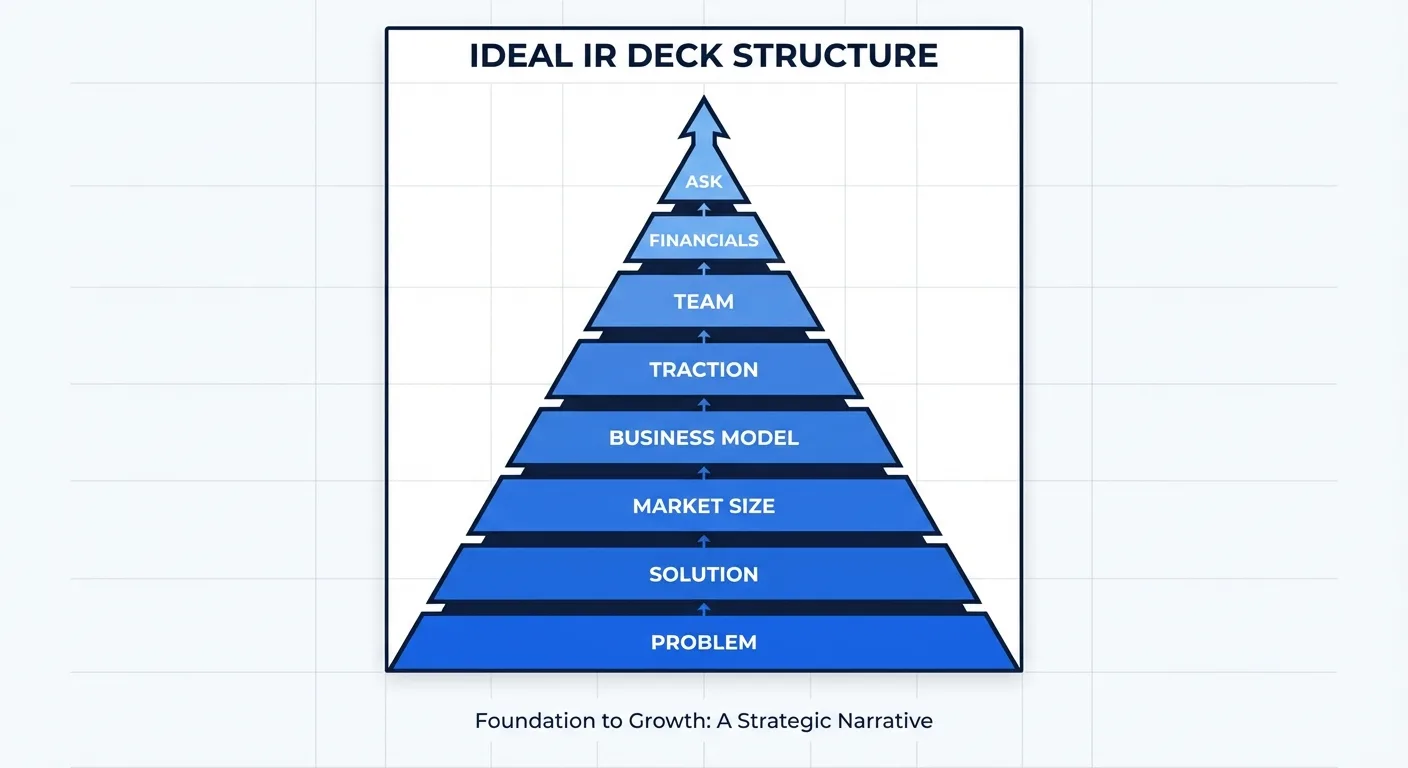
Your IR deck is not a script for your pitch. It is the artifact that continues selling your company after you leave the room. Research from DocSend's fundraising analysis consistently shows that investors spend an average of just 3 minutes and 44 seconds reviewing a deck. That means every slide must earn its place.
The Essential Slides: A Proven Structure
After analyzing successful fundraising decks across seed, Series A, and growth-stage rounds, we recommend a 12-to-15-slide structure. Here is the breakdown of each essential section and what it needs to accomplish.
1. Title Slide
This seems simple, but founders routinely get it wrong. Your title slide should include your company name, a one-sentence description of what you do, your logo, and the round you are raising. Nothing else. Avoid taglines that sound clever but explain nothing. "Reinventing the future of work" tells an investor nothing. "AI-powered contract management for mid-market legal teams" tells them everything they need in one line.
2. Problem Statement
The problem slide is where you establish urgency. Investors need to believe that a real, painful, and widespread problem exists before they care about your solution. Use concrete data: "Mid-market companies spend an average of 14 hours per contract on manual review, costing $6,900 per agreement in legal fees." Avoid hypothetical scenarios. Cite real statistics, reference industry reports, or describe a specific customer's pain point with permission.
The strongest problem slides frame the issue in economic terms -- time wasted, revenue lost, or risk incurred. Investors think in dollars, and your problem should be denominated accordingly.
3. Solution
Now you earn the right to talk about your product. The solution slide should clearly articulate what you have built and how it directly addresses the problem you just described. Use a product screenshot or a simple diagram. Avoid feature lists -- instead, describe the transformation your product enables.
For example: "AiDocX uses advanced AI to analyze contracts in under 60 seconds, flagging risky clauses, missing standard terms, and inconsistencies that would take a lawyer 3-4 hours to identify manually." That is a solution framed as an outcome, not a feature list.
4. Market Size (TAM, SAM, SOM)
Investors need to see that you are pursuing a market large enough to generate venture-scale returns. Present your Total Addressable Market (TAM), Serviceable Addressable Market (SAM), and Serviceable Obtainable Market (SOM) with clear methodology.
Bottom-up sizing is far more credible than top-down. Instead of saying "The global document management market is $7.2 billion," say "There are 2.4 million mid-market companies in North America. Our average contract value is $720/year. That gives us an SAM of $1.73 billion in North America alone." Show your math. Investors will check it.
5. Product Deep Dive
This is where you demonstrate that your solution actually works. Include screenshots, user flow diagrams, or a brief demo walkthrough. Highlight the features that create defensibility -- AI capabilities, integrations, proprietary data advantages. If you support multiple languages (AiDocX supports 13, for instance), that is a differentiator worth showcasing as it signals international scalability from day one.
6. Business Model
Clearly explain how you make money. Present your pricing tiers, average revenue per user, and any expansion revenue mechanics. Investors pay close attention to pricing architecture because it signals how you think about value capture.
A transparent pricing comparison can be powerful. If your competitors charge $10+ per month for basic functionality while you offer a free tier with premium plans starting at $6/month, that pricing advantage is a distribution story. Lower price points reduce friction in customer acquisition and expand your addressable user base -- both of which investors care about deeply.
7. Traction
This is the slide that makes or breaks most decks. Present your key metrics honestly and in context. Depending on your stage, relevant metrics include Monthly Recurring Revenue (MRR), month-over-month growth rate, number of paying customers, net revenue retention, and engagement metrics.
Use charts, not tables. A revenue chart with a clear upward trajectory communicates momentum instantly. If you are pre-revenue, show user growth, waitlist numbers, pilot results, or letter of intent commitments. The key is demonstrating that real people or organizations want what you have built.
8. Competitive Landscape
Do not pretend you have no competitors. Instead, show that you understand the landscape and have a differentiated position within it. A 2x2 matrix works well here, plotting competitors along two axes that favor your positioning.
For document management, you might plot "AI Capability" against "Affordability" and show how incumbent solutions like DocuSign and DocSend charge $10+ per month for individual features while lacking AI-powered generation and analysis. An all-in-one platform that combines signatures, tracking, AI analysis, and virtual data rooms at a fraction of the cost occupies a compelling quadrant.
9. Go-to-Market Strategy
Explain how you acquire customers and how that will scale. Cover primary channels, customer acquisition cost (CAC), and LTV:CAC ratio. If you have a freemium model, explain your free-to-paid conversion rate.
10. Team
Investors fund people as much as products. Highlight relevant experience, domain expertise, and unfair advantages. Prior exits, deep industry knowledge, or AI/ML technical expertise are all worth emphasizing.
11. Financial Projections
Present a 3-to-5-year model showing revenue, key expenses, and a path to profitability. Be realistic -- hockey-stick projections without supporting logic damage credibility. Show your assumptions: customer growth rate, ARPU, churn rate, and major cost drivers.
12. The Ask
State clearly how much you are raising, what the intended use of funds is, and what milestones you expect to achieve with this capital. Break the use of funds into 3-4 categories: product development, go-to-market, team expansion, and operations. Be specific about what success looks like at the end of this runway.
Design Principles That Build Trust
Content is paramount, but design quality signals professionalism. A few principles matter most.
Consistency over creativity. Use a consistent color palette (2-3 colors), a single font family, and uniform spacing throughout. Visual consistency reduces cognitive load for investors reviewing dozens of decks per week.
One idea per slide. Each slide should communicate a single concept. If you are cramming two charts and a paragraph onto one slide, split it. White space helps your key messages land.
Data visualization over text. Replace paragraphs with charts and infographics wherever possible. Given that investors spend under four minutes on average per deck, visual communication is essential, not optional.
Professional typography. Use no more than two font sizes per slide. Avoid font sizes below 18pt for body text. If it is too small to read during a screen share, it is too small.
Common Mistakes That Kill Investor Interest
Burying the lead. If your most impressive metric appears on slide 11, most investors will never see it. Front-load your strongest proof points with a "highlights" slide early in the deck.
Feature dumping. Investors care about outcomes, not feature lists. Focus on three to four capabilities that directly support your value proposition.
Ignoring the narrative arc. Your deck should tell a story: painful problem, elegant solution, massive market, proof it works, capable team, clear plan. Each slide should flow logically into the next.
Unrealistic projections. Projecting $100 million in revenue within three years on $50,000 MRR is a red flag. Ground your projections in defensible assumptions.
No clear ask. Surprisingly common: decks that never clearly state what they need. Always end with a specific amount and how it will be deployed.
How AI Tools Are Changing Deck Creation
The process of building an IR deck has traditionally been painful -- weeks of iteration in PowerPoint, expensive design consultants, and countless rounds of feedback. AI is fundamentally changing this workflow.
Modern AI-powered platforms can generate initial deck structures from your company data, suggest slide layouts based on proven frameworks, and ensure consistency across your entire presentation. At AiDocX, our AI deck generation feature uses advanced language models to help founders create professionally structured IR decks in a fraction of the traditional time.
You provide your company details -- product description, market data, traction metrics, team information -- and the AI generates a complete deck structure with suggested content for each slide. You then refine and customize. What used to take two to three weeks can be accomplished in an afternoon.
Beyond generation, AI helps with content quality -- identifying weak value propositions, suggesting stronger data framing, and flagging common mistakes like buried metrics or missing competitive context.
Document tracking analytics add another dimension. When you share your deck through a platform like AiDocX, you can see exactly which slides investors spend the most time on, where they drop off, and how many times they revisit specific sections. This data is invaluable for iterating on your deck between meetings. If every investor skips your market size slide but lingers on your traction page, that tells you something important about what resonates.
After the Deck: What Comes Next
Building a great IR deck is necessary but not sufficient. How you distribute and manage it matters equally.
Track engagement relentlessly. Use document analytics to understand how investors interact with your deck. Platforms that offer built-in tracking -- rather than requiring a separate DocSend subscription at $10+ per month -- let you monitor views, time per slide, and forwarding activity without adding another tool to your stack.
Prepare supporting documents. Investors who engage with your deck will request additional materials -- financial models, customer references, technical documentation. Having these organized in a virtual data room (VDR) with proper access controls demonstrates operational maturity and accelerates due diligence.
Follow up with data. When reaching out after a meeting, reference specific slides the investor engaged with: "I noticed you spent time on our retention metrics -- here is additional cohort data that supports those numbers." This level of specificity, enabled by document analytics, transforms generic follow-ups into targeted conversations.
Final Thoughts
The IR decks that win investor confidence share common traits: they tell a clear story, present honest data, demonstrate deep market understanding, and make a specific ask. No amount of design polish will compensate for a weak business case, but a strong business case poorly presented will fail to capture attention.
In 2026, founders have access to tools that previous generations could not have imagined. AI-assisted deck generation, real-time engagement analytics, and integrated document management platforms have compressed the timeline from idea to investor-ready presentation. The founders who leverage these tools effectively will have a meaningful advantage in an increasingly competitive fundraising landscape.
Your IR deck is often the first substantive impression an investor has of your company. Make it count.
Ready to automate your documents with AI?
Start free with AiDocX — AI contract drafting, meeting minutes, consultation notes, e-signatures, and more in one platform.
Get Started FreeMore from AiDocX Blog

AI Addiction Counseling Notes: Templates & Automation Guide for 2026
Complete guide for addiction counselors on writing MI session records, relapse prevention plans, and CBT notes — with AI automation tips and HIPAA 42 CFR Part 2 compliance.
 SophieKim March 13, 2026 13 min
AI Counseling Notes Guide (2026): Free Templates + Auto-Generate in Minutes
Complete guide to writing counseling notes in 2026. Includes copy-paste templates for psychology, legal, sales, and general counseling, plus how to auto-generate structured records with AI.
SophieKim March 13, 2026 12 min
AI Domestic Violence Counseling Notes (2026): Templates + Safety Guide for DV Advocates
Complete guide to domestic violence counseling documentation in 2026. Includes intake records, danger assessment checklists, safety plan templates, and how to automate records with AI while protecting victim privacy.
SophieKim March 13, 2026 13 min