The Startup NDA Guide: 7 Clauses You Must Include (+ Free AI Review)
Need an NDA for your startup? This guide covers the 7 essential clauses every startup NDA must include, common mistakes founders make, and how to get your NDA reviewed by AI for free before signing.
 James · Business Strategy February 28, 2026 8 min read
The Startup NDA Guide: 7 Clauses You Must Include (+ Free AI Review)
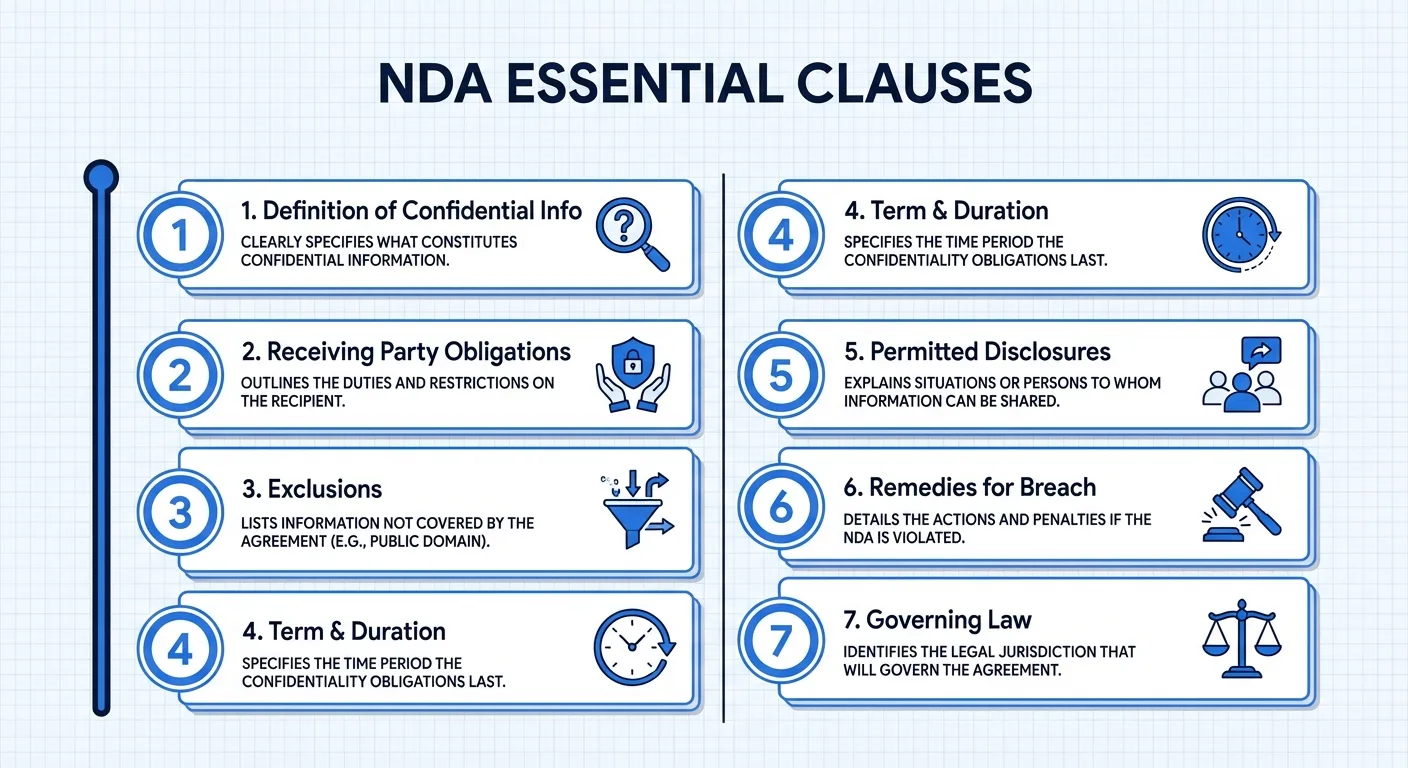
TL;DR: A startup NDA needs 7 essential clauses: definition of confidential information, obligations of the receiving party, exclusions, term and duration, permitted disclosures, remedies for breach, and governing law. Most startup NDAs are either too vague (won't hold up) or too aggressive (scare away partners). This guide helps you get it right.
You're about to share your business plan with a potential investor. Or you're hiring a freelance developer who'll have access to your source code. Or a potential partner wants to explore a collaboration.
In all these scenarios, you need an NDA. But here's the problem: most founders either skip the NDA entirely ("we trust each other") or use a generic template they found online that doesn't actually protect them.
An NDA that's too vague is useless in court. An NDA that's too aggressive makes you look paranoid and drives away partners. Let's find the middle ground.
When You Actually Need an NDA
You need an NDA when:
- Sharing your business plan or financial projections with investors
- Hiring contractors or freelancers who'll access proprietary code/data
- Exploring partnerships where you'll share business strategies
- Engaging with potential acquirers during due diligence
- Onboarding employees who'll handle sensitive information
You probably don't need an NDA when:
- Pitching at a demo day (investors won't sign NDAs for cold pitches — it's an industry norm)
- Sharing your general idea (ideas aren't protectable; execution is)
- The information is already public
A common mistake: sending an NDA to a VC before an introductory meeting. Most VCs won't sign it — they hear hundreds of pitches and can't risk being accused of sharing ideas between portfolio companies. Save the NDA for when you're actually sharing detailed financials, customer data, or proprietary technology.
The 7 Essential NDA Clauses
1. Definition of Confidential Information
This is the most important clause and the one most often written poorly.
Too vague (won't protect you):
"All information shared between the parties shall be considered confidential."
Too broad (unenforceable):
"All information the Disclosing Party has ever created, in any form, whether marked confidential or not."
Just right:
"Confidential Information means all non-public information disclosed by the Disclosing Party, including but not limited to: source code, algorithms, customer lists, financial data, business strategies, product roadmaps, and trade secrets, whether disclosed orally, in writing, or electronically."
Key principle: Be specific enough that a court can identify what's protected, but broad enough to cover information you haven't thought of yet.
2. Obligations of the Receiving Party
What must the person who receives your confidential information actually do?
Standard obligations:
- Use the information only for the stated purpose (e.g., "evaluating a potential business relationship")
- Protect the information with at least the same care they use for their own confidential information
- Restrict access to employees/contractors who need to know and who are bound by similar obligations
- Not reverse engineer products or materials shared under the NDA
3. Exclusions from Confidential Information
Every NDA needs carve-outs. Information is NOT confidential if it:
- Was already known to the receiving party before disclosure (with evidence)
- Becomes publicly available through no fault of the receiving party
- Is independently developed by the receiving party without using the confidential information
- Is received from a third party who is not bound by confidentiality obligations
- Is required to be disclosed by law or court order (with prompt notice to the disclosing party)
These exclusions are standard and expected. If an NDA lacks them, it's a red flag — it's either poorly drafted or deliberately overreaching.
4. Term and Duration
Two separate time periods to define:
Agreement term: How long the NDA relationship lasts (e.g., "This agreement is effective for 2 years from the date of execution").
Survival period: How long confidentiality obligations continue after the agreement ends (e.g., "Confidentiality obligations shall survive for 3 years after termination").
Industry standards:
- Investor discussions: 2 years agreement + 2 years survival
- Contractor/freelancer: Duration of engagement + 2-3 years survival
- Partnership exploration: 1-2 years agreement + 2 years survival
- Trade secrets: Some NDAs specify "until the information ceases to be a trade secret" — this can be indefinite
5. Permitted Disclosures
The receiving party needs to share your information with their team. That's expected. But you want guardrails:
- Disclosure to employees, directors, and advisors who need to know — but they must be bound by confidentiality obligations at least as protective as the NDA
- Disclosure to legal and financial advisors in connection with the stated purpose
- Disclosure required by law, regulation, or court order — but with written notice to you first, so you can seek a protective order
6. Remedies for Breach
What happens if they break the NDA?
Standard remedy language:
"The Disclosing Party shall be entitled to seek injunctive relief in addition to any other remedies available at law or in equity, without the necessity of proving actual damages or posting bond."
This is important because with confidential information, money damages are often inadequate — once your trade secret is out, you can't un-ring the bell. Injunctive relief lets you get a court order to stop the breach immediately.
7. Governing Law and Dispute Resolution
Governing law: Which jurisdiction's law applies? For US startups, this is typically Delaware or your state of incorporation.
Dispute resolution options:
- Courts: Traditional litigation. Public, potentially expensive, but familiar.
- Arbitration: Private, often faster, final and binding. Good for international agreements.
- Mediation first, then arbitration: A two-step process that encourages settlement before escalation.
For startups: Arbitration is often preferable because it's private (your confidential information stays out of public court records) and typically faster.
Mutual vs. One-Way NDA
One-way NDA: Only one party discloses confidential information. The other party has obligations but shares nothing.
Mutual NDA: Both parties share and both parties have obligations.
For startups: Almost always use a mutual NDA. Even when you're the one sharing most of the information, a mutual NDA:
- Feels fairer to the other party (they're more likely to sign without pushback)
- Protects you if they share information about their own operations during discussions
- Looks more professional than a one-sided agreement
Common Startup NDA Mistakes
Mistake 1: Making the NDA too aggressive
If your NDA includes a $1 million liquidated damages clause and a 10-year non-compete, experienced counterparties will either refuse to sign or red-flag you as difficult to work with.
Mistake 2: No definition of "Purpose"
Every NDA should state WHY the information is being shared. Without a defined purpose, the receiving party could argue they're free to use it however they want.
Mistake 3: Forgetting the return/destruction clause
When the NDA term ends or the relationship dissolves, the receiving party should be required to return or destroy all confidential information and certify in writing that they've done so.
Mistake 4: Not signing the NDA before sharing information
Obvious, but it happens constantly. Founders share their pitch deck, then say "oh, we should probably get an NDA signed." By then, the information is already out.
Use AI to Review Your NDA Before Signing
Before you sign any NDA — whether it's one you drafted or one someone sent you — run it through an AI contract review tool. AiDocX offers free AI analysis that will:
- Flag one-sided clauses that favor the other party
- Identify missing standard clauses (like exclusions or return/destruction)
- Highlight unusually long terms or excessive penalties
- Suggest specific language changes to make the NDA more balanced
This takes 30 seconds and costs nothing on the free plan. It's not a substitute for a lawyer on high-stakes deals, but it's an excellent first filter that catches the most common issues.
Bottom Line
A good startup NDA is:
- Specific enough to be enforceable
- Reasonable enough that people will sign it
- Mutual so both parties are protected
- Time-limited with clear survival periods
Include all 7 essential clauses, avoid the common mistakes, and review every NDA with AI before signing. Your future self will thank you.
Ready to automate your documents with AI?
Start free with AiDocX — AI contract drafting, meeting minutes, consultation notes, e-signatures, and more in one platform.
Get Started FreeMore from AiDocX Blog
AI Addiction Counseling Notes: Templates & Automation Guide for 2026
Complete guide for addiction counselors on writing MI session records, relapse prevention plans, and CBT notes — with AI automation tips and HIPAA 42 CFR Part 2 compliance.
 SophieKim March 13, 2026 13 min
AI Counseling Notes Guide (2026): Free Templates + Auto-Generate in Minutes
Complete guide to writing counseling notes in 2026. Includes copy-paste templates for psychology, legal, sales, and general counseling, plus how to auto-generate structured records with AI.
SophieKim March 13, 2026 12 min
AI Domestic Violence Counseling Notes (2026): Templates + Safety Guide for DV Advocates
Complete guide to domestic violence counseling documentation in 2026. Includes intake records, danger assessment checklists, safety plan templates, and how to automate records with AI while protecting victim privacy.
SophieKim March 13, 2026 13 min