Free Affidavit Template and Online Generator Guide for 2026
Learn how to create a legally valid affidavit with a free template, understand common types, avoid mistakes, and sign your sworn statement online.
 James · Content Manager August 21, 2026 14 min read
Free Affidavit Template and Online Generator Guide for 2026
An affidavit is a written statement of facts that a person declares to be true under oath or affirmation. It is often used for court matters, identity changes, property issues, financial applications, business records, and administrative requests. This guide explains the common types of affidavits, what makes one legally valid, and how to create and sign one online using a free template.
What Is an Affidavit?
An affidavit is a formal written statement made voluntarily by a person known as the affiant or deponent. The person swears or affirms that the information is true, usually in front of a notary public, commissioner for oaths, solicitor, or another authorized witness.
The document normally contains the affiant's full legal name and address, a statement identifying the purpose of the affidavit, numbered paragraphs containing factual statements, a declaration that the contents are true, the affiant's signature, the date and place of signing, the signature and seal or details of the authorized witness, when required, and exhibits or supporting documents, if relevant.
An affidavit is different from an ordinary letter or personal statement because it is made under oath or affirmation. That formal promise gives it greater evidentiary weight, although an affidavit is not automatically accepted as proof of every fact. A court or organization may still question its accuracy, require additional evidence, or reject it if it does not follow the applicable rules.
The exact requirements vary by country, state, province, court, agency, and document type. A general affidavit template can help organize your information, but it cannot replace instructions from the court, government office, lender, employer, or other recipient.
Common Types of Affidavits
Choosing the right type of affidavit helps you include the facts the recipient actually needs. Some affidavits are general-purpose, while others follow a specific legal or administrative format.
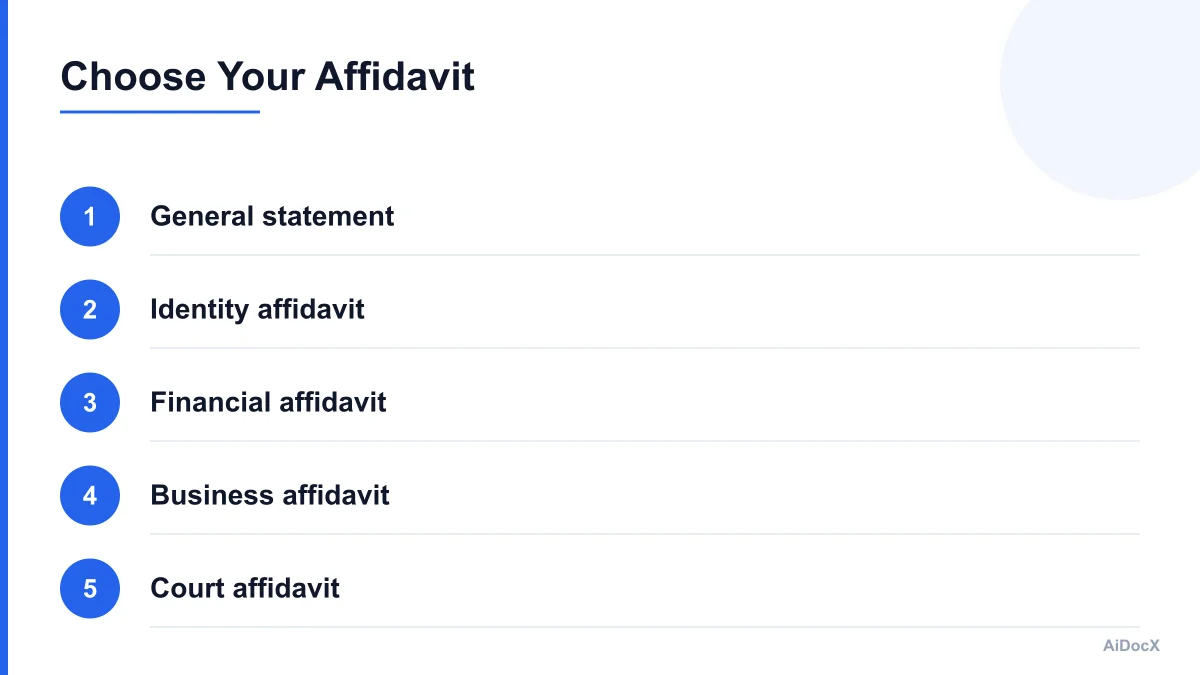
General affidavit
A general affidavit is used to confirm a set of facts when no specialized form is prescribed. For example, someone might use one to explain a lost document, confirm a timeline, or provide evidence about an event within their personal knowledge.
A general affidavit should be focused. It should explain who is making the statement, why the statement is needed, and what facts the person can personally confirm.
Affidavit of identity
An affidavit of identity confirms that a person is known by more than one name or that different records refer to the same individual. It may be used when a person's name changed after marriage or divorce, a passport and birth certificate use different names, a spelling variation appears in official records, or a middle name is included on one document but omitted from another.
The affiant should list each relevant name exactly as it appears on the supporting records and explain the reason for the difference. Copies of identification documents may be attached if the recipient permits them.
Affidavit of residence or domicile
This affidavit confirms where a person lives or maintains a principal residence. It may be requested for school enrollment, immigration matters, licensing, benefits, tax issues, or local registration.
The statement should include the residential address, the period of residence, and any facts needed to distinguish a permanent residence from a temporary location. The affiant should avoid claiming more than they can document.
Affidavit of financial support
An affidavit of financial support states that one person will provide financial assistance to another. It can arise in immigration applications, education arrangements, housing matters, family support, or private agreements.
A recipient may expect details such as the relationship between the parties, the amount and frequency of support, the duration of the commitment, employment or income information, housing, food, tuition, or medical expenses covered, and supporting financial records.
Some government programs provide mandatory forms for financial sponsorship. Use the official form when one exists rather than substituting a general affidavit.
Financial affidavit
A financial affidavit gives a structured picture of income, assets, debts, expenses, and liabilities. It is commonly used in divorce, child support, debt proceedings, probate, loan applications, and business disputes.
Accuracy is especially important because financial affidavits often require detailed schedules and supporting records. Omitting an account, understating income, or listing outdated liabilities can create serious problems.
Affidavit of heirship
An affidavit of heirship identifies the heirs of a deceased person, often for property or estate administration. It may state the decedent's marital status, children, date of death, debts, and family history.
The rules for using this document differ significantly between jurisdictions. An estate office, title company, or probate court may require specific witnesses, waiting periods, filing procedures, or additional records.
Affidavit of service
An affidavit of service confirms that legal documents were delivered to another person. It usually identifies the server, the documents served, the date and time of delivery, the location or method of service, the person who received the documents, and any facts showing that service complied with the applicable rules.
The person who actually served the documents generally needs to sign this affidavit. A party to the case should not prepare a false affidavit of service simply because delivery was inconvenient.
Business affidavit
A business affidavit confirms facts relating to a company, transaction, record, or employee. Examples include an affidavit confirming authority to act for a company, ownership of business property, the authenticity of records, or the circumstances of a commercial transaction.
Business affidavits should identify the organization accurately and explain the affiant's role and source of knowledge. If the statement concerns company records, the affiant should say how those records were created, maintained, and reviewed.
What Makes an Affidavit Legally Valid?
There is no single worldwide affidavit rule. However, most valid affidavits contain several common elements.
The affiant is clearly identified
Use the affiant's complete legal name and enough identifying information for the recipient to understand who is making the statement. Depending on the situation, this may include an address, occupation, relationship to the matter, or role in a business.
Do not include unnecessary sensitive information such as a full government identification number unless the recipient specifically requires it.
The facts are stated clearly
An affidavit should contain facts rather than conclusions, arguments, or emotional commentary. Compare these examples:
Weak: "The contractor behaved dishonestly and caused many problems."
Stronger: "On March 4, 2026, I paid the contractor $3,000 by bank transfer. The agreed delivery date was March 18, 2026. As of April 2, 2026, the work had not started, and no refund had been issued."
The stronger version identifies dates, amounts, actions, and personal knowledge. It allows the reader to evaluate the situation without relying on vague labels.
The statements are based on personal knowledge
An affiant should distinguish between what they personally saw, did, received, or recorded and what they learned from someone else. If information comes from another source, identify that source when appropriate.
For example: "I received the invoice by email from Jordan Lee on May 6, 2026." This is more precise than: "The company says the invoice was sent in May."
Some legal systems permit statements based on information and belief, but these may carry less weight or require an explanation. Follow the rules for the proceeding.
The document includes a sworn declaration
An affidavit normally includes wording such as: "I, [full name], declare under oath or affirmation that the statements in this affidavit are true and correct to the best of my knowledge and belief."
The precise jurat or declaration language may be prescribed by local law. A notary or other authorized witness may use a standard form that identifies whether the affiant swore an oath or made a solemn affirmation.
The affiant signs properly
The affiant must sign the document in the manner required by the recipient or jurisdiction. In many situations, the signature must be witnessed or notarized. Signing before the document is complete can create confusion, especially if pages or attachments are later changed.
If electronic signatures are permitted, use a process that creates a reliable record of who signed, when they signed, and what version they signed.
The oath or affirmation is administered correctly
A notary or other authorized officer generally confirms the affiant's identity, administers an oath or affirmation, observes the signing or acknowledgment, and completes the jurat or certificate.
A notary is not usually confirming that every statement is true. The notary is confirming the identity and signing procedure. The affiant remains responsible for the truthfulness of the contents.
Required exhibits are attached and identified
If the affidavit refers to an invoice, photograph, letter, contract, receipt, or official record, label the attachment clearly. For example: "Exhibit A — Payment receipt dated March 4, 2026" and "Exhibit B — Email exchange dated March 18–April 2, 2026."
Use the same exhibit labels in the affidavit text. Keep the final document in the correct order and check that every referenced attachment is present.
Free Affidavit Template Structure
A simple affidavit template can be adapted for many general-purpose situations. Replace bracketed text and remove sections that do not apply.
AFFIDAVIT OF [PURPOSE]
Province/State of: [Location] County/District of: [Location]
I, [full legal name], of [residential or business address], [occupation or role, if relevant], swear or affirm as follows:
- I am the affiant in this matter and have personal knowledge of the facts stated in this affidavit.
- [State the first relevant fact, including names, dates, locations, and amounts where applicable.]
- [State the next relevant fact in chronological or logical order.]
- [Explain any important background or relationship between the people, organizations, or documents involved.]
- [Identify any supporting document attached as an exhibit.]
- [Add any additional fact required by the recipient, court, agency, or agreement.]
I make this affidavit in support of [state the purpose or application] and declare that the information above is true and correct to the best of my knowledge and belief.
Signed at [city and jurisdiction] on [day, month, year].
Affiant: Signature: ______________________________ Name: [Full legal name]
Sworn or affirmed before me at [location] on [date].
Authorized witness signature: ______________________________ Name and title: [Notary public, commissioner, or other authority] Commission or registration number: [If applicable] Seal or stamp: [If required]
This template is a starting structure, not a universal legal form. If the recipient gives you a prescribed affidavit, copy its headings and wording closely. Some jurisdictions require a specific commencement, court caption, exhibit certificate, or witness statement.
How to Create an Affidavit Online
Creating an affidavit online is useful when you need a clear document quickly, but the process should still follow the formal requirements of the receiving organization.
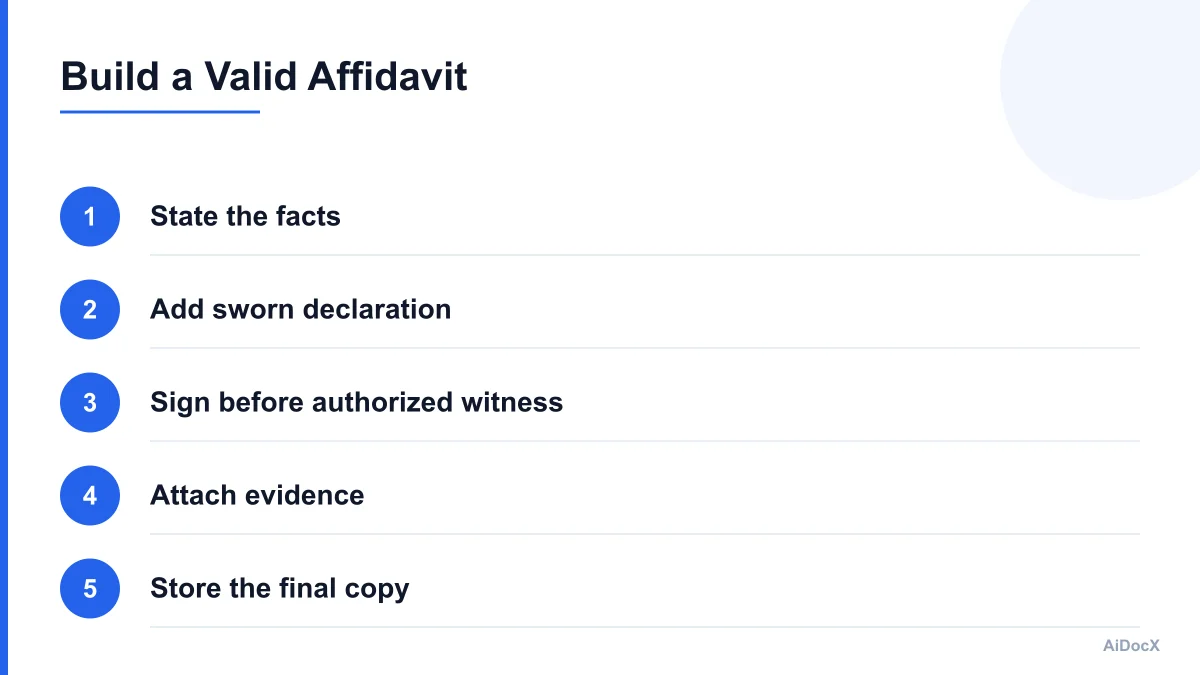
1. Confirm what the recipient requires
Before drafting, identify who will receive the affidavit and ask: is there an official form, must the affidavit be notarized, is remote online notarization accepted, are electronic signatures permitted, are exhibits required, is there a page limit or filing deadline, does the affidavit need a specific heading or case number, and must the document be signed in a particular jurisdiction.
This step prevents a common problem: preparing a polished general affidavit that cannot be filed because the recipient requires a different form.
2. Gather the facts and supporting records
Create a short fact list before writing. Record the names, dates, locations, amounts, document titles, and events in chronological order. Gather relevant evidence such as receipts, emails, photographs, account statements, or identification documents.
Keep the affidavit limited to facts that matter. Adding unrelated background can make the statement harder to review and may create unnecessary inconsistencies.
3. Draft in numbered paragraphs
Numbered paragraphs make it easier for a court, agency, or business to refer to specific statements. Keep each paragraph focused on one main idea. Use plain language and define technical terms where necessary.
A practical sequence is: identify the affiant and their connection to the matter, explain the purpose of the affidavit, present the relevant facts in order, identify supporting exhibits, and end with the truth declaration and signature section.
4. Review for accuracy and completeness
Read the document as if you were checking someone else's evidence. Confirm that names are spelled consistently and that dates do not conflict. Check that amounts, addresses, exhibit labels, and references match the attached records.
Do not guess. If you cannot remember an exact date, use a truthful description such as "on or about March 2026" only when the recipient permits that level of uncertainty. Never alter a fact to make the story appear cleaner.
AiDocX's AI document generator can help turn organized facts into a structured affidavit draft, and its e-signature workflow can help preserve the signed version and signing record. You should still review every statement and confirm the notarization or witnessing requirements for your situation.
5. Complete the oath, affirmation, and signature
Follow the instructions of the notary, commissioner, court, or receiving organization. Do not sign early if the witness must observe the signature. If a remote process is used, confirm that the provider and method are legally recognized where the affidavit will be submitted.
After signing, make sure the witness completes every required field, including date, location, title, commission details, seal, and certificate wording.
6. Attach and preserve the final version
Combine the signed affidavit and exhibits in the required order. Save a final PDF with a clear file name, such as "Affidavit_Identity_Name_2026-08-21.pdf".
Keep the original signed copy if a paper original exists. Store the final electronic file in a secure location and avoid editing the signed PDF. If a correction is needed, prepare a new version and have it signed again rather than changing the executed document.
Affidavit Compared With Similar Documents
People often use "affidavit," "declaration," and "statement" interchangeably, but the documents may have different formal requirements.
| Document | Typical feature | Common use |
|---|---|---|
| Affidavit | Sworn or affirmed before an authorized witness | Court and official proceedings |
| Statutory declaration | Formal declaration under a statute | Government and administrative matters |
| Unsworn declaration | Signed statement made under penalty of perjury | Proceedings where permitted |
| Witness statement | Narrative evidence, often signed | Litigation or investigations |
| Ordinary statement | Informal description of facts | Internal or general communication |
An affidavit usually requires an oath, affirmation, or notarization. An unsworn declaration may be accepted in some courts or agencies, but only if the applicable law allows it. A standard business letter is not necessarily a substitute for either document.
If the instructions say "affidavit," do not assume a simple signed statement will be accepted. If the instructions say "declaration," check whether notarization is unnecessary or whether a specific statutory wording is required.
Common Affidavit Mistakes to Avoid
Using the wrong form
The most serious mistake is ignoring a required official form. Search the recipient's website or contact its office before using a generic template.
Including opinions as facts
Statements such as "the other party is unreliable" or "the transaction was unfair" may be arguments rather than evidence. Replace them with specific events that support the conclusion.
Relying on hearsay without explanation
Do not present something you heard from another person as if you personally witnessed it. Identify the source and check whether the proceeding permits that type of statement.
Leaving dates and amounts vague
Important facts should be as specific as the records allow. Missing dates can make a timeline difficult to understand, while inconsistent amounts can undermine credibility.
Attaching documents without referring to them
An attachment does not automatically explain itself. Mention each important exhibit in the relevant paragraph and label it consistently.
Signing before the document is complete
Do not sign a blank page or a document that may later be altered. Make sure all pages and attachments are final before the oath or affirmation is completed.
Treating notarization as proof of truth
A notary generally verifies identity and signing formalities, not the truth of every statement. The affiant remains responsible for accuracy.
Forgetting jurisdiction-specific rules
Rules may differ for remote notarization, electronic signatures, witnesses, court filing, immigration applications, and property transfers. General online tools cannot determine every local requirement.
Using AI without reviewing the output
AI can organize information, but it may misunderstand a date, invent a detail, use the wrong legal terminology, or omit a fact. Compare every sentence with your records before signing.
Final Affidavit Review Checklist
Use this checklist before submitting your document:
- I confirmed whether an official form is required.
- I used my complete and consistent legal name.
- I explained my connection to the facts.
- Every important statement is accurate.
- The facts are based on personal knowledge or clearly identified sources.
- Dates, amounts, names, and addresses match my records.
- The paragraphs are numbered and easy to follow.
- Each exhibit is labeled and referenced in the affidavit.
- The oath or affirmation wording is appropriate.
- I know whether notarization or witnessing is required.
- I will sign only when the document is complete.
- The authorized witness will complete the certificate, seal, or stamp.
- I saved the final signed copy securely.
- I checked the submission deadline and delivery method.
A free affidavit template is most useful when it gives your facts a clear structure and leaves room for the formal requirements of the receiving organization. Start by confirming the correct document type, write only what you can support, complete the oath or affirmation properly, and preserve the executed version. For a faster drafting workflow, AiDocX can help generate a tailored affidavit and collect an electronic signature where that method is accepted.
Ready to automate your documents with AI?
Start free with AiDocX — AI contract drafting, meeting minutes, consultation notes, e-signatures, and more in one platform.
Get Started FreeMore from AiDocX Blog

How to Read a Business Contract: A Founder's Checklist (2026)
A practical way to review parties, scope, money, IP, liability, and exit terms before signing a business contract.
 MinjiLee October 7, 2026 9 min
ESIGN vs eIDAS: What Founders Should Know About E-Signatures (2026)
What U.S. ESIGN and EU eIDAS actually say, where exceptions apply, and what founders should keep to document an electronic signing.
MinjiLee October 7, 2026 7 min
Does Document Automation Pay Off? An ROI Worksheet for Founders (2026)
Estimate document automation ROI with your own volume, time, labor, and software costs. Includes a clearly labeled example and break-even formula.
 Chloe October 7, 2026 8 min