The Complete Guide to AI-Powered Contract Review in 2026
Learn how AI contract review works, its advantages over manual review, key features to evaluate, and how modern platforms like AiDocX use advanced AI to cut review time by 90% while catching risks humans miss.
 MinjiLee · Strategic Lead January 15, 2026 8 min read
Every business runs on contracts. NDAs, service agreements, employment contracts, vendor terms, partnership deals — the paperwork never stops. Yet for most organizations, contract review remains a slow, expensive, and error-prone process. A single overlooked clause can cost a company millions. A delayed review can kill a deal.
In 2026, AI-powered contract review has moved from experimental novelty to business-critical infrastructure. If you are still reviewing every contract manually line by line, you are spending more time, more money, and catching fewer problems than your competitors.
This guide covers everything you need to know about AI contract review: how it works under the hood, concrete benefits compared to manual review, the features that separate good tools from great ones, and practical advice for integrating AI review into your workflow.
What Is AI Contract Review?
AI contract review uses natural language processing and large language models to read, interpret, and analyze legal documents. Rather than simply searching for keywords, modern AI systems understand the semantic meaning of contract language. They can identify obligations, rights, risks, deadlines, and anomalies across an entire document in seconds.
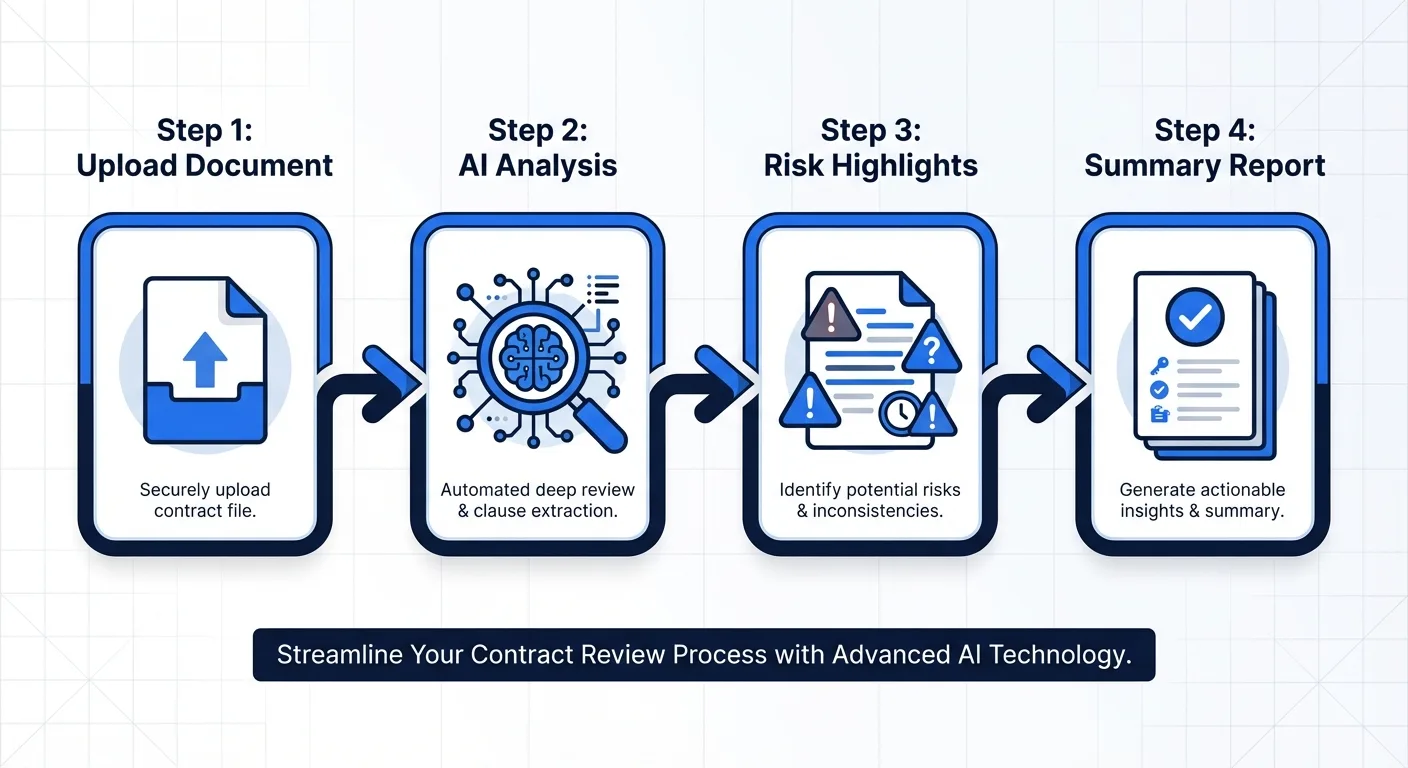
The technology has matured significantly since the early days of basic clause extraction. Today's systems can:
- Identify risky or unusual clauses that deviate from standard market terms
- Flag missing provisions that should be present in a given contract type
- Extract key data points like parties, dates, payment terms, and renewal conditions
- Compare clauses against your organization's preferred positions
- Summarize complex agreements in plain language for non-legal stakeholders
- Generate redline suggestions with explanations for why a change is recommended
The best AI contract review tools do not replace lawyers. They amplify them. A lawyer who once spent four hours reviewing an NDA can now spend fifteen minutes reviewing the AI's analysis and focusing attention on the genuinely novel or concerning provisions.
How AI Contract Review Works: The Technical Reality
Understanding the technology behind AI contract review helps you evaluate tools and set realistic expectations.
Document Ingestion and Parsing
The first step is converting the contract into a format the AI can process. This means handling PDFs, Word documents, scanned images (via OCR), and even photographs of physical documents. Quality tools handle formatting artifacts, headers, footers, page numbers, and multi-column layouts without losing context.
Language Model Analysis
The core analysis is performed by large language models — the same family of technology behind systems like advanced AI, which powers AiDocX's analysis engine. These models have been trained on vast corpora of legal text, enabling them to understand legal terminology, common clause structures, and the implications of specific language choices.
Modern systems use retrieval-augmented generation (RAG) to ground their analysis in relevant legal frameworks and your organization's specific standards. This means the AI is not just guessing; it is referencing established legal principles and your customized risk parameters.
Risk Scoring and Classification
After analysis, the AI categorizes findings by severity and type. A missing indemnification cap might be flagged as high risk, while a minor formatting inconsistency in a notice provision might be low priority. This classification helps reviewers triage efficiently and focus on what matters.
Output and Integration
Results are presented as structured reports with specific references to clause locations, plain-language explanations of concerns, and actionable recommendations. The best platforms integrate this directly into document workflows — so you can review, negotiate, sign, and track all in one place.
Manual Review vs. AI Review: A Direct Comparison
Let us be specific about what AI contract review changes in practice.
Time
A typical 20-page commercial contract takes a junior associate 2 to 4 hours to review thoroughly. An experienced attorney might do it in 1 to 2 hours. AI review of the same document takes 30 to 90 seconds for initial analysis, plus 15 to 30 minutes for human verification of the AI's findings.
Net result: 80-90% reduction in review time.
Cost
At average legal billing rates of $200 to $500 per hour, manual review of a single contract costs $400 to $2,000. For organizations processing hundreds of contracts monthly, the annual spend on review alone can reach six or seven figures.
AI review platforms range from free to $79 per month for comprehensive plans. Even accounting for the human review time on top of AI analysis, the cost per contract drops by 70-95%.
Net result: A 50-person company reviewing 100 contracts per month could save $30,000 to $150,000 annually.
Accuracy and Consistency
Humans get tired. They miss things at 4 PM that they would catch at 9 AM. They have blind spots shaped by their training and experience. Two lawyers reviewing the same contract will often flag different issues.
AI review is perfectly consistent. It applies the same rigor to the last contract of the day as the first. It does not skip sections because it is rushing before a deadline. Studies from Stanford's CodeX center have shown that AI systems identify 10-20% more potential risk clauses than experienced attorneys reviewing the same documents.
Net result: More issues caught, fewer missed risks, consistent quality regardless of volume.
Scalability
Manual review creates a linear relationship between volume and resources: twice as many contracts means twice as many hours (and twice the cost). AI review breaks this relationship. Whether you process 10 contracts or 10,000, the AI's per-document cost and speed remain essentially constant.
Key Features to Look for in an AI Contract Review Tool
Not all AI contract review tools are created equal. Here are the features that separate genuinely useful platforms from marketing demos.
1. Contract Generation, Not Just Review
Many tools only analyze existing contracts. But the most valuable platforms can also generate contracts from templates and natural language instructions. If you describe the deal terms you want, the AI should be able to produce a solid first draft. This is a capability that eliminates hours of drafting time in addition to review time.
AiDocX is one of the few platforms that offers both AI contract generation and review. You can describe your agreement in plain language, select from professionally drafted templates, and get a complete contract ready for review and customization — all powered by advanced AI.
2. Multi-Language Support
In a global business environment, contracts arrive in many languages. Your tool should handle multilingual analysis without requiring separate subscriptions or manual translation steps. AiDocX supports 18 languages natively, meaning you can analyze a contract in Korean, German, or Portuguese with the same depth as English.
3. Integrated Workflow
Contract review does not exist in isolation. After review comes negotiation, signing, and management. Tools that force you to export from one platform and import to another create friction and data loss. Look for platforms that integrate review with electronic signatures, document tracking, and ongoing contract management.
4. Risk Detection Specificity
Vague warnings like "this clause may be risky" are not helpful. Good AI review tools explain why a clause is concerning, what the potential impact is, and what alternative language would mitigate the risk. The analysis should be specific enough that a non-lawyer can understand the issue and a lawyer can act on it immediately.
5. Audit Trail and Compliance
For regulated industries, you need a clear record of what was reviewed, when, by whom (or what), and what was flagged. This audit trail should be automatic, tamper-evident, and exportable.
6. Reasonable Pricing
Enterprise contract review tools from legacy vendors often start at $500 to $1,000 per month with per-document fees on top. For small and mid-size businesses, this is prohibitive. Modern platforms like AiDocX have demonstrated that AI contract review can be delivered at a fraction of that cost — starting free for basic usage and scaling to $79 per month for unlimited enterprise features.
How AiDocX Approaches AI Contract Review
AiDocX was built from the ground up as an AI-native document platform. Contract review is not a bolted-on feature; it is a core part of the architecture.
Powered by advanced AI
AiDocX uses advanced AI models for contract analysis. The model's large context window means it can process entire contracts — even lengthy master service agreements — in a single pass without chunking that might lose cross-reference context. The model excels at understanding nuanced legal language and identifying implications that span multiple sections.
Beyond Review: AI Contract Generation
Where AiDocX truly differentiates is in contract creation. Using AI-powered templates, you can generate complete contracts by specifying your requirements in natural language. The AI drafts the document, you review and customize, then send for signature — all within the same platform.
This generation capability is not a gimmick. It produces legally sound contracts based on established templates refined by legal professionals. For standard agreements like NDAs, consulting contracts, service agreements, and employment offers, it eliminates 80% of the drafting time.
Document Tracking and Analytics
After you send a contract for review or signature, AiDocX provides real-time analytics on engagement. You can see when the recipient opened the document, which pages they spent the most time on, and whether they have forwarded it to others. This intelligence — similar to what DocSend offers for investor decks but included free in AiDocX — helps you time your follow-ups and understand counterparty priorities.
All-in-One Platform
Most organizations currently use separate tools for contract drafting (Word), review (manual or separate AI tool), signatures (DocuSign at $10+ per month), document tracking (DocSend at $10+ per month), and storage (various). AiDocX consolidates all of these into a single platform starting at $0 per month for the free tier and $6 per month for the Basic plan.
Practical Tips for Implementing AI Contract Review
Start with High-Volume, Low-Complexity Contracts
NDAs, standard vendor agreements, and employment offer letters are ideal starting points. These contracts are repetitive enough that AI review quickly proves its value, and the risk of AI error is lower because the documents follow well-established patterns.
Establish a Human-in-the-Loop Process
AI review should accelerate your team, not replace their judgment. Define a clear process where the AI performs initial analysis, a human reviews the AI's findings, and final sign-off comes from an authorized person. This hybrid approach captures 95% of the time savings while maintaining full accountability.
Build Your Organization's Playbook
The best AI review tools let you customize what "good" looks like for your organization. Define your preferred positions on key clauses — indemnification caps, limitation of liability, IP ownership, termination rights — and configure the AI to flag deviations from your standards.
Measure and Iterate
Track metrics before and after implementing AI review: average review time, cost per contract, number of issues caught, and time to signature. These numbers build the business case for expanding AI review to more complex contract types.
Train Your Team
AI review changes the reviewer's role from "find every issue" to "evaluate the AI's findings and exercise judgment on ambiguous items." This requires different skills. Invest time in helping your legal and business teams understand how to work effectively with AI analysis.
The Future of AI Contract Review
We are still in the early stages of AI-powered contract management. In 2026, the trajectory is clear: AI will handle an increasing share of routine contract work, freeing legal professionals to focus on strategic negotiations, novel deal structures, and high-stakes transactions.
Platforms that combine AI generation, review, signatures, tracking, and analytics into a single workflow — rather than point solutions that address only one step — will define the next generation of document management.
The organizations that adopt AI contract review today are not just saving time and money. They are building institutional knowledge, establishing efficient processes, and positioning themselves to move faster than competitors who are still reviewing every clause by hand.
If you are ready to see what AI-powered contract review looks like in practice, AiDocX offers a free tier that includes AI contract analysis, electronic signatures, and document tracking. There is no better way to evaluate the technology than to try it on your own contracts.
Ready to automate your documents with AI?
Start free with AiDocX — AI contract drafting, meeting minutes, consultation notes, e-signatures, and more in one platform.
Get Started FreeMore from AiDocX Blog
Consulting Proposal Template (2026): 9 Sections + Example
Copy a consulting proposal template with nine sections, pricing options, and a filled example. Includes tips to make the proposal easy to approve.
 AiDocX Team October 24, 2026 11 min
Internship Agreement Template (2026): Paid & Unpaid Interns
Copy an internship agreement template for paid or unpaid interns. Covers U.S. and UK pay rules, duties, IP, confidentiality, and a filled example.
AiDocX Team October 24, 2026 12 min
Meeting Minutes Template (2026): 4 Formats + Filled Example
Copy a meeting minutes template in four formats: team, decision log, board, and client call. See a filled example and a 15-minute workflow.
AiDocX Team October 24, 2026 11 min