App Development Contract: 7 Essential Clauses for 2026
Protect your app project with these 7 critical contract clauses. Learn how to balance IP rights, payment milestones, and scope management for developers and startups.
 James · Content Manager July 4, 2026 5 min read
App Development Contract: 7 Essential Clauses for 2026
App development contracts often fail because they prioritize legal form over operational reality. When a startup hires a developer, the goal is a working product; when a developer takes on a project, the goal is predictable revenue and protected assets. Both parties need a document that anticipates friction points before they arise.
This guide breaks down the seven clauses that matter most, offering practical language and structure to keep projects on track and relationships intact.
Key Clauses in App Development Contracts
A robust app development agreement should address seven core areas. Missing any of these creates ambiguity that can lead to scope creep, payment disputes, or IP litigation.
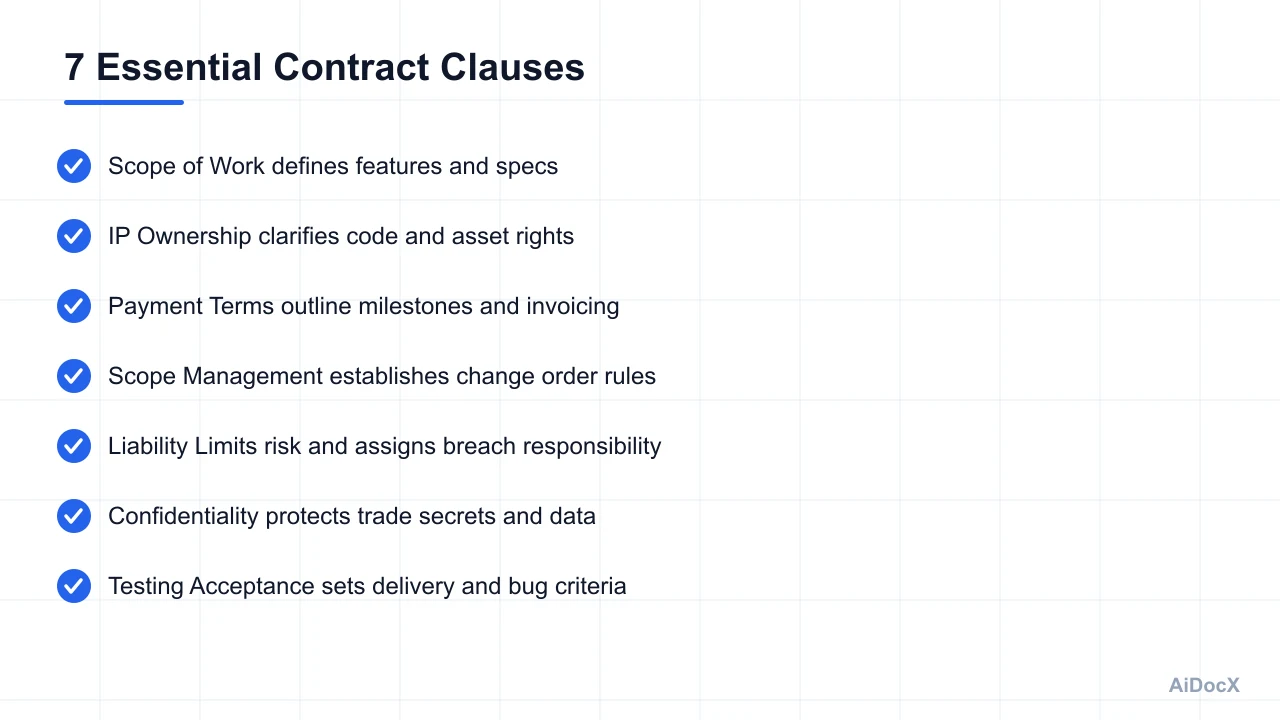
- Scope of Work: Defines features, platforms, and technical specifications.
- Intellectual Property (IP) Ownership: Clarifies who owns the code, designs, and underlying assets.
- Payment Terms: Outlines rates, milestones, and invoicing schedules.
- Scope Management: Establishes rules for handling change requests.
- Liability and Indemnification: Limits risk and assigns responsibility for breaches.
- Confidentiality (NDA): Protects trade secrets, user data, and business logic.
- Testing and Acceptance: Sets criteria for delivery and bug-fix obligations.
Tools like AiDocX can streamline this process, using AI to draft and review app development contracts with a focus on precise IP and source-code clauses, ensuring nothing falls through the cracks during negotiation.
Intellectual Property and Source Code Ownership
IP assignment is the most contentious clause in app development. Without clear language, developers may retain rights to code they wrote, or startups may find themselves unable to transfer the app to a new vendor later.
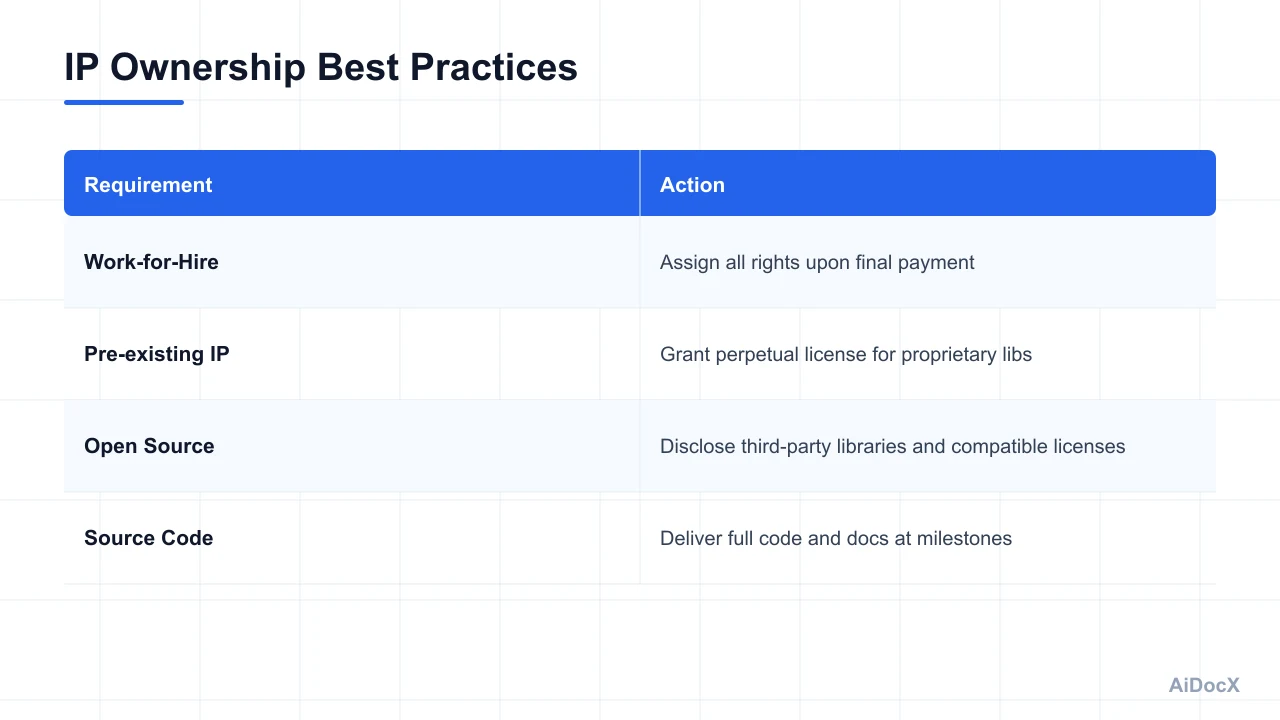
Best practices include:
- Work-for-Hire Language: Specify that all deliverables are "works made for hire" and assign all rights to the startup upon final payment.
- Pre-existing IP: If the developer uses proprietary libraries or frameworks, grant the startup a perpetual, irrevocable license to use them within the app.
- Open Source Compliance: Require disclosure of all third-party libraries and ensure licenses are compatible with the startup's business model.
- Source Code Handover: Mandate delivery of full source code, documentation, and credentials at specific milestones, not just at project end.
AiDocX AI drafts and reviews app development contracts, helping you catch vague ownership terms and ensure source-code handover obligations are enforceable before you sign.
Payment Terms and Milestone Structures
Ambiguous payment terms are the fastest route to cash-flow problems. Fixed-price contracts protect startups from budget overruns but can strain developers if the scope is unclear. Time-and-materials (T&M) contracts offer flexibility but require strong trust.
Structure payments around deliverables:
- Milestone-Based Payments: Tie payments to completed, verifiable milestones (e.g., "UI/UX Approval," "Beta Release").
- Retainers for Ongoing Work: If the project requires long-term maintenance, include a monthly retainer clause separate from development fees.
- Late Payment Penalties: Include a modest interest clause for overdue invoices to encourage timely payment without damaging the relationship.
- Kill Fees: Define compensation if the startup terminates the contract early, covering work completed and non-refundable expenses.
Scope Management and Change Orders
Scope creep kills profitability. Even well-intentioned clients may request small additions that accumulate into weeks of unpaid work. A formal change order process protects both sides by ensuring every modification is documented, priced, and approved.
Change Order Workflow
[IMAGE2]
Key elements of a change order clause:
- Written Requirement: All changes must be submitted in writing; verbal requests do not trigger billing adjustments.
- Impact Assessment: The developer has a set window (e.g., 3 business days) to estimate the time and cost impact.
- Mutual Approval: Work on the change begins only after both parties sign the amendment.
- Impact on Timeline: Explicitly state whether the change extends the delivery date.
Liability, Indemnification, and Confidentiality
Startups need assurance that the developer won't expose them to legal risk, while developers need protection against catastrophic claims.
- Limitation of Liability: Cap total liability at a reasonable amount, typically the total contract value. Exclude consequential damages like lost profits.
- Indemnification: The developer should indemnify the startup against claims that the code infringes on third-party IP. The startup should indemnify the developer against claims arising from the app's content or business practices.
- Confidentiality: Define what constitutes confidential information, the duration of the NDA, and exceptions for information that becomes public through no fault of the receiving party.
Testing, Acceptance, and Warranty
Delivery isn't complete until the app passes agreed-upon testing standards. Without acceptance criteria, startups may reject work indefinitely, and developers may face open-ended revision requests.
- Acceptance Period: Grant the startup a fixed window (e.g., 10 business days) to review and approve deliverables. Silence after this period constitutes acceptance.
- Defect Triage: Distinguish between "critical bugs" (must fix before acceptance) and "minor issues" (addressed in a post-launch warranty).
- Warranty Period: Offer a 30-to-90-day warranty for bug fixes after launch, excluding issues caused by third-party services or user error.
- Maintenance Options: Clearly state that post-warranty support is billed separately or covered by a maintenance retainer.
Final Review Checklist
Use this checklist before signing to ensure your contract covers the essentials.
- Scope of work lists all features, platforms, and technical specs.
- IP assignment transfers ownership to the startup upon final payment.
- Pre-existing IP and open-source components are disclosed and licensed.
- Payment milestones align with verifiable deliverables.
- Change order process requires written approval and impact estimates.
- Liability is capped and consequential damages are excluded.
- Acceptance period and defect triage criteria are defined.
- Confidentiality obligations cover trade secrets and user data.
Moving Forward with Confidence
A contract isn't just a legal formality; it's a project management tool. By embedding clear IP terms, structured payments, and disciplined scope management into your agreement, you reduce friction and build a foundation for a successful partnership.
For developers and startups looking to finalize their agreements efficiently, AiDocX offers AI-powered drafting and review capabilities tailored to app development contracts, helping you identify risks and align expectations from day one.
Ready to automate your documents with AI?
Start free with AiDocX — AI contract drafting, meeting minutes, consultation notes, e-signatures, and more in one platform.
Get Started FreeMore from AiDocX Blog
Machine Shop Job Traveler Template: Routing Sheet + Example
Copy a machine shop job traveler template for small job shops. Includes a routing sheet, filled example, traceability fields, sign-offs, and setup tips.
Weekly Status Report Template: 4 Formats + Examples
Copy one of four weekly status report templates for individual work, projects, leadership, or blockers. See a worked example and a practical review checklist.
How to Read a Business Contract: A Founder's Checklist (2026)
A practical way to review parties, scope, money, IP, liability, and exit terms before signing a business contract.
 MinjiLee October 7, 2026 9 min