
Asset vs. Stock Purchase: Small Business Deal Structure Guide 2026
Confused by your lawyer's choice between asset and stock purchase agreements? Learn the tax, liability, and contract differences to protect your small business deal.
 James · Content Manager August 21, 2026 11 min read
Asset vs. Stock Purchase: Small Business Deal Structure Guide 2026
You have signed the letter of intent. The price is agreed. Now, your lawyer sends over a draft that looks completely different from what you expected. One side wants to buy the "company"; the other wants to buy the "assets." This is not a semantic debate. It is a structural decision that dictates who pays the taxes, who inherits the debts, and which contracts survive the closing.
For small business owners and buyers, this choice is often made by default because no one understands the mechanics. If you choose the wrong structure, you could inherit a lawsuit you never knew about, or the seller could face a tax bill that kills the deal. This guide breaks down the practical differences between an Asset Purchase Agreement (APA) and a Stock Purchase Agreement (SPA), explaining how each affects liability, taxes, and operations so you can negotiate with confidence.
The Core Difference: What You Are Actually Buying
The fundamental distinction lies in the legal entity. In a Stock Purchase Agreement, the buyer purchases the shares of the corporation or the membership interests of an LLC. The legal entity remains exactly the same. It is the same business, with the same name, the same EIN, and the same history, just under new ownership. The buyer steps into the seller’s shoes.
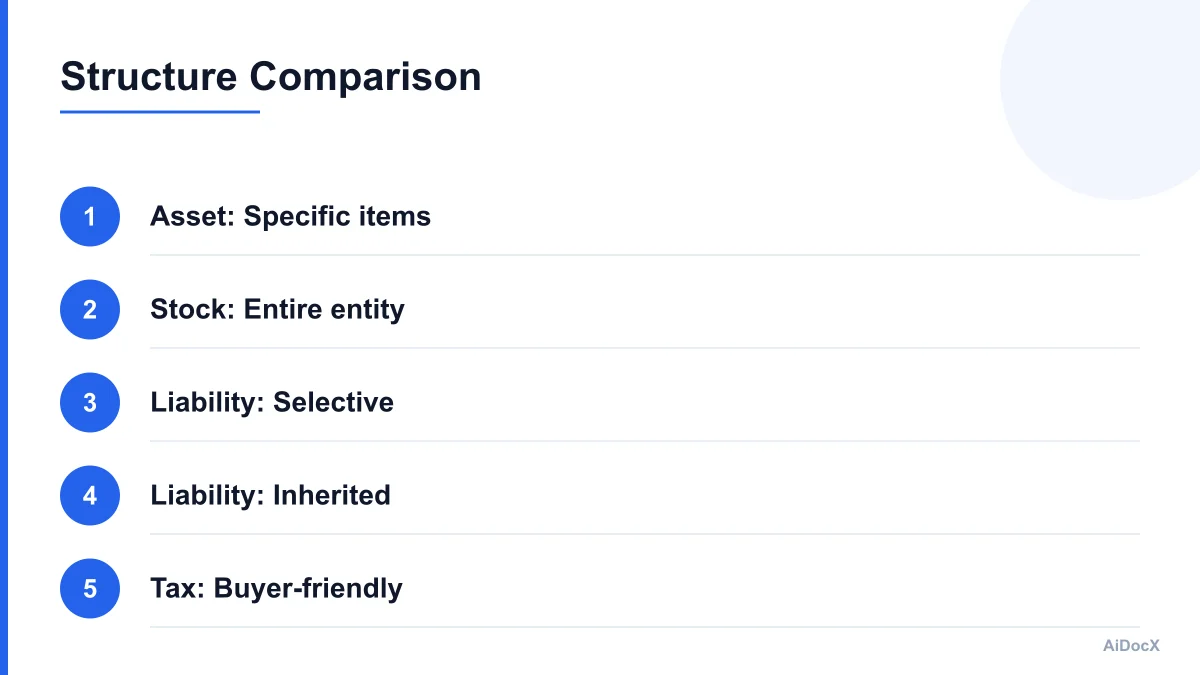
In an Asset Purchase Agreement, the buyer purchases specific items: equipment, inventory, customer lists, intellectual property, and real estate. The legal entity itself is not sold. Instead, the buyer takes these items and places them into a new or existing entity of their choosing. The seller’s entity remains intact, usually with the cash proceeds, and may eventually be dissolved.
Think of it this way:
- Stock Purchase: You buy the house, the furniture, the debts, and the previous owner’s reputation. The house stays the same house.
- Asset Purchase: You buy the furniture and the land. You move them to your new house. The old house stays with the previous owner, along with any mold in the walls.
This distinction is the root of all other differences. If you are buying a clean, young business with no history, a stock purchase might be simpler. If you are buying a business with a long history of operations, an asset purchase is often safer for the buyer.
Tax Implications: Who Pays the Hidden Cost
Tax is often the deciding factor, but it is rarely discussed until the last minute. The tax treatment differs significantly between the two structures, and the burden usually falls on the buyer in an asset deal and the seller in a stock deal.
In an Asset Purchase: The buyer gets a "step-up" in basis. This means the buyer can depreciate the assets at their new purchase price. For example, if a company buys a delivery truck for $50,000 in 2015, and the truck is worth $20,000 today, an asset buyer can often assign a portion of the purchase price to that truck and depreciate it over a shorter period (often 5 years) rather than the original useful life. This creates a tax shield for the buyer. However, the seller must recognize gain on the sale of each asset. If the seller sold assets held for less than a year, they pay ordinary income tax rates. If held for more than a year, they may pay capital gains rates, but the calculation is complex and often results in higher tax liability for the seller compared to selling stock.
In a Stock Purchase: The buyer does not get a step-up in basis. The internal assets of the company keep their original tax basis. This is bad for the buyer because they cannot depreciate the assets as if they just bought them. However, for the seller, selling stock is often more tax-efficient. If the seller held the stock for more than a year, the gain is typically taxed at long-term capital gains rates, which are lower than ordinary income rates.
The Practical Conflict: Buyers generally prefer asset purchases for the tax shield. Sellers generally prefer stock purchases for the lower tax rate. This conflict is why deal teams often negotiate the price to account for the tax difference. If the seller insists on a stock purchase, the buyer may ask for a lower price to offset the loss of depreciation benefits.
The Liability Trap: What You Inherit
This is the most critical section for risk-averse buyers. In a stock purchase, the buyer acquires the entire legal entity. This means the buyer inherits all liabilities, known and unknown.
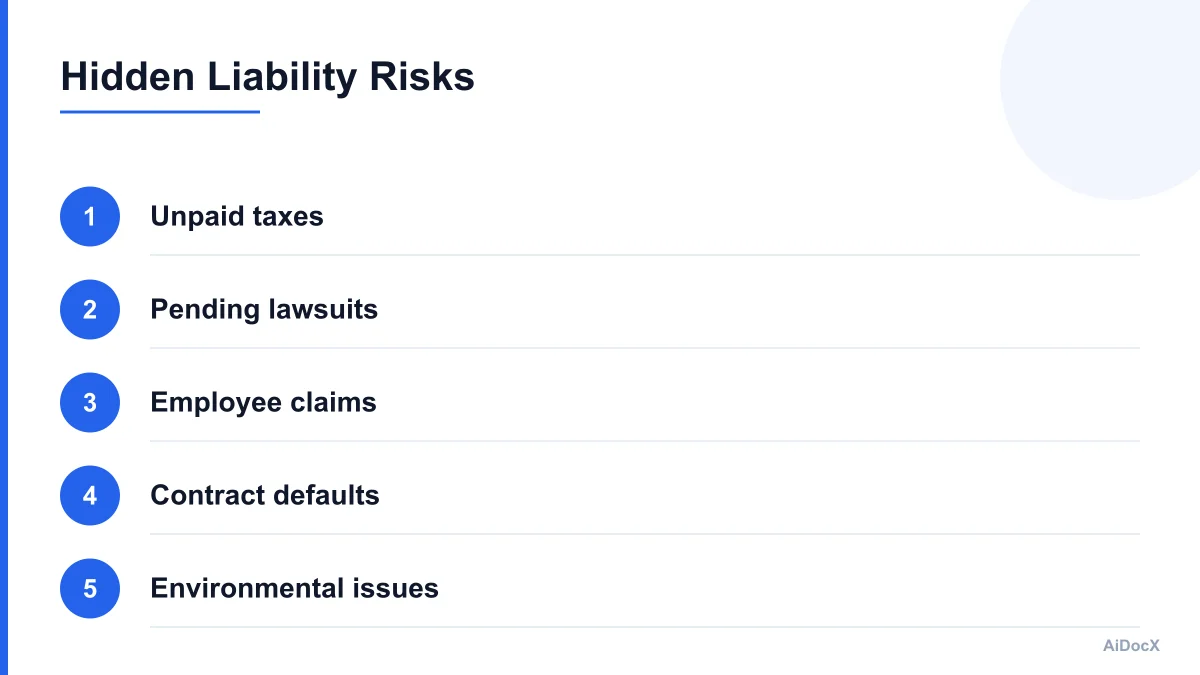
If the business you are buying has an unpaid tax debt from three years ago, an unresolved customer lawsuit, or a workers' compensation claim that hasn't been filed yet, it becomes your problem. The legal entity is the defendant in all these matters. You are buying the history of the company, including its mistakes.
In an asset purchase, the buyer only assumes the liabilities that are specifically listed in the agreement. Typically, these are "assumed liabilities" like the current accounts payable to suppliers or existing employee obligations. All other liabilities remain with the seller’s entity. This is known as a "clean start."
Common Hidden Liabilities in Stock Purchases:
- Unpaid Taxes: Sales tax, payroll tax, or income tax liabilities from prior years.
- Pending Litigation: Lawsuits that have been filed but not yet resolved.
- Contractual Defaults: Breaches of contract that have not yet triggered a penalty.
- Environmental Issues: Contamination from past operations (especially in manufacturing or retail).
- Employee Claims: Wage and hour violations or discrimination claims.
If you are buying a business with a long operating history, a stock purchase without robust indemnification clauses is a high-risk gamble. The seller may promise to indemnify you, but if the seller’s entity is dissolved or the seller has no assets left, that indemnification is worthless. An asset purchase avoids this by leaving the liabilities behind.
Contractual Succession: Do Your Deals Survive?
When you buy a business, you want to keep the existing customer relationships, vendor contracts, and leases. However, not all contracts transfer automatically.
In a Stock Purchase: Because the legal entity does not change, existing contracts remain in force. You do not need the counterparty’s permission to continue the business. The lease is still with the same entity. The supply agreement is still with the same entity. This is a major advantage for operational continuity.
In an Asset Purchase: Most contracts require the consent of the third party to transfer. This is called a "change of control" or "assignment" clause.
- Leases: The landlord must agree to the new tenant.
- Supply Agreements: The supplier must agree to the new buyer.
- Customer Contracts: Some customers may have the right to terminate if ownership changes.
This creates a significant administrative burden. The buyer must identify every material contract and negotiate a transfer. If a key supplier refuses to transfer the contract, the buyer may lose a critical part of the business. This is why asset purchases often include a "no-shop" clause or require the seller to use best efforts to obtain consents.
The Exception: Some contracts, like employment agreements, may not be assignable at all. In an asset purchase, the buyer often hires the employees directly, creating new employment relationships, rather than assigning the old ones.
Franchisees and Specialized Industries
If you are buying a franchise, the structure is often dictated by the franchisor. Most franchise agreements require the transfer of the franchise rights, which is typically done via an asset purchase. The franchisor wants to approve the new operator and ensure the specific assets (signage, equipment) are transferred to a compliant entity.
In highly regulated industries (healthcare, finance, logistics), regulatory licenses are often attached to the individual or the specific entity.
- Stock Purchase: The license stays with the entity. However, many regulators require approval for a change in ownership, even if the entity name doesn't change.
- Asset Purchase: The license may not transfer at all. The buyer may need to apply for a new license, which can take months.
Before choosing a structure, check with the relevant regulatory body. If the license cannot be transferred in an asset purchase, a stock purchase may be the only viable option, even if it carries higher liability risks.
Drafting the Agreement: Clauses That Matter
Once you have chosen the structure, the drafting must reflect that choice. A generic template will not work. The liability, tax, and assumed-contract clauses differ significantly between the two.
In an APA (Asset Purchase):
- Schedule of Assets: Must be exhaustive. Anything not listed is not sold.
- Assumed Liabilities: Must be specific. Do not use "all liabilities" unless you intend to take everything.
- Indemnification: The seller should indemnify the buyer for any pre-closing liabilities that are not assumed.
- Tax Allocation: Should specify how the purchase price is allocated among assets for tax purposes.
In an SPA (Stock Purchase):
- Representations and Warranties: The seller makes detailed statements about the company’s condition (no lawsuits, no tax issues, accurate financials).
- Disclosure Schedule: The seller lists exceptions to the reps. If a lawsuit is listed here, the buyer knows about it.
- Escrow/Indemnity Cap: A portion of the purchase price is held in escrow to cover breaches of the reps.
- Non-Compete: The seller (as the former owner) agrees not to compete. In an APA, this is often a separate agreement.
Practical Tip: If you are using a platform like AiDocX, you can input the same deal terms (price, assets, liabilities) and generate either an APA or an SPA. The platform pre-fills the liability and tax clauses based on the structure selected, flagging the specific differences for your review. This ensures you don’t miss the critical clauses that change between the two formats.
Common Mistakes to Avoid
- Assuming "Same Business" Means "Same Entity": In an asset purchase, the business is new. The EIN changes. The bank accounts change. The business license changes. Plan for this operational shift.
- Ignoring the Tax Allocation: In an asset purchase, the allocation of the purchase price to specific assets (goodwill, inventory, equipment) affects the tax bill. If you allocate too much to goodwill, you lose depreciation benefits. Work with a tax advisor to optimize this.
- Forgetting to Transfer IP: In an asset purchase, you must explicitly assign patents, trademarks, and copyrights. If you don’t, the seller still owns the brand.
- Not Checking for Change of Control Clauses: Review all material contracts for clauses that require consent upon a change of ownership. In a stock purchase, this is still relevant if the contract defines "change of control" broadly.
- Skipping the Due Diligence on Liabilities: If you choose a stock purchase, you must dig deep into the seller’s history. Look for tax notices, legal holds, and employee complaints.
Checklist: Before You Sign
Use this checklist to ensure you have considered the structural implications:
- Identify the Structure: Have you decided between APA and SPA based on liability and tax needs?
- List Assumed Liabilities: If APA, do you have a complete list of debts you are willing to take on?
- Review Material Contracts: Have you identified all contracts that require consent to transfer?
- Check Regulatory Licenses: Will the licenses transfer, or do you need to apply for new ones?
- Tax Allocation: Have you discussed the purchase price allocation with a tax professional?
- Indemnification: Is there an escrow or indemnity cap to protect against unknown liabilities?
- IP Assignment: Are all intellectual property rights explicitly assigned in the agreement?
- Employee Matters: Have you planned how to handle existing employees (hires, benefits, non-competes)?
Conclusion
The choice between an Asset Purchase Agreement and a Stock Purchase Agreement is not just a legal formality. It is a strategic decision that impacts your tax liability, your risk exposure, and your operational continuity. There is no one-size-fits-all answer. A clean, young business may benefit from a stock purchase for simplicity. A complex, long-standing business may require an asset purchase to isolate liabilities.
Your job is to understand the trade-offs. Know what you are buying. Know what you are inheriting. And ensure the agreement reflects your intent. By structuring the deal correctly from the start, you protect your investment and set the stage for a smooth transition.
If you are moving past the letter of intent stage, consider using a platform that can draft both structures from the same deal-terms intake. AiDocX allows you to compare the liability, tax, and assumed-contract clauses side-by-side, ensuring you don’t miss the critical differences before you sign.
Ready to automate your documents with AI?
Start free with AiDocX — AI contract drafting, meeting minutes, consultation notes, e-signatures, and more in one platform.
Get Started FreeMore from AiDocX Blog
Weekly Status Report Template: 4 Formats + Examples
Copy one of four weekly status report templates for individual work, projects, leadership, or blockers. See a worked example and a practical review checklist.

How to Read a Business Contract: A Founder's Checklist (2026)
A practical way to review parties, scope, money, IP, liability, and exit terms before signing a business contract.
 MinjiLee October 7, 2026 9 min
ESIGN vs eIDAS: What Founders Should Know About E-Signatures (2026)
What U.S. ESIGN and EU eIDAS actually say, where exceptions apply, and what founders should keep to document an electronic signing.
MinjiLee October 7, 2026 7 min