Board Consent Template 2026: Fast Startup Sign-Offs
Streamline startup governance with our 2026 Board Consent Template. Learn how to approve decisions remotely, avoid meeting scheduling delays, and keep momentum.
 James · Content Manager August 8, 2026 10 min read
Board Consent Template 2026: Fast Startup Sign-Offs
Running a startup means moving fast, but corporate governance often feels like the anchor holding you back. You have a term sheet on the table, a key hire ready to start, or a critical vendor contract that needs approval by Friday. Waiting two weeks to schedule a board meeting is not an option. This is where board consent and written resolutions come in.
A board consent allows your directors to approve corporate actions without gathering in a physical or virtual room. It is a legally recognized method of decision-making in most jurisdictions, provided your bylaws permit it and statutory requirements are met. For founders, it is the difference between losing a deal due to administrative lag and closing it with precision. This guide explains how to use written consents effectively in 2026, ensuring your decisions are valid, enforceable, and audit-ready.
What Is a Board Written Resolution?
A board written resolution is a legal document that records the approval of specific corporate actions by all directors who would have been entitled to vote at a valid board meeting. Instead of holding a meeting, taking minutes, and voting, the board reviews the proposed action in writing and signs the document individually.
In the context of modern startup governance, this mechanism is not just a convenience; it is a strategic tool. It decouples decision-making from calendar constraints. When a founder needs to authorize an equity grant, approve a budget variance, or ratify a contract, the written consent process ensures that every director has explicitly agreed to the action.
The Legal Basis
The authority to act via written consent comes from two primary sources:
- State Corporate Law: Most U.S. states, including Delaware, California, and Wyoming, explicitly allow corporations to act by written consent unless their certificate of incorporation prohibits it. For example, Section 141(f) of the Delaware General Corporation Law permits actions by unanimous written consent.
- Corporate Bylaws: Your startup’s bylaws will specify the procedure for written consents. They typically outline notice requirements, the definition of a quorum, and how signatures are collected.
It is crucial to verify that your bylaws do not require a formal meeting for certain types of decisions. While most operational and financial decisions can be handled via consent, some jurisdictions or specific bylaw provisions may reserve major actions (like mergers or dissolutions) for formal meetings.
Why Use a Written Consent?
The primary advantage of a board consent is speed. In the early stages of a startup, opportunities and threats emerge rapidly. A written consent eliminates the logistical friction of scheduling.
Speed and Efficiency
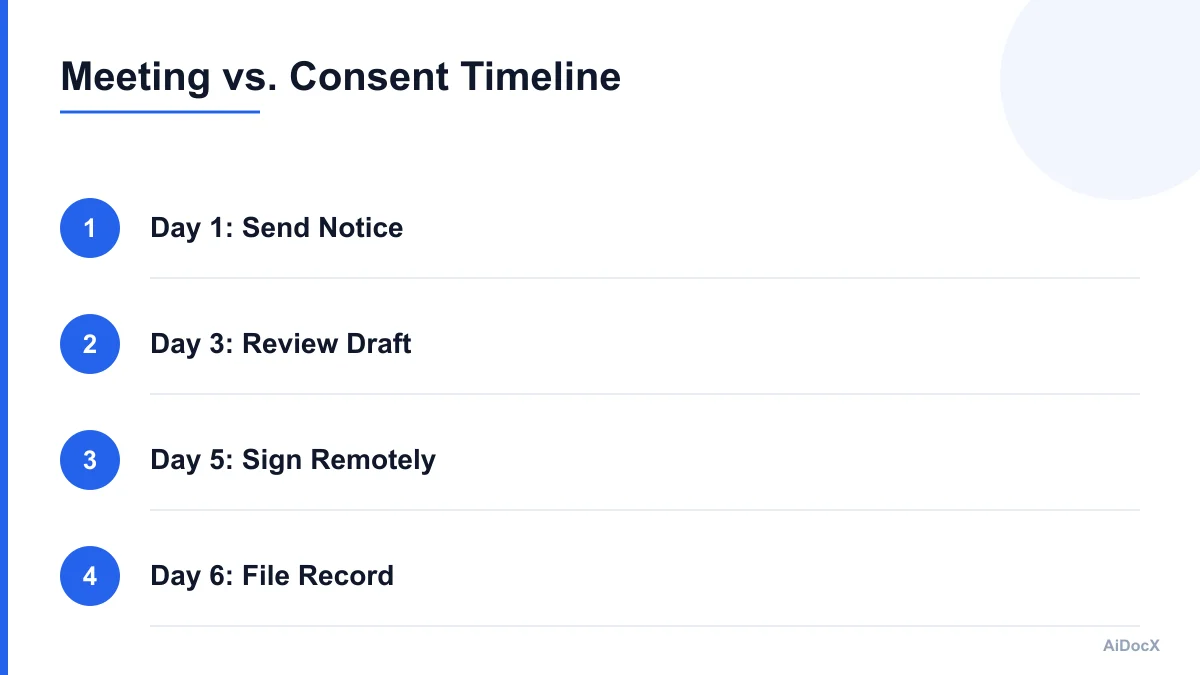
Consider a scenario where your lead investor requires a board approval for a financing round before wiring funds. If you call a formal meeting, you must send notice (usually 2-5 days), provide an agenda, allow time for review, and then hold the meeting. With a written consent, you can draft the document, send it for signature, and have it fully executed within 24-48 hours, depending on the responsiveness of your directors.
Cost Reduction
Formal board meetings, especially those involving external counsel or corporate secretaries, incur costs. There is the cost of preparation (drafting agendas, minutes, and supporting materials) and the cost of attendance. Written consents reduce the administrative burden significantly. The board reviews the materials asynchronously, and the legal record is created simultaneously with the approval.
Flexibility for Remote Teams
Startups are increasingly distributed. Directors may be located in different time zones, traveling, or simply too busy for a two-hour Zoom call. Written consents allow directors to review documents on their own time and sign from anywhere. This is particularly valuable for startups with independent directors who may have limited availability.
How to Draft a Board Consent Resolution
Drafting a board consent requires precision. Unlike a meeting minute, which summarizes a discussion, a consent is a direct record of approval. The document must clearly state the action being taken and obtain the necessary signatures.
Essential Components of a Board Consent
A robust board consent template should include the following elements:
- Header and Title: Clearly identify the document as a "Unanimous Written Consent of the Board of Directors" of the specific company. Include the company name and jurisdiction.
- Date: The date on which the consent is executed. This is critical for determining when the action becomes effective.
- Recitals: A brief background section explaining why the consent is being issued. This might reference a previous meeting, a specific contract, or a strategic initiative.
- Resolutions: The core of the document. Each decision should be stated in a separate section, typically numbered or lettered. Use clear, imperative language (e.g., "RESOLVED, that the Company enters into the Service Agreement with Vendor X").
- Authorization: Specify who is authorized to execute the documents related to the consent. For example, "The CEO is hereby authorized and directed to sign the Service Agreement on behalf of the Company."
- Signatures: Spaces for each director to sign and date the consent. In many jurisdictions, unanimous consent is required unless the bylaws allow for a lesser majority.
Drafting Tips for Clarity
- Be Specific: Avoid vague language. Instead of "Approve the budget," specify "Approve the Q3 Operating Budget as attached hereto as Exhibit A."
- Reference Attachments: If the decision relies on specific documents (like a term sheet or contract), attach them as exhibits and reference them in the resolution.
- Define Effective Date: Clearly state when the action takes effect. If it is immediate, state "effective as of the date hereof." If it is retroactive, ensure that the action was legally permissible at the retroactive date.
Step-by-Step: Executing a Written Consent
The process of executing a board consent is straightforward, but it must be followed correctly to ensure validity.
- Prepare the Draft: The founder or corporate secretary drafts the consent, ensuring all resolutions are accurate and complete. Attach any necessary supporting documents.
- Review by Directors: Send the draft to all directors. Allow sufficient time for review. While not always legally required for consents (unlike meeting notices), it is best practice to give directors at least 24-48 hours to review.
- Collect Signatures: Directors sign the document. In 2026, digital signatures are universally accepted and preferred. Ensure that each director signs individually.
- Verify Unanimity: Check that all directors who are entitled to vote have signed. If one director abstains or votes against, you may need a formal meeting instead, depending on your bylaws.
- File the Consent: Once fully executed, the consent should be filed in the corporate minute book. It serves as the official record of the decision.
- Notify Relevant Parties: If the consent affects third parties (like a bank or a counterparty), provide them with a certified copy of the consent as proof of authority.
AiDocX drafts a written consent resolution and collects every board member's signature remotely, so a startup can move on a decision in hours instead of scheduling a meeting. This automation reduces the risk of human error in the signature collection process and ensures that the document is formatted correctly for legal compliance.
Common Mistakes to Avoid
Even with a template, mistakes can invalidate a board consent. Here are the most common pitfalls founders and corporate secretaries encounter.
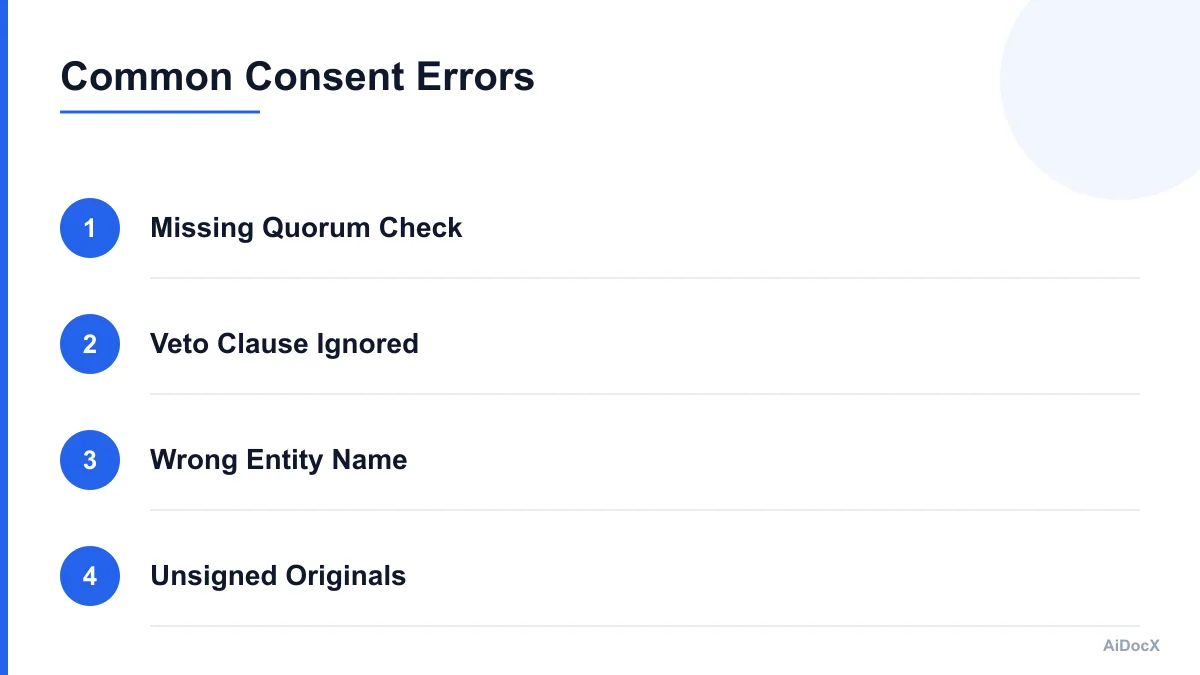
Ignoring Quorum Requirements
Even in a written consent, you must ensure that the number of signatures constitutes a quorum. If your bylaws require a majority vote, and you only have signatures from a minority of directors, the consent is invalid. Always check your bylaws for the specific quorum and voting threshold requirements.
Failing to Obtain Unanimity When Required
Some states and bylaws require unanimous consent for certain actions, or for written consents to be valid in lieu of a meeting. If one director does not sign, you cannot proceed with the consent unless your bylaws explicitly allow for non-unanimous consents. If a director objects, you may need to call a formal meeting to address their concerns.
Incomplete Signatures
A signature without a date, or a signature from an unauthorized person (like a director’s assistant), can render the consent invalid. Ensure that each director signs and dates the document personally. Digital signature platforms should capture the timestamp and the identity of the signer to avoid disputes.
Not Attaching Supporting Documents
If the resolution references an attached contract or budget, failing to include that attachment can create ambiguity. If the attachment is missing, the resolution may be unenforceable or subject to interpretation. Always attach all referenced documents and mark them clearly as exhibits.
Integrating Written Consents into Your Governance Workflow
For startups, governance should be scalable. Integrating written consents into your workflow ensures that you can maintain compliance without slowing down growth.
Establishing a Consent Calendar
Maintain a calendar of upcoming decisions that may require board approval. This could include quarterly budget approvals, annual equity grant refreshes, or periodic contract renewals. By anticipating these needs, you can prepare consents in advance and collect signatures efficiently.
Using Technology for Compliance
Manual signature collection is prone to error and delay. Utilizing a digital contract and document management platform can streamline the process. These platforms can:
- Auto-generate consents based on pre-approved templates.
- Send reminders to directors who have not yet signed.
- Store executed consents in a secure, searchable repository.
- Provide an audit trail of who signed and when.
This technological integration is particularly valuable for startups with a large board or frequent decision-making cycles. It reduces the administrative burden on the founder and ensures that the corporate record is always up-to-date.
When to Use a Formal Meeting Instead
While written consents are efficient, they are not suitable for every situation. There are times when a formal board meeting is necessary or preferred.
Complex or Controversial Decisions
If a decision is likely to be controversial or requires extensive discussion, a formal meeting is better. A meeting allows for real-time dialogue, questioning, and debate. A written consent is a binary approval/disapproval mechanism that does not facilitate discussion.
Statutory Requirements
Some jurisdictions or specific corporate actions may require a formal meeting. For example, the removal of a director or the amendment of bylaws may require a meeting in some states. Always consult with legal counsel to determine if a formal meeting is mandatory.
Maintaining Director Engagement
Formal meetings provide an opportunity for directors to engage with the company’s strategy and operations. Relying solely on written consents can lead to "board fatigue" or disengagement. Regular meetings help maintain strong relationships between the board and management.
Checklist for Board Consent Execution
Before finalizing a board consent, use this checklist to ensure compliance and accuracy.
- Verify that the company’s bylaws permit written consents.
- Confirm that a quorum of directors is available to sign.
- Ensure all resolutions are clearly stated and specific.
- Attach all necessary supporting documents (exhibits).
- Check that each director has signed and dated the consent.
- Verify that the signatures are from authorized directors.
- File the executed consent in the corporate minute book.
- Notify relevant third parties if required by the consent.
Conclusion
Board consent and written resolutions are powerful tools for startup founders who need to move quickly. They provide a legal, efficient, and flexible way to approve corporate actions without the hassle of scheduling meetings. By understanding the legal requirements, drafting clear resolutions, and avoiding common mistakes, founders can maintain robust governance while keeping their business agile.
In 2026, the expectation for speed and efficiency in startup operations is higher than ever. Leveraging written consents, especially with the help of automated platforms like AiDocX, ensures that your governance keeps pace with your growth. Start implementing written consents today to streamline your decision-making process and focus on what matters most: building your company.
Ready to automate your documents with AI?
Start free with AiDocX — AI contract drafting, meeting minutes, consultation notes, e-signatures, and more in one platform.
Get Started FreeMore from AiDocX Blog
Affiliate Agreement Template (2026): Protect Your Business When Paying Commissions
Free affiliate agreement template for 2026: key clauses, FTC disclosure requirements, affiliate vs referral agreement compared, a worked example, and a copy-paste version.
James September 22, 2026 11 min
AI Receipt Generator (2026): Create Professional Payment Receipts in Seconds
Generate professional payment receipts with AI in seconds. Receipt vs invoice vs credit note explained, the fields to include, a worked example, and a copy-paste template.
James September 22, 2026 9 min
Bill of Sale Template (2026): Free Generator for Cars, Trailers & Personal Property
Free bill of sale template for 2026: the fields to include, state notarization rules, federal odometer disclosure, a worked example, and a copy-paste version.
James September 22, 2026 10 min