Board Resolution Template 2026: Bank, Finance & Signatory
Learn when a startup needs a board resolution, how to draft it for banks and investors, and avoid common legal pitfalls. Includes 2026 best practices.
 James · Content Manager August 14, 2026 10 min read
Board Resolution Template 2026: Bank, Finance & Signatory
You’ve been asked for a board resolution. Maybe it’s to open a business bank account, maybe it’s to authorize a SAFE note, or perhaps it’s to appoint a new CFO. For most founders, this request triggers a spike of anxiety. You aren’t a lawyer. You don’t have a general counsel on payroll. And you certainly don’t want to send a document back to your bank or investor because of a formatting error or a missing signature.
The truth is, a board resolution is not a mysterious legal artifact reserved for Fortune 500 companies. It is a simple, standardized record of a decision made by your company’s governing body. When drafted correctly, it protects you, satisfies compliance officers, and speeds up critical business operations. In 2026, with stricter KYC (Know Your Customer) and AML (Anti-Money Laundering) regulations, the bar for clarity and accuracy has only risen. This guide will walk you through exactly when you need one, how to draft it without legal jargon, and how to get it signed efficiently so you can get back to building your business.
Why Startups Actually Need Board Resolutions
Many early-stage founders believe that because they are the majority shareholder, they can just "do" things. While it is true that in small private companies, the board and shareholders are often the same people, the legal distinction remains critical. A board resolution is the formal evidence that the company, as a separate legal entity, has authorized an action.
Without this documentation, you are operating on informal consensus. This creates two major risks:
- Personal Liability: If a decision is not formally recorded, courts may "pierce the corporate veil," holding you personally liable for the company’s debts or actions.
- Institutional Rejection: Banks, investors, and government agencies (like the IRS or state secretaries of state) require proof that the person signing a contract or opening an account has the authority to do so. They do not trust your word; they trust the paper trail.
You need a board resolution for any significant corporate action. This includes:
- Opening a corporate bank account.
- Approving a seed or Series A financing round.
- Issuing stock options to employees or founders.
- Hiring or firing C-suite executives (CEO, CFO, COO).
- Approving annual budgets or major expenditures.
- Amending the bylaws or articles of incorporation.
- Appointing a registered agent.
The Anatomy of a Bank-Ready Board Resolution
When a bank compliance officer or an investor’s legal team requests a resolution, they are looking for specific elements. If any of these are missing, the document is rejected, and you are sent back to square one. A valid board resolution for a startup typically follows this structure:
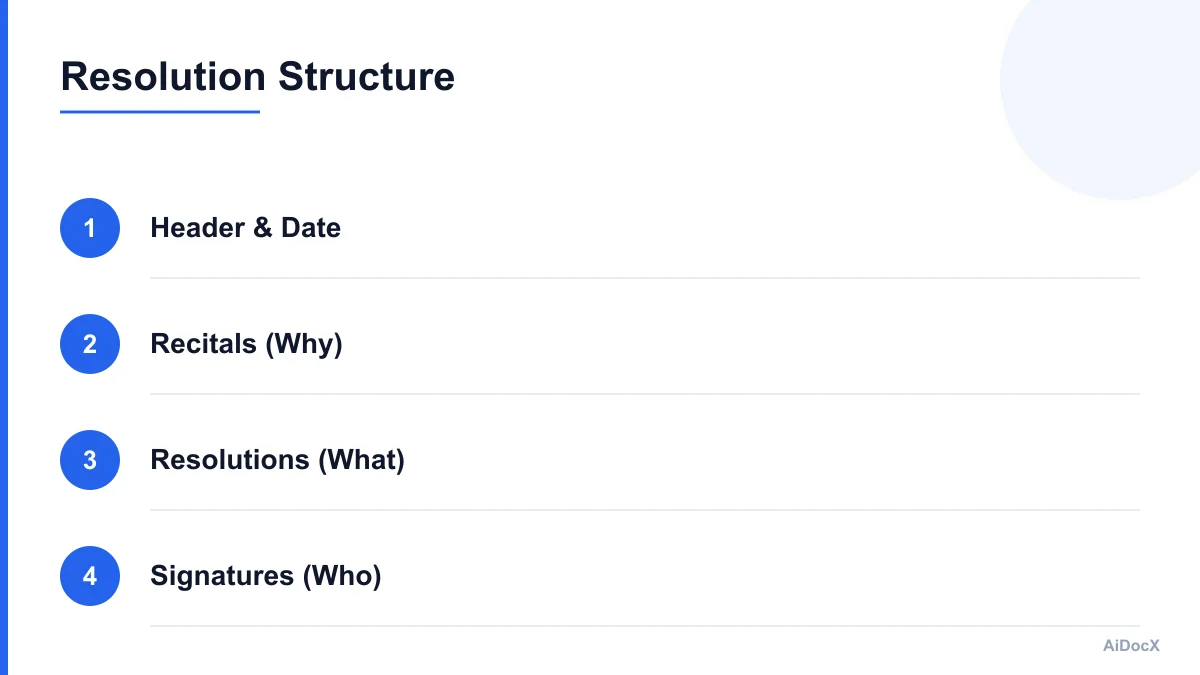
1. The Header
This must clearly identify the company. Use the exact legal name as it appears on your Certificate of Incorporation. Include the state of incorporation and the date of the meeting.
2. The Recitals (The "Whereas" Clauses)
This section provides context. It explains why the board is meeting and what decision is being considered. For example, "WHEREAS, the Company desires to open a checking account with [Bank Name]..."
3. The Resolutions (The "Resolved" Clauses)
This is the core of the document. It states the specific decisions made. Each decision should be a separate "Resolved" clause. This section must be unambiguous. It should specify exactly who is authorized to act, what actions they can take, and any limits on their authority.
4. The Signatures
The resolution must be signed by the directors (and sometimes the secretary) who were present at the meeting. In many jurisdictions, a written consent signed by all directors is legally equivalent to a meeting. The signatures must be original or digitally compliant (like DocuSign or Adobe Sign).
5. The Attestation
Often, the Corporate Secretary or a director will add a section at the end attesting that the resolution was duly adopted at a valid meeting where a quorum was present. This adds an extra layer of validity for third parties like banks.
Step-by-Step: Drafting a Resolution for a Bank Account
Let’s look at a concrete example. You need to open a business bank account. This is one of the most common requests. Here is how you draft it correctly.
Step 1: Verify Your Bylaws
Before you write a single word, check your company’s bylaws. They will specify:
- How many directors constitute a quorum (usually a majority).
- Whether written consents are allowed instead of a meeting.
- Who has the authority to sign bank documents (usually the CEO or CFO).
Step 2: Draft the Header
Start with a clear title: Unanimous Written Consent of the Board of Directors of [Company Name], a [State] Corporation.
Include the date: Date: [Month, Day, Year]
Step 3. Write the Recitals
Keep it simple. Avoid overly complex legal language.
- WHEREAS, the Board of Directors believes it is in the best interest of the Company to establish a banking relationship with [Bank Name];
- WHEREAS, the Board has reviewed the terms and conditions of the proposed account;
Step 4. Define the Resolutions
Be specific. Banks reject vague resolutions. Do not just say "Authorized to open an account." Say:
- RESOLVED, that a checking account be opened with [Bank Name];
- RESOLVED, that [CEO Name] and [CFO Name] are authorized to execute all documents related to the account;
- RESOLVED, that any one of the authorized signatories may deposit, withdraw, or transfer funds;
- RESOLVED, that the bank is authorized to verify the identity of the signatories with the Company’s corporate secretary.
Step 5. Get Signatures
If you have three directors and all three agree, you can use a Unanimous Written Consent. Have each director sign and date the document. If you hold a meeting, record the minutes and have the attendees sign the resolution.
Common Mistakes That Delay Bank Approval
Even experienced founders make errors that cause banks to reject their resolutions. Here are the most common pitfalls and how to avoid them.
Mistake 1: Using the Wrong Corporate Name
If your company is "TechStart, LLC" but you write "TechStart Inc." or "TechStart Technologies," the bank will reject it. The name on the resolution must match the name on the bank application and the certificate of formation exactly.
Mistake 2: Vague Signatory Authority
Phrases like "any officer" or "the CEO" can be problematic if the bylaws have changed or if there is a co-CEO situation. Always use full legal names and titles. For example, use "John Doe, Chief Executive Officer" instead of just "John Doe."
Mistake 3: Outdated Director Lists
If a director has resigned or been added since the last resolution, the bank may question the validity. Ensure the list of directors signing the resolution matches the current board. If a director is missing, you may need to update your corporate records first.
Mistake 4: Forgetting the Secretary’s Attestation
Many banks require a "Secretary’s Certificate" or attestation confirming that the meeting was valid. Without this, the bank may assume the resolution was not properly adopted. Always include a section at the end for the Corporate Secretary to sign and date, confirming the resolution was passed in accordance with the bylaws.
Mistake 5: Mixing Shareholder and Board Actions
Some actions, like amending the bylaws or approving a merger, require shareholder approval, not just board approval. Confusing the two can invalidate the resolution. Check your bylaws to see if an action requires both board and shareholder consent.
When to Use a Board Resolution vs. a Shareholder Consent
Founders often confuse board resolutions with shareholder consents. While they serve similar purposes, they are legally distinct.
Board Resolutions are for operational and managerial decisions. These are actions that the board of directors is empowered to make under the law and your bylaws. Examples include hiring executives, approving budgets, and opening bank accounts.
Shareholder Consents are for fundamental changes to the company’s structure or ownership. These are actions that require the approval of the majority shareholders. Examples include amending the articles of incorporation, approving mergers, or selling a substantial portion of the company’s assets.
In many small startups, the same people are both directors and shareholders. However, the legal form must still be followed. If you are raising a financing round, you will likely need a shareholder consent to approve the issuance of new stock, in addition to a board resolution to approve the terms of the deal.
How to Manage Resolutions Efficiently in 2026
As your startup grows, the number of resolutions you need to draft and track will increase. Managing these documents via email attachments and manual signature collection is inefficient and prone to error. This is where modern tools like AiDocX can streamline the process. Instead of manually formatting each resolution, AiDocX drafts a board resolution from the specific decision being made—whether it’s for a bank account, financing, or officer appointment—and routes it to every director for e-signature the same day. This ensures consistency, reduces legal risk, and speeds up execution.
Best Practices for Resolution Management
- Maintain a Corporate Binder: Keep all resolutions, minutes, and consents in a single digital or physical location. This is crucial for due diligence during fundraising or acquisition.
- Use Standard Templates: Create standard templates for common actions (bank accounts, stock options, hiring). This reduces drafting time and ensures consistency.
- Track Expiration: Some resolutions have time limits. For example, a resolution authorizing a bank account may expire if the account is not opened within 90 days. Keep track of these dates.
- Regular Updates: Review your board and officer list annually. Update your resolutions to reflect any changes in leadership or directorship.
Checklist: Before You Send the Resolution
Before you send your board resolution to the bank or investor, run it through this checklist:
- Corporate Name: Does the name match the certificate of formation exactly?
- Date: Is the date of the resolution current or within the bank’s validity window (usually 90 days)?
- Quorum: Were enough directors present or consenting to approve the action?
- Signatories: Are the full legal names and titles of the authorized signers included?
- Specificity: Does the resolution clearly state what actions are authorized?
- Secretary’s Attestation: Is there a section for the Corporate Secretary to sign?
- Signatures: Are all required signatures original or digitally valid?
- Attachments: Have you included any required supporting documents (e.g., bank application, ID copies)?
Closing Thoughts
A board resolution is not just a bureaucratic hurdle; it is a fundamental tool of corporate governance. For startups, getting it right builds trust with banks, investors, and partners. It demonstrates that you are running your company with professionalism and legal discipline.
By understanding the anatomy of a resolution, avoiding common mistakes, and using the right tools, you can handle these requests efficiently. Whether you are opening your first bank account or closing a seed round, a well-drafted board resolution protects you and your company. Remember, clarity and precision are your best allies. If you want to simplify the process, consider using a platform like AiDocX to draft and sign your resolutions quickly and correctly, ensuring you stay compliant as you scale.
Don’t let paperwork slow down your momentum. Get your resolutions right, and keep moving forward.
Ready to automate your documents with AI?
Start free with AiDocX — AI contract drafting, meeting minutes, consultation notes, e-signatures, and more in one platform.
Get Started FreeMore from AiDocX Blog
Buy Sell Agreement Template (2026): Triggers, Valuation and Funding for Co-Owners
A free buy sell agreement template for co-owners, with triggering events, valuation methods, insurance funding and cross-purchase vs. redemption structures.
James September 26, 2026 12 min
Consignment Agreement Template (2026): Commission, Title, Risk of Loss and Unsold Goods
Free consignment agreement template for makers, artists and boutiques: commission split, title, insurance and how to protect consigned inventory.
James September 26, 2026 9 min
Distribution Agreement Template (2026): Territory, Exclusivity, Minimums and Reseller Terms
Free distribution agreement template (works as a reseller agreement template too): territory, exclusivity, minimums, pricing, IP and termination.
James September 26, 2026 13 min