
Business Partnership Dissolution Agreement Guide 2026
Learn how to dissolve a business partnership cleanly in 2026. Avoid lawsuits with a comprehensive agreement covering asset division, liability release, and next steps.
 James · Content Manager August 3, 2026 9 min read
Business Partnership Dissolution Agreement Guide 2026: How to Split Up a Partnership Without a Lawsuit
Ending a business partnership is rarely a joyful event, but it is a necessary step for many entrepreneurs. Whether the split is amicable or contentious, the goal remains the same: to separate cleanly, fairly, and legally. A poorly handled dissolution can lead to lingering debts, tangled ownership rights, and expensive litigation that drains resources long after the business has ceased operations.
The key to avoiding a lawsuit is preparation and clarity. In 2026, with digital signatures and automated legal tools becoming standard, there is no excuse for vague verbal agreements or incomplete paperwork. A well-drafted Business Partnership Dissolution Agreement serves as the final roadmap for both parties, detailing exactly who gets what, who owes what, and how the business entity will be formally closed. This guide provides a practical, step-by-step approach to navigating this complex process, ensuring you protect your personal assets and move forward with confidence.
Step 1: Review Your Existing Partnership Agreement
Before drafting a new dissolution document, you must look at the contract that started the relationship. Most formal partnerships operate under a Partnership Agreement or Operating Agreement (if structured as an LLC). These documents almost always contain a "Dissolution" or "Buyout" section that outlines the procedures for ending the partnership.

What to Look For
- Dissolution Triggers: Does the agreement specify conditions under which a partner can leave (e.g., death, disability, breach of contract, or mutual consent)?
- Valuation Methods: How does the existing agreement dictate the value of the departing partner’s interest? Is it based on book value, fair market value, or a predetermined formula?
- Right of First Refusal: Does the remaining partner have the first option to buy out the departing partner’s share before it can be offered to third parties?
- Dispute Resolution: Does the agreement require mediation or arbitration before filing a lawsuit?
If your existing agreement is silent on dissolution or the terms are outdated, you will need to negotiate new terms. This is where the dissolution agreement becomes critical. It acts as a superseding contract that overrides previous terms regarding the exit process. If you cannot reach a mutual understanding, you may need to rely on state partnership laws (such as the Uniform Partnership Act in the US), which can be rigid and less favorable than a negotiated settlement.
Step 2: Notify Stakeholders and Secure Business Records
Once the partners have agreed to dissolve, the administrative process begins. Transparency is key to preventing accusations of fraud or mismanagement during the wind-down period.
Immediate Actions
- Notify Employees: If you have staff, inform them professionally and promptly. Ensure they understand that their employment contracts will be honored or terminated according to law.
- Alert Creditors and Vendors: Send formal written notice to key creditors, suppliers, and lenders. This stops new charges from being added to the business account and clarifies that the business is winding down.
- Secure Digital Assets: Change passwords for all business accounts, including banking, email, CRM, and cloud storage. Ensure that intellectual property (IP) and customer data are preserved and not deleted prematurely, as this could be seen as spoliation of evidence if disputes arise later.
- Cancel Licenses and Permits: Notify local, state, and federal agencies that the business is ceasing operations. This includes tax registrations, professional licenses, and DBA (Doing Business As) filings.
Step 3: Inventory and Valuation of Assets
The most contentious part of any partnership split is the division of assets. To avoid arguments, you must create a comprehensive, unbiased inventory of everything the business owns. This includes tangible assets (equipment, inventory, real estate) and intangible assets (brand name, domain names, customer lists, software, and intellectual property).
Valuation Methods
Choosing the right valuation method is crucial for fairness. Common approaches include:
- Book Value: Based on the balance sheet. This is simple but often undervalues assets that have appreciated in value.
- Fair Market Value: What a willing buyer would pay a willing seller. This is more accurate but requires professional appraisal for significant assets like real estate or specialized machinery.
- Income Approach: Based on the future earning potential of the business. Useful for service-based businesses with strong recurring revenue.
- Asset-Based Approach: Summing up the value of all individual assets minus liabilities.
Practical Tip: Hire a neutral third-party appraiser for high-value items. The cost of an appraisal is negligible compared to the cost of a lawsuit over a disputed $50,000 piece of equipment.
Step 4: Allocating Debts and Liabilities
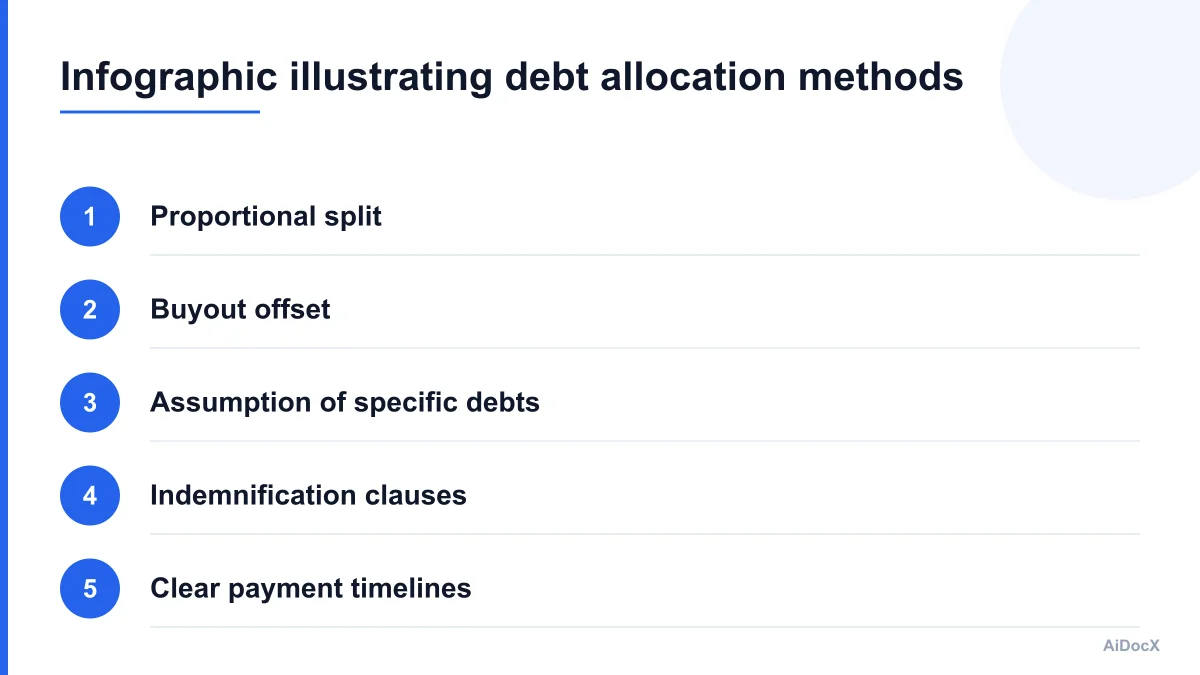
Just as assets must be divided, liabilities must be addressed. Leaving debts unresolved can haunt the departing partner personally, especially in general partnerships where partners have joint and several liability.
Types of Liabilities to Address
- Secured Debt: Loans backed by collateral (e.g., equipment loans). The dissolution agreement must state who assumes these payments and who keeps the collateral.
- Unsecured Debt: Credit card balances, vendor invoices, and unsecured loans. These should be paid off from business assets before distribution of remaining equity.
- Tax Liabilities: Outstanding federal, state, and local taxes. The IRS and state agencies can pursue individual partners for unpaid business taxes.
- Contingent Liabilities: Potential future claims, such as pending lawsuits or warranty obligations. The agreement should specify who is responsible for defending against and paying these claims if they arise post-dissolution.
Critical Clause: Include an indemnification clause. This states that if a creditor comes after the departing partner for a debt that was assigned to the remaining partner, the remaining partner will reimburse the departing partner for all costs, including legal fees.
Step 5: Drafting the Dissolution Agreement
With the assets and liabilities tallied, it is time to draft the legal document. A robust Business Partnership Dissolution Agreement should include the following sections:
Essential Clauses
- Effective Date: The specific date the partnership is legally dissolved.
- Distribution of Assets: A detailed list of who receives which assets. For example, "Partner A receives the delivery van and assumes the associated loan," or "Partner B receives the domain name and customer database."
- Payment Terms: If one partner is buying out the other, specify the total amount, down payment, installment schedule, and interest rate (if any).
- Release of Claims: Both parties agree to release each other from future claims related to the business, except for those explicitly preserved in the agreement (e.g., indemnification for pre-existing liabilities).
- Non-Compete and Non-Solicitation: Optionally, restrict the departing partner from starting a competing business or soliciting existing clients for a defined period. Note: Enforceability varies by jurisdiction.
- Governing Law: Specify which state’s laws govern the agreement.
- Signatures: Both partners must sign.
Pro Tip: Use a platform like AiDocX to draft a partnership dissolution agreement covering asset division and liability release, then gets both parties to sign with a timestamped record. This ensures the document is legally robust and the signing process is secure and verifiable, reducing the risk of future disputes over authenticity.
Step 6: Execute the Buyout or Asset Distribution
Once the agreement is signed, the financial transaction begins. This step must be executed precisely to avoid tax complications or accusations of breach of contract.
Execution Checklist
- Wire Transfer: Use bank wires for large transactions rather than checks, which can be traced more easily and have clear settlement dates.
- Transfer Titles: For vehicles, equipment, or real estate, update the titles to reflect the new ownership. File necessary forms with the DMV or county recorder.
- Update Domain Registrars: If one partner keeps the website, ensure the domain registration is transferred to their name.
- Close Bank Accounts: Only close accounts after all debts are paid and assets are distributed. Keep the account open until the final tax return is filed.
Step 7: Finalize Tax and Legal Filings
Dissolving the business entity is not complete until all governmental and tax obligations are satisfied. Failure to do this can result in penalties and continued liability for the partners.
Required Filings
- Final Tax Returns: File the final income tax return for the business, marking it as "Final Return."
- Final Payroll Taxes: If you have employees, file final Form 941 (quarterly payroll tax) and issue final W-2s or 1099s to employees and contractors.
- State Dissolution Forms: File Articles of Dissolution or Certificate of Cancellation with the Secretary of State. Pay any associated fees.
- IRS EIN Closure: While you don’t "close" an EIN, you should notify the IRS that the business is no longer active if required by your state.
- Cancel DBA/Fictitious Name: If you registered a trade name, cancel it with the county or state clerk.
Common Mistakes to Avoid
Even in amicable splits, small oversights can lead to big problems. Here are the most common errors partners make during dissolution:
- Ignoring Intellectual Property: Failing to assign IP rights can lead to disputes over who owns the brand, website, or proprietary software.
- Skipping the Indemnification Clause: Without it, one partner may be stuck paying for a lawsuit that arose before the split but was discovered afterward.
- Not Updating Credit Reports: Ensure that business debts are closed or transferred in the name of the responsible partner. Left unattended, they can damage the credit score of the partner no longer associated with the business.
- Verbal Agreements: Never rely on a handshake. If it’s not in writing, it doesn’t exist in the eyes of the law.
- Delaying the Process: The longer you wait, the more likely it is that one partner will become resentful or that the business will incur additional liabilities.
Pre-Dissolution Checklist
Use this checklist to ensure you have covered all bases before finalizing your dissolution:
- Review original Partnership/Operating Agreement
- Notify employees, vendors, and creditors
- Conduct full asset and liability inventory
- Agree on valuation method for assets
- Draft comprehensive Dissolution Agreement
- Include indemnification and release clauses
- Execute buyout payments and asset transfers
- Update titles, domains, and ownership records
- File final tax returns and state dissolution forms
- Cancel licenses, permits, and DBA registrations
- Close business bank accounts
- Secure and archive business records
Moving Forward
Ending a business partnership is a significant life and business event. It requires careful planning, honest communication, and legal precision. By following the steps outlined in this guide, you can dissolve your partnership cleanly, protect your personal assets, and avoid the stress and expense of litigation.
Remember, the goal is not just to split the pie, but to ensure that both partners can walk away with their reputation and financial health intact. Take the time to draft a thorough agreement, seek professional advice when necessary, and use modern tools to streamline the process.
If you are ready to formalize your split, consider using AiDocX to draft a partnership dissolution agreement covering asset division and liability release, then gets both parties to sign with a timestamped record. This ensures your final agreement is secure, legally sound, and ready for immediate execution.
Ready to automate your documents with AI?
Start free with AiDocX — AI contract drafting, meeting minutes, consultation notes, e-signatures, and more in one platform.
Get Started FreeMore from AiDocX Blog

AI Press Release Generator: Write One in Minutes (+ Template)
Learn what a press release is, the AP-style format, and how to use an AI press release generator to draft one in minutes with a fill-in template.
James September 21, 2026 10 min
Angel Investment Agreement (2026): Key Terms + Template Guide
Angel investor agreement explained: the four structures founders actually sign, key terms, securities basics, a closing checklist and a summary term sheet.
James September 21, 2026 12 min
Artist Commission Contract Template (2026): Free Template + Guide
Free artist commission contract template with license tiers, deposit, revision, refund and AI-training clauses, plus a guide to getting it e-signed.
James September 21, 2026 12 min