Catering Service Agreement Template 2026: Lock In Headcount, Menu & Deposit
Protect your catering business from last-minute cancellations and headcount drops. Use this 2026 agreement template to secure deposits, finalize menus, and enforce penalties.
 James · Content Manager August 9, 2026 12 min read
Catering Service Agreement Template 2026: How Caterers Lock In Headcount, Menu, and Deposit Before an Event
If you are an independent caterer or run a small catering company, you know the anxiety of the "maybe" list. A client promises 100 guests, then cancels 30 at the last minute. Or they change the menu from roast beef to vegan three days before the event, leaving you with wasted inventory and no recourse. Without a signed contract, these scenarios are just bad business luck. With one, they are breach of contract.
In 2026, clients expect seamless digital workflows. They want to sign documents on their phones and receive automated reminders for final numbers. But behind that convenience lies a critical need for legal protection. A robust catering service agreement is not just paperwork; it is your primary tool for cash flow stability and risk management. This guide details how to structure an agreement that locks in headcount, secures deposits, and defines menu changes, ensuring you get paid for the work you planned, not just the work you delivered.
Why Independent Caterers Lose Money on Unsigned Events
Many independent caterers operate on the edge of profitability. A single wasted event can wipe out the margin of three successful ones. The most common financial leak is the "verbal agreement." When a client says, "Let's do 100 people," and you prepare food for 100, you are taking on all the risk. If the client reduces the guest list to 50, you have already purchased perishable goods, booked staff, and allocated kitchen space for 100. Without a contract, you have no leverage to charge for the unused capacity.
Furthermore, the catering industry in 2026 is more competitive. Clients are comparing you against large corporate caterers who have sophisticated contract management systems. If you cannot provide a clear, professional agreement that outlines your policies, you appear less professional. Clients may hesitate to commit large deposits because they fear hidden fees or inflexibility. A transparent, well-drafted agreement actually builds trust. It shows you are organized, protected, and serious about your business.
The problem isn't that clients want to stiff you; it's that they often don't realize the operational impact of their changes until it's too late. A contract translates operational realities into financial terms. It turns "I'm sorry I can't come" into "You owe 50% of the total contract value." This shift is essential for survival in the small business catering sector.
The Non-Negotiable: Securing the Deposit
The deposit is the first line of defense. It serves two purposes: it commits the client financially, and it covers your initial non-refundable costs, such as marketing, administrative setup, and initial ingredient procurement. In 2026, the standard deposit structure for catering has evolved. While 10% was common a decade ago, inflation and supply chain volatility have pushed this higher.
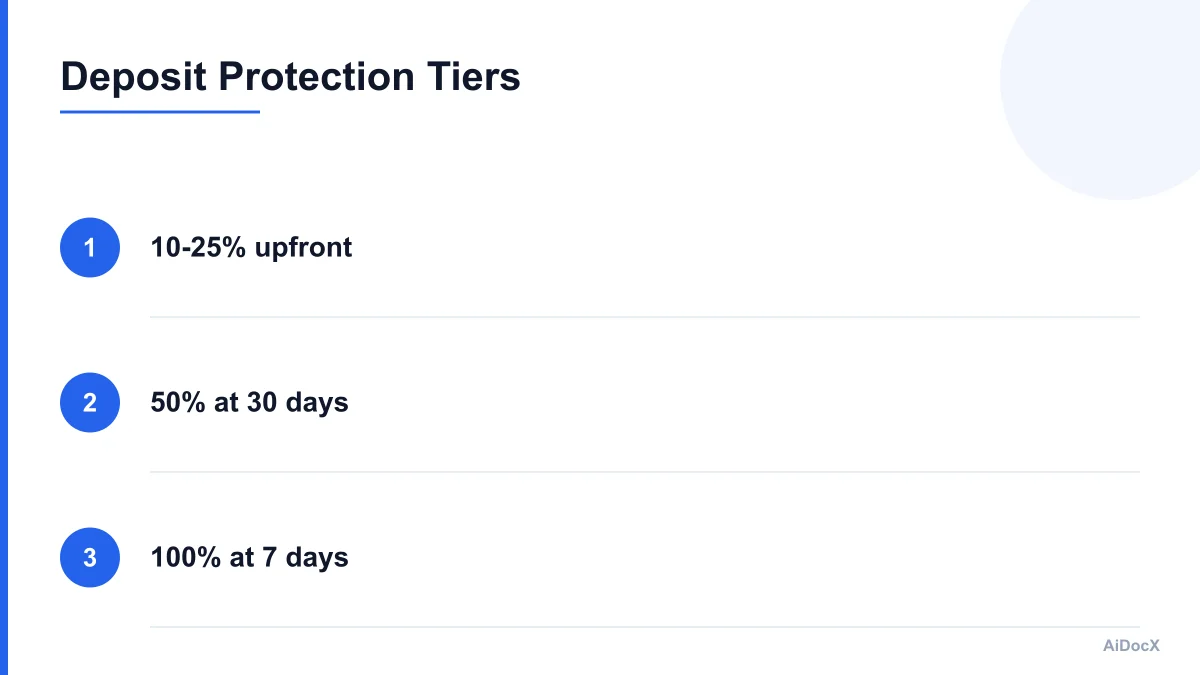
A strong agreement should structure deposits in tiers rather than a single lump sum. This reduces the risk for the client while ensuring you have cash flow at every stage.
- Initial Booking Deposit (10-25%): Due upon signing. This reserves your date and covers initial administrative costs. This amount should be non-refundable after 48 hours.
- Mid-Point Deposit (25-30%): Due 30-45 days before the event. This covers the bulk of the initial ingredient orders and staff scheduling.
- Final Payment (Remaining Balance): Due 7-14 days before the event. This ensures you have all funds cleared before you start cooking.
If a client cancels after the initial deposit, you keep it. If they cancel after the mid-point deposit, you keep both. This structure protects you from the "double booking" problem, where you turn down other work for a client who then bails.
Practical Tip: Never start purchasing specialized ingredients or booking staff without at least the initial deposit cleared in your account. Verbal promises do not pay suppliers.
Managing Headcount Changes and Menu Locks
Headcount is the most volatile variable in catering. Clients often estimate high to avoid embarrassment, only to realize later that fewer people will attend. A contract must define "Final Guaranteed Headcount" with a specific deadline. In 2026, this deadline is typically 72 hours before the event.
The Headcount Adjustment Clause
Your agreement should state that the final headcount is the number of guests actually attending, not the number invited. However, you must also protect yourself against last-minute drops.
- The Buffer Zone: Allow the client to adjust the headcount up or down by 5-10% without penalty up to 72 hours before the event. This accounts for minor RSVP fluctuations.
- The Penalty Zone: Any reduction in headcount below 90% of the original estimate after the 72-hour window incurs a penalty. A common standard is to charge for the difference at a premium rate (e.g., 110% of the per-person cost) to account for wasted labor and fixed costs.
- The Minimum Charge: Always include a minimum headcount clause. For example, "The total charge shall be for a minimum of 50 guests, regardless of actual attendance." This prevents a client from booking a wedding for 200 but showing up with 10.
Menu Locks and Substitutions
Menus change, but ingredients do not. If a client decides to switch from salmon to chicken two days before the event, you have already purchased the salmon. The contract must state that menu changes are subject to availability and may incur additional costs if they require last-minute purchasing or labor changes.
- Free Substitutions: Allowed up to 14 days before the event.
- Paid Substitutions: Allowed up to 7 days before, with a 20% surcharge to cover rush fees.
- No Substitutions: After 72 hours, the original menu is locked. Any changes require full re-pricing and may not be feasible due to prep timelines.
By locking the menu and headcount, you eliminate the "surprise" costs that eat into your profit margins.
Staffing and Service Hours: Defining the Scope
Catering is not just food; it is labor. One of the most common disputes is over "overtime" or "setup time." Clients often assume that because you are there to serve, you should stay until the last plate is cleared, regardless of how long it takes. A clear agreement defines the service window.
Defining Service Hours
Specify the exact start and end times of the service. For example, "Service begins at 6:00 PM and concludes at 10:00 PM, including setup and breakdown."
- Setup and Breakdown: These hours should be billable. If you arrive at 3:00 PM to set up and leave at 11:00 PM to clean up, you are working 8 hours. If the service is only 4 hours, the extra 4 hours are setup/breakdown.
- Overtime Rates: Define an hourly overtime rate that kicks in after the agreed service window. A common rate is 1.5x the regular hourly staff rate. This prevents clients from dragging events out indefinitely, knowing you will just "stay late" for free.
Staffing Levels
Specify the number of servers, bartenders, and chefs required. If the client increases the headcount by 20%, you have the right to add staff. If they don't pay for the additional staff, you are subsidizing their event.
Checklist for Staffing Clauses:
- Define start/end times clearly.
- Include setup and breakdown hours in total billable time.
- State overtime rate (e.g., 1.5x hourly wage).
- Specify ratio of staff to guests (e.g., 1 server per 20 guests).
- Require client approval for any additional staff on-site.
Force Majeure and Cancellation Policies
Events are vulnerable to external factors. Weather, natural disasters, pandemics, and venue closures can all prevent an event from happening. A "Force Majeure" clause protects both parties by excusing performance when unforeseen events occur.
What is Force Majeure?
Force Majeure includes acts of God, war, terrorism, government restrictions, and pandemics. It does not include client indecision, lack of funds, or minor illnesses.
Cancellation Tiers
Instead of a simple "no refund" policy, use a sliding scale based on when the cancellation occurs. This is fairer and more likely to be upheld in court.
- 30+ Days Before: Full refund of deposit (or keep 10% as administrative fee).
- 14-29 Days Before: Keep 50% of total contract value.
- 7-13 Days Before: Keep 75% of total contract value.
- Less than 7 Days: Keep 100% of total contract value.
This structure encourages clients to communicate early. If they know they will lose 75% of the money by cancelling a week before, they are more likely to try to reschedule or find a replacement date.
Rescheduling Options
Offer a rescheduling option within the contract. For example, "The client may reschedule the event once within 6 months of the original date at no additional administrative fee, provided the new date is available." This keeps the business and the relationship alive, even if the original date is lost.
Vendor and Venue Logistics: Who Pays What?
Caterers rarely work in a vacuum. You often need access to the venue's kitchen, electricity, water, and storage. The agreement should clarify responsibilities regarding third-party vendors and venue fees.
Venue Coordination
Specify that the caterer is not responsible for coordinating with other vendors (florists, DJs, photographers) unless explicitly stated. This prevents the "blame game" when a flower delivery is late and the client blames the caterer for a delayed start.
Utility and Equipment Fees
If the venue charges for electricity, water, or kitchen use, state who is responsible. Often, these costs are passed through to the client. Include a line item for "Venue Fees" in the invoice, separate from the catering cost, so the client understands they are paying the venue, not you.
Insurance Requirements
Many venues require caterers to have liability insurance. Your agreement should state that you carry $1-2 million in general liability insurance and can provide a Certificate of Insurance (COI) upon request. This reassures the client and the venue that you are a professional operator.
The Role of Technology in Contract Execution
In 2026, paper contracts are obsolete. Clients expect to sign documents digitally. Using a digital contract platform like AiDocX can streamline this process significantly. AiDocX drafts a catering agreement with headcount, menu, and deposit terms, then gets it signed so a cancellation or last-minute change has a contract behind it.
Digital contracts offer several advantages:
- Speed: Send the contract immediately after the verbal agreement. Sign it within hours, not days.
- Clarity: Use clear, plain-language clauses. Avoid legalese that confuses clients.
- Automation: Set up automatic reminders for final headcount and payment deadlines.
- Security: Store all signed contracts in a secure, searchable cloud database.
By using a digital platform, you ensure that every client, from a small birthday party to a corporate gala, has the same level of professional protection.
Common Mistakes to Avoid in Catering Contracts
Even experienced caterers make mistakes in their agreements. Here are the most common pitfalls and how to avoid them.
- Vague Language: Avoid phrases like "reasonable effort" or "standard practice." Use specific numbers, dates, and percentages.
- No Kill Fee: Failing to include a cancellation policy means you have no leverage if a client bails.
- Ignoring Gratuity: Clearly state whether gratuity is included or optional. If optional, specify the percentage suggested (e.g., 18-20%).
- No Late Payment Penalty: If the client pays late, you should charge interest. A standard rate is 1.5% per month or $50 per day after the due date.
- Forgetting Alcohol Liability: If you are serving alcohol, include a clause stating that the client is responsible for their guests' actions and must provide adequate non-alcoholic options and food. This is crucial for liability protection.
Pre-Event Checklist for Caterers
Before you sign the final agreement and start planning, use this checklist to ensure all bases are covered.
- Client Identity: Verify the client's full legal name and contact information.
- Event Date & Time: Confirm the exact start and end times, including setup and breakdown.
- Location: Specify the full address of the venue, including any secondary locations (e.g., bar area).
- Headcount: Define the estimated headcount and the deadline for final numbers.
- Menu: Attach the final menu as an exhibit. Note any substitutions or allergies.
- Deposit: Specify the deposit amount, due date, and refundability terms.
- Final Payment: Specify the due date (e.g., 7 days before event) and accepted payment methods.
- Cancellation Policy: Include the sliding scale cancellation tiers.
- Force Majeure: Include the force majeure clause.
- Insurance: Confirm your insurance is current and provide COI if required.
- Signatures: Ensure both parties sign and date the agreement.
Coordinating catering as part of a wider event? Planners can use our event planner contract template to set vendor authority and cancellation terms.
Conclusion: Protect Your Craft, Secure Your Income
Catering is a creative and labor-intensive business. You deserve to be paid for your expertise, your ingredients, and your time. A well-drafted service agreement is not about being difficult; it's about being professional. It sets clear expectations, prevents misunderstandings, and protects your bottom line.
In 2026, the market is saturated with options. The caterers who thrive are those who operate like businesses, not just artists. By locking in headcount, securing deposits, and defining clear policies, you remove the guesswork and the risk. You can focus on what you do best: creating memorable dining experiences.
Don't leave your next event to chance. Use a template that covers all the bases. Consider using a tool like AiDocX to draft a catering agreement with headcount, menu, and deposit terms, then gets it signed so a cancellation or last-minute change has a contract behind it. Your business is too valuable to operate on verbal promises. Sign the deal, serve the food, and enjoy the peace of mind.
Ready to automate your documents with AI?
Start free with AiDocX — AI contract drafting, meeting minutes, consultation notes, e-signatures, and more in one platform.
Get Started FreeMore from AiDocX Blog
Buy Sell Agreement Template (2026): Triggers, Valuation and Funding for Co-Owners
A free buy sell agreement template for co-owners, with triggering events, valuation methods, insurance funding and cross-purchase vs. redemption structures.
James September 26, 2026 12 min
Consignment Agreement Template (2026): Commission, Title, Risk of Loss and Unsold Goods
Free consignment agreement template for makers, artists and boutiques: commission split, title, insurance and how to protect consigned inventory.
James September 26, 2026 9 min
Distribution Agreement Template (2026): Territory, Exclusivity, Minimums and Reseller Terms
Free distribution agreement template (works as a reseller agreement template too): territory, exclusivity, minimums, pricing, IP and termination.
James September 26, 2026 13 min