Cleaning Service Contract Template 2026: Protect Your Business
Stop relying on text messages. Get a legally binding cleaning service contract template for 2026 that protects your payments, scope, and reputation.
 James · Content Manager August 9, 2026 11 min read
Cleaning Service Contract Template 2026: What a Cleaning Business Should Get Signed Before the First Job
For years, many independent cleaners and small cleaning companies have operated on handshake deals, text message confirmations, and verbal agreements. It’s fast, it feels friendly, and it works—until it doesn’t. A missed payment, a disputed charge for "extra mess," or a client claiming you damaged a vase can turn a profitable month into a legal headache. In 2026, the expectation for professional documentation is higher than ever. Clients want clarity, and you need protection.
Relying on informal communication leaves you vulnerable. A proper cleaning service contract isn’t just legal jargon; it’s a boundary-setting tool that defines exactly what you will do, what you won’t do, and how you get paid. This guide breaks down exactly what your contract needs to include, why it matters, and how you can implement a digital signing process that takes minutes, not days.
Why Text Messages Aren’t Enough Anymore
The biggest mistake small cleaning businesses make is assuming that a text message confirmation is a binding contract. While some jurisdictions might argue that informal agreements hold weight, proving the terms in a dispute is incredibly difficult. Texts are fragmented, easily deleted, and often lack specific legal language regarding liability, indemnification, and scope limitations.
When a client disputes a charge or claims you didn’t complete a task, you need a document that both parties reviewed and accepted. A formal contract eliminates the "I thought you meant..." conversations. It sets professional expectations from day one. It signals to your client that you run a legitimate business, not just a side hustle. This perception alone can justify higher rates and reduce the number of difficult clients who try to negotiate scope after the fact.
Furthermore, insurance providers and bonding companies often require proof of formal agreements in the event of a claim. If you are applying for commercial cleaning contracts or bidding on larger residential jobs, a standardized contract template is often a prerequisite for qualification. You cannot win high-value contracts if you cannot demonstrate that you have risk management protocols in place.
The Core Components of a Bulletproof Cleaning Contract
A robust cleaning contract must cover specific areas to protect both the provider and the client. It should be clear, concise, and easy to understand for the average homeowner or office manager. Here are the essential sections every 2026 cleaning contract should include.
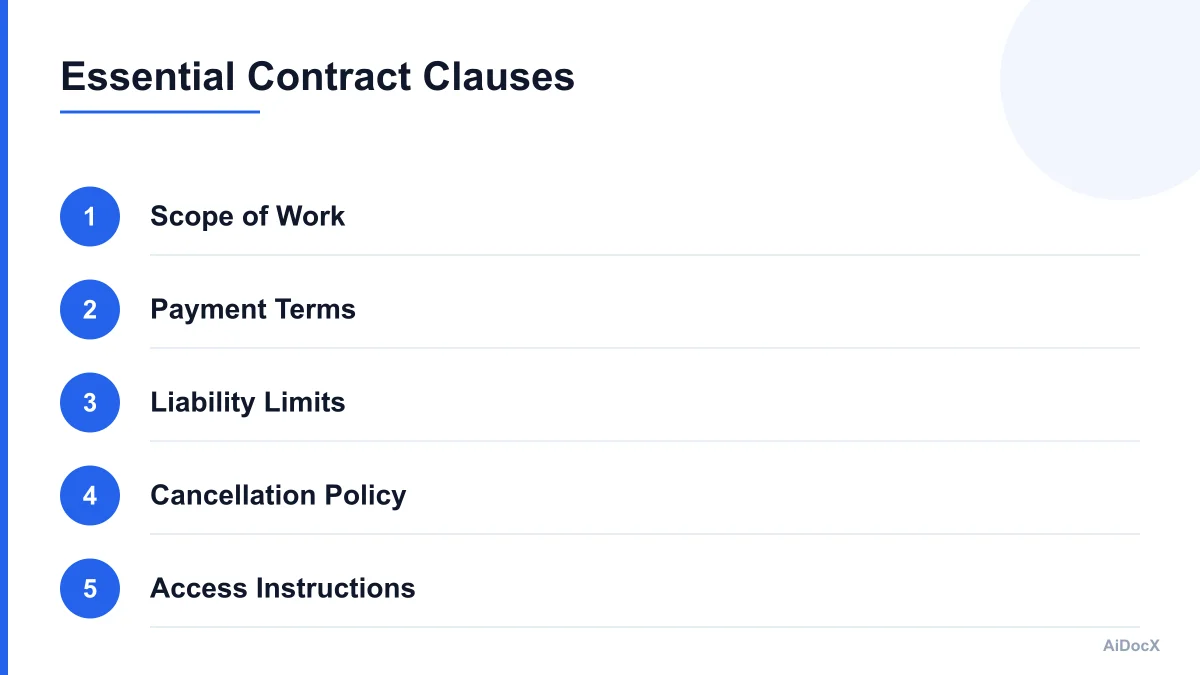
1. Detailed Scope of Services
Vague descriptions like "clean the house" are your enemy. You need to list exactly what is included. For example: "Vacuuming all carpets, mopping hard floors, cleaning kitchen appliances (exterior only), and wiping down bathroom fixtures." Conversely, you must explicitly state what is not included. Common exclusions include window washing on the exterior, laundry services, pet waste removal, and hoarding cleanup. By defining the scope, you prevent scope creep where clients expect extra services without extra pay.
2. Frequency and Schedule
Define how often the cleaning will occur (weekly, bi-weekly, monthly, one-time) and the expected duration of each visit. Specify the days and times the team will arrive. Include a clause that allows for rescheduling with reasonable notice. This helps you manage your calendar and ensures the client knows when to expect you.
3. Pricing and Payment Terms
Be transparent about costs. Is it a flat fee per visit or an hourly rate? If hourly, state the estimated hours and what happens if the job takes longer. Define the payment methods accepted (credit card, bank transfer, check) and the due date for invoices. A clear "Net 15" or "Due on Receipt" policy prevents late payments.
4. Cancellation and No-Show Policy
This is critical for protecting your income. State clearly that cancellations made with less than 24 or 48 hours' notice will incur a fee (usually 50% of the scheduled visit cost). This policy discourages last-minute changes and compensates you for time set aside that could have been billed to another client.
5. Liability and Insurance
Include a clause that limits your liability. State that you carry general liability insurance (if applicable) and bonding. Clarify that you are not responsible for pre-existing damage or items of high value unless specifically declared and insured. This protects you from catastrophic claims over minor incidents.
6. Access and Security
Explain how the client will provide access (key, lockbox, code) and who is responsible for keeping the property secure. Specify that your team will lock up upon departure. This reassures the client and clarifies responsibility for security breaches.
7. Termination Clause
Define how either party can end the contract. Typically, this is 30 days’ written notice. This provides an exit strategy for both sides if the relationship isn’t working, preventing messy breakups.
Common Mistakes Cleaning Contractors Make
Even with a template, many cleaning business owners make critical errors that undermine their legal protection. Avoid these pitfalls to ensure your contract is effective.
Mistake 1: Using Generic Internet Templates
Downloading a free contract from a generic legal website often results in documents that don’t address specific industry nuances. A template designed for a landscaper won’t cover the unique liabilities of working inside someone’s home with chemicals and equipment. Ensure your template is tailored specifically for cleaning services.
Mistake 2: Overcomplicating the Language
While legal protection is vital, the contract must be readable. If a client cannot understand the terms, they are less likely to sign, and you may face disputes over "unfair terms." Use plain English. Instead of "indemnification against all manner of claims," say "You are responsible for any damage caused by your negligence."
Mistake 3: Failing to Update the Contract
Your business changes. You might start offering carpet cleaning or move to a new pricing structure. If your contract doesn’t reflect current services, you are bound by the old terms. Review and update your contract annually or whenever you add a new service line.
Mistake 4: Not Getting a Signature
Sending a contract via email without requiring a signature is not enough. A signature (digital or physical) provides proof of acceptance. Without it, a client can claim they never agreed to the cancellation fee or the scope limitations. Always ensure the document is executed before work begins.
Mistake 5: Ignoring Local Regulations
Laws regarding independent contractors, employee classification, and consumer rights vary by state and country. A generic contract might not comply with local labor laws or consumer protection acts. Consult with a local business attorney to ensure your contract adheres to regional regulations.
How to Get Signed Before the First Visit
The biggest hurdle to getting contracts signed is friction. If the process is complicated, clients will delay, and you might start working before the paper is signed. In 2026, the solution is digital simplicity. You need a system that allows you to send a contract, have the client review it, and sign it from their phone in under two minutes.
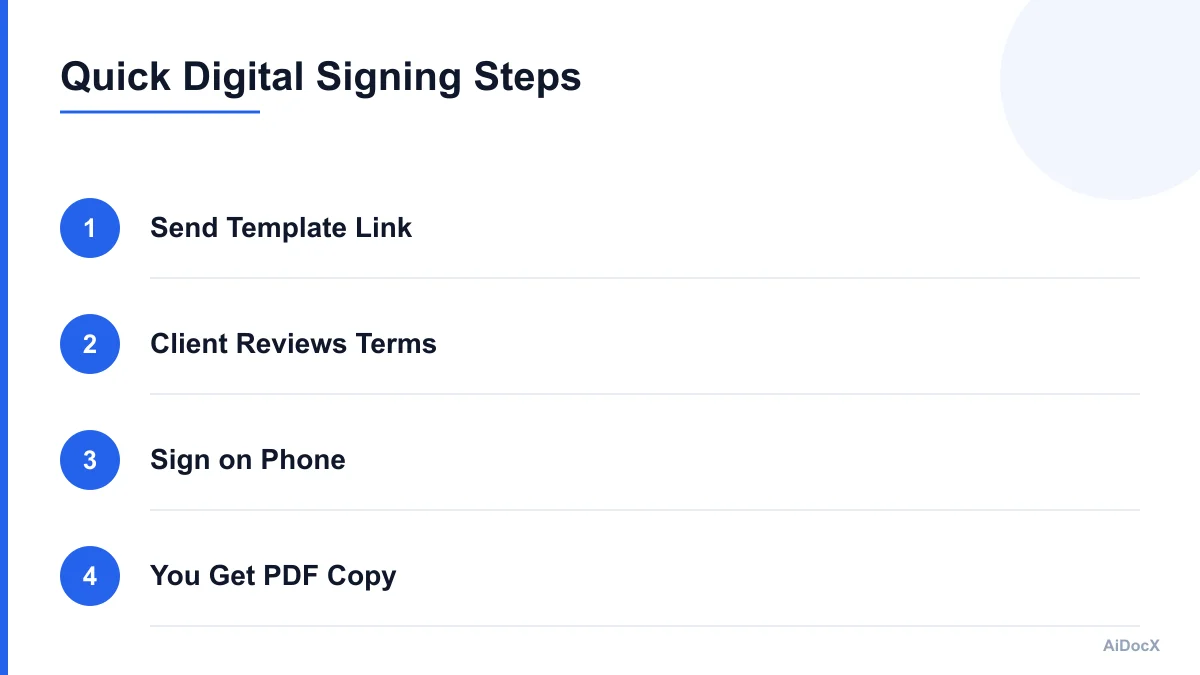
This is where modern contract platforms shine. For example, AiDocX turns a cleaning service contract into a reusable template with scope, schedule, and payment terms, then collects a client's signature from a phone before the first visit. This seamless integration removes the back-and-forth emails and printed PDFs that clutter your workflow.
Step-by-Step Implementation
- Create Your Template: Use a specialized cleaning contract template. Input your standard terms, pricing structures, and scope definitions. Customize it with your business logo and contact information.
- Send the Link: When a new client inquires, send them a secure link via email or SMS. The link opens a mobile-friendly view of the contract.
- Client Review: The client can read the terms on their phone. They can ask questions via chat or email before proceeding.
- Digital Signature: Once ready, the client signs electronically. The platform records the timestamp, IP address, and email verification, creating a legally binding audit trail.
- Store and Access: The signed contract is automatically saved to your cloud storage. You can access it anytime for reference or in case of a dispute.
This process not only protects you but also enhances the client experience. It feels professional and modern, setting the tone for a high-quality service relationship.
Comparing Manual vs. Digital Contract Management
To understand the value of adopting a digital contract system, it helps to compare the traditional manual approach with a modern digital workflow.
| Feature | Manual (Print/PDF/Email) | Digital (e.g., AiDocX) |
|---|---|---|
| Time to Sign | Hours to Days (printing, scanning, mailing) | Minutes (on-device signature) |
| Storage | Physical filing cabinets or scattered emails | Centralized, searchable cloud storage |
| Security | Risk of lost documents or unauthorized edits | Encrypted, tamper-evident audit trails |
| Updates | Requires re-sending full documents for changes | Auto-update all future templates |
| Compliance | Hard to prove timestamp and IP verification | Automatic legal verification data |
The digital approach reduces administrative overhead significantly. Instead of spending hours printing, signing, and filing, you spend seconds sending and minutes having it done. This efficiency allows you to focus on growing your cleaning business rather than managing paperwork.
Customizing for Different Cleaning Niches
Not all cleaning jobs are the same. A contract for a residential home cleaner differs from one for a commercial office cleaner. Your template should be adaptable.
Residential Cleaning
Focus on trust and security. Include clauses about background checks for your staff, pet safety protocols, and key handling. Emphasize your liability insurance to reassure homeowners. Define the scope to include or exclude deep cleaning tasks like inside oven cleaning or window washing.
Commercial Cleaning
Focus on uptime and performance. Include Service Level Agreements (SLAs) that define what "clean" means (e.g., "florescent tubes dusted monthly"). Include penalties or service credits if standards are not met. Address access issues for after-hours cleaning. Define the chain of command for communication so that issues are resolved quickly without disrupting business operations.
Specialized Cleaning (Carpet, Pressure Washing)
Focus on risk mitigation. These jobs carry higher risks of damage. Include specific clauses about pre-inspection of surfaces, testing on inconspicuous areas, and limitations on warranty for colorfastness or material integrity. Make sure the client acknowledges the risks involved.
The Legal Weight of E-Signatures
Some clients may hesitate to sign electronically, asking for a wet ink signature. It is important to reassure them that e-signatures are legally binding in most jurisdictions, including under the U.S. ESIGN Act and the EU eIDAS regulation.
Courts consistently uphold digital signatures when proper authentication methods are used. Platforms like AiDocX verify the signer’s identity through email confirmation and capture metadata such as the time of signing and the device used. This level of detail is often stronger than a handwritten signature, which can be forged or disputed more easily.
By educating your clients on this, you remove a common barrier to signing. Frame it as a benefit to them: "I send you a digital contract so you can review it at your convenience and sign it securely from your phone. It’s faster and more secure than printing and scanning."
Checklist: Before You Start Your Next Job
Use this checklist to ensure your business is protected before you step foot on a new job site.
- Contract Prepared: Do you have a current, customized cleaning contract template?
- Scope Defined: Are all services and exclusions clearly listed?
- Payment Terms Set: Are prices, due dates, and late fees explicitly stated?
- Cancellation Policy Clear: Is the no-show fee and cancellation window defined?
- Liability Clause Included: Is your insurance and liability limitation clearly stated?
- Access Instructions: Is the method for entering the property defined?
- Digital Signature Ready: Is your e-signature platform set up and tested?
- Client Signed: Have you received the fully executed contract before starting work?
- Copy Stored: Is the signed contract saved in your secure digital records?
Conclusion: Protect Your Peace of Mind
A cleaning business is built on trust, but trust needs structure. In 2026, operating without a formal contract is a significant risk that can cost you money, time, and reputation. By implementing a clear, comprehensive cleaning service contract template, you protect yourself from disputes, ensure timely payments, and set professional boundaries.
The key is to make the process easy for both you and your clients. Don’t let paperwork slow you down. Use technology to streamline the signing process, ensuring you are covered before you even pick up your mop. With the right tools and templates, you can focus on what you do best: delivering excellent cleaning services.
Ready to protect your business? Explore how AiDocX turns a cleaning service contract into a reusable template with scope, schedule, and payment terms, then collects a client's signature from a phone before the first visit. Start building your professional foundation today.
Ready to automate your documents with AI?
Start free with AiDocX — AI contract drafting, meeting minutes, consultation notes, e-signatures, and more in one platform.
Get Started FreeMore from AiDocX Blog
Buy Sell Agreement Template (2026): Triggers, Valuation and Funding for Co-Owners
A free buy sell agreement template for co-owners, with triggering events, valuation methods, insurance funding and cross-purchase vs. redemption structures.
James September 26, 2026 12 min
Consignment Agreement Template (2026): Commission, Title, Risk of Loss and Unsold Goods
Free consignment agreement template for makers, artists and boutiques: commission split, title, insurance and how to protect consigned inventory.
James September 26, 2026 9 min
Distribution Agreement Template (2026): Territory, Exclusivity, Minimums and Reseller Terms
Free distribution agreement template (works as a reseller agreement template too): territory, exclusivity, minimums, pricing, IP and termination.
James September 26, 2026 13 min