Co-Branding Partnership Agreement Template 2026: Essential Clauses
Secure your joint campaign with a clear co-branding agreement. Learn key clauses for IP, revenue, and approvals to protect both brands in 2026.
 James · Content Manager August 9, 2026 9 min read
Co-Branding Partnership Agreement Template 2026: Essential Clauses
Co-branding can accelerate growth, but without a solid contract, it can also destroy your brand equity. In 2026, the landscape of joint ventures is more complex, with stricter data privacy laws and higher scrutiny on brand alignment. A handshake deal is no longer enough. You need a written agreement that clearly defines who owns what, how revenue is split, and who has final say on creative decisions.
This guide breaks down the critical components of a co-branding partnership agreement. We will walk you through the essential clauses that protect your startup or small business, ensuring that your joint campaign delivers value without creating legal or reputational liabilities.
1. Defining the Scope and Objectives
Before discussing money or law, you must define what "success" looks like for both parties. Vague goals lead to vague expectations, which lead to conflict. In 2026, scope creep is a major risk in digital campaigns where content production is agile and fast-paced.
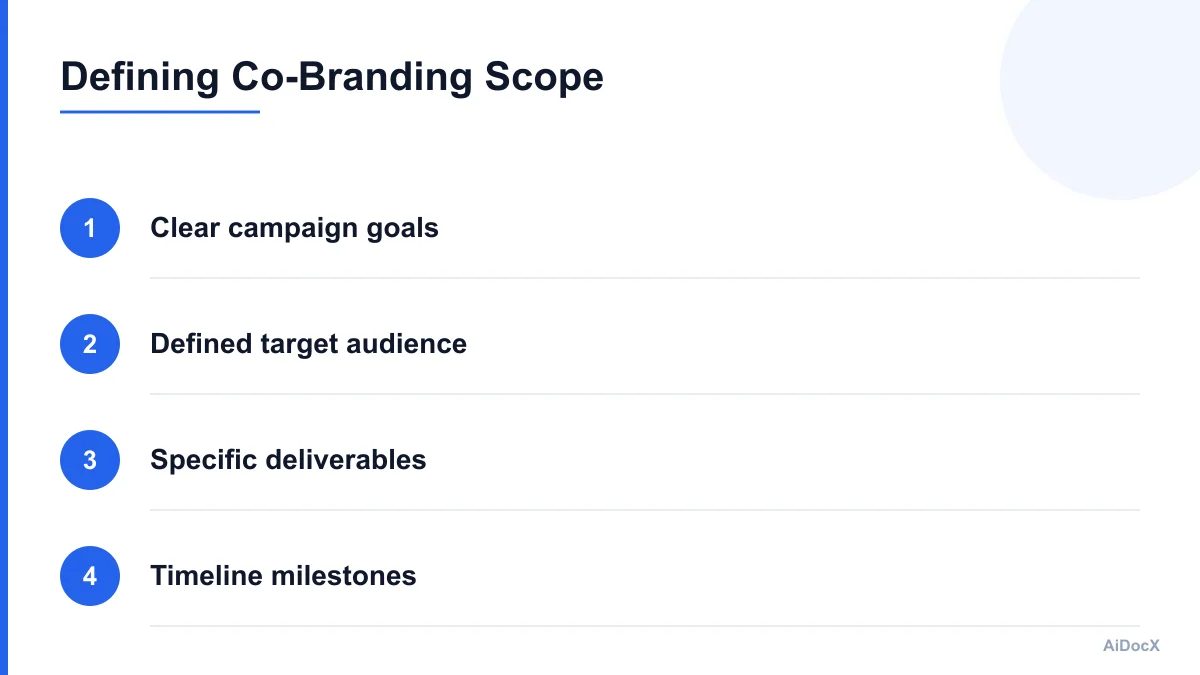
A strong agreement starts with a clear statement of purpose. This section should outline the specific product, event, or campaign being co-branded. It should answer: What are we building? Who is it for? When does it launch?
Key Elements of Scope Definition
- Campaign Specifics: Detail the exact deliverables. Is it a joint webinar? A co-branded software feature? A physical product bundle? Be as specific as possible.
- Target Audience: Define the shared audience. Are both companies targeting the same demographic? If not, how will the marketing message be tailored?
- Timeline and Milestones: Include a detailed project plan with key dates. This includes design approval, content creation, legal review, and launch dates.
- Roles and Responsibilities: Clearly assign tasks. Who handles customer support? Who manages the ad spend? Who creates the graphics?
Common Mistake: The "Everything" Clause
Avoid language that suggests an open-ended partnership. Phrases like "both parties will collaborate on marketing efforts" are too broad. Instead, use "Company A will manage social media promotion, while Company B will handle email newsletter distribution." Specificity protects you from unexpected workloads.
2. Intellectual Property and Usage Rights
Intellectual property (IP) is the most critical asset in a co-branding deal. Without clear ownership terms, you risk losing control over your brand assets or inadvertently infringing on your partner’s IP. In 2026, with the rise of AI-generated content and digital assets, IP definitions need to be even more precise.
Pre-Existing vs. New IP
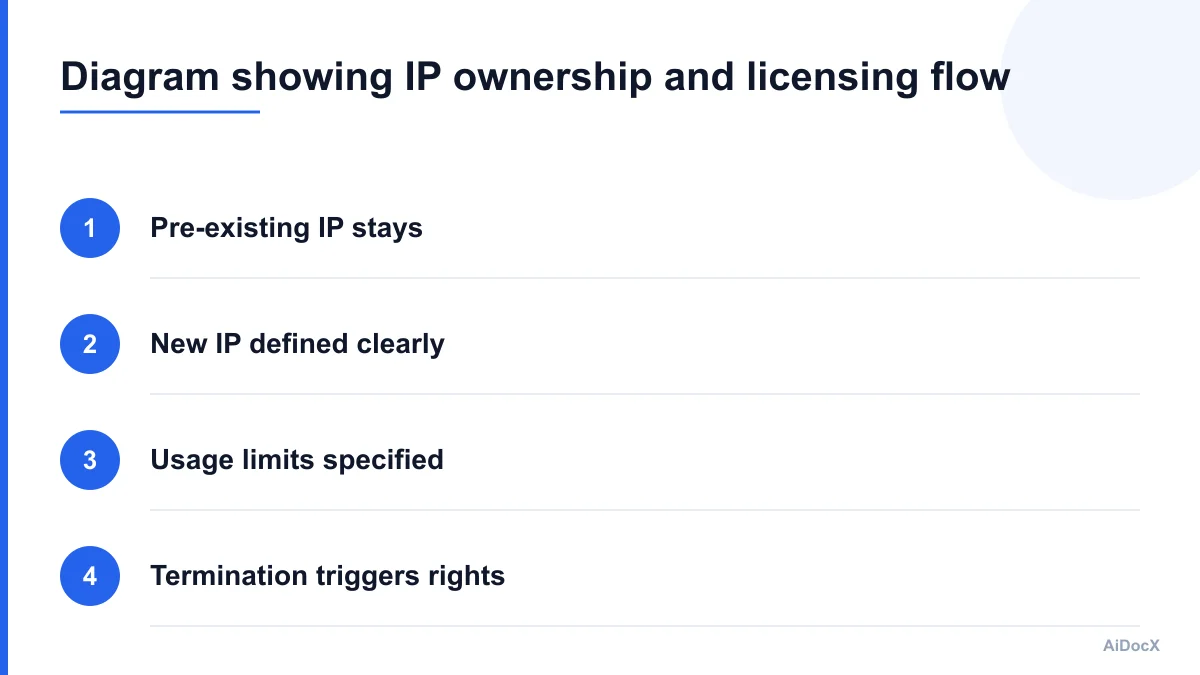
The agreement must distinguish between pre-existing IP and newly created IP.
- Pre-Existing IP: Each party retains ownership of their logos, trademarks, content, and technology brought into the partnership. This is non-negotiable. You do not own your partner’s brand just because you worked with them.
- New IP: Define who owns the content created specifically for the campaign. Is it joint ownership? Does one party own the content and license it to the other?
Licensing and Usage Rights
Ownership is not the same as usage. You need a license to use your partner’s assets and vice versa.
- Scope of License: Specify where and how the logos can be used. Can the partner use your logo on their website? In their sales deck? In paid ads?
- Duration: How long can they use your IP? Usually, it should be tied to the campaign duration plus a reasonable wind-down period for archival purposes.
- Termination of Rights: What happens when the partnership ends? The agreement should state that all usage rights terminate immediately upon termination, and the partner must remove your logo from their materials within a set timeframe (e.g., 30 days).
Example Clause
"Company A grants Company B a non-exclusive, non-transferable license to use Company A’s logo and trademarks solely for the purpose of promoting the Joint Campaign during the Term. Upon termination, Company B shall cease all use of Company A’s IP and remove all references from its marketing materials within thirty (30) days."
3. Financial Terms and Revenue Split
Money talks. Ambiguity in financial terms is the leading cause of co-branding disputes. Whether you are splitting revenue, sharing costs, or exchanging services, the agreement must be explicit.
Revenue Sharing Models
- Percentage Split: A straightforward percentage of net or gross revenue. Define "net" clearly. Does it include refunds? Chargebacks? Advertising costs?
- Fixed Fee: One party pays the other a flat fee for the co-branding effort.
- Hybrid Model: A smaller fixed fee plus a percentage of revenue.
Cost Allocation
Who pays for what? This is often overlooked until the bill arrives.
- Production Costs: Who pays for graphic design, video production, and copywriting?
- Advertising Spend: Who funds the paid social media campaigns? Is it split 50/50?
- Platform Fees: Who covers transaction fees from payment processors?
Payment Terms
- Invoicing Schedule: When are invoices issued? Monthly? Upon milestone completion?
- Payment Window: Net 15? Net 30? Late fees?
- Audit Rights: Allow each party the right to audit the other’s financial records related to the campaign to ensure accuracy. This builds trust and prevents disputes.
Common Mistake: Ignoring Refunds and Chargebacks
In e-commerce co-branding, refunds are inevitable. The agreement should specify how refunds are handled. Does the revenue split apply only to net sales (after refunds)? If so, how are past commissions adjusted?
4. Approval Rights and Creative Control
Who has the final say on the creative output? Disagreements over brand voice, visual identity, and messaging can derail a campaign. Establishing a clear approval process upfront prevents bottlenecks and protects brand integrity.
The Approval Workflow
Define a step-by-step process for approving marketing materials.
- Draft Submission: One party submits the creative assets.
- Review Period: The other party has a set number of business days (e.g., 5 days) to review.
- Feedback Loop: The submitting party incorporates feedback or explains why it was not adopted.
- Final Approval: Written confirmation (email is fine) that the asset is approved for publication.
Brand Guidelines
Each party should provide their brand guidelines, which the other party agrees to follow. This includes logo usage, color palettes, typography, and tone of voice.
Emergency Clauses
In 2026, real-time social media engagement is crucial. Include a clause for "emergency approvals" where a simplified process is allowed for time-sensitive content, with post-publication confirmation required within 24 hours.
Common Mistake: Silent Approval
Avoid clauses that say "if no feedback is provided within 48 hours, the asset is approved." This can lead to unintended approvals. Instead, require explicit written approval for all major assets. Minor tweaks can be handled with a "no objection" clause.
5. Data Privacy and Compliance
In 2026, data privacy is not just a legal requirement; it is a brand trust issue. Co-branding often involves sharing customer data, which triggers obligations under GDPR, CCPA, and other global privacy laws.
Data Sharing Agreement
- Data Types: Specify what data is being shared. Is it email addresses? Purchase history? Behavioral data?
- Purpose Limitation: Data can only be used for the specific campaign. It cannot be used for future marketing without explicit consent.
- Security Measures: Both parties must agree to maintain industry-standard security measures to protect shared data.
Compliance Responsibilities
- Consent Management: Who is responsible for obtaining user consent for data sharing? Usually, it is the party collecting the data.
- Right to Delete: If a user requests data deletion, how is this handled across both systems?
- Breach Notification: Define the process for notifying each other in case of a data breach. Include a timeline (e.g., within 24 hours).
Common Mistake: Assuming Consent Transfers
Just because a user agreed to terms with Company A does not mean they agreed to share data with Company B. The co-branding agreement must outline how dual consent is obtained, often through a joint privacy notice or checkbox.
6. Liability and Indemnification
What happens when things go wrong? A co-branding agreement must include liability and indemnification clauses to protect both parties from financial loss due to negligence, IP infringement, or breach of contract.
Indemnification
- Mutual Indemnification: Each party agrees to indemnify the other against claims arising from their own actions, negligence, or breach of the agreement.
- Scope: This includes legal fees, settlements, and judgments.
Limitation of Liability
- Cap on Damages: Consider capping liability to a specific amount, such as the total fees paid under the agreement.
- Exclusions: Certain types of damages (e.g., indirect, consequential, or punitive damages) are often excluded.
Insurance Requirements
Require both parties to maintain adequate insurance coverage, such as general liability and professional liability insurance. Request certificates of insurance as part of the agreement.
Common Mistake: One-Sided Liability
Ensure the indemnification clause is mutual. If one party bears all the risk, the deal is unbalanced and may not be enforceable or attractive.
7. Termination and Exit Strategy
No one likes to think about the end of a partnership, but it is essential to plan for it. A well-drafted termination clause ensures a smooth exit, protecting both brands’ reputations and assets.
Termination for Cause
- Breach: Material breach of the agreement that is not cured within a specified period (e.g., 30 days).
- Insolvency: If one party becomes bankrupt or insolvent.
- Reputational Harm: If one party’s actions severely damage the other’s brand reputation.
Termination for Convenience
Allow either party to terminate the agreement without cause, with adequate notice (e.g., 60 days). This provides flexibility if business priorities change.
Post-Termination Obligations
- Wind-Down Period: Define a period for completing ongoing obligations.
- Return of Materials: Return or destroy all confidential information and co-branded materials.
- Transition of Customers: If applicable, outline how customer accounts or subscriptions are transferred or closed.
Common Mistake: Ignoring Transition Costs
Include provisions for who pays for the wind-down process. This can include costs for removing co-branded content from websites, canceling ad campaigns, and notifying customers.
Checklist for Your Co-Branding Agreement
Before signing, review your co-branding agreement against this checklist:
- Scope Defined: Are the campaign goals, deliverables, and timeline clearly stated?
- IP Ownership: Is pre-existing and new IP ownership clearly defined?
- Usage Rights: Are licensing terms for logos and content specific and limited?
- Financial Terms: Are revenue splits, cost allocations, and payment terms explicit?
- Approval Process: Is the creative approval workflow and timeline established?
- Data Privacy: Are data sharing and compliance responsibilities outlined?
- Liability: Are indemnification and limitation of liability clauses mutual?
- Termination: Is the exit strategy and post-termination process clear?
Final Thoughts
A co-branding partnership can be a powerful growth engine for small businesses and startups. However, the success of the partnership depends on the clarity and fairness of the agreement. By addressing IP, finances, approvals, and liability upfront, you protect your brand and set the stage for a successful collaboration.
If you are planning a joint campaign, do not rely on generic templates or handshakes. AiDocX drafts a co-branding agreement covering IP ownership, revenue split, and approval rights, then gets both companies' signatures before a joint campaign goes live. This ensures you are protected and focused on what matters: delivering value to your customers.
Ready to automate your documents with AI?
Start free with AiDocX — AI contract drafting, meeting minutes, consultation notes, e-signatures, and more in one platform.
Get Started FreeMore from AiDocX Blog

Buy Sell Agreement Template (2026): Triggers, Valuation and Funding for Co-Owners
A free buy sell agreement template for co-owners, with triggering events, valuation methods, insurance funding and cross-purchase vs. redemption structures.
James September 26, 2026 12 min
Consignment Agreement Template (2026): Commission, Title, Risk of Loss and Unsold Goods
Free consignment agreement template for makers, artists and boutiques: commission split, title, insurance and how to protect consigned inventory.
James September 26, 2026 9 min
Distribution Agreement Template (2026): Territory, Exclusivity, Minimums and Reseller Terms
Free distribution agreement template (works as a reseller agreement template too): territory, exclusivity, minimums, pricing, IP and termination.
James September 26, 2026 13 min