Co-Founder Agreement Template 2026: Secure Your Startup Early
Protect your equity and roles with a solid co-founder agreement template. Learn vesting, IP assignment, and dispute resolution before incorporating in 2026.
 James · Content Manager August 3, 2026 11 min read
Co-Founder Agreement Template 2026: Secure Your Startup Early
The difference between a successful startup and a failed one often isn’t the product—it’s the partnership. In 2026, with remote teams, digital-first incorporation, and heightened scrutiny from angel investors, a handshake is no longer enough. You need a binding document that defines equity, roles, and exit strategies before you write a single line of code or make your first sale.
This guide provides a comprehensive framework for a co-founder agreement. It covers the critical legal and operational clauses you must negotiate, explains why vesting matters more than initial split, and outlines how to structure your relationship for longevity. Whether you are incorporating tomorrow or still in the ideation phase, this template-driven approach ensures you start with a real paper trail instead of a handshake.
Why You Need a Co-Founder Agreement Before Incorporation
Many founders delay formalizing their partnership, believing that discussing terms like equity and departure is awkward or premature. This is a critical mistake. A co-founder agreement is not just a legal formality; it is a strategic tool that aligns expectations and prevents future conflicts.
Investors view a signed co-founder agreement as a sign of maturity. It demonstrates that you have thought through the dynamics of your team and have mechanisms in place to handle disagreements or unexpected departures. Without it, you risk:
- Equity Disputes: If one founder leaves early, they may retain a significant chunk of equity, making the startup uninvestable.
- IP Ambiguity: Without clear assignment, the company may not own the code or content created during the pre-incorporation phase.
- Role Confusion: Overlapping responsibilities can lead to inefficiency and resentment.
- Legal Vulnerability: In the absence of a written agreement, state default laws apply, which rarely reflect the founders' actual intentions.
By drafting this agreement before incorporating, you establish a clear foundation. You can adjust terms as the business evolves, but the initial agreement sets the tone for transparency and professionalism.
The Core Clauses Every Co-Founder Agreement Must Include
A robust co-founder agreement is more than a simple equity split document. It is a comprehensive roadmap for the partnership. Below are the essential clauses that must be addressed in your 2026 startup agreement.
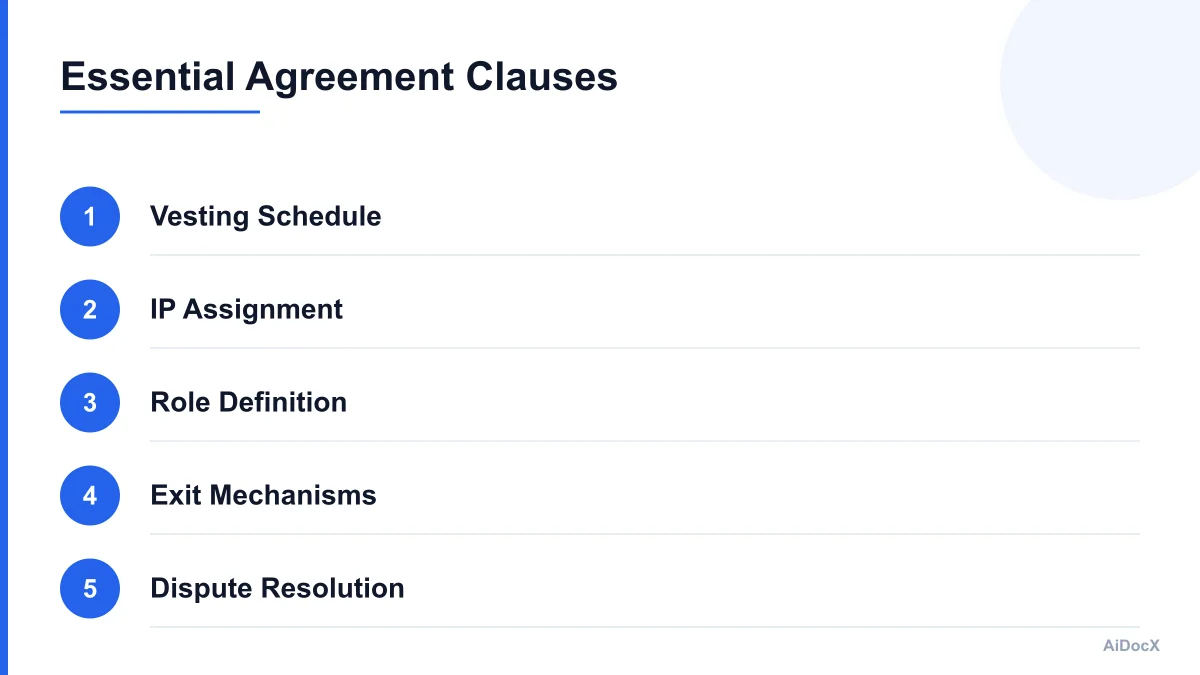
1. Equity Split and Ownership Structure
The equity split is the most visible part of the agreement, but it is rarely the most important. A 50/50 split might seem fair, but it can create deadlocks in decision-making. A 60/40 or 70/30 split, based on contribution, risk, and role, is often more sustainable.
- Initial Allocation: Define the percentage of equity each founder receives.
- Class of Shares: Specify if founders are receiving Common Stock or another class.
- Future Dilution: Acknowledge that equity will be diluted in future funding rounds.
2. Vesting Schedule
Vesting ensures that founders earn their equity over time. This protects the company if a co-founder leaves early. The standard model in 2026 remains the four-year vesting schedule with a one-year cliff.
- Cliff: No equity vests until the one-year mark. If a founder leaves before 12 months, they walk away with zero equity.
- Monthly/Quarterly Vesting: After the cliff, equity vests monthly or quarterly over the remaining three years.
- Acceleration: Consider single-trigger or double-trigger acceleration clauses in case of an acquisition or change of control.
3. Intellectual Property (IP) Assignment
This is non-negotiable. All work created by founders related to the business must be assigned to the company. This includes code, designs, customer lists, and business plans developed before incorporation.
- Pre-Existing IP: If a founder brings prior technology, it must be licensed or assigned to the company.
- Moral Rights: Waive any moral rights to the IP to ensure the company has full control.
- Post-Employment: Clarify that IP created during the course of the relationship belongs to the company.
4. Roles and Responsibilities
Clearly defining who does what prevents overlap and conflict. This section should outline:
- Titles: CEO, CTO, CMO, etc.
- Day-to-Day Duties: Specific responsibilities and reporting lines.
- Decision-Making Authority: Which decisions require unanimous consent vs. majority vote.
- Time Commitment: Full-time vs. part-time expectations, especially in the early stages.
5. Departure and Buy-Sale Provisions
What happens if a co-founder wants to leave, is fired, becomes disabled, or dies? The agreement must define the "bad leaver" and "good leaver" scenarios.
- Good Leaver: Usually retains vested equity.
- Bad Leaver: Typically forfeits unvested equity and may have vested equity bought back at a discount.
- Buy-Sell Formula: Define how the price of repurchasing equity is calculated (e.g., fair market value, fixed formula).
6. Dispute Resolution
Disagreements are inevitable. Establish a process for resolving them before they escalate to litigation.
- Mediation: Require non-binding mediation with a neutral third party.
- Arbitration: Specify binding arbitration for final resolution, which is often faster and cheaper than court.
- Governing Law: State which jurisdiction’s laws apply to the agreement.
Drafting Your First Version: A Step-by-Step Guide
Creating a co-founder agreement doesn’t require a law degree, but it does require careful thought. Follow these steps to draft a solid foundation.
Step 1: Align on Vision and Values
Before discussing numbers, have an open conversation about the company’s mission, long-term goals, and core values. Are you building for an exit in five years, or for long-term independence? Do you value rapid growth over stability? These high-level alignments will inform the specific clauses you include.
Step 2: Define Contributions and Risk
List each founder’s contributions: capital, IP, time, connections, and expertise. Discuss the level of risk each person is taking. The founder taking the biggest financial or career risk might warrant a larger equity stake, but this should be balanced against the value of ongoing contributions.
Step 3: Negotiate the Equity Split
Use the contributions and risk assessment to propose an initial split. Be prepared to justify your position with data and logic. Remember, the split can be adjusted later through vesting or future grants, but the initial agreement sets the baseline.
Step 4: Choose a Vesting Model
Adopt the standard four-year vesting with a one-year cliff. This is the industry standard and is expected by investors. Avoid custom vesting schedules unless there are exceptional circumstances, as they can complicate future fundraising.
Step 5: Document IP Assignment
Create a separate IP Assignment Agreement if needed, but ensure the co-founder agreement explicitly references it. All founders must sign this to ensure the company owns its assets.
Step 6: Review and Finalize
Once the draft is complete, review it together. Discuss every clause. If there are ambiguities, clarify them. It is better to have a difficult conversation now than a legal battle later.
Common Mistakes to Avoid in Co-Founder Agreements
Even well-intentioned founders make mistakes when drafting their agreement. Avoid these common pitfalls to protect your startup.
Mistake 1: Equating Equity with Salary
Equity is not a substitute for fair compensation. If founders are working for little or no salary, the equity should reflect that, but it should not be the only factor. Ensure the agreement acknowledges any deferred salary and how it will be treated in future funding rounds.
Mistake 2: Ignoring Future Contributions
The initial equity split should not be fixed in stone if future contributions will vary significantly. Use vesting and option pools to adjust for future work. A static split can lead to resentment if one founder contributes significantly more over time.
Mistake 3: Overlooking Non-Compete and Non-Solicit Clauses
These clauses protect the company’s interests by preventing founders from leaving to start a competing business or poaching employees. Ensure these clauses are reasonable in scope and duration to be enforceable.
Mistake 4: Failing to Update the Agreement
As the company grows, the co-founder agreement may need updates. Add new founders, adjust roles, or modify equity grants. Keep the agreement current and maintain a clear record of all amendments.
Mistake 5: Skipping Legal Review
While you can draft the initial agreement yourself, have a lawyer review it before signing. Legal costs are small compared to the risk of an unenforceable clause or a future lawsuit.
Vesting Schedules and Equity: The Heart of the Agreement
Vesting is the mechanism that ensures founders stay committed to the company. It aligns incentives and protects the business from early departures.
The Standard Model: 4-Year Vesting with a 1-Year Cliff
- Year 1 (Cliff): No equity vests. If a founder leaves before 12 months, they receive nothing.
- Year 2-4: Equity vests monthly or quarterly. After 4 years, 100% of the equity is vested.
Variations and Considerations
- Graded Vesting: Some founders may prefer a 5-year vesting schedule with a 1.5-year cliff, especially if they are taking on more risk or have a longer track record.
- Performance-Based Vesting: In rare cases, equity may be tied to specific milestones (e.g., reaching $1M ARR). This is complex and generally not recommended for early-stage startups due to enforcement difficulties.
- Acceleration: In the event of an acquisition, acceleration clauses can ensure founders receive their equity if they are terminated without cause. Single-trigger acceleration (upon acquisition) is less common than double-trigger acceleration (upon acquisition and termination).
Roles, Responsibilities, and Decision-Making
Clear roles prevent overlap and ensure accountability. The agreement should define:
- CEO: Overall strategy, investor relations, and final decision-making authority.
- CTO: Technical vision, product development, and engineering team management.
- CMO: Marketing strategy, brand management, and customer acquisition.
- COO: Operations, finance, and day-to-day management.
Decision-Making Authority
Define which decisions require unanimous consent, majority vote, or founder discretion. Examples:
- Unanimous Consent: Selling the company, issuing new shares, changing the business model.
- Majority Vote: Hiring senior executives, approving annual budgets.
- Founder Discretion: Daily operational decisions, minor contract approvals.
Time Commitment
Specify whether founders are expected to work full-time. If a founder is part-time, their equity should reflect that, and their obligations should be clearly defined.
Dispute Resolution and Exit Strategies
Disagreements are inevitable. The agreement should provide a clear path for resolving them.
Mediation and Arbitration
- Mediation: A neutral third party helps founders reach a voluntary agreement. It is non-binding but often effective.
- Arbitration: A neutral arbitrator makes a binding decision. It is faster and more private than litigation.
Buy-Sale Provisions
Define how equity is repurchased if a founder leaves.
- Good Leaver: Retains vested equity. The company may have the option to buy it back at fair market value.
- Bad Leaver: Forfeits unvested equity. Vested equity may be bought back at a discount (e.g., original purchase price).
- Death or Disability: Equity is typically transferred to the founder’s estate or retained, with specific buy-out terms.
Using AiDocX to Streamline Your Agreement
Drafting a co-founder agreement from scratch can be time-consuming and prone to errors. AiDocX simplifies this process by providing a structured, legally sound template tailored for early-stage startups.
AiDocX drafts a co-founder agreement covering equity split, vesting, and roles, then routes it for e-signature so founders start with a real paper trail instead of a handshake. The platform ensures that all critical clauses are included and customizable, allowing you to focus on building your business rather than wrestling with legal jargon.
Benefits of Using AiDocX
- Speed: Generate a draft agreement in minutes, not days.
- Accuracy: Ensure all essential clauses are present and correctly formatted.
- Ease of Use: Simple interface for editing and signing.
- Integration: Seamlessly route documents for e-signature to all co-founders.
Checklist: Pre-Incorporation Co-Founder Agreement
Before you incorporate, ensure you have addressed the following items:
- Equity split is clearly defined and justified by contributions and risk.
- Vesting schedule is set (4-year with 1-year cliff recommended).
- IP assignment clause is included, covering all pre-existing and future IP.
- Roles and responsibilities are explicitly stated for each founder.
- Decision-making authority and voting rights are defined.
- Departure scenarios (good leaver/bad leaver) are outlined.
- Dispute resolution mechanism (mediation/arbitration) is specified.
- Non-compete and non-solicit clauses are included.
- All founders have reviewed and signed the agreement.
- A copy of the signed agreement is stored securely.
Conclusion
A co-founder agreement is not a sign of distrust; it is a sign of professionalism. It protects the relationship, the business, and the future investors who will eventually invest in your startup. By addressing equity, vesting, roles, and exit strategies early, you lay the groundwork for a resilient and successful partnership.
Take the time to draft a solid agreement. Use tools like AiDocX to streamline the process, but ensure you understand every clause. Your future self—and your investors—will thank you. Start with a real paper trail, not a handshake, and build your startup on a foundation of clarity and trust.
Ready to automate your documents with AI?
Start free with AiDocX — AI contract drafting, meeting minutes, consultation notes, e-signatures, and more in one platform.
Get Started FreeMore from AiDocX Blog
AI Press Release Generator: Write One in Minutes (+ Template)
Learn what a press release is, the AP-style format, and how to use an AI press release generator to draft one in minutes with a fill-in template.
James September 21, 2026 10 min
Angel Investment Agreement (2026): Key Terms + Template Guide
Angel investor agreement explained: the four structures founders actually sign, key terms, securities basics, a closing checklist and a summary term sheet.
James September 21, 2026 12 min
Artist Commission Contract Template (2026): Free Template + Guide
Free artist commission contract template with license tiers, deposit, revision, refund and AI-training clauses, plus a guide to getting it e-signed.
James September 21, 2026 12 min