Coaching Client Agreement Template 2026: Essential Guide
Secure your first paying clients in 2026 with a solid coaching client agreement. Learn scope, payment, and liability clauses solo coaches need.
 James · Content Manager August 3, 2026 11 min read
Coaching Client Agreement Template 2026: Essential Guide
You have the certification. You have the first paying client. But do you have the protection? In 2026, the line between casual advice and professional consulting is blurrier than ever, making a written agreement not just a legal formality, but a business necessity. A robust coaching client agreement shields you from scope creep, clarifies payment expectations, and sets the professional tone for your entire relationship. This guide breaks down exactly what solo coaches need to include in their contracts this year, ensuring you get paid, stay protected, and deliver value without the headache.
1. Why You Need a Written Agreement (Even for Friends)
Many solo coaches hesitate to present a contract. They worry it feels "corporate," "distant," or that it implies distrust. However, the reality is quite the opposite. A well-drafted agreement is a tool for clarity, not conflict. It removes ambiguity about what the client can expect and what they are responsible for providing. Without a written contract, you are operating on a handshake, which leaves you vulnerable to miscommunication, non-payment, and undefined scope.
In 2026, the gig economy and freelance coaching landscape are saturated. Clients are savvy, but they are also busy. A clear agreement respects their time by outlining exactly how the engagement works. It also protects your professional reputation. If a client expects results that are outside the scope of your service (e.g., expecting medical advice from a wellness coach), a contract provides the documented boundary to politely decline and refer them elsewhere.
Furthermore, having a written contract is essential for tax purposes and business legitimacy. It serves as proof of income and defines the nature of the business relationship, which is crucial if you ever need to apply for loans, grants, or insurance. Think of the agreement as the foundation of your professional practice. It allows you to focus on coaching, knowing that the business side is secure.
2. Defining Scope of Services: The Anti-Scope Creep Section
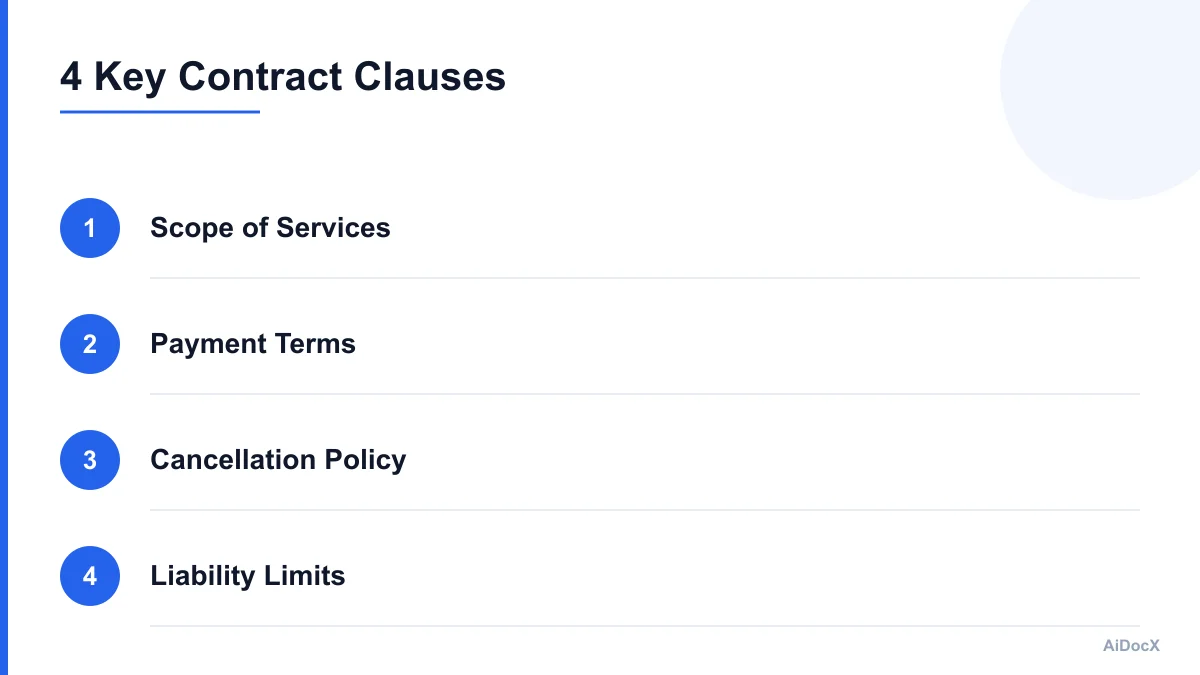
The most common reason for client disputes is scope creep. The client assumes "coaching" includes unlimited email support, social media strategy, or personal errands. You assume it’s just the weekly video call. This disconnect leads to burnout and resentment. The "Scope of Services" section must be specific, measurable, and realistic.
Avoid vague language like "ongoing support" or "general guidance." Instead, use concrete deliverables. For example, specify the number of sessions, the duration of each session, and the format (Zoom, phone, in-person). If you offer between-session support, define the channel (e.g., "two 15-minute voice notes per week via our secure portal") and the response time (e.g., "within 48 hours").
Consider including a "What Is Not Included" subsection. This is powerful for managing expectations. Clearly state that you do not provide therapy, legal advice, financial planning, or medical diagnosis. This protects you from liability and ensures clients seek the right professional help for their specific needs.
Here is a practical example of a scope definition:
- Deliverables: 6 weekly 60-minute video coaching sessions.
- Support: Access to a shared resource library and two 10-minute check-in calls per month.
- Exclusions: No tax advice, legal counsel, or psychological therapy. No unlimited email correspondence outside of scheduled sessions.
By defining the boundaries early, you signal professionalism. Clients respect clear limits because it shows you value your time and expertise. It also makes it easier to upsell later if they need additional services, as the baseline is clearly established.
3. Payment Terms and Invoicing: Getting Paid on Time
Money conversations are uncomfortable, but they are necessary. A contract should leave no room for ambiguity regarding when, how, and how much you get paid. In 2026, digital payment methods are standard, so your contract should reflect modern convenience while maintaining strict terms.
First, specify the total fee and the payment schedule. Are you charging a flat project fee, a monthly retainer, or a per-session rate? If it’s a package deal (e.g., a 12-week program), require upfront payment or a significant deposit (e.g., 50% upfront, 50% halfway). This commitment increases client accountability and reduces no-shows.
Second, define the payment methods. List accepted platforms (PayPal, Stripe, Square, bank transfer) and specify that payments are due in USD or your local currency. If you charge in a different currency, include a clause about exchange rate fluctuations.
Third, establish late fees and grace periods. A common practice is a 5% late fee after 7 days, or a 10% fee after 14 days. While you hope never to use this, it’s essential to have it in writing to enforce payment discipline. Also, specify the invoicing process. Will you send invoices automatically? Are they due Net-15 or Net-30? For coaching, "Due on Receipt" is standard for individual clients.
Finally, address refunds. Will you offer a money-back guarantee for the first session? If so, under what conditions? A clear refund policy protects your income while giving the client confidence to buy in. For example: "Refunds are available within 48 hours of the first session if the client has not yet attended any sessions. After the first session, no refunds are issued."
4. The Must-Have Clauses for 2026
Beyond scope and payment, several other clauses are critical for a modern coaching agreement. These clauses address liability, confidentiality, intellectual property, and termination.
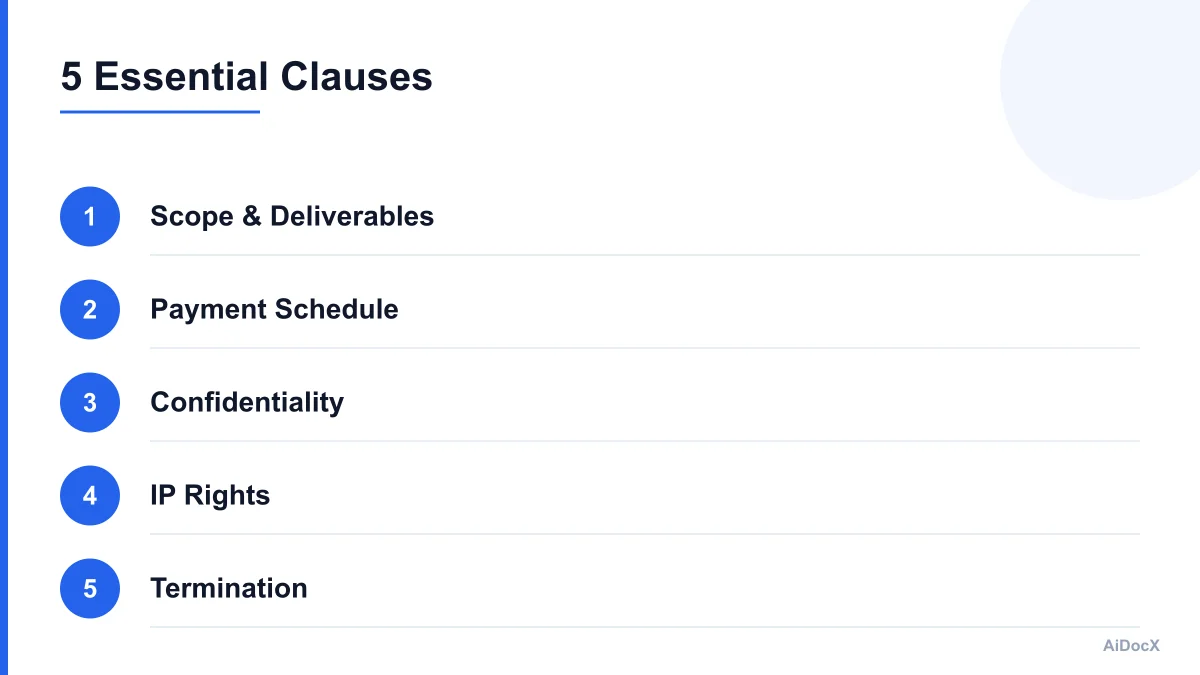
Limitation of Liability: This is your shield. It states that you are not liable for indirect, incidental, or consequential damages. In simple terms, if a client follows your advice and loses money or fails to achieve a specific result, you are not financially responsible. This does not mean you are excused from negligence, but it protects you from lawsuits based on unmet expectations.
Confidentiality (NDA): Both parties should agree to keep the engagement private. For the client, this ensures their personal challenges remain confidential. For you, it protects your proprietary methods, frameworks, and client lists. Explicitly state that neither party will disclose the terms of the agreement or the content of the sessions to third parties without written consent.
Intellectual Property (IP): If you provide workbooks, templates, or recorded sessions, clarify who owns them. Typically, you retain ownership of your materials, and the client gets a license to use them for personal use only. They cannot resell, share, or republish your materials. This protects your intellectual property from being stolen or misused.
Termination Clause: Define how either party can end the relationship. Include a notice period (e.g., 14 days’ written notice). Specify what happens to unused sessions or prepaid fees. A fair policy might be: "Either party may terminate this agreement with 14 days' written notice. Any prepaid fees for sessions not yet rendered will be refunded on a pro-rata basis." This provides an exit strategy for both sides, reducing friction if the fit isn’t right.
Independent Contractor Status: Clarify that you are an independent contractor, not an employee. This prevents misclassification issues with tax authorities and ensures you are responsible for your own taxes and benefits. It also reinforces that you control how the work is performed.
5. Choosing the Right Format: Digital vs. Paper
In 2026, paper contracts are largely obsolete for digital coaches. They are slow, expensive to print and mail, and hard to store securely. Digital agreements are faster, more secure, and easier to manage.
Digital contracts allow for e-signatures, which are legally binding in most jurisdictions, including the US (ESIGN Act), EU (eIDAS), and many other regions. They provide an audit trail with timestamps, IP addresses, and device information, which adds a layer of security and proof of consent.
When selecting a digital contract platform, look for features like:
- Customizable Templates: Start with a base template and fill in the blanks.
- E-Signature Integration: Seamless signing without leaving the platform.
- Automated Reminders: Send follow-up emails if the client hasn’t signed.
- Secure Storage: Cloud-based storage with encryption to protect sensitive data.
- Client Portal: A place for clients to view and download their signed agreement.
AiDocX drafts a coaching client agreement covering scope, payment, and cancellation, then gets it signed before the first session so expectations are clear on both sides. This ensures you never start a session without a signed contract in place, eliminating the awkward "did you send me that link?" moments.
6. Common Mistakes to Avoid
Even with a good template, coaches often make critical errors in their agreements. Avoid these pitfalls to maintain professionalism and legal safety.
Mistake 1: Using a Generic Internet Template Without Review. Not all templates are created equal. A template designed for a lawyer may not fit a life coach. Ensure the language matches your industry and jurisdiction. Always customize the scope and payment terms to fit your specific business model.
Mistake 2: Being Too Vague About Results. Avoid promising specific outcomes like "I will help you lose 10 pounds" or "I will guarantee you a promotion." Coaching is about guidance and support, not guaranteed results. Use language like "I will provide tools and strategies to help you achieve your goals." This manages expectations and reduces liability.
Mistake 3: Forgetting to Update the Agreement. If you change your pricing, add new services, or update your cancellation policy, you need a new agreement. Do not assume the old one covers the changes. Have clients sign an amendment or a new contract for any significant changes to the scope or terms.
Mistake 4: Not Requiring Signatures Before Work Begins. The biggest risk is starting work before the contract is signed. Once you deliver value, you lose leverage. Make it a non-negotiable policy: no session happens until the contract is signed and the deposit is paid.
7. Step-by-Step: How to Present the Agreement to Clients
Presenting a contract can feel awkward, but it’s a normal part of professional business. Here’s how to handle it smoothly:
- Send the Agreement Early: Include the contract in your onboarding packet. Send it 3-5 days before the first session. This gives the client time to read it and ask questions.
- Explain the "Why": In your onboarding email or call, briefly explain why you use a contract. Say something like, "I use a standard agreement to ensure we’re both clear on the scope, payment terms, and expectations. This helps me focus fully on your goals during our sessions."
- Be Open to Questions: Encourage the client to ask questions. If they have concerns about a clause, discuss it openly. If you’re flexible on a minor point, you can accommodate it, but keep major terms firm.
- Use a Professional Platform: Use a reputable e-signature service. Avoid sending PDFs that need manual signing and emailing back. A digital workflow looks more professional and is easier to manage.
- Confirm Receipt and Signature: Once signed, send a copy to the client for their records. Keep a secure copy for your files.
8. Pre-Session Checklist for Solo Coaches
Before you accept a new client, run through this checklist to ensure your business is protected and ready.
- Define Scope: Clearly write down what is included and excluded in the coaching package.
- Set Payment Terms: Determine the total fee, deposit amount, and late fee policy.
- Draft the Agreement: Use a reliable template or tool to create a professional contract.
- Include Key Clauses: Ensure liability, confidentiality, IP, and termination clauses are present.
- Choose a Digital Platform: Set up an e-signature tool for seamless signing.
- Send for Signature: Deliver the agreement to the client at least 3 days before the first session.
- Verify Payment: Confirm the deposit or full payment has been received before the first session.
- Store Securely: Save a signed copy in your secure cloud storage and send a copy to the client.
- Follow Up: Send a welcome email with session details and any pre-work after the contract is signed.
Conclusion
A coaching client agreement is not just a legal document; it’s a strategic tool that protects your time, your income, and your professional reputation. In 2026, as the coaching industry continues to grow, standing out requires more than just great coaching skills—it requires business acumen. By implementing a clear, comprehensive agreement, you set the stage for successful, long-term client relationships.
Start by reviewing your current practices. If you’re still operating on handshakes, it’s time to make the switch. Use the guidelines in this post to draft a contract that reflects your value and protects your interests. Remember, clarity is kindness. A good agreement allows you and your clients to focus on what matters most: achieving results. And if you’re looking for a streamlined way to get started, AiDocX drafts a coaching client agreement covering scope, payment, and cancellation, then gets it signed before the first session so expectations are clear on both sides. Take the first step today and secure your coaching business with confidence.
Ready to automate your documents with AI?
Start free with AiDocX — AI contract drafting, meeting minutes, consultation notes, e-signatures, and more in one platform.
Get Started FreeMore from AiDocX Blog
AI Press Release Generator: Write One in Minutes (+ Template)
Learn what a press release is, the AP-style format, and how to use an AI press release generator to draft one in minutes with a fill-in template.
James September 21, 2026 10 min
Angel Investment Agreement (2026): Key Terms + Template Guide
Angel investor agreement explained: the four structures founders actually sign, key terms, securities basics, a closing checklist and a summary term sheet.
James September 21, 2026 12 min
Artist Commission Contract Template (2026): Free Template + Guide
Free artist commission contract template with license tiers, deposit, revision, refund and AI-training clauses, plus a guide to getting it e-signed.
James September 21, 2026 12 min