The Contract Management Lifecycle: A Practical 2026 Guide
Learn how to manage contracts from drafting and negotiation through signature, obligation tracking, renewal, and secure archiving.
 James · Content Manager August 21, 2026 14 min read
The Contract Management Lifecycle: A Practical 2026 Guide
Contracts do more than record an agreement. They create obligations, deadlines, approval requirements, payment terms, and renewal decisions that affect daily operations and cash flow. This guide explains the contract management lifecycle from the first draft through negotiation, execution, monitoring, renewal, and archiving.
What the Contract Management Lifecycle Covers
The contract management lifecycle is the set of activities used to create, manage, and close an agreement. It begins when someone identifies a business need and ends when the contract expires, is terminated, renewed, or replaced.
For a small business or startup, the lifecycle usually includes these stages: intake and drafting (define the business need and prepare the agreement), review and negotiation (confirm legal, financial, operational, and commercial terms), approval and execution (obtain internal approval and collect signatures), storage and obligation tracking (keep the final contract accessible and monitor commitments), renewal, amendment, or exit (decide what happens before the term ends), and archiving (preserve the final record and supporting documents according to company policy).
These stages are connected. A weak intake process creates unclear drafts. An informal negotiation process can leave important changes undocumented. Poor storage makes signed terms difficult to find. Missed notice dates can trigger unwanted renewals or unexpected costs.
A useful lifecycle process does not need to be complicated. It needs clear ownership, consistent records, and timely reminders. A ten-person startup may manage contracts with a structured folder, a contract register, and a few standard templates. A growing company may need workflow software, approval rules, searchable clauses, and automated notifications.
The goal is not to add paperwork to every agreement. The goal is to make the right information visible at the right time.
Stage One: Drafting and Intake
The lifecycle starts when a team member needs to create or receive a contract. This might be a customer agreement, vendor contract, employment document, partnership agreement, lease, data-processing agreement, or statement of work.
Before drafting, capture the basic facts: who are the parties, what is each party expected to provide, what is the commercial value, when should performance begin, how long should the agreement last, who owns the relationship internally, does the agreement require legal, finance, security, or executive review, and are there existing templates or previous agreements to use.
This information can be recorded in a short contract request form. Requiring these details early prevents repeated clarification later and helps the reviewer understand the context behind the document.
Use the right starting document
Avoid drafting every agreement from a blank page. Start with an approved template when one exists, but make sure the template matches the type of transaction.
For example, a customer master services agreement should not be used as a vendor purchasing agreement. A one-time consulting engagement may need a statement of work rather than a full master agreement. A data-processing agreement may need specific privacy and security language. A renewal may need an amendment instead of a new contract.
Templates should include standard positions on payment, confidentiality, intellectual property, liability, termination, governing law, and dispute resolution where appropriate. They should also contain clear placeholders for variable information such as party names, fees, dates, deliverables, and notice addresses.
A template is a starting point, not a substitute for judgment. If the deal is unusually large, regulated, international, high-risk, or strategically important, involve qualified legal counsel.
Establish a contract request record
The request record should stay connected to the contract throughout its lifecycle. At minimum, capture requester and department, counterparty name and contact, contract type, estimated value and currency, start and end dates, renewal terms, payment schedule, key deliverables, required approvers, risk or exception notes, and current status.
This record gives operations and finance a shared view of what is in progress. It also makes reporting easier. For example, a founder can see which customer contracts are waiting for signature, while finance can identify vendor agreements approaching renewal.
Common drafting mistakes include using an outdated template, leaving placeholders in the final copy, failing to define deliverables, and allowing different versions to circulate by email. A simple naming convention and one controlled working location can prevent many of these problems.
Stage Two: Review and Negotiation
Review determines whether the draft accurately reflects the intended deal and whether the company can accept its risks. Negotiation then turns the draft into terms both parties can accept.
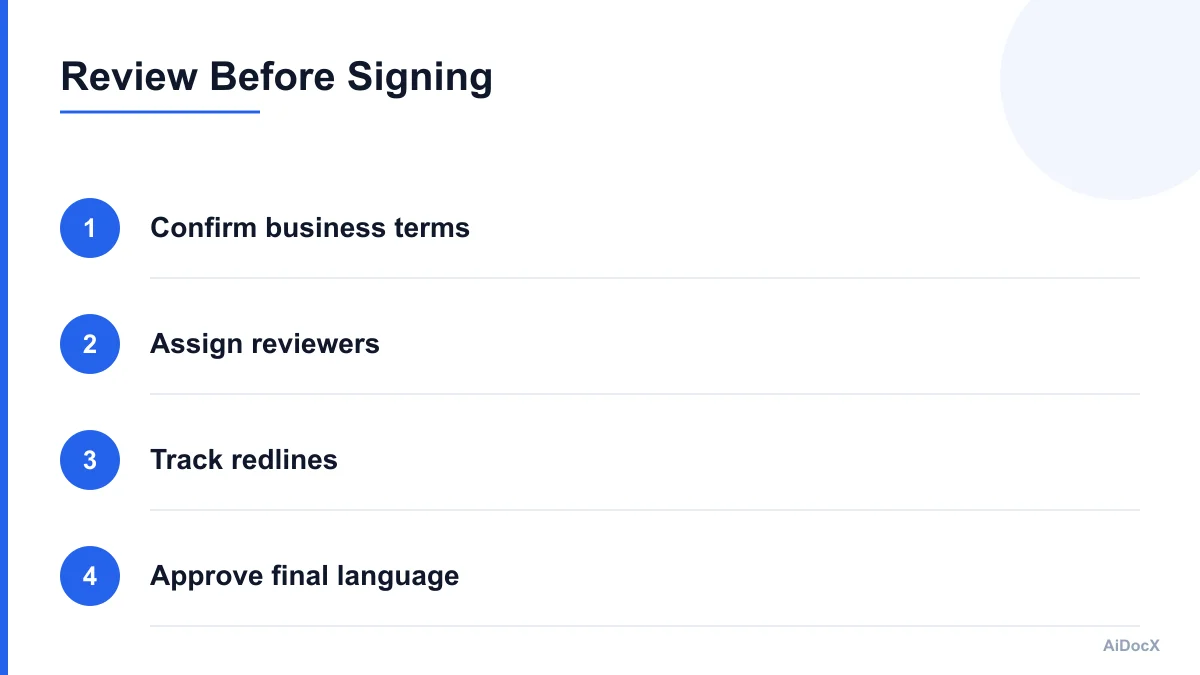
Different reviewers should focus on different questions. The business owner asks whether the agreement matches what was promised. Finance asks whether pricing, billing, taxes, credits, expenses, and payment terms are clear. Operations asks whether the team can meet the required service levels and deadlines. Security or privacy asks whether data handling and access requirements are workable. Legal asks whether the rights, obligations, risks, and remedies are acceptable.
Not every contract needs every reviewer. The important point is to define review thresholds in advance. For example, a standard low-value vendor contract may need department and finance approval, while a data-sharing agreement may require security review regardless of price.
Separate business review from legal review
Business review asks whether the contract works in practice. Legal review asks whether the language creates unacceptable exposure or ambiguity. These are related but different activities.
A business reviewer should verify scope and deliverables, pricing and discount structure, implementation dates, service levels, acceptance criteria, support responsibilities, reporting requirements, and customer or vendor commitments.
A legal reviewer may focus on limitation of liability, indemnification, confidentiality, intellectual property ownership, termination rights, warranties, insurance, governing law, dispute resolution, and compliance obligations.
Make comments specific. "This clause is too broad" is less useful than "The indemnity should be limited to third-party claims arising from our breach, negligence, or intentional misconduct."
Manage redlines as a controlled process
Negotiations often involve several versions. Without version control, people may approve one document while the counterparty signs another.
Use a consistent process: assign a clear file name and version number, keep the original draft unchanged, record who made each material change, summarize important changes in plain language, confirm that all commercial changes are reflected in the latest draft, remove comments and tracked changes only after the language is final, compare the clean version against the last approved redline, and store the final draft separately from working versions.
A negotiation log can be simple. For each open issue, record the clause, current position, owner, next action, and agreed resolution. This prevents the same issue from being debated repeatedly and gives a new team member enough context to take over.
Focus on material terms
Do not spend equal time on every sentence. Prioritize terms that affect money, control, risk, or operational workload.
For a software vendor contract, material terms might include annual subscription price and automatic increases, minimum commitment, renewal notice period, service-level credits, data export rights, security obligations, liability cap, termination assistance, and user and usage limits.
For a customer contract, focus on scope and acceptance, invoicing milestones, late payment consequences, change requests, intellectual property, support obligations, customer dependencies, termination fees, and renewal pricing.
AiDocX can help teams manage the contract record from drafting through e-signature and renewal tracking, while the people responsible for the deal still make the business and legal decisions.
Stage Three: Approval and Execution
Once the language is settled, the agreement moves from negotiation to approval and signature. This stage is often treated as administrative, but it is where many preventable errors occur.
Before routing a contract for signature, complete a final execution check: are the legal names of all parties correct, are the signatories authorized to bind their organizations, are all exhibits, schedules, order forms, and attachments included, are the effective date and term correct, do the fees match the approved commercial terms, have tracked changes and internal comments been removed, are signature blocks complete, does the signature method meet the company's requirements, and is the final file clearly labeled as the execution version.
A contract may be legally signed but operationally incomplete if an attachment is missing or an order form does not match the master agreement. Check the full document package, not just the main agreement.
Define approval authority
A small business should document who can approve different contracts. The policy might consider total contract value, length of commitment, budget owner, non-standard payment terms, data access, intellectual property transfer, liability exposure, automatic renewal, exclusivity, and geographic scope.
For example, a department lead may approve a standard monthly software subscription below a certain threshold. Finance may need to approve unusual payment schedules. An executive may need to approve a multi-year commitment, major customer discount, or uncapped liability.
The approval record should show the approver, date, decision, and any conditions. Approval in a chat message may be acceptable for a very small team, but it should still be linked to the contract record and retained with the final documentation.
Make signature completion visible
Signature tracking should answer three questions immediately: who has signed, who is still outstanding, and what happens if the signature is delayed.
Set a reasonable follow-up schedule, especially for customer contracts that affect revenue recognition or vendor agreements that affect service continuity. Confirm that the signed copy is returned to the central contract repository rather than left only in an individual inbox.
Electronic signatures reduce turnaround time and improve auditability, but they do not eliminate the need for an accurate final document. The signature platform should receive only the approved execution version.
Stage Four: Storage and Obligation Tracking
A signed contract has no operational value if the people who need it cannot find or understand it. Storage should make the authoritative version easy to identify while preserving relevant history.
Create a single source of truth
Use a central repository for executed contracts. Organize records using consistent metadata such as contract type, counterparty, department, owner, effective date, expiration date, renewal date, notice deadline, contract value, currency, status, risk category, and related customer or vendor record.
A folder structure alone is often insufficient because one contract may need to be found by counterparty, owner, renewal date, or contract type. Searchable metadata is more useful than deeply nested folders.
Use a naming format that stays readable: Counterparty - Contract Type - Effective Date - Status. For example: Northstar Labs - MSA - 2026-04-01 - Executed.
Avoid names such as final_final_v3.pdf. They do not communicate whether the document is signed, approved, or current.
Track obligations, not just dates
A contract register that records only start and end dates is incomplete. Track the commitments that can cause missed revenue, service failures, penalties, or disputes.
Examples include customer billing milestones, vendor payment dates, minimum purchase commitments, service-level reporting, insurance certificate renewals, data deletion deadlines, product delivery milestones, review meetings, price increase dates, audit rights, notice deadlines, and required certifications.
Assign an owner to each material obligation. "Operations" is not a sufficient owner; use a person or a clearly defined role. Include the action, due date, source clause, and escalation path.
For example:
| Obligation | Owner | Due date | Evidence |
|---|---|---|---|
| Submit quarterly usage report | Finance lead | July 10 | Approved report |
| Renew insurance certificate | Operations manager | August 1 | Certificate PDF |
| Provide data export at termination | Technical lead | Contract end | Export confirmation |
Review obligations on a regular cadence. Monthly reviews may be appropriate for a growing company with many active contracts. A quarterly review may be sufficient for a smaller portfolio, provided critical deadlines have earlier reminders.
Stage Five: Monitor Performance and Changes
Contract management continues after signature. Teams must confirm that the agreement is being performed as expected and that changes are documented.
Create a lightweight contract performance review for important agreements. Ask whether deliverables are arriving on time, whether invoices are consistent with the agreed rates, whether service levels are being met, whether credits or refunds are due, whether scope has expanded without a signed change, whether stakeholders are using the current process, whether new security, privacy, or regulatory requirements have emerged, and whether the relationship is still commercially valuable.
A contract may remain technically active while the business arrangement changes substantially. If a customer adds a new product, a vendor changes its pricing, or a service scope expands, document the change through an amendment, change order, or replacement agreement.
Do not rely on operational behavior to update the contract automatically. If the team starts doing something different from the written agreement, record the decision and assess whether the document needs to change.
Connect contracts to finance
Finance teams need contract information to forecast revenue, expenses, cash flow, and liabilities. Useful connections include contract value and billing schedule, payment terms, renewal increases, prepaid amounts, usage-based charges, minimum commitments, credits and rebates, termination fees, and foreign currency exposure.
A contract register should not replace the accounting system, but the two should agree on key dates and amounts. Differences between the signed contract and the finance record can cause missed invoices, incorrect accruals, or unplanned spend.
Stage Six: Renewal, Amendment, or Exit
The end of the initial term is a decision point, not an automatic administrative event. Start the review well before the notice deadline.
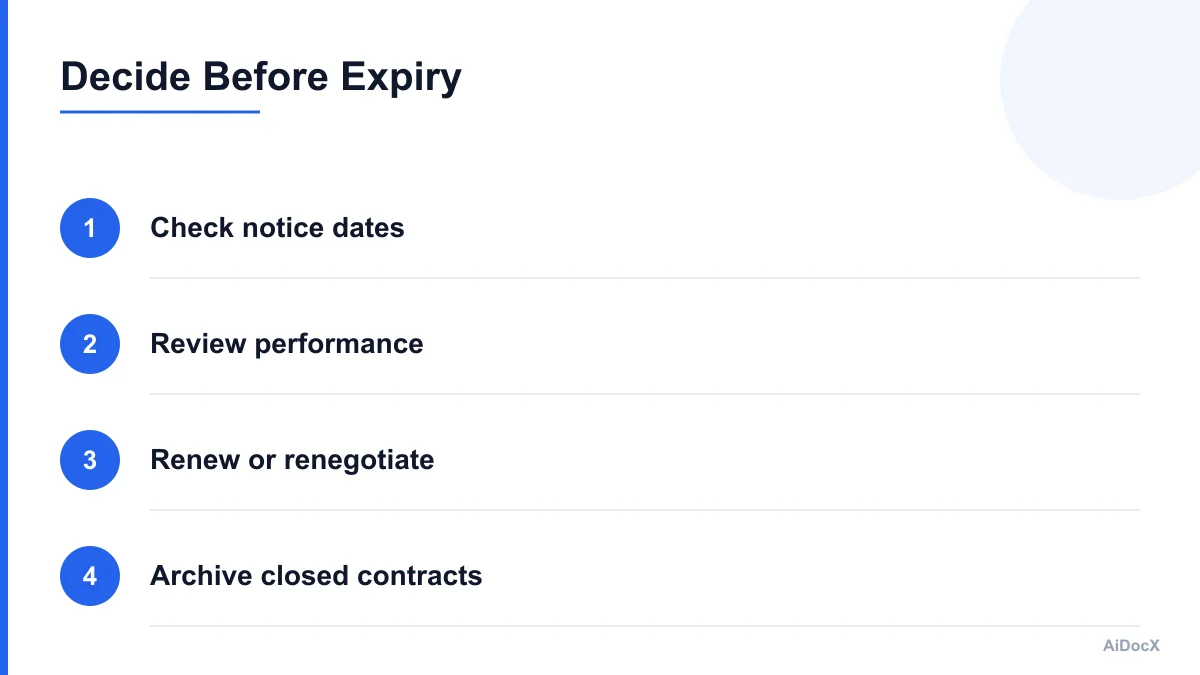
A practical timeline might include: 120 days before expiry, confirm contract owner and business need; 90 days before expiry, review performance, usage, pricing, and alternatives; 60 days before expiry, decide whether to renew, renegotiate, replace, or exit; 30 days before the notice deadline, send required notice or begin signature workflow; and after the decision, update the contract record and notify finance and operations.
The correct timeline depends on the agreement. Some contracts require notice 30 days before renewal; others require 60, 90, or 180 days. Always use the contract's actual notice provision rather than a standard assumption.
Evaluate renewal value
Before renewing, review more than the headline price: was the service used enough to justify the cost, did the counterparty meet its obligations, were there recurring support or quality problems, has the team's need changed, is the current scope still accurate, are competitors offering better terms, will the price increase affect the budget, does the renewal create a new minimum commitment, and is data export or migration feasible if the agreement ends.
For customer contracts, review profitability, payment history, support effort, expansion potential, and strategic value. For vendor contracts, review total cost, adoption, security posture, switching costs, and operational dependency.
Handle amendments carefully
An amendment should identify the original agreement and clearly state which provisions change. It should not silently rewrite unrelated terms.
Check that the amendment includes the original contract title and date, the parties, specific sections being changed, new language, the effective date of the change, confirmation that all other terms remain unchanged, and required signatures.
After signing, store the amendment with the original agreement and update the contract summary. If the amendment changes price, term, scope, or notice dates, update the finance and obligation records as well.
Close and archive responsibly
If a contract ends, confirm that closure is complete: final invoices are paid or disputed, deliverables are accepted, equipment or credentials are returned, data retention and deletion steps are completed, access is removed, open claims are documented, required termination notices are saved, and the final status is marked as expired or terminated.
Archiving does not mean deleting. Preserve the executed agreement, amendments, notices, approval record, and relevant completion evidence according to your retention policy. Restrict access to sensitive documents while keeping them available for audits, disputes, tax reviews, or future reference.
Common Contract Management Mistakes
Small teams often encounter the same avoidable problems.
Keeping contracts in personal inboxes
Email is useful for negotiation, but it is a poor long-term repository. When an employee leaves, important agreements and renewal dates may disappear with their mailbox.
Tracking only expiration dates
The most important deadline may be the notice date, price increase date, milestone, or insurance renewal date. Record all material dates separately.
Treating every contract the same
A standard low-value tool subscription does not need the same workflow as a strategic partnership or data-sharing agreement. Use risk and value thresholds to allocate review effort.
Losing the negotiated context
A clean PDF may not explain why a term was accepted or which concessions were made. Preserve a concise negotiation summary for material contracts.
Failing to define ownership
A contract without an accountable owner becomes everyone's responsibility and no one's priority. Assign one owner and a backup.
Signing before the scope is complete
A vague scope creates disputes even when the legal language is strong. Define deliverables, acceptance, dependencies, and change procedures before signature.
Allowing silent renewals to surprise the business
Automatic renewal clauses are not inherently bad, but they require advance visibility. Put notice deadlines on a shared calendar or contract workflow.
Treating amendments as informal
A pricing change agreed in a call or email may not be enough to alter a signed agreement. Use the amendment or change-order process required by the contract.
A Practical Contract Lifecycle Checklist
Use this checklist as a starting point and adapt it to your risk profile:
- Record the business need and contract owner
- Select the correct approved template
- Confirm parties, scope, value, and key dates
- Identify required legal, finance, security, and executive reviews
- Track negotiation versions and open issues
- Confirm all commercial terms before final approval
- Verify signatory authority
- Check exhibits, schedules, and attachments
- Send only the approved execution version for signature
- Save the completed signed copy centrally
- Record effective date, expiration date, and notice deadline
- Assign owners to material obligations
- Link billing and payment terms to finance records
- Review performance before renewal
- Document amendments and change orders
- Complete closure steps for expired or terminated contracts
- Archive the final record according to retention policy
The best contract management process is one people can follow consistently. Start with a central repository, a contract register, standard templates, clear approval thresholds, and reminders for material deadlines. As the business grows, add more automation where it removes repetitive work without obscuring accountability.
AiDocX helps teams manage contracts end-to-end, from drafting and review to e-signature and renewal tracking. Whether you use a dedicated platform or a carefully designed internal process, treating contracts as a lifecycle gives your operations and finance teams better visibility, fewer surprises, and more control over the agreements that run the business.
Ready to automate your documents with AI?
Start free with AiDocX — AI contract drafting, meeting minutes, consultation notes, e-signatures, and more in one platform.
Get Started FreeMore from AiDocX Blog
How to Read a Business Contract: A Founder's Checklist (2026)
A practical way to review parties, scope, money, IP, liability, and exit terms before signing a business contract.
 MinjiLee October 7, 2026 9 min
ESIGN vs eIDAS: What Founders Should Know About E-Signatures (2026)
What U.S. ESIGN and EU eIDAS actually say, where exceptions apply, and what founders should keep to document an electronic signing.
MinjiLee October 7, 2026 7 min
Does Document Automation Pay Off? An ROI Worksheet for Founders (2026)
Estimate document automation ROI with your own volume, time, labor, and software costs. Includes a clearly labeled example and break-even formula.
 Chloe October 7, 2026 8 min