Contract Risk Management with AI: A Practical Framework for 2026
Learn how AI-powered contract risk management helps businesses identify hidden risks, reduce legal exposure, and streamline compliance. A practical framework for modern organizations.
 MinjiLee · Strategic Lead January 20, 2026 9 min read
Every contract your business signs carries risk. Some risks are obvious — a missed payment deadline, an unfavorable termination clause. Others lurk beneath layers of legal jargon, invisible until they trigger a costly dispute or regulatory penalty. According to the International Association for Contract and Commercial Management (IACCM), poor contract management costs organizations an average of 9% of their annual revenue. For a company generating $10 million, that translates to $900,000 in preventable losses every year.
Traditional contract risk management relies on manual review by legal teams who are often stretched thin, leading to inconsistent analysis, missed red flags, and slow turnaround times. Artificial intelligence is changing this equation fundamentally. AI-powered contract analysis can process agreements in minutes rather than days, identify risk patterns across thousands of documents simultaneously, and flag problematic clauses that even experienced attorneys might overlook during a hurried review.
This guide presents a practical framework for implementing AI-powered contract risk management in your organization, regardless of your company size or legal budget.
Understanding the Four Categories of Contract Risk
Before building a risk management framework, you need to understand what you are managing. Contract risks generally fall into four distinct categories, each requiring different mitigation strategies.
Financial Risk
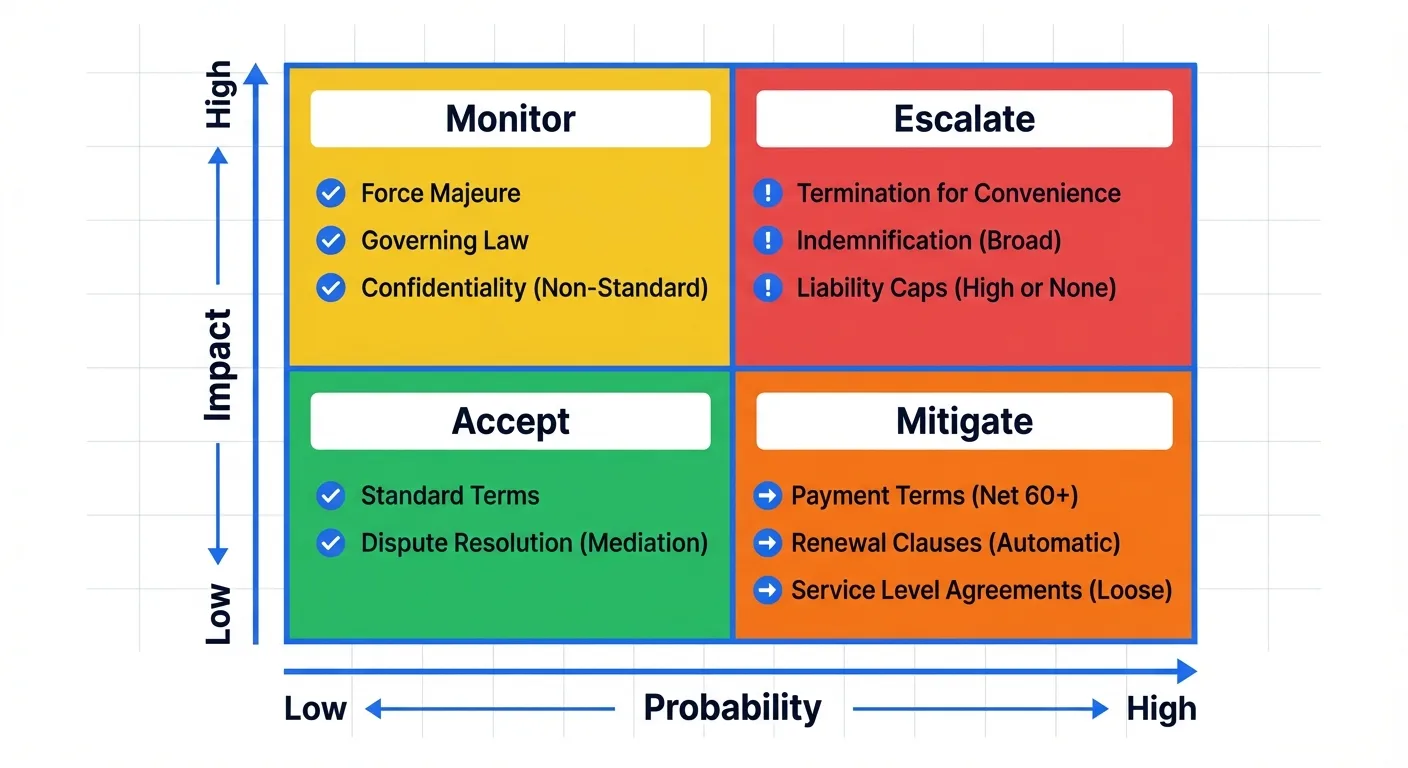
Financial risk is the most immediately quantifiable category. It includes payment terms that strain cash flow, penalty clauses that create disproportionate liability, automatic renewal provisions that lock you into unfavorable pricing, and indemnification clauses that expose you to unlimited financial liability.
A common example: a vendor contract that includes a price escalation clause tied to an ambiguous index. The vendor interprets the clause broadly, your finance team interprets it narrowly, and you end up in a dispute that costs more to resolve than the price difference itself.
Compliance Risk
Regulatory compliance risk has expanded dramatically over the past decade. Contracts must now account for data privacy regulations like GDPR and CCPA, industry-specific requirements such as HIPAA in healthcare or SOX in finance, anti-corruption laws like the FCPA and UK Bribery Act, and environmental and sustainability mandates that vary by jurisdiction.
A single non-compliant clause in a data processing agreement can result in fines of up to 4% of annual global turnover under GDPR. The challenge is that compliance requirements change frequently, and what was acceptable language two years ago may now create significant exposure.
Operational Risk
Operational risks arise from contract terms that affect your ability to deliver products or services effectively. These include overly ambitious service level agreements (SLAs), ambiguous scope definitions that invite scope creep, force majeure clauses that are too narrow to cover realistic disruption scenarios, and intellectual property provisions that inadvertently transfer ownership of your core assets.
Operational risks are particularly insidious because they often do not manifest until a crisis occurs. A force majeure clause that excludes pandemics seemed like a minor oversight in 2019. By 2020, it was the most expensive sentence in thousands of commercial contracts.
Reputational Risk
Reputational risk is the hardest to quantify but can be the most damaging. Contracts that include non-compete clauses preventing employees from earning a living, terms that enable exploitative labor practices in supply chains, or environmental commitments that your operations cannot actually fulfill all create reputational exposure. In an era of social media and instant public scrutiny, a single problematic contract provision can become a viral controversy overnight.
Traditional vs. AI-Powered Risk Management
Understanding the limitations of traditional approaches highlights why AI is not just an improvement but a necessary evolution.
The Traditional Approach
In a traditional contract risk management workflow, a contract arrives for review and enters a queue. A legal professional (in-house counsel, outside attorney, or paralegal) reads the document from beginning to end, comparing its terms against company standards and known risk factors. They annotate concerns, draft redline suggestions, and send the contract back for negotiation.
This approach has served businesses for decades, but it suffers from fundamental limitations. Human reviewers process language linearly, making it difficult to catch inconsistencies between clauses that appear dozens of pages apart. Fatigue and cognitive bias lead to inconsistent results — the same reviewer may flag a risk on Monday morning that they miss on Friday afternoon. Review speed is constrained by reading speed, meaning complex agreements can take days or weeks to process. And institutional knowledge walks out the door when experienced legal professionals leave the organization.
For small businesses and startups, the situation is worse. Hiring an attorney for contract review costs $300 to $500 per hour or more. Many businesses simply cannot afford to have every contract professionally reviewed, so they sign agreements with unexamined risks.
The AI-Powered Approach
AI contract analysis fundamentally changes the risk management equation across several dimensions. Modern AI systems powered by large language models can analyze a contract in minutes rather than hours or days. They evaluate every clause against a comprehensive risk framework simultaneously, not linearly. They apply the same rigorous standards to every contract, every time, without fatigue or bias. And they improve continuously as they process more documents and receive feedback.
Critically, AI does not replace legal expertise — it augments it. AI handles the exhaustive first-pass analysis, identifying and categorizing risks so that human reviewers can focus their expertise on the genuinely complex judgment calls. This hybrid approach delivers better outcomes than either AI or human review alone.
Building Your AI-Powered Risk Management Framework
Implementing effective contract risk management requires more than just purchasing a tool. Here is a step-by-step framework for building a robust system.
Step 1: Establish Your Risk Taxonomy
Before any technology can help you manage risk, you need to define what risks matter to your organization. Create a risk taxonomy that categorizes risks by type (financial, compliance, operational, reputational), severity (critical, high, medium, low), and likelihood of occurrence.
Your taxonomy should reflect your specific industry and business model. A SaaS company will prioritize data processing and intellectual property risks. A manufacturing firm will focus on supply chain and environmental compliance. A financial services company will emphasize regulatory and fiduciary risks.
Step 2: Define Your Standard Terms and Acceptable Boundaries
For each risk category, establish clear guidelines about what terms are acceptable, what requires negotiation, and what is a deal-breaker. Document these standards in a playbook that both AI tools and human reviewers can reference.
For example, your indemnification standard might specify that mutual indemnification is acceptable, one-way indemnification favoring the other party requires VP-level approval, and unlimited indemnification is never acceptable regardless of deal size.
Step 3: Implement AI-Powered Analysis
Deploy AI contract analysis tools that can automatically scan incoming agreements and flag deviations from your standards. The best AI platforms go beyond simple keyword matching — they understand the semantic meaning of clauses and can identify risks even when expressed in unusual or convoluted language.
AiDocX, for example, uses advanced AI-powered AI analysis to evaluate contracts against multiple risk dimensions simultaneously. When you upload a contract, the AI identifies potentially problematic clauses, explains why each flagged provision creates risk, and suggests alternative language. This analysis happens in minutes and costs a fraction of what manual legal review would require, with plans starting at just $6 per month for the Basic tier and AI analysis features available even on the free plan.
Step 4: Create an Escalation Workflow
Not every flagged risk requires the same response. Build a tiered escalation workflow. Low-severity risks can be noted and accepted by the contract owner. Medium-severity risks should be reviewed by a designated approver with negotiation authority. High and critical risks must be escalated to legal counsel or senior leadership.
AI risk scoring helps you prioritize. Instead of treating every contract as equally urgent, your team can focus attention where it matters most.
Step 5: Track, Measure, and Improve
Risk management is not a one-time implementation. Track metrics like the number of risks identified per contract, the percentage of flagged risks that lead to contract modifications, the time from contract receipt to fully executed agreement, and the financial impact of risks that were caught versus those that were missed.
Use these metrics to refine your risk taxonomy, update your standard terms, and improve your AI model's accuracy over time.
How AI Identifies Hidden Risks Humans Miss
The most valuable capability of AI contract analysis is its ability to detect risks that are genuinely difficult for human reviewers to catch. Here are the patterns where AI consistently outperforms manual review.
Cross-Reference Inconsistencies
Contracts often contain clauses that reference or depend on other clauses. A limitation of liability in Section 12 might be undermined by an indemnification obligation in Section 18. Human reviewers reading linearly may not connect these provisions, especially in lengthy agreements. AI evaluates all clauses simultaneously and flags contradictions or inconsistencies that create ambiguous obligations.
Omission Detection
What a contract does not say can be as dangerous as what it does say. AI systems trained on large corpora of commercial agreements can identify when standard protective provisions are missing. If a software license agreement lacks a data breach notification requirement, or a services agreement omits a limitation of consequential damages, AI flags the absence as a risk.
Unusual Language Patterns
Experienced drafters sometimes use non-standard language to obscure unfavorable terms. A clause that says "Vendor shall use commercially reasonable efforts to maintain uptime" sounds protective, but "commercially reasonable efforts" is a significantly lower standard than "best efforts" and creates minimal accountability. AI recognizes these linguistic subtleties and translates them into plain-language risk assessments.
Regulatory Alignment
Keeping track of evolving regulations across multiple jurisdictions is a monumental task. AI systems that are regularly updated can check contract language against current regulatory requirements and flag provisions that may have been compliant when drafted but are now problematic under new rules.
Aggregate Risk Patterns
Perhaps the most powerful AI capability is the ability to analyze risk across your entire contract portfolio. Rather than evaluating each contract in isolation, AI can identify systemic risks — for example, discovering that 40% of your vendor agreements contain auto-renewal clauses with 90-day notice requirements, creating a concentrated risk of involuntary commitment.
Practical Implementation: Getting Started Today
You do not need a massive budget or a large legal team to start managing contract risk with AI. Here is a practical path to implementation.
Week 1-2: Audit your current state. Gather your existing contracts into a central repository. Identify which agreements are most critical to your business and which are approaching renewal. This baseline assessment tells you where to focus first.
Week 3-4: Select and deploy your AI platform. Choose a contract analysis platform that fits your scale and budget. AiDocX offers a compelling entry point because it combines AI contract analysis with document tracking and e-signatures in a single platform — eliminating the need to stitch together multiple tools. The free tier lets you start analyzing contracts immediately at no cost, and the Basic plan at $6 per month provides expanded AI analysis capabilities that would cost hundreds of dollars per contract through traditional legal review.
Month 2: Analyze your highest-risk contracts. Run your most critical agreements through AI analysis. Focus on contracts with the largest financial exposure, those approaching renewal, and any agreements with counterparties that have a history of disputes. Use the AI findings to create your initial risk taxonomy and standard terms playbook.
Month 3 and beyond: Systematize and scale. Establish a process where every new contract goes through AI analysis before signature. Build your escalation workflows. Begin tracking risk metrics and refining your framework based on real data.
The Cost of Inaction
Every month you operate without systematic contract risk management, you accumulate hidden exposure. The IACCM estimates that the average large enterprise has 20,000 to 40,000 active contracts at any given time, with as many as 10% containing terms that deviate significantly from organizational standards.
For small and mid-sized businesses, the numbers are smaller but the impact proportionally larger. A single problematic clause in a single contract can threaten the viability of the entire business. A personal guarantee buried in a vendor agreement, an intellectual property assignment clause in a consulting contract, or a non-compete that prevents you from pivoting your business model — any of these can be catastrophic.
AI-powered contract risk management is no longer an enterprise luxury. With platforms like AiDocX making AI analysis accessible at price points that any business can afford, there is no longer a valid reason to leave your contracts unexamined. The framework outlined in this guide gives you a clear path from unmanaged risk to systematic protection.
The contracts you sign today define the risks you carry tomorrow. Start managing them intelligently.
Ready to automate your documents with AI?
Start free with AiDocX — AI contract drafting, meeting minutes, consultation notes, e-signatures, and more in one platform.
Get Started FreeMore from AiDocX Blog
Consulting Proposal Template (2026): 9 Sections + Example
Copy a consulting proposal template with nine sections, pricing options, and a filled example. Includes tips to make the proposal easy to approve.
 AiDocX Team October 24, 2026 11 min
Internship Agreement Template (2026): Paid & Unpaid Interns
Copy an internship agreement template for paid or unpaid interns. Covers U.S. and UK pay rules, duties, IP, confidentiality, and a filled example.
AiDocX Team October 24, 2026 12 min
Meeting Minutes Template (2026): 4 Formats + Filled Example
Copy a meeting minutes template in four formats: team, decision log, board, and client call. See a filled example and a 15-minute workflow.
AiDocX Team October 24, 2026 11 min