Daycare Service Agreement Template 2026: Protect Your Home Business
Secure your home daycare with a professional service agreement. Cover hours, fees, and late pickup policies clearly to avoid disputes and ensure smooth operations in 2026.
 James · Content Manager August 9, 2026 12 min read
Daycare Service Agreement Template 2026: Protect Your Home Business
Operating a home daycare is less about watching children and more about running a small business that happens to care for children. Without a formal contract, you are operating on a handshake, which is a risky foundation for any business relationship. A daycare service agreement serves as the legal and operational backbone of your provider-parent relationship, setting clear boundaries before the first day begins.
In 2026, parents expect transparency, professionalism, and clarity. They want to know exactly what they are paying for, when services start and stop, and what happens if emergencies arise. This post outlines the essential components of a robust daycare service agreement and provides a practical framework for home daycare providers to protect their livelihoods while maintaining warm, trusting relationships with families.
Why Every Home Daycare Needs a Written Contract
Many home daycare providers hesitate to use formal contracts. You might worry that a legal document feels cold, impersonal, or overly litigious for a setting centered on love and care. However, ambiguity is the enemy of trust. When expectations are verbal, they are subject to memory lapses, changing circumstances, and misunderstandings. A written agreement removes guesswork and establishes a professional standard from day one.
Clarifying Expectations Reduces Conflict
The most common disputes in childcare arise not from malice, but from miscommunication. A parent might assume "half-day" means 9 AM to 12 PM, while the provider expects 9 AM to 1 PM. Another parent might believe that occasional late pickups will be handled with a simple "no problem," while the provider needs to adjust staffing or cover overtime costs. A service agreement codifies these details, ensuring both parties are on the same page.
Legal Protection and Liability
While a contract does not shield you from negligence, it does protect you from contractual breaches. If a parent stops paying fees without notice, if they repeatedly violate health protocols, or if they withdraw their child without the required notice period, the agreement provides the basis for holding them accountable. It also helps define the scope of your liability regarding minor injuries or illnesses, provided you adhere to local licensing laws.
Professionalism Builds Trust
Parents are choosing between you and other providers, including centers and other home daycares. Presenting a well-structured, professional agreement signals that you take your role seriously. It demonstrates that you are organized, prepared, and committed to running a stable environment. This professionalism often reassures parents that their child is in capable, structured hands.
The Non-Negotiable Clauses in a Daycare Agreement
A comprehensive daycare service agreement must cover specific operational details. These clauses form the core of your business relationship and should be tailored to your specific license and local regulations. Below are the essential sections every home daycare contract should include.
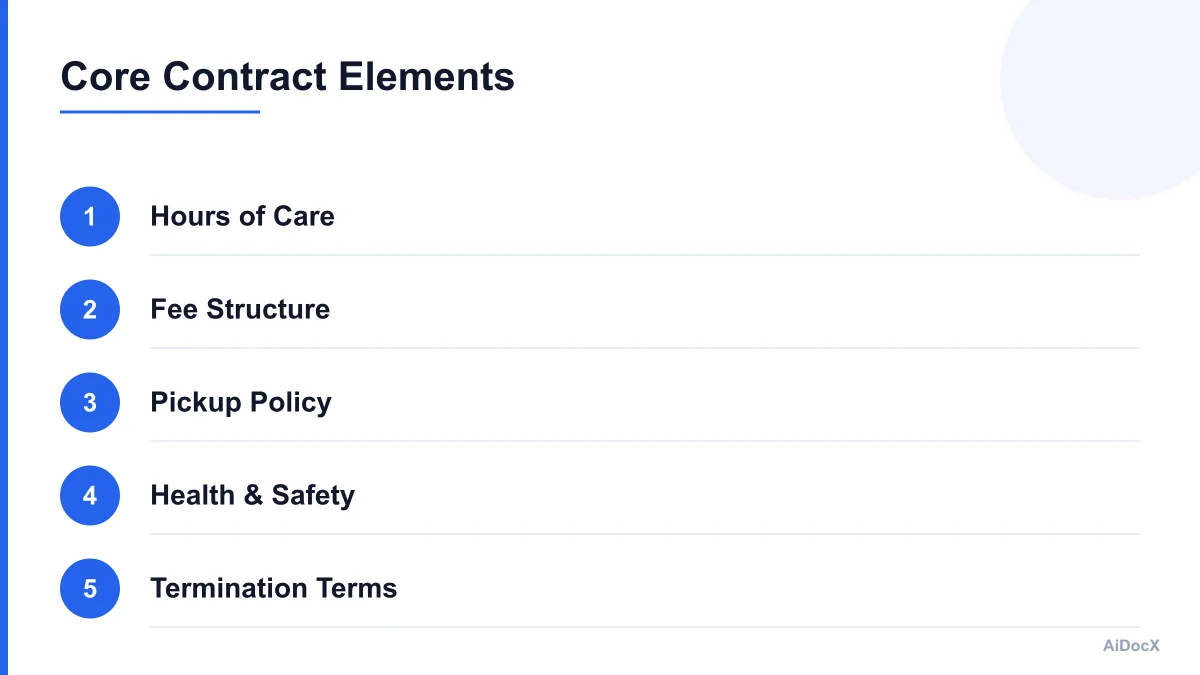
Hours of Care and Schedule
Clearly define the operational hours. Do you offer full-time care (e.g., 7 AM to 6 PM) or part-time options (e.g., Mondays and Wednesdays only)? Specify the start and end times, and clarify whether early drop-off or late pick-up is accommodated, and under what conditions. If you have fixed closing times (e.g., for staff breaks or administrative tasks), state those explicitly.
Fee Structure and Payment Terms
This section must be detailed to avoid billing disputes. Include:
- Tuition Rates: Specify the cost for full-time, half-time, or weekly/monthly billing.
- Payment Schedule: When is payment due? (e.g., the 1st of the month, weekly in advance).
- Accepted Methods: Check, bank transfer, credit card, or cash.
- Late Payment Fees: Is there a grace period? Are late fees applied after a certain date?
- Tax Information: Clarify if tuition includes sales tax or if it is tax-exempt in your jurisdiction.
Late Pickup Policy
This is one of the most critical clauses. Late pickups disrupt your schedule, affect other children, and may incur additional staffing costs. Define what constitutes "late" (e.g., more than 15 minutes past closing time). State the fee structure clearly (e.g., $20 for the first 15 minutes, $10 for each additional 15 minutes). Ensure this aligns with local licensing regulations, which may cap or specify late fees.
Sick Child Policy
Define when a child should not attend daycare. List specific symptoms that require a child to stay home (fever over 100.4°F, vomiting, diarrhea, contagious rashes, etc.). State how long the child must be symptom-free before returning. Also, outline your policy on notifying parents if a child becomes ill during care hours, including your protocol for isolation and contacting the emergency contact.
Termination and Notice Period
How much notice is required to terminate the agreement? Standard practice is two to four weeks’ notice. This gives you time to adjust your enrollment and ensures the family has time to find alternative care. Specify that the notice period applies to both the provider and the parent. Clarify that tuition is still due during the notice period unless otherwise agreed.
Health and Safety Protocols
Outline your safety procedures, including medication administration, allergy management, and emergency evacuation plans. Require parents to disclose all known medical conditions, allergies, and current medications. State that you are not a medical professional and that in case of emergency, you will contact 911 and the designated emergency contacts. Include a clause requiring parents to keep information up to date.
Common Mistakes to Avoid in Your Contract
Even with the best intentions, home daycare providers often make errors in their service agreements that can lead to confusion or legal vulnerability. Avoid these common pitfalls to ensure your contract is effective and enforceable.
Vague Language
Avoid using ambiguous terms like "reasonable notice" or "fair price." Instead, use specific numbers and dates. For example, instead of "please give notice if you can," write "Parents must provide at least 14 calendar days' written notice before terminating care." Specificity prevents arguments about interpretation later.
Ignoring Local Licensing Regulations
Your daycare service agreement must comply with state or local licensing requirements. Some jurisdictions have specific rules about what can and cannot be included in a contract. For example, some states prohibit certain types of late fees or require specific health disclosure forms. Always review your contract against your licensing handbook or consult with a legal professional familiar with childcare laws in your area.
Overpromising Services
Do not include services in your contract that you cannot consistently deliver. If you promise "daily nap time" but your schedule is unpredictable, or if you promise "organic meals" but you occasionally serve standard snacks, you risk breaching the agreement. Stick to what you can reliably provide. It is better to underpromise and overdeliver than to set expectations you cannot meet.
Failing to Update the Agreement
Your business may change over time. You might expand your hours, introduce a new fee structure, or adopt new health protocols. If you do not update the service agreement, the old terms may still apply, leading to confusion. Include a clause that allows you to update the agreement with proper notice (e.g., 30 days) and require parents to acknowledge the changes.
How to Present the Agreement to Parents
The way you present the service agreement is just as important as its content. A rushed or awkward presentation can make parents feel defensive or uncomfortable. Treat the signing process as part of the enrollment experience, not an administrative hurdle.
Introduce It Early in the Conversation
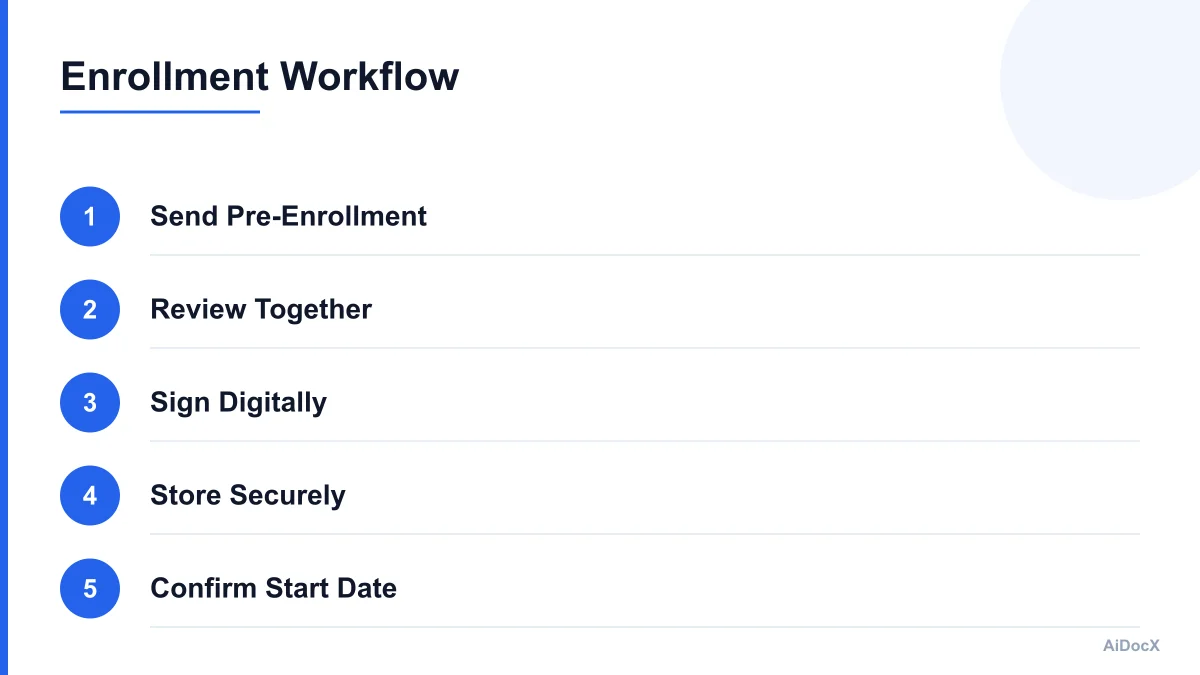
Do not spring the contract on parents during the final enrollment meeting. Mention the existence of a service agreement during your initial phone screening or tour. You might say, "We have a comprehensive service agreement that outlines our hours, fees, and policies. I’ll send it over for you to review before we finalize enrollment." This gives parents time to read it and ask questions in advance.
Offer a Review Period
Encourage parents to read the agreement carefully. Offer to walk them through it during the enrollment meeting. Answer their questions patiently and explain the rationale behind certain clauses. For example, if you have a strict sick child policy, explain that it protects all the children in your care. Transparency builds trust.
Make Signing Easy and Accessible
Use digital tools to collect signatures. Handwritten contracts can be lost, damaged, or difficult to store securely. Digital signatures are convenient, timestamped, and easily archived. Ensure the platform you use is secure and compliant with data protection regulations. Provide parents with a copy of the signed agreement immediately after signing.
Keep a Positive Tone
Frame the agreement as a tool for mutual protection and clarity, not as a set of restrictions. Emphasize that it helps both parties avoid misunderstandings and ensures a smooth experience for everyone. Use language that is professional yet warm. For example, "This agreement helps us create a stable, predictable environment for your child."
Managing Changes and Updates to the Agreement
Life is dynamic, and your daycare business may evolve. You might move locations, change your hours, or adjust your fees. It is essential to have a clear process for updating the service agreement.
Include a Modification Clause
Your contract should include a clause stating that either party may propose changes to the agreement with written notice. Specify the notice period (e.g., 30 days) and how changes will be communicated (e.g., via email or a portal update). Clarify that continued enrollment after the notice period constitutes acceptance of the new terms.
Communicate Changes Proactively
When you need to change a term, communicate it clearly and early. Explain the reason for the change and how it benefits the business or the children. For example, if you are increasing fees due to rising costs, explain that this ensures the quality of care remains high. Avoid surprise changes, which can damage trust.
Get Acknowledgment for Significant Changes
For major changes, such as a fee increase or a shift in operating hours, require parents to acknowledge the update. This could be a digital signature or a written confirmation. This step ensures that there is no dispute later about whether the parent was informed of the change.
Using Technology to Streamline Enrollment
Managing contracts manually can be time-consuming and prone to error. Technology can simplify the enrollment process, ensuring that agreements are stored securely and signatures are collected efficiently.
Digital Signature Platforms
Use platforms that allow you to send contracts electronically and collect signatures on any device. This eliminates the need for printing, scanning, and mailing. Look for platforms that offer audit trails, which record when the document was viewed and signed. This adds an extra layer of security and verification.
Centralized Document Storage
Store all signed agreements in a secure, cloud-based system. This ensures that you can access them from anywhere, should you need to reference a term or policy. It also protects against loss due to physical damage (fire, flood, etc.). Ensure the storage solution is compliant with data privacy laws, such as GDPR or CCPA, if applicable.
Automated Reminders and Updates
Some platforms allow you to set up automated reminders for contract renewals or updates. This helps you stay on top of administrative tasks and ensures that you do not miss critical deadlines for notifying parents of changes.
The Role of AiDocX in Simplifying Enrollment
Creating a legally sound and comprehensive daycare service agreement from scratch can be daunting. You need to ensure that all clauses are clear, compliant, and tailored to your specific business model. This is where platforms like AiDocX can be invaluable.
AiDocX drafts a daycare service agreement with hours, fees, and pickup policy spelled out, then collects a parent's signature at enrollment so expectations are on record. The platform simplifies the process by providing customizable templates that can be adapted to your specific needs. It ensures that all critical clauses are included and that the language is clear and professional. Additionally, AiDocX streamlines the signature collection process, making it easy for parents to sign digitally and for you to store the documents securely.
By using a tool like AiDocX, you can reduce the administrative burden of enrollment and focus more on what matters most: providing high-quality care for the children in your charge. It ensures that your business operations are protected while maintaining a positive and professional relationship with families.
Pre-Enrollment Checklist for Providers
Before a family officially enrolls, ensure that all administrative and legal bases are covered. Use this checklist to prepare your enrollment process.
- Review your local licensing requirements for contract content.
- Draft or select a daycare service agreement template.
- Customize the template with your specific hours, fees, and policies.
- Define your sick child policy and health disclosure requirements.
- Set up a digital signature platform for easy enrollment.
- Prepare a welcome packet that includes the agreement and other forms.
- Schedule enrollment meetings to review the agreement with parents.
- Ensure you have a secure system for storing signed agreements.
- Train any co-providers or assistants on the enrollment process.
- Review and update the agreement annually or as business needs change.
Conclusion
A daycare service agreement is not just a legal formality; it is a foundational tool for running a successful home daycare business. It protects you from disputes, clarifies expectations, and demonstrates professionalism to parents. By including essential clauses such as hours, fees, late pickup policies, and health protocols, you create a stable environment for everyone involved.
Avoid common mistakes like vague language or ignoring local regulations. Present the agreement to parents early and with a positive tone, using technology to streamline the signing process. Tools like AiDocX can simplify this process, ensuring that your agreements are comprehensive, compliant, and easy to manage.
Invest time in creating a robust service agreement. It pays dividends in reduced stress, fewer conflicts, and a more professional reputation. Start today by reviewing your current practices and implementing a clear, written contract for all new enrollments. Your business, and your peace of mind, will thank you.
Ready to automate your documents with AI?
Start free with AiDocX — AI contract drafting, meeting minutes, consultation notes, e-signatures, and more in one platform.
Get Started FreeMore from AiDocX Blog

Buy Sell Agreement Template (2026): Triggers, Valuation and Funding for Co-Owners
A free buy sell agreement template for co-owners, with triggering events, valuation methods, insurance funding and cross-purchase vs. redemption structures.
James September 26, 2026 12 min
Consignment Agreement Template (2026): Commission, Title, Risk of Loss and Unsold Goods
Free consignment agreement template for makers, artists and boutiques: commission split, title, insurance and how to protect consigned inventory.
James September 26, 2026 9 min
Distribution Agreement Template (2026): Territory, Exclusivity, Minimums and Reseller Terms
Free distribution agreement template (works as a reseller agreement template too): territory, exclusivity, minimums, pricing, IP and termination.
James September 26, 2026 13 min