Electronic Signatures: Legal Validity Across Jurisdictions in 2026
Are e-signatures legal in your country? Quick-reference guide to ESIGN Act, eIDAS, and Asia-Pacific laws — plus which signature levels hold up in court.
 MinjiLee · Strategic Lead February 5, 2026 9 min read
One of the most common questions we hear from businesses adopting electronic signatures is deceptively simple: "Is this actually legal?"
The short answer is yes — in nearly every jurisdiction worldwide, electronic signatures carry the same legal weight as handwritten signatures for the vast majority of business transactions. But the details matter. Different countries have different frameworks, different signature types carry different evidentiary weight, and certain document categories still require wet ink or advanced authentication.
This guide provides a thorough, jurisdiction-by-jurisdiction analysis of electronic signature law as it stands in 2026. Whether you are signing an NDA with a partner in Seoul, closing a SaaS agreement with a customer in Berlin, or executing a real estate contract in New York, you need to understand the legal landscape.
The Three Levels of Electronic Signatures
Before diving into specific jurisdictions, it is essential to understand the internationally recognized classification of electronic signatures. The European Union's eIDAS regulation established a three-tier framework that has become the global reference point, even in countries that do not formally adopt it.
Simple Electronic Signatures (SES)
A simple electronic signature is any data in electronic form that is attached to or logically associated with other electronic data and used to sign. This includes typing your name in an email, clicking an "I Accept" button, drawing your signature on a touchscreen, or using a platform like AiDocX to apply your signature to a document.
SES is legally valid for most business transactions worldwide. It is the most commonly used form of electronic signature and the one you encounter daily.
Advanced Electronic Signatures (AES)
An advanced electronic signature must meet four criteria: it is uniquely linked to the signatory, it is capable of identifying the signatory, it is created using data that the signatory can use under their sole control, and it is linked to the signed data in such a way that any subsequent change is detectable.
In practice, AES typically involves digital certificates and cryptographic keys. It provides stronger evidence of identity and document integrity than SES.
Qualified Electronic Signatures (QES)
A qualified electronic signature is an advanced electronic signature created by a qualified signature creation device and based on a qualified certificate issued by a trust service provider. QES is the gold standard — in the EU, it is legally equivalent to a handwritten signature by default, with no additional proof required.
QES requires identity verification by an accredited trust service provider and the use of certified hardware or software. It is mandatory for only a narrow set of transactions, primarily in the EU.
United States: ESIGN Act and UETA
The United States established the legal foundation for electronic signatures over two decades ago, and the framework remains robust and business-friendly.
Federal Law: ESIGN Act (2000)
The Electronic Signatures in Global and National Commerce Act (ESIGN) provides that electronic signatures and records cannot be denied legal effect solely because they are in electronic form. The law applies to interstate and international commerce and preempts state laws that are inconsistent with its provisions.
Key principles of ESIGN:
- Electronic signatures are legally equivalent to handwritten signatures
- Electronic records satisfy any legal requirement for written records
- Consumer consent is required before using electronic records in consumer transactions
- The law is technology-neutral — it does not mandate any specific signature technology
State Law: UETA
The Uniform Electronic Transactions Act (UETA) has been adopted by 49 states (all except New York, which has its own Electronic Signatures and Records Act — ESRA). UETA aligns closely with ESIGN and provides consistent rules across states.
Exceptions in the US
Certain documents are excluded from ESIGN and UETA:
- Wills, codicils, and testamentary trusts
- Family law documents (adoption, divorce)
- Court orders and official court documents
- Cancellation of utility services
- Cancellation of health or life insurance
- Product recall notices affecting health or safety
- Documents required to accompany hazardous materials transport
For virtually all business contracts — NDAs, service agreements, employment offers, vendor contracts, licensing deals, partnership agreements — electronic signatures are fully valid under US law.
European Union: eIDAS Regulation
The EU's electronic Identification, Authentication, and Trust Services (eIDAS) regulation, updated in 2024 as eIDAS 2.0, is the most comprehensive electronic signature framework in the world.
Core Principles
eIDAS establishes that an electronic signature cannot be denied legal admissibility solely because it is in electronic form. It creates the three-tier hierarchy (SES, AES, QES) described above and establishes a framework of trust service providers across all EU member states.
Legal Effects by Signature Level
Simple Electronic Signatures are admissible as evidence in legal proceedings across the EU. Their legal effect is determined by national law, and courts evaluate them based on the totality of circumstances.
Advanced Electronic Signatures carry stronger evidentiary weight due to their identity-linking and tamper-detection properties. They satisfy the legal requirements for a signature in most business contexts.
Qualified Electronic Signatures have the legal effect of a handwritten signature in all EU member states. A QES created in one member state is recognized in all others. This is the only signature level that receives automatic legal equivalence without requiring additional proof.
When QES Is Required
Most EU business transactions can be completed with SES or AES. QES is required only for specific high-stakes transactions that vary by member state:
- Germany: Real estate transfers (notarization still required), certain corporate filings
- France: Public procurement above certain thresholds, notarized acts
- Italy: Communications with public administration in some contexts
- Belgium: Certain notarial acts
For standard commercial contracts, SES is legally sufficient across the EU. AiDocX's electronic signatures meet the requirements for SES and can be used for the vast majority of business agreements in all 27 EU member states.
United Kingdom: Post-Brexit Framework
After Brexit, the UK retained the substance of eIDAS through the UK Electronic Communications Act 2000 and the Electronic Identification and Trust Services for Electronic Transactions Regulations 2016 (UK eIDAS). The Law Commission confirmed in its 2019 report that electronic signatures are valid for virtually all documents under English law, including deeds (with proper witnessing).
The UK framework recognizes all three signature levels and maintains mutual recognition arrangements with EU trust service providers, ensuring cross-border transactions remain smooth.
South Korea: Digital Signature Act
South Korea's electronic signature framework is particularly relevant for AiDocX given our strong user base in the Korean market.
The Electronic Signatures Act (revised 2020) removed the previous privileged status of government-certified digital signatures, placing all electronic signatures on equal legal footing. Under the revised law:
- All electronic signatures are admissible as evidence
- No electronic signature type is presumed superior to another solely based on certification status
- The Korean courts evaluate electronic signatures based on reliability, security, and the circumstances of their creation
Korea's Electronic Document and Electronic Transactions Act further establishes that electronic documents and signatures satisfy legal requirements for written form and signatures in commercial transactions.
For Korean businesses, this means that signing contracts through platforms like AiDocX is legally equivalent to wet-ink signatures for standard business agreements. The platform's comprehensive audit trail — capturing signer identity, timestamp, IP address, and document hash — provides strong evidentiary support in Korean courts.
Singapore: Electronic Transactions Act
Singapore's Electronic Transactions Act (ETA), most recently amended in 2021, provides a clear and permissive framework for electronic signatures.
Key provisions:
- Electronic signatures are not denied legal effect solely because they are electronic
- Where law requires a signature, an electronic signature satisfies that requirement if the method identifies the person and indicates their intention
- Secure electronic signatures (Singapore's equivalent of AES) receive a presumption of reliability
Excluded from the ETA: Wills, negotiable instruments, powers of attorney, real property transactions (deeds/transfers), and court documents.
Singapore's position as a regional business hub makes its permissive e-signature framework particularly important for companies operating across Southeast Asia.
Australia: Electronic Transactions Act 1999
Australia's federal Electronic Transactions Act 1999 and corresponding state legislation establish that:
- Electronic signatures satisfy legal signature requirements if the method identifies the person, indicates their approval, and is reliable and appropriate for the purpose
- Electronic communications have the same legal effect as paper equivalents
- Government agencies can specify additional requirements for electronic signatures in specific contexts
Each Australian state has adopted complementary legislation, creating a consistent national framework. During and after the COVID-19 pandemic, Australia expanded electronic signature acceptance to include company documents, deeds, and statutory declarations — many of these expanded provisions have been made permanent.
Japan: Act on Electronic Signatures and Certification Business
Japan's framework distinguishes between general electronic signatures and "specified authenticated electronic signatures." A general electronic signature is admissible as evidence of the signatory's intent. A specified authenticated electronic signature — verified by an accredited certification authority — receives a presumption of authenticity.
For most commercial contracts between businesses, standard electronic signatures are legally effective. The Japanese courts have consistently upheld electronic signatures in commercial disputes.
India: Information Technology Act 2000
India recognizes two categories:
- Electronic signatures (broad, technology-neutral category added in 2008 amendment)
- Digital signatures (specific cryptographic signatures using asymmetric key pairs)
Both are legally valid for most contracts. Exceptions include negotiable instruments, powers of attorney, trust deeds, and wills. The Indian Evidence Act specifically provides for the admissibility of electronic records and signatures.
Practical Compliance: What Your E-Signature Platform Must Provide
Regardless of jurisdiction, courts evaluating electronic signatures look for evidence that establishes:
- Intent to sign: The signer deliberately chose to apply their signature
- Identity verification: There is reasonable evidence of who signed
- Document integrity: The document was not altered after signing
- Consent to electronic process: The signer agreed to conduct the transaction electronically
- Record retention: A complete, accessible record of the signed document and signing process exists
The Importance of Audit Trails
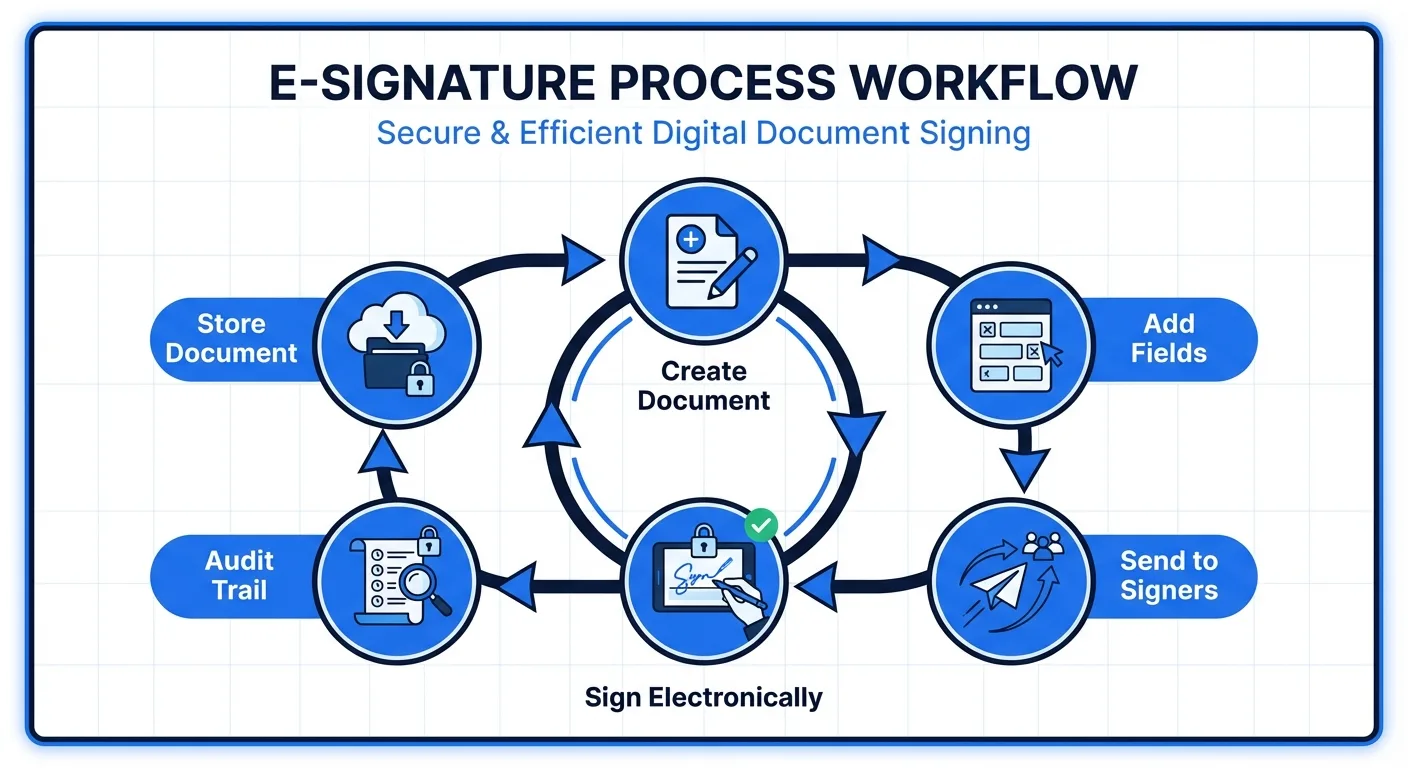
The audit trail is your strongest evidence in any legal challenge to an electronic signature. A comprehensive audit trail should capture:
- Signer's name and email address
- Date and time of signature (with timezone)
- IP address of the signing device
- Authentication method used
- Document hash (SHA-256 or equivalent) proving document integrity
- Complete history of document access and viewing
- Browser and device information
- Any identity verification steps completed
AiDocX automatically generates and stores a tamper-evident audit trail for every signature transaction. This audit trail is included with the completed document and stored independently, ensuring that even if the signed document is challenged, the signing evidence is preserved and verifiable.
Cost Considerations: Enterprise vs. Modern Platforms
Legal validity is table stakes — every major e-signature platform produces legally binding signatures. The real differentiator is cost and capability.
DocuSign, the market leader, starts at $10 per user per month for its Personal plan, scaling to $25 for Standard and $40 or more for Business Pro. For a team of 10, you are looking at $100 to $400 per month just for signatures.
AiDocX starts with a free tier that includes electronic signatures with full audit trails. The Basic plan at $6 per month adds expanded features, and even the Enterprise tier at $79 per month costs less than DocuSign's mid-tier plan for a small team. Critically, AiDocX bundles signatures with AI contract analysis, document tracking analytics, and a virtual data room — capabilities that would require additional subscriptions on other platforms.
This is not a minor pricing difference. For a growing business that needs 50 to 100 signatures per month plus document tracking and AI analysis, the total platform cost comparison is stark:
- Separate tools: DocuSign ($25/mo) + DocSend ($10/mo) + AI analysis tool ($50+/mo) = $85+ per month minimum
- AiDocX Basic: $6 per month for signatures, tracking, and AI analysis combined
Best Practices for Legal Compliance
Know your jurisdiction's exceptions: Identify document types that require wet ink or notarization in your operating jurisdictions.
Use a platform with strong audit trails: The strength of your electronic signature in court depends directly on the quality of your audit trail. Choose a platform that captures comprehensive signing metadata.
Obtain clear consent: Before sending documents for electronic signature, ensure recipients understand and agree to the electronic process. Most platforms, including AiDocX, handle this through built-in consent workflows.
Maintain accessible records: Store signed documents and audit trails in a format that remains accessible over time. Avoid proprietary formats that might become unreadable.
Match signature level to risk: Use SES for routine business contracts. Consider AES or QES for high-value transactions, regulatory filings, or jurisdictions with specific requirements.
Support multiple languages: If you operate internationally, use a platform that supports your counterparties' languages. AiDocX supports 18 languages, ensuring that signers can navigate the signing experience in their preferred language.
Looking Ahead
The global trend is unmistakable: electronic signatures are becoming the default, and wet-ink signatures are becoming the exception. Regulatory frameworks continue to expand acceptance, courts consistently uphold electronic signatures, and the COVID-19 era permanently shifted expectations about remote document execution.
For businesses operating in 2026, the question is no longer whether electronic signatures are legal. The question is whether you are using a platform that provides the right combination of legal compliance, comprehensive audit trails, AI-powered document intelligence, and reasonable pricing.
AiDocX was built to answer that question. With legally compliant electronic signatures, AI contract review and generation, document tracking analytics, and support for 18 languages — all starting free — it provides everything a modern business needs to manage documents confidently across any jurisdiction.
Ready to automate your documents with AI?
Start free with AiDocX — AI contract drafting, meeting minutes, consultation notes, e-signatures, and more in one platform.
Get Started FreeMore from AiDocX Blog
Consulting Proposal Template (2026): 9 Sections + Example
Copy a consulting proposal template with nine sections, pricing options, and a filled example. Includes tips to make the proposal easy to approve.
 AiDocX Team October 24, 2026 11 min
Internship Agreement Template (2026): Paid & Unpaid Interns
Copy an internship agreement template for paid or unpaid interns. Covers U.S. and UK pay rules, duties, IP, confidentiality, and a filled example.
AiDocX Team October 24, 2026 12 min
Meeting Minutes Template (2026): 4 Formats + Filled Example
Copy a meeting minutes template in four formats: team, decision log, board, and client call. See a filled example and a 15-minute workflow.
AiDocX Team October 24, 2026 11 min