Employee Offer Letter Template 2026: Clear, Compliant, Legal-Safe
Hire your first employee in 2026 with a legally compliant offer letter. Avoid costly mistakes with this clear, step-by-step guide and template for small businesses.
 James · Content Manager August 1, 2026 9 min read
Employee Offer Letter Template 2026: Clear, Compliant, and Legal-Safe
Hiring your first employee is a milestone, but it’s also a minefield of legal liabilities if handled incorrectly. In 2026, employment laws remain strict, and ambiguity in your offer letter can lead to wage-and-hour disputes, wrongful termination claims, or broken trust before day one. A professional offer letter isn’t just paperwork; it’s the foundation of your employment relationship. It sets expectations, protects your business, and ensures you are compliant with federal and state regulations. This guide breaks down exactly what to include, what to avoid, and how to structure your offer for maximum clarity and legal safety.
Why Your Offer Letter Matters More Than Ever
Many founders treat the offer letter as a formality—a quick email to confirm the salary and start date. This is a dangerous mistake. In the eyes of the law, the offer letter (and the candidate’s acceptance of it) forms a binding contract. If your document is vague, inconsistent, or non-compliant, you lose the ability to manage that employee effectively.
For small business owners and solo founders, the stakes are high. You don’t have a dedicated HR department to catch errors. A poorly drafted offer can lead to:
- Misclassification Issues: Accidentally classifying a contractor as an employee or vice versa.
- Wage Disputes: Unclear commission structures or overtime policies.
- At-Will Ambiguity: Clauses that inadvertently create an implied contract of employment, making termination difficult.
- Benefit Conflicts: Promising benefits you cannot legally or financially provide.
A well-drafted offer letter serves three purposes: it attracts top talent by showing professionalism, it sets clear boundaries, and it provides legal protection. In 2026, with remote work and hybrid models becoming standard, clarity on location, equipment, and data security is more critical than ever.
The Non-Negotiable Core Sections
Every compliant offer letter must contain specific elements to be legally valid and operationally clear. While state laws vary, these core sections are universal best practices for 2026 hiring.
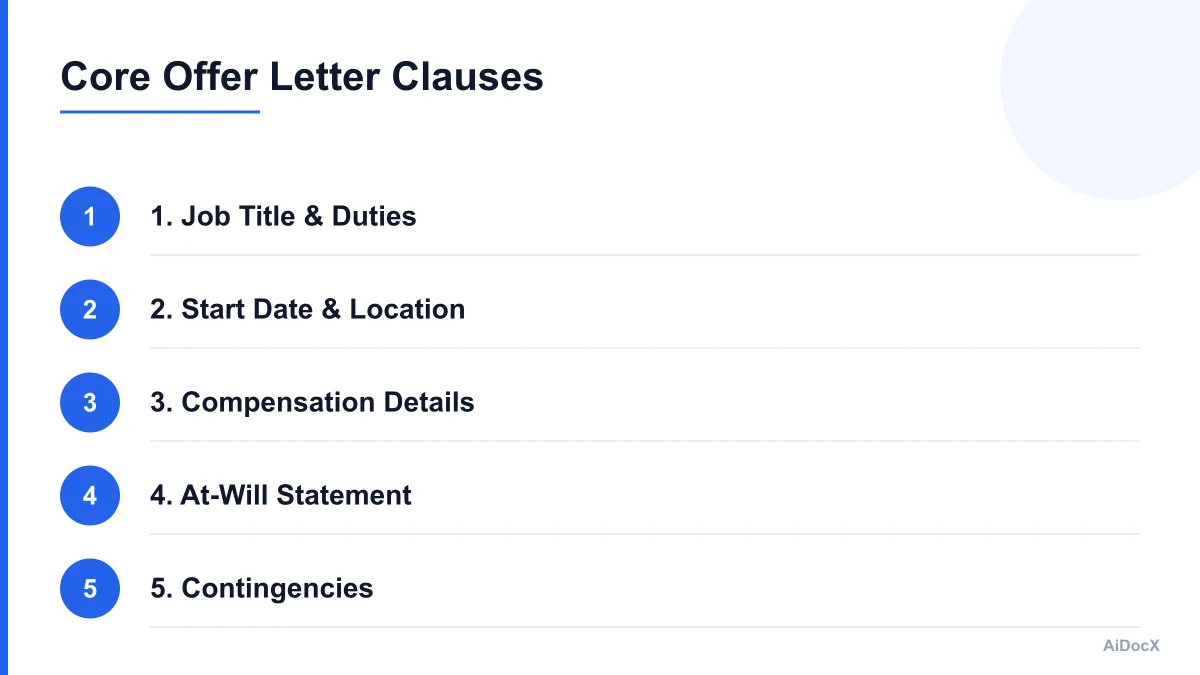
1. Job Title and Detailed Duties
Be specific. "Marketing Manager" is too vague. Use a clear title and a concise description of primary responsibilities. This helps define the scope of work and protects you if the role evolves. However, avoid an exhaustive list of duties that could be used to claim the employee is not performing their job when they are simply not doing a task you forgot to mention.
2. Compensation Structure
Clearly state the base salary or hourly rate. If there is a bonus or commission structure, outline the eligibility criteria, payment schedule, and any caps. In 2026, transparency in pay is not just good practice; it’s a legal requirement in many states and cities. Avoid phrases like "competitive salary" without a number. Ambiguity here is the #1 cause of post-hire resentment and legal disputes.
3. Employment Status and At-Will Language
Unless you are offering a fixed-term contract, you must explicitly state that employment is "at-will." This means either you or the employee can terminate the relationship at any time, with or without cause, and with or without notice. This is crucial for legal flexibility. Without this clause, courts may infer an implied contract for permanent employment, making termination significantly harder.
4. Start Date and Work Location
Specify the exact start date. For remote roles, define the "primary work location" for tax and jurisdictional purposes. If the role is hybrid, outline the expected days in the office. This is also where you address equipment: will you provide a laptop, or is the employee using their own device?
5. Contingencies
Protect your business by making the offer contingent on:
- Successful completion of a background check.
- Verification of employment eligibility (I-9 completion).
- Reference checks.
- Signing of the final employee handbook or confidentiality agreement.
Essential Clauses for 2026 Compliance
Beyond the basics, modern offer letters need specific clauses to address current legal and technological landscapes. Ignoring these can expose your small business to significant risk.
Data Privacy and Remote Work Policies
With remote work ubiquitous, you must address data security. Include a brief clause stating that the employee is responsible for maintaining the security of company data and devices. Reference your company’s IT policy or data privacy agreement. In 2026, GDPR and CCPA compliance are not optional, even for small businesses handling customer data.
Intellectual Property (IP) Assignment
Ensure that any work created by the employee belongs to the company. This is standard, but it must be explicit. The offer letter should state that the employee agrees to assign all intellectual property rights to the company for work performed during employment. Note that some states (like California) have specific laws regarding IP assignment, so ensure your language aligns with local statutes.
Confidentiality and Non-Solicitation
Include a brief confidentiality clause protecting trade secrets and proprietary information. A non-solicitation clause prevents the employee from poaching your clients or other employees for a specified period after leaving. Keep these clauses reasonable in scope and duration to ensure they are enforceable.
Benefits and Leave
Outline the benefits package clearly. Do not overpromise. If you offer health insurance, specify when it begins (e.g., first of the month following 30 days of employment). For 2026, be aware of evolving paid leave laws. Some states mandate paid family leave or sick leave regardless of company size. Explicitly state that benefits are subject to change and governed by the official plan documents, not the offer letter.
Common Legal Pitfalls to Avoid
Even experienced founders make mistakes. Here are the most common pitfalls that create legal headaches later.
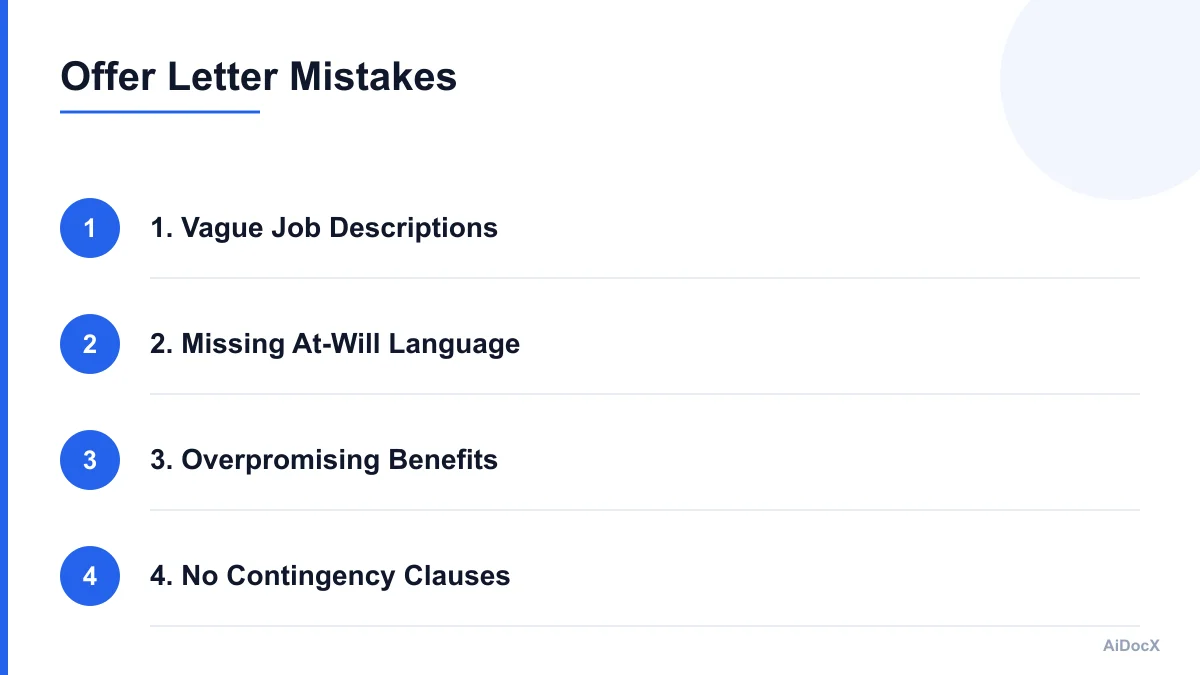
Mistake 1: Vague Job Descriptions
The Problem: Using broad terms like "other duties as assigned" without context. The Risk: Employees may refuse tasks outside their perceived role, or you may struggle to justify termination for poor performance if the duties weren't clearly defined. The Fix: List 5-7 key responsibilities. Use "other duties as assigned" only as a catch-all for minor, related tasks.
Mistake 2: Missing At-Will Statement
The Problem: Forgetting to include "employment is at-will" or using language like "we hope you’ll stay with us for a long time." The Risk: Courts may interpret this as an implied contract of indefinite employment, requiring "just cause" for termination. The Fix: Use clear, unambiguous at-will language. Place it prominently in the document.
Mistake 3: Overpromising Benefits
The Problem: Verbal promises or informal emails promising bonuses, raises, or equity that aren’t in the written contract. The Risk: These can be legally binding. If you can’t deliver, you face breach of contract claims. The Fix: Stick to the written offer. If you make verbal promises, document them and update the offer letter.
Mistake 4: Ignoring State-Specific Laws
The Problem: Using a generic template from the internet without checking local laws. The Risk: Violations of state laws regarding pay transparency, non-compete bans, or predictive scheduling. The Fix: Customize your offer letter for each state where you have employees. Consult local legal counsel.
Structuring the Offer Letter for Clarity and Tone
Your offer letter should be professional yet welcoming. It’s the first formal document the employee receives, setting the tone for your relationship.
Use Clear, Plain Language
Avoid legalese where possible. Use short sentences and active voice. For example, instead of "The employee shall be compensated at a rate of," use "You will be paid a salary of." Clarity reduces confusion and disputes.
Organize with Headings and Bullet Points
Make the document easy to scan. Use headings for each section (Compensation, Benefits, Duties). Use bullet points for lists of duties or benefits. This ensures the candidate doesn’t miss critical information.
Include a Clear Call to Action
End the offer letter with clear instructions on how to accept. Specify the deadline for acceptance and the method (e.g., signing and returning via email or an e-signature platform). Include a line stating that the offer expires on a specific date if not accepted.
Step-by-Step Guide to Drafting Your Offer
- Gather Candidate Information: Confirm the candidate’s full name, job title, start date, and compensation agreement.
- Select a Template: Use a compliant template that aligns with your state’s laws.
- Customize Core Details: Fill in the job title, duties, salary, and start date. Ensure accuracy.
- Add Legal Clauses: Include at-will language, confidentiality, IP assignment, and contingency clauses.
- Review for Compliance: Check for state-specific requirements like pay transparency statements or non-compete restrictions.
- Finalize and Send: Use a professional format. Avoid sending via plain text email if possible.
- Track Acceptance: Ensure you have a signed copy for your records.
Using Technology to Streamline the Process
Drafting a compliant offer letter manually is time-consuming and prone to error. This is where tools like AiDocX can help. AiDocX drafts a professional offer letter in minutes and gets it e-signed by the candidate with a verifiable audit trail. This ensures you have a legally binding, time-stamped record of the agreement, reducing the risk of disputes later.
By automating the drafting and signing process, you save time and reduce the risk of missing critical clauses. AiDocX also helps you stay compliant by updating templates with current legal standards, giving you peace of mind as a solo founder or small business owner.
Final Checklist Before Sending
Before you hit send, run through this checklist to ensure your offer letter is complete and compliant.
- Job title and detailed duties are clearly defined.
- Compensation (salary/hourly rate) is explicitly stated.
- At-will employment status is clearly declared.
- Start date and work location are specified.
- Contingencies (background check, I-9) are listed.
- Benefits and leave policies are accurately described.
- Confidentiality and IP assignment clauses are included.
- State-specific legal requirements are met (e.g., pay transparency).
- Offer expiration date is stated.
- Contact information for questions is provided.
Conclusion
Your employee offer letter is more than a formality; it’s a strategic tool that protects your business and sets the stage for a successful employment relationship. By including clear, compliant, and specific details, you avoid legal pitfalls and build trust with your new hire. Take the time to get it right. Use templates, consult legal resources, and consider automation tools like AiDocX to ensure your documents are professional, compliant, and legally sound. Hiring is a big step—make sure your paperwork is just as solid as your vision.
Ready to automate your documents with AI?
Start free with AiDocX — AI contract drafting, meeting minutes, consultation notes, e-signatures, and more in one platform.
Get Started FreeMore from AiDocX Blog
AI Press Release Generator: Write One in Minutes (+ Template)
Learn what a press release is, the AP-style format, and how to use an AI press release generator to draft one in minutes with a fill-in template.
James September 21, 2026 10 min
Angel Investment Agreement (2026): Key Terms + Template Guide
Angel investor agreement explained: the four structures founders actually sign, key terms, securities basics, a closing checklist and a summary term sheet.
James September 21, 2026 12 min
Artist Commission Contract Template (2026): Free Template + Guide
Free artist commission contract template with license tiers, deposit, revision, refund and AI-training clauses, plus a guide to getting it e-signed.
James September 21, 2026 12 min