Employee Termination Letter Template 2026: Reduce Wrongful-Termination Risk
Protect your small business with a legally sound employee termination letter. Learn the 2026 best practices for documenting exits, avoiding lawsuits, and staying compliant.
 James · Content Manager August 1, 2026 10 min read
Employee Termination Letter Template 2026: How to Document a Termination Properly and Reduce Wrongful-Termination Risk
Terminating an employee is one of the most stressful responsibilities for a small business owner or an HR-of-one operator. It is rarely just an administrative task; it is a high-stakes legal and emotional event. Without a legal team on standby, the margin for error is slim. A poorly worded email or a verbal dismissal can easily escalate into a wrongful termination lawsuit, costing you time, money, and reputation.
The solution lies in documentation. A well-drafted termination letter serves as the definitive record of the decision, protecting both you and the departing employee. In 2026, with increasing scrutiny on workplace transparency and labor rights, having a standardized, legally compliant process is not optional—it is essential. This guide provides the framework, template, and strategic advice you need to handle terminations with confidence and clarity.
Why Documentation Is Your Best Legal Shield
In employment law, if it isn’t written down, it didn’t happen. This adage is particularly true in termination cases. When an employee claims they were fired for discriminatory reasons, retaliation, or breach of contract, the burden of proof often falls on the employer to demonstrate that the decision was based on legitimate, non-discriminatory business reasons.
A termination letter is not just a notification; it is a legal artifact. It establishes the "paper trail" that proves the termination was consistent with company policy and previous performance issues. For small businesses without dedicated HR departments, this document is your primary defense against claims of wrongful termination, breach of implied contract, or violation of public policy.
The Consequences of Poor Documentation
Failing to document a termination properly can lead to several negative outcomes:
- Legal Liability: Employees may file claims for wrongful termination, discrimination, or retaliation. Without written evidence, your word against theirs can lead to costly litigation.
- Reputational Damage: Disgruntled former employees can leave negative reviews or speak poorly of your business in the industry, affecting future hiring and client relationships.
- Operational Disruption: Ambiguity about the terms of separation can lead to disputes over final pay, benefits, or return of company property, distracting you from running your business.
By investing time in creating a thorough termination letter, you mitigate these risks. The goal is not to hide the truth but to present it clearly, factually, and professionally.
The Anatomy of a Legally Sound Termination Letter
A termination letter must be concise, factual, and free of emotional language. It should serve as a clear record of the separation. While specific requirements vary by state and employment type, certain elements are universally recommended for protecting your business in 2026.
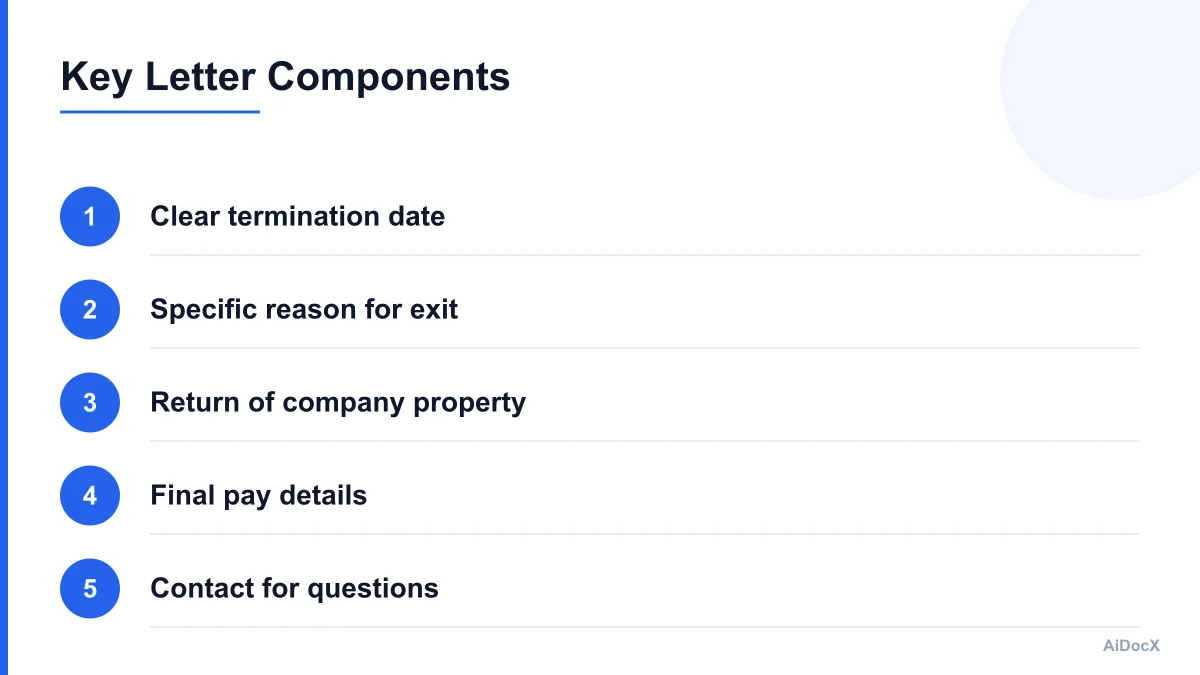
Essential Components
- Clear Header: Include your company letterhead, the date, and the employee’s full name and address. This establishes the document’s authenticity.
- Statement of Termination: Begin with an unambiguous statement that employment is ending. Use phrases like "Your employment with [Company Name] is terminated effective [Date]." Avoid euphemisms like "we are parting ways" or "we have decided to move in a different direction," which can be interpreted as vague or misleading.
- Effective Date and Time: Specify the exact date and, if necessary, the time when the termination becomes effective. This is crucial for determining the end of employment benefits and the start of any non-compete or non-solicitation periods.
- Reason for Termination: State the reason clearly and concisely. If the termination is due to performance, reference specific past warnings or performance improvement plans. If it is for misconduct, reference the specific policy violated. Avoid subjective language or personal opinions.
- Final Compensation Details: Outline what the employee will receive in their final paycheck, including accrued but unused vacation time (if required by state law), overtime, and any other owed wages. Specify the date of the final payment.
- Return of Company Property: List all company property that must be returned, such as laptops, keys, access cards, and company vehicles. Provide clear instructions on how and when to return these items.
- Benefits Information: Briefly mention the status of health insurance, retirement plans, and other benefits. Include information about COBRA eligibility if applicable, and direct the employee to relevant resources or HR contacts.
- Contact Information: Provide a contact person for any questions regarding the separation process, final pay, or benefits. This should be someone neutral and professional, such as an HR representative or a manager not directly involved in the termination decision.
The Step-by-Step Process for Terminating an Employee
Writing the letter is only one part of the process. How you deliver the termination and handle the immediate aftermath is equally important. A structured approach minimizes confusion and reduces the risk of conflict.
Step 1: Prepare in Advance
Before the meeting, gather all relevant documentation, including performance reviews, warning letters, and the termination letter itself. Ensure you have calculated the final paycheck according to state laws. Plan the logistics: where will the meeting take place? Who will be present? (Ideally, two witnesses are recommended, such as another manager or an HR representative).
Step 2: Conduct the Meeting
Keep the meeting short and direct. State the purpose of the meeting immediately. Deliver the termination letter and allow the employee to review it. Avoid engaging in debates or justifications. If the employee becomes upset, remain calm and professional. Reiterate that the decision is final.
Step 3: Secure Company Property
Immediately revoke access to company systems, email, and physical premises. If the employee is present, collect all company property in a supervised manner. Provide a checklist of items to be returned.
Step 4: Communicate with the Team
After the termination, inform the remaining team members in a brief, professional manner. You do not need to disclose the reasons for the termination. Focus on the transition of responsibilities and reassure the team about the stability of the business.
Step 5: Finalize Administrative Tasks
Process the final paycheck according to state laws. Handle COBRA notifications if applicable. Update internal records and offboard the employee from all systems. Keep a copy of all documentation in the employee’s personnel file.
Common Mistakes That Lead to Lawsuits
Even well-intentioned business owners can make critical errors during the termination process. These mistakes can create loopholes that plaintiffs’ attorneys exploit. Avoid these common pitfalls to protect your business.
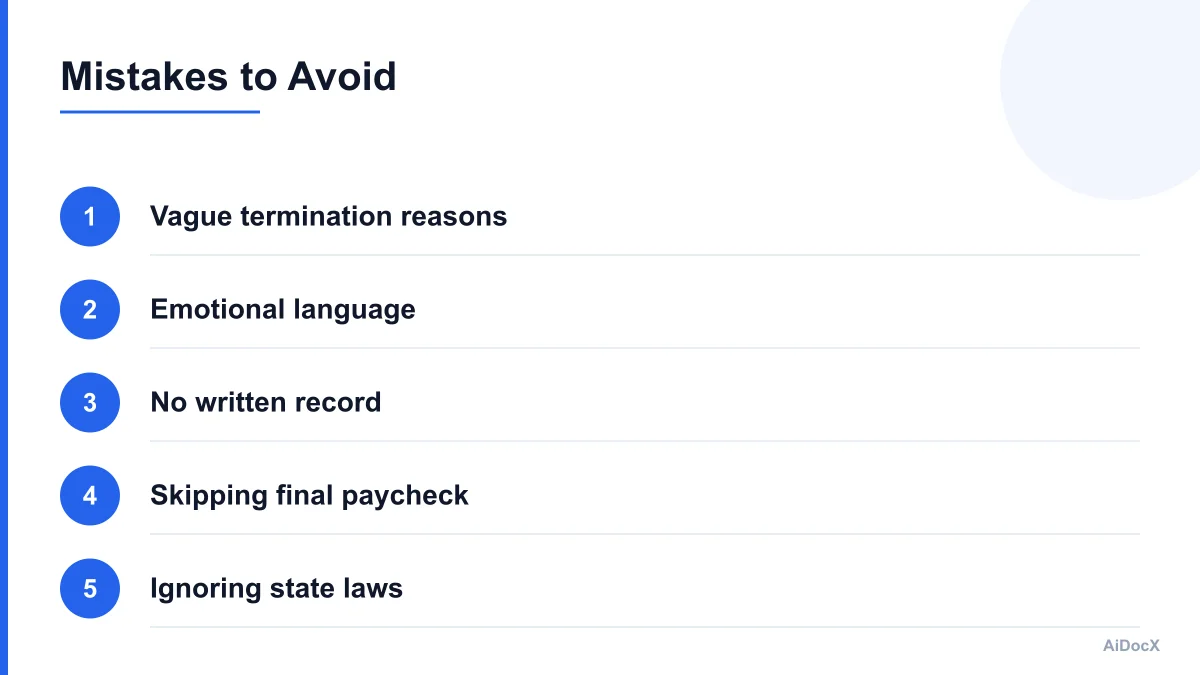
Mistake 1: Using Vague Language
Phrases like "you are not a good fit" or "we are restructuring" can be ambiguous and open to interpretation. If the termination is for performance, cite specific failures. If it is for redundancy, explain the business rationale clearly. Vagueness can be perceived as a cover for discrimination or retaliation.
Mistake 2: Including Emotional or Defamatory Statements
Never include personal insults, opinions, or unverified accusations in the termination letter. The letter should be factual. Emotional language can be used as evidence of bias or bad faith, strengthening a wrongful termination claim.
Mistake 3: Failing to Follow State Laws
Employment laws vary significantly by state. Some states require immediate payment of final wages, while others allow a delay of up to 72 hours. Some states mandate specific notices for termination. Ignoring these requirements can result in statutory penalties and additional liability.
Mistake 4: Skipping the Written Record
Relying on verbal communications is risky. Always provide a written termination letter. Even if you have a strong verbal agreement, the absence of written documentation can leave you vulnerable in court.
Mistake 5: Not Conserving Documentation
Keep detailed records of all communications, performance reviews, and warnings related to the employee. This "paper trail" is essential for defending against claims that the termination was arbitrary or discriminatory.
State-Specific Considerations for 2026
Employment law is primarily governed by state law, not federal law. As of 2026, several states have introduced new regulations regarding workplace transparency, pay equity, and termination procedures. Small business owners must be aware of these changes.
Right to Work Notification Laws
Some states require employers to provide new hires with a "Right to Work" notice, which informs employees of their rights and responsibilities under labor laws. While this primarily applies to new hires, some states have extended similar notification requirements to terminations. Check your state’s labor department website for specific forms.
Final Paycheck Timing
States vary widely in when final wages must be paid. For example:
- California: Immediate payment is required for all terminations.
- New York: Final wages must be paid on the next regular payday.
- Texas: Final wages are due on the next regular payday.
Failure to comply with these timing requirements can result in significant penalties, including waiting time wages.
Continuation of Health Benefits (COBRA)
For companies with 20 or more employees, the Consolidated Omnibus Budget Reconciliation Act (COBRA) requires you to offer continuation of health insurance coverage. For smaller companies, state mini-COBRA laws may apply. Ensure you provide the required COBRA election notices within the specified timeframe.
Non-Compete and Non-Solicitation Agreements
The enforceability of non-compete and non-solicitation agreements varies by state. Some states have banned non-competes entirely, while others have strict limits on their scope and duration. If you are enforcing such an agreement, ensure it is clearly stated in the termination letter and complies with state law.
Using Templates and Tools to Ensure Compliance
Drafting a termination letter from scratch can be daunting. Using a standardized template ensures consistency and reduces the risk of omitting critical information. However, templates are not one-size-fits-all. They must be customized to fit the specific circumstances of each termination.
Customizing the Template
When using a template, replace the placeholders with specific details. Ensure the reason for termination is accurate and supported by documentation. Review the final check details to ensure they comply with state laws. Have a legal professional review the letter if the termination is complex or high-risk.
The Role of AI in Documentation
Artificial intelligence is transforming how businesses handle documentation. Platforms like AiDocX can help draft clear, properly documented termination letters by analyzing your specific case details and generating a compliant document. These tools can also keep a signed, timestamped record for compliance, providing an additional layer of protection.
While AI cannot replace legal advice, it can streamline the process and reduce human error. By using AI-powered tools, you can ensure that your termination letters are consistent, professional, and legally sound.
Checklist for a Smooth Termination Process
Before proceeding with the termination, use this checklist to ensure you have covered all bases.
- Review employee’s personnel file for all relevant documentation
- Consult with legal counsel if the termination is high-risk
- Calculate final wages and accrued benefits
- Prepare the termination letter with specific, factual reasons
- Plan the termination meeting logistics (location, witnesses)
- Revoke access to company systems and property
- Notify the team of the departure (without disclosing reasons)
- Process final paycheck according to state laws
- Provide COBRA and benefits information
- Store all documentation securely in the employee’s file
Conclusion: Protecting Your Business Through Professionalism
Terminating an employee is never easy, but handling it with professionalism and precision can protect your business from legal risks. A well-drafted termination letter is your best tool for documenting the decision and demonstrating that the termination was based on legitimate business reasons.
By following the steps outlined in this guide, staying informed about state-specific laws, and leveraging tools like AiDocX to ensure proper documentation, you can navigate the termination process with confidence. Remember, the goal is not just to end the employment relationship but to do so in a way that minimizes liability and preserves your business’s reputation.
Take the time to prepare, communicate clearly, and document thoroughly. Your future self—and your bottom line—will thank you.
Ready to automate your documents with AI?
Start free with AiDocX — AI contract drafting, meeting minutes, consultation notes, e-signatures, and more in one platform.
Get Started FreeMore from AiDocX Blog

AI Press Release Generator: Write One in Minutes (+ Template)
Learn what a press release is, the AP-style format, and how to use an AI press release generator to draft one in minutes with a fill-in template.
James September 21, 2026 10 min
Angel Investment Agreement (2026): Key Terms + Template Guide
Angel investor agreement explained: the four structures founders actually sign, key terms, securities basics, a closing checklist and a summary term sheet.
James September 21, 2026 12 min
Artist Commission Contract Template (2026): Free Template + Guide
Free artist commission contract template with license tiers, deposit, revision, refund and AI-training clauses, plus a guide to getting it e-signed.
James September 21, 2026 12 min