Employment Agreement Template 2026: Small Business Guide
Secure your hire with a robust employment agreement template for 2026. Covers compensation, termination, and confidentiality beyond the basic offer letter.
 James · Content Manager August 9, 2026 11 min read
Employment Agreement Template 2026: Small Business Guide
Sending an offer letter is a milestone. It signals that you’ve found the right person, and they’ve accepted your vision for their role. But for many small business owners, the excitement of the new hire masks a critical legal gap: the absence of a formal, signed employment agreement.
An offer letter is a preliminary step, often lacking the legal teeth needed to protect your business interests. Without a comprehensive employment agreement covering compensation structures, termination procedures, and confidentiality, you are operating on trust alone. In 2026, with evolving labor laws and increased scrutiny on employee data and intellectual property, relying on a handshake or a simple email chain is no longer a viable strategy.
This guide details exactly what a small business needs in an employment agreement template before an employee’s first day. We will move beyond the basics to ensure you are protected, compliant, and clear from day one.
The Critical Difference: Offer Letter vs. Employment Agreement
To understand why you need an employment agreement, you must first distinguish it from an offer letter. While these terms are often used interchangeably by non-HR professionals, they serve fundamentally different legal and operational purposes.
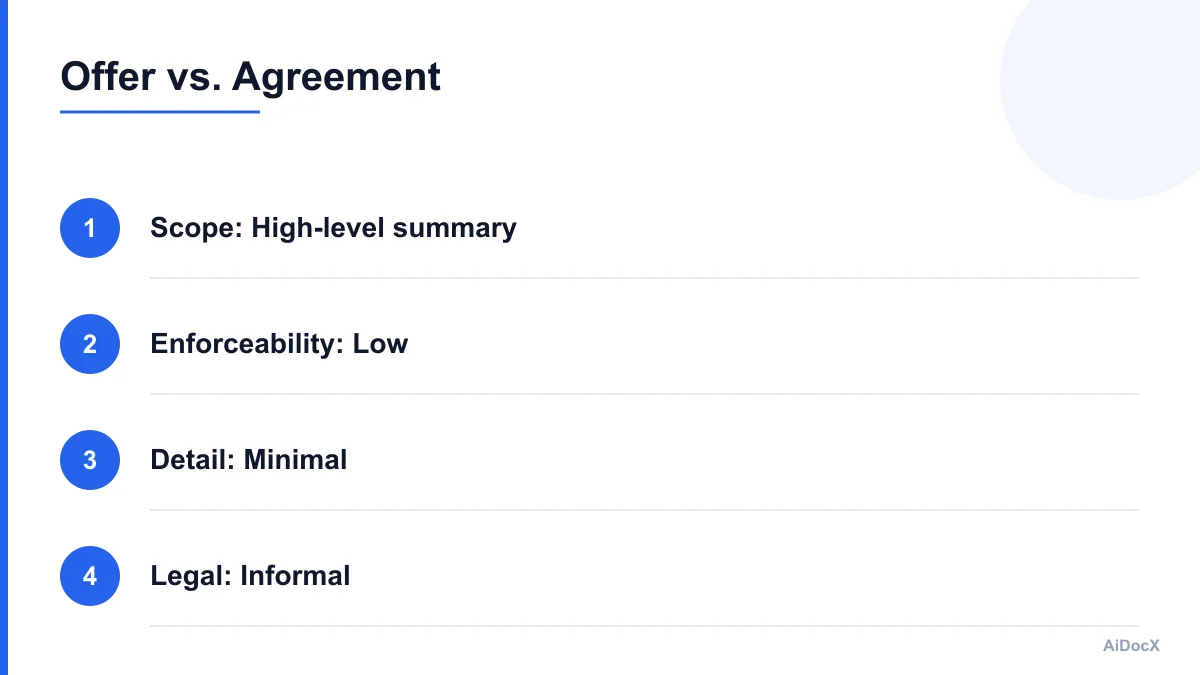
The Offer Letter: The Invitation
An offer letter is a document that outlines the basic terms of employment. It is typically brief, enthusiastic, and focused on the "what" and "when." It usually includes:
- Job title and reporting structure.
- Start date.
- Base salary or hourly wage.
- Brief mention of benefits.
- "At-will" employment statement (in applicable jurisdictions).
The offer letter is an invitation to enter into an employment relationship. Once signed, it creates a contract, but it is often too vague to handle complex scenarios like IP ownership, non-disclosure, or detailed termination procedures.
The Employment Agreement: The Rulebook
An employment agreement is a comprehensive legal contract. It details the rights, responsibilities, and obligations of both the employer and the employee. It is the rulebook for the employment relationship. Unlike the offer letter, which is a snapshot of the initial terms, the employment agreement is the ongoing framework that governs the relationship from day one through departure.
Key Differences at a Glance:
| Feature | Offer Letter | Employment Agreement |
|---|---|---|
| Length | 1-2 pages | 5-15+ pages |
| Focus | Basic terms, excitement | Legal protection, detailed terms |
| Enforceability | Moderate (depends on jurisdiction) | High (if drafted correctly) |
| Confidentiality | Rarely included | Standard inclusion |
| IP Ownership | Often omitted | Explicitly assigned to employer |
| Termination | Simple notice | Detailed procedures, cause vs. no cause |
| Non-Compete/Non-Solicit | Rarely included | Standard inclusion (where legal) |
For small businesses, the employment agreement is not just paperwork; it is insurance. It prevents misunderstandings and provides a clear path for resolution if things go wrong.
Why Small Businesses Need a Formal Agreement in 2026
In the past, some small business owners viewed employment agreements as overly bureaucratic or intimidating for new hires. However, the landscape of work has changed significantly. In 2026, the need for robust employment contracts has intensified due to several factors:
1. Intellectual Property (IP) Protection
Small businesses often rely on proprietary methods, customer lists, software code, or unique brand strategies. Without an explicit IP assignment clause in an employment agreement, an employee may claim ownership of the work they created during their tenure. This is particularly risky in tech, creative, and consulting sectors. An agreement ensures that all work product created during employment belongs to the company.
2. Data Privacy and Confidentiality
With the rise of remote work and cloud-based tools, sensitive data is more accessible than ever. Employees handle customer information, financial records, and strategic plans daily. A strong confidentiality clause (NDA) within the employment agreement defines what constitutes confidential information and the employee’s duty to protect it. This is crucial for compliance with regulations like GDPR (if dealing with EU data) and various state-level privacy laws.
3. Clear Termination Procedures
Terminating an employee is one of the most stressful aspects of small business management. Without a clear agreement outlining termination procedures, disputes can arise over wrongful termination, severance, or final pay. A well-drafted agreement specifies the grounds for termination (cause vs. no cause), notice periods, and any post-termination obligations, reducing legal risk and emotional friction.
4. Competitive Landscape
Non-solicitation and non-compete clauses (where enforceable) protect your business from former employees taking clients or recruiting staff to start a competing venture. While these clauses are under scrutiny in many jurisdictions, carefully drafted non-solicitation agreements are generally more enforceable and essential for protecting your client relationships.
Key Clauses Every Small Business Employment Agreement Must Include
When drafting or selecting an employment agreement template for 2026, ensure it includes the following essential clauses. Each serves a specific protective function.
1. Compensation and Benefits
While the offer letter states the salary, the agreement should detail the entire compensation structure.
- Base Salary/Hourly Wage: Clearly defined amount and pay period.
- Bonus Structure: If applicable, specify the criteria for bonuses (performance, company profitability, etc.).
- Equity/Stock Options: If offering equity, reference the stock option plan and vesting schedule.
- Benefits: Outline health insurance, retirement plans, and paid time off (PTO). Specify eligibility dates and any waiting periods.
Pro Tip: Avoid vague language like "competitive salary." Use specific figures or clear formulas to prevent disputes.
2. Duties and Responsibilities
Define the employee’s role with enough specificity to set expectations but enough flexibility to allow for growth.
- Job Title and Description: Reference an attached job description if necessary.
- Reporting Structure: Who does the employee report to?
- Duties and Responsibilities: List core responsibilities. Include a clause that allows the employer to assign additional duties as needed.
- Standard of Performance: Expectations for performance and conduct.
3. Term and Termination
This is the most critical section for risk management.
- Term: Specify if the employment is "at-will" (where applicable) or for a fixed term.
- Termination for Cause: Define what constitutes "cause" (e.g., misconduct, breach of contract, negligence). Specify immediate termination rights.
- Termination Without Cause: Outline the notice period required (e.g., two weeks’ notice) and any severance pay.
- Resignation: Require the employee to provide written notice (e.g., two weeks) before resigning.
- Return of Property: Obligation to return all company assets (laptops, phones, data, keys) upon termination.
4. Confidentiality and Non-Disclosure
Protect your trade secrets and sensitive information.
- Definition of Confidential Information: Broadly define what is confidential (customer lists, financial data, business strategies, etc.).
- Obligations: The employee agrees not to disclose or use confidential information for personal gain or for the benefit of others.
- Duration: Specify how long the confidentiality obligation lasts (often indefinitely for trade secrets).
- Permitted Disclosures: Allow for disclosures required by law or court order.
5. Intellectual Property Assignment
Ensure the company owns what the employee creates.
- Work Made for Hire: State that all work product created during the course of employment is the property of the employer.
- Assignment of Rights: The employee assigns all rights, title, and interest in their work product to the company.
- Moral Rights Waiver: Where applicable, waive the employee’s moral rights to the work.
- Prior Inventions: Allow the employee to disclose any pre-existing IP they are bringing to the role, ensuring it is not mistakenly assigned to the company.
6. Non-Solicitation and Non-Compete
- Non-Solicitation of Clients: The employee agrees not to solicit or do business with the company’s clients for a specified period after termination.
- Non-Solicitation of Employees: The employee agrees not to recruit or hire other employees.
- Non-Compete: Caution: Non-compete clauses are heavily regulated and banned in many jurisdictions (e.g., California, Minnesota, Oklahoma). Consult local legal counsel before including this. If included, it must be reasonable in scope, duration, and geography.
7. Dispute Resolution
Specify how disputes will be handled to avoid costly litigation.
- Governing Law: Which state’s laws govern the agreement?
- Arbitration/Mediation: Require disputes to be resolved through binding arbitration or mediation rather than court.
- Attorney’s Fees: Specify that the prevailing party in any dispute is entitled to recover attorney’s fees.
Common Mistakes to Avoid When Drafting Your Agreement
Even with a template, small business owners often make critical errors that render their agreements unenforceable or ineffective.
1. Using Outdated Templates
Legal landscapes change. A template from 2020 may not comply with 2026 labor laws, particularly regarding non-competes, pay transparency, and remote work regulations. Always ensure your template is current.
2. Vague Language
Phrases like "other duties as assigned" are standard, but vague terms like "reasonable effort" or "best practices" can lead to disputes. Be specific about expectations, compensation, and termination procedures.
3. Ignoring Local Laws
Employment law is highly localized. What is enforceable in New York may be illegal in California. Always have a local employment attorney review your agreement, especially for clauses like non-competes and arbitration.
4. Failing to Get a Signature
An unsigned agreement is worthless. Ensure the employee signs the agreement before their first day. Do not allow them to start work with the agreement "pending signature."
5. Overlooking Remote Work Provisions
With remote work being common, include clauses addressing:
- Work location (if flexible).
- Equipment provided by the company.
- Reimbursement for home office expenses.
- Data security requirements for remote work.
How to Implement Your Employment Agreement Process
Having a great template is only half the battle. You need a process to ensure every new hire receives, reviews, and signs the agreement correctly.
Step 1: Customize the Template
Once you have a solid template (such as one from AiDocX, which drafts a full employment agreement with compensation, termination, and confidentiality terms), customize it for each role. Adjust the job description, compensation, and specific duties. Do not use a one-size-fits-all approach for all employees.
Step 2: Legal Review
Have an employment attorney review your customized agreements. This is a one-time cost that can save you thousands in potential litigation. Ask them to flag any clauses that may be unenforceable in your jurisdiction.
Step 3: Prepare for Onboarding
Integrate the agreement signing into your onboarding workflow.
- Send in Advance: Email the agreement to the candidate 3-5 days before their start date.
- Explain Key Terms: Have your HR manager or founder briefly explain the key terms, especially confidentiality and IP assignment, during the first day.
- Use E-Signature: Use a secure e-signature platform to collect signatures. This ensures you have a timestamped, legally binding record.
Step 4: Secure Storage
Store signed agreements securely. Use a digital HRIS (Human Resources Information System) or a secure cloud storage solution with access controls. Ensure that only authorized personnel can view these sensitive documents.
Step 5: Annual Review
Review your employment agreement template annually. Update it to reflect changes in law, company structure, and business practices.
Pre-Onboarding Checklist: Is Your Hire Ready?
Before your new employee walks through the door, ensure you have completed the following:
- Job Description Finalized: Clear duties and reporting structure defined.
- Compensation Agreed: Salary, bonus, and equity terms documented.
- Agreement Drafted: Full employment agreement customized for the role.
- Legal Review Completed: Attorney has approved key clauses.
- Equipment Ready: Laptop, phone, and software access prepared.
- Onboarding Schedule Created: First-week agenda and training plan set.
- E-Signature Link Sent: Agreement sent to candidate for review and signature.
- Signed Agreement Received: Contract is fully executed and stored.
- Team Notified: Colleagues are aware of the new hire’s role and start date.
- Background Check Completed: If applicable, results are reviewed and cleared.
Conclusion: Start Strong, Stay Protected
The first day of a new employee is a pivotal moment. It sets the tone for the entire employment relationship. By providing a comprehensive, clear, and legally sound employment agreement, you demonstrate professionalism and respect for the employee while protecting your business interests.
Don’t let the excitement of hiring overshadow the importance of paperwork. An offer letter is just the beginning. A robust employment agreement is the foundation of a secure and successful working relationship.
If you are looking to streamline this process, consider using a tool like AiDocX. It drafts a full employment agreement with compensation, termination, and confidentiality terms, then routes it for e-signature so a hire starts with paperwork actually on file. This ensures you never miss a critical clause and that your documents are always up-to-date.
Take the time to get it right. Your business, your intellectual property, and your peace of mind will thank you.
Disclaimer: This blog post is for informational purposes only and does not constitute legal advice. Employment laws vary by jurisdiction. Always consult with a qualified employment attorney before drafting or signing employment agreements.
Ready to automate your documents with AI?
Start free with AiDocX — AI contract drafting, meeting minutes, consultation notes, e-signatures, and more in one platform.
Get Started FreeMore from AiDocX Blog
Buy Sell Agreement Template (2026): Triggers, Valuation and Funding for Co-Owners
A free buy sell agreement template for co-owners, with triggering events, valuation methods, insurance funding and cross-purchase vs. redemption structures.
James September 26, 2026 12 min
Consignment Agreement Template (2026): Commission, Title, Risk of Loss and Unsold Goods
Free consignment agreement template for makers, artists and boutiques: commission split, title, insurance and how to protect consigned inventory.
James September 26, 2026 9 min
Distribution Agreement Template (2026): Territory, Exclusivity, Minimums and Reseller Terms
Free distribution agreement template (works as a reseller agreement template too): territory, exclusivity, minimums, pricing, IP and termination.
James September 26, 2026 13 min