Employment Contract vs Offer Letter: Key Differences in 2026
Confused by HR paperwork? Learn the legal and practical differences between an offer letter and an employment contract. See which document you need for your 2026 hires.
 James · Content Manager August 19, 2026 10 min read
Employment Contract vs Offer Letter: Key Differences in 2026
For many startup founders and SME HR managers, the moment of hiring is a mix of excitement and administrative dread. The biggest source of anxiety often isn't the interview, but the paperwork that follows. You have a candidate, you have a verbal agreement, and now you need to put it in writing. But should you send an offer letter, or do you need to draft a full employment contract? This question is critical because these two documents serve distinct legal and operational purposes. Using the wrong one can lead to ambiguity, disputes, or even compliance issues down the line.
This guide breaks down the exact differences between an offer letter and an employment contract. We will explore what each document legally covers, when it is appropriate to use one over the other, and how to manage both efficiently. By the end, you will have a clear framework for deciding which document to send to each new hire, ensuring you protect your business while making the process smooth for your team.
The Legal Distinction: What Each Document Actually Does
To understand the difference, you must first understand the legal weight of each document. An offer letter and an employment contract are not interchangeable; they are two stages of the employment relationship with different levels of detail and legal binding.
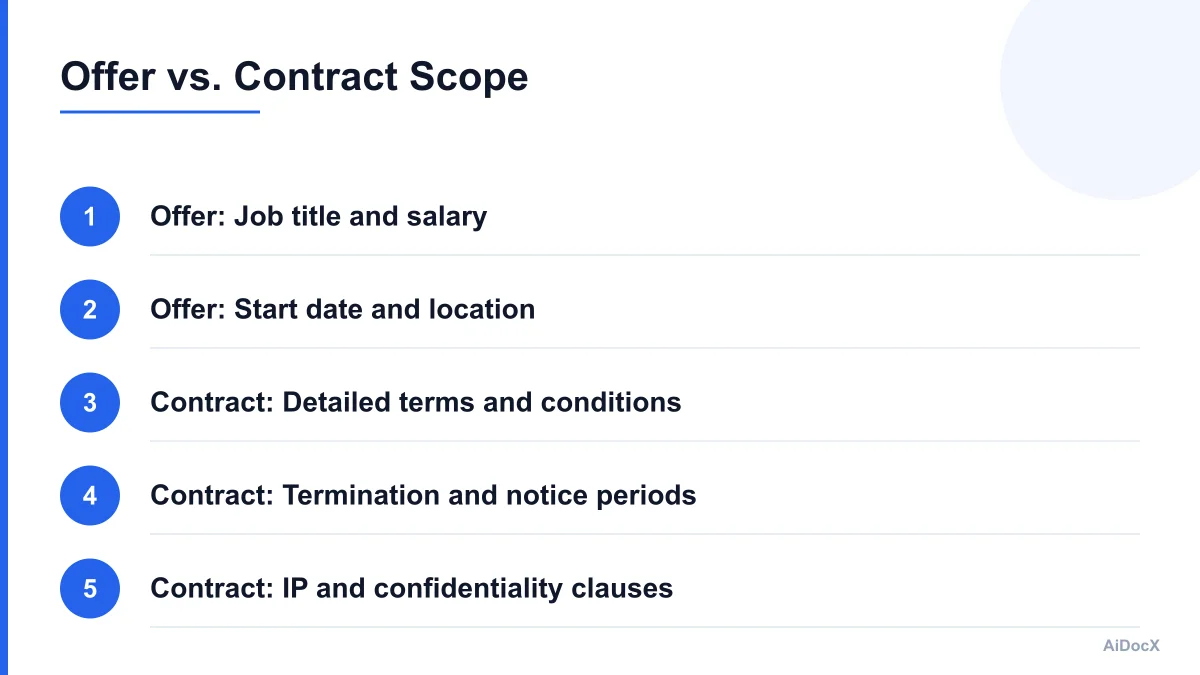
An offer letter is a preliminary document. It outlines the basic terms of employment: the job title, the starting salary, the start date, and the work location. Its primary purpose is to secure the candidate’s acceptance. In most jurisdictions, an offer letter is a binding agreement regarding the specific terms it contains. If you promise a $80,000 salary in the offer letter, you are legally obligated to pay that amount. However, it is typically a summary, not a comprehensive rulebook.
An employment contract, on the other hand, is the definitive agreement. It details the rights and responsibilities of both the employer and the employee. It includes the terms from the offer letter but goes much deeper, covering termination procedures, notice periods, intellectual property ownership, non-compete clauses, and code of conduct. The employment contract is the document that governs the day-to-day relationship and the eventual end of that relationship.
Think of the offer letter as the handshake that seals the deal, and the employment contract as the manual that explains how the relationship will work. Relying solely on an offer letter for a permanent, full-time role is like buying a house with only the price tag and no deed. It’s a significant risk.
Core Content: Comparing the Clauses
The most practical way to distinguish these documents is to look at what is actually written inside them. While there is some overlap, the depth of coverage varies significantly.
Offer Letter Components:
- Job Title: The specific role the employee will hold.
- Compensation: Base salary, and potentially bonus structures or equity grants.
- Start Date: The official first day of work.
- Location: The primary office or remote location.
- Reporting Structure: Who the employee will report to.
- At-Will Statement: In the US, a statement that employment is "at-will," meaning either party can terminate the relationship at any time for any legal reason.
- Exclusivity: A clause stating the candidate must not accept other offers once this one is accepted.
Employment Contract Components:
- All Offer Letter Terms: It includes everything listed above.
- Termination and Notice: Specific rules on how and when employment can be ended, including notice periods (e.g., 30 days’ notice).
- Intellectual Property (IP) Assignment: A critical clause stating that any work created by the employee during their tenure belongs to the company.
- Confidentiality and Non-Disclosure (NDA): Rules about protecting sensitive company data.
- Non-Compete and Non-Solicitation: Restrictions on working for competitors or poaching clients/employees after leaving.
- Governing Law: Which state or country’s laws apply to the contract.
- Dispute Resolution: How conflicts will be handled (e.g., arbitration vs. court).
- Compliance with Policies: Agreement to follow the employee handbook and company code of conduct.
If you send only an offer letter, you are missing the IP assignment and detailed termination clauses. This is a massive gap for tech companies and startups where intellectual property is the core asset. Without a signed IP assignment, you may not legally own the code or designs your employees create.
When to Use Which: A Decision Framework
So, when is an offer letter sufficient, and when do you absolutely need a full employment contract? The answer depends on the nature of the role and the risk profile of the hire.
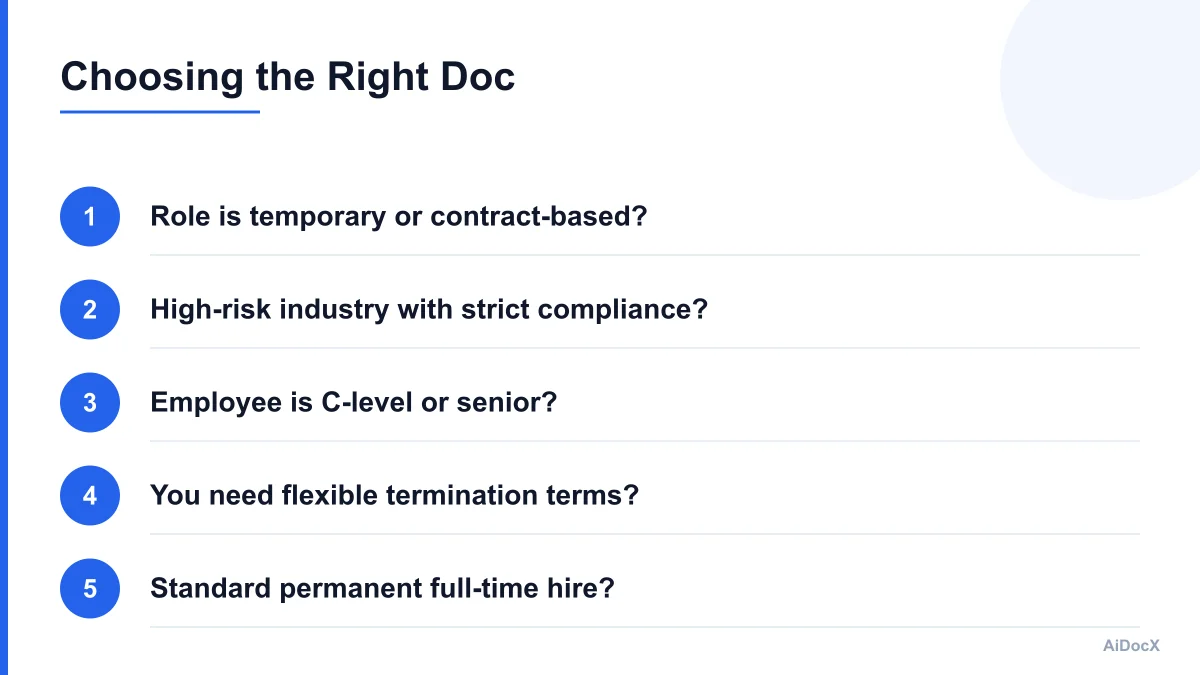
Use an Offer Letter (Plus a separate IP/NDA agreement) when:
- The role is temporary, part-time, or freelance.
- The employee is not handling sensitive IP or proprietary data.
- The company is in a jurisdiction where at-will employment is the norm and standard.
- You are hiring for a short-term project or a contract-to-hire scenario.
Use a Full Employment Contract when:
- The role is permanent and full-time.
- The employee will be creating code, designs, content, or other intellectual property.
- The employee is a C-level executive, senior engineer, or anyone with access to high-level strategic data.
- You operate in a jurisdiction with strict labor laws that require detailed written contracts (e.g., many European and Asian countries).
- You want to include non-compete or non-solicitation clauses.
The Hybrid Approach: Many US-based startups use a hybrid approach. They send a concise offer letter to get the candidate’s signature quickly. Simultaneously, they send a separate, standalone Intellectual Property Assignment Agreement and a Non-Disclosure Agreement. This covers the critical legal bases without the weight of a full 20-page employment contract. However, if you are hiring in a non-at-will jurisdiction or for a high-risk role, a full employment contract is non-negotiable.
Common Mistakes That Create Legal Gaps
Even experienced HR managers make errors when drafting these documents. Avoid these common pitfalls to protect your business.
1. Relying Solely on the Offer Letter for IP Protection This is the most dangerous mistake. An offer letter rarely contains a robust IP assignment clause. If your developer writes a new algorithm and you only have an offer letter, you might not own that algorithm. Always ensure a separate IP Assignment Agreement is signed, or include a strong IP clause in the employment contract.
2. Vague Termination Language Avoid phrases like "employment may be terminated for cause." Define what "cause" means. Is it theft? Gross misconduct? Failure to meet performance standards? If the terms are vague, you may face wrongful termination claims. A full employment contract allows you to define these terms precisely.
3. Ignoring Local Labor Laws Labor laws vary significantly by region. A clause that is standard in California might be illegal in France. For example, non-compete clauses are strictly regulated or banned in some jurisdictions. Always have your contracts reviewed by a local employment lawyer.
4. Inconsistent Terms Between Offer and Contract If the offer letter says "20 days PTO" and the employment contract says "15 days PTO," you have a conflict. The employee will likely argue for the better term. Ensure that the terms in the offer letter are mirrored exactly in the employment contract, or clearly state that the employment contract supersedes the offer letter.
5. Failing to Get Signatures An unsigned document is not a contract. Ensure you have a clear process for getting digital or wet-ink signatures. Use e-signature platforms to streamline this, but always verify that the signatory has the authority to sign on behalf of the company.
How to Manage Both Documents Efficiently
Managing two different documents for every hire can be cumbersome. The key to efficiency is consistency and automation. You don’t want to start from scratch for every new employee.
1. Create Standard Templates Develop a standard offer letter template and a standard employment contract template for each role type (e.g., Engineering, Sales, Operations). Keep these templates updated with the latest legal requirements.
2. Use a Centralized HR System Store all signed documents in a secure, centralized HR system. This ensures that you can easily retrieve the contract when an employee leaves or when a dispute arises.
3. Automate the Workflow When a candidate accepts an offer, the system should automatically generate the employment contract based on the accepted offer details. This reduces manual entry errors and speeds up the onboarding process.
4. Version Control If you update your templates, ensure that old versions are archived and new versions are clearly marked. This prevents confusion if you need to reference a past contract.
5. Regular Legal Reviews Labor laws change. Review your templates annually with legal counsel to ensure they remain compliant.
The Role of Technology in Document Management
As your company grows, the manual process of drafting and managing offer letters and contracts becomes a bottleneck. This is where technology can help. Tools like AiDocX allow you to draft both an offer letter and a full employment contract from the same employee profile. This means you don’t have to re-enter data like salary, title, or start date. You can switch between templates easily, ensuring that you always pick the right document for each hire. This not only saves time but also reduces the risk of errors, as the data is consistent across both documents.
For SMEs and startups, this level of automation is a game-changer. It allows you to scale your hiring process without scaling your legal risk. You can focus on building your team, not on paperwork.
Checklist: Before You Send the Document
Before you hit send on any employment document, run through this checklist to ensure you are covered.
- Verify the Role: Is the position permanent, full-time, or high-risk? If yes, use a full employment contract.
- Check IP Clauses: Does the document include a strong Intellectual Property Assignment clause?
- Review Termination Terms: Are the termination and notice periods clearly defined and compliant with local law?
- Ensure Consistency: Do the terms in the offer letter match the terms in the employment contract?
- Local Law Compliance: Have you confirmed that the clauses are legal in the employee’s jurisdiction?
- Signature Process: Is there a clear process for obtaining a legally binding signature?
- Storage Plan: Where will the signed document be stored, and who has access to it?
Conclusion: Protect Your Business, Simplify Your Process
The difference between an offer letter and an employment contract is not just a matter of length; it is a matter of legal protection and clarity. An offer letter secures the hire, but an employment contract secures the business. For most permanent, full-time roles, especially in tech and creative industries, a full employment contract is essential. It protects your intellectual property, defines the terms of separation, and ensures compliance with local labor laws.
You don’t have to choose between speed and security. With the right templates and tools, you can draft both documents efficiently and ensure that every hire is properly documented. By understanding the distinct roles of each document and using a structured approach, you can mitigate legal risks and build a strong foundation for your team.
As you prepare to hire for 2026, take the time to review your current documentation process. Are you using the right document for the right role? Are your templates up to date? Making these adjustments now will save you time, money, and potential legal headaches in the future. Your next hire is an investment in your company’s future; make sure the paperwork is just as solid.
Ready to automate your documents with AI?
Start free with AiDocX — AI contract drafting, meeting minutes, consultation notes, e-signatures, and more in one platform.
Get Started FreeMore from AiDocX Blog
How to Read a Business Contract: A Founder's Checklist (2026)
A practical way to review parties, scope, money, IP, liability, and exit terms before signing a business contract.
 MinjiLee October 7, 2026 9 min
ESIGN vs eIDAS: What Founders Should Know About E-Signatures (2026)
What U.S. ESIGN and EU eIDAS actually say, where exceptions apply, and what founders should keep to document an electronic signing.
MinjiLee October 7, 2026 7 min
Does Document Automation Pay Off? An ROI Worksheet for Founders (2026)
Estimate document automation ROI with your own volume, time, labor, and software costs. Includes a clearly labeled example and break-even formula.
 Chloe October 7, 2026 8 min