Exclusivity Agreement Template 2026: Lock In Your Partner
Secure your supply chain or distribution network with a legally binding exclusivity agreement. Learn key clauses, risks, and how to draft an enforceable contract for 2026.
 James · Content Manager August 9, 2026 9 min read
Exclusivity Agreement Template 2026: How a Small Business Locks In an Exclusive Supplier, Distributor, or Partner Relationship
For small business owners, growth often hinges on securing reliable supply chains or exclusive distribution channels. A verbal promise of exclusivity sounds secure in the early stages of a partnership, but it offers zero legal protection when market conditions shift or a partner decides to work with a competitor. In 2026, as business relationships become increasingly complex and cross-border, the need for precise, enforceable documentation is higher than ever.
An exclusivity agreement is not just a formality; it is a strategic asset that protects your market share, ensures supply stability, and provides a clear framework for dispute resolution. However, poorly drafted agreements can lead to costly litigation or unintended non-competition clauses that stifle your own growth. This guide outlines how to structure a robust exclusivity agreement, highlighting critical clauses, common pitfalls, and the importance of using a reliable digital platform like AiDocX to ensure your contract is legally sound and enforceable.
Why Small Businesses Need Formal Exclusivity Agreements
Many small business owners operate under the misconception that a strong handshake or a friendly email exchange is sufficient to establish an exclusive relationship. While this may work for short-term, low-stakes transactions, it fails completely when significant capital investment is involved.
The Risk of "Verbal Exclusivity"
Without a written contract, you have no proof of the scope or duration of the exclusivity. If a supplier decides to sell to your direct competitor, you cannot sue for breach of contract because you cannot prove the terms. You might argue for "promissory estoppel" (reliance on a promise), but this is difficult, expensive, and uncertain.
Strategic Advantages of Written Exclusivity
- Supply Chain Security: If you are a distributor, an exclusivity agreement guarantees that your supplier will not sell the same product to other distributors in your territory. This protects your investment in marketing and customer acquisition.
- Market Control: If you are a manufacturer, exclusivity prevents other manufacturers from producing similar products in your region, allowing you to dominate a niche market.
- Investment Confidence: Banks and investors are more likely to fund a business that has secured exclusive rights to a product or territory, as it reduces market risk.
- Clear Expectations: A written agreement defines performance metrics, pricing, and delivery schedules, reducing friction and misunderstandings later.
Understanding the Core Components of an Exclusivity Clause
An exclusivity clause is the heart of the agreement. It must be drafted with precision to avoid ambiguity. Vague language is the enemy of enforceability.
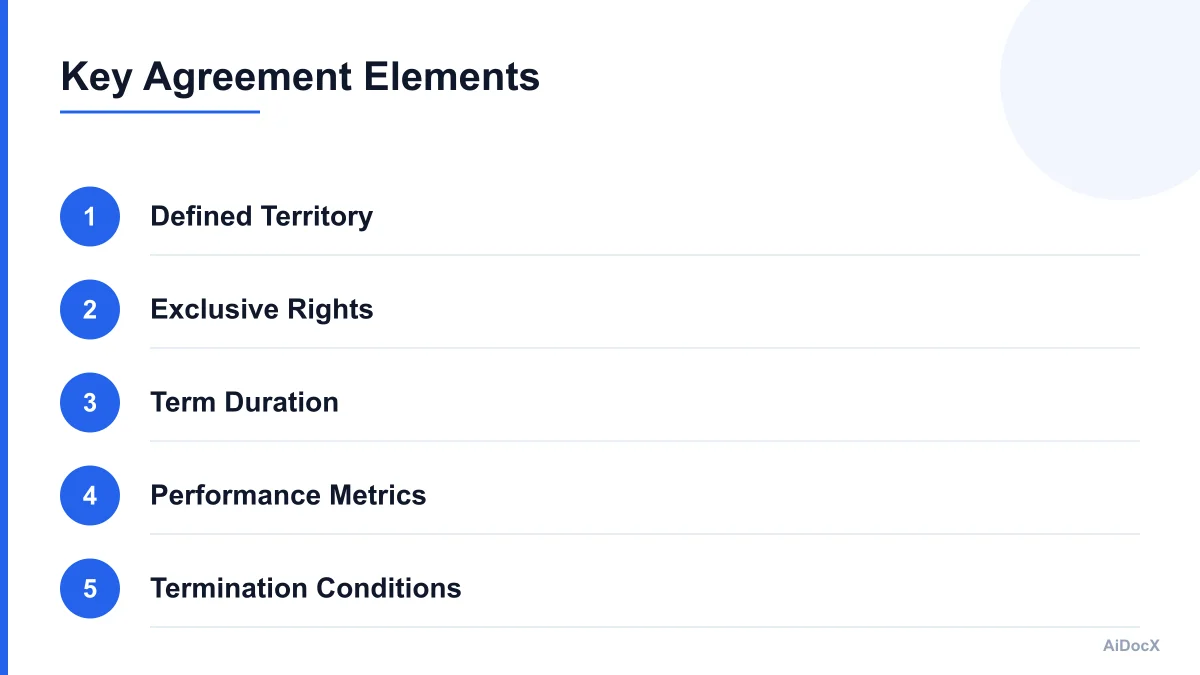
1. Definition of Exclusive Rights
You must clearly define what "exclusive" means. Does it mean the supplier cannot sell to anyone else? Or that they cannot sell to competing businesses?
- Absolute Exclusivity: The supplier cannot sell the product to any other party in the territory.
- Sole Distributorship: The supplier can sell to others, but only through you (the distributor).
- Territorial Exclusivity: You have exclusive rights in a specific geographic area (e.g., "the State of California" or "the EU region").
2. Scope of Products or Services
Be specific about what is covered. If you are distributing "Product A," does that include "Product B," which is a newer version released next year?
- Example: "Exclusive rights to distribute the 'Model X' series of widgets, including any subsequent updates or minor revisions to Model X, but excluding the 'Model Y' industrial line."
3. Territory
Geography is critical. Ambiguous terms like "the country" or "the region" can lead to disputes.
- Best Practice: Use precise legal boundaries. "The exclusive territory is the continental United States, excluding Alaska and Hawaii."
4. Term and Renewal
How long does the exclusivity last? One year? Five years?
- Auto-Renewal: Consider including an auto-renewal clause unless either party provides notice of termination within a specific window (e.g., 90 days before expiration).
- Performance-Based Renewal: Link renewal to meeting specific sales targets. This protects the supplier if you fail to promote the product adequately.
Drafting the Agreement: Step-by-Step Guide
Creating an exclusivity agreement requires more than just filling in blanks. It requires strategic thinking about your business goals and the partner's capabilities.
Step 1: Define Your Business Objectives
Before drafting, ask yourself:
- What is my minimum viable sales volume?
- What is my maximum acceptable price?
- What are my exit conditions if the partner underperforms?
Step 2: Identify the Partner’s Capabilities
Evaluate the partner’s financial stability, distribution network, and reputation. An exclusivity agreement is a two-way street; you are giving up the right to work with others in exchange for their commitment. Ensure they have the capacity to fulfill that commitment.
Step 3: Determine Performance Metrics
To protect yourself, include clear KPIs (Key Performance Indicators).
- Minimum Purchase Quantity (MPQ): The partner must buy at least X units per quarter.
- Sales Targets: The partner must achieve $Y in revenue annually.
- Market Development: The partner must open Z new retail locations per year.
If these metrics are not met, you should have the right to terminate the exclusivity or convert the agreement to a non-exclusive one.
Step 4: Address Pricing and Payment Terms
Exclusivity often comes with a price premium or discount. Define:
- Wholesale Price: Fixed price or price list.
- Payment Terms: Net 30, Net 60, etc.
- Price Adjustment Clause: How will price changes be communicated? (e.g., 90 days' notice).
Step 5: Include Termination and Exit Clauses
Life happens. Partners go bankrupt, merge, or change strategy. Your agreement must outline how to end the relationship cleanly.
- Termination for Cause: Immediate termination for breach, insolvency, or illegal acts.
- Termination for Convenience: Either party can exit with N days' notice.
- Post-Termination Obligations: What happens to existing inventory? Can the partner sell off stock for a grace period?
Common Pitfalls in Drafting Exclusivity Agreements
Even experienced business owners make mistakes when negotiating exclusivity. Avoid these common traps.
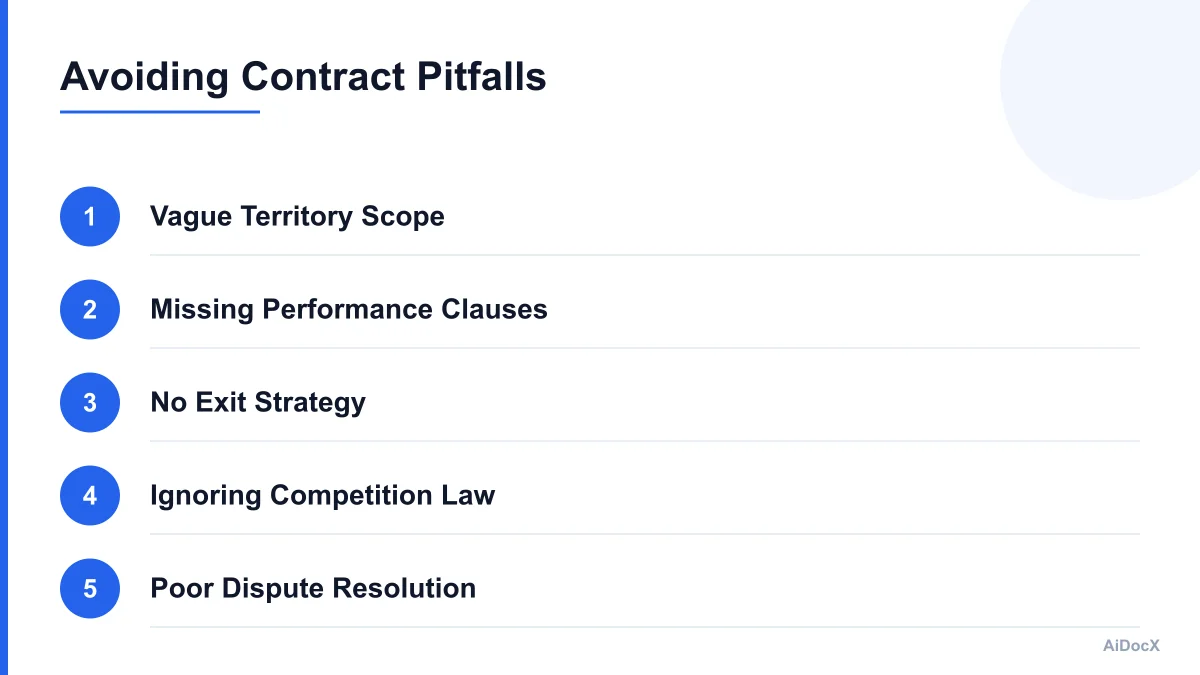
1. Vague Territory Definitions
Using terms like "all of Asia" or "the Northeast" without defining borders can lead to disputes over whether a customer in a border region belongs to you or your partner. Always use precise legal definitions.
2. Ignoring Competition Law (Antitrust)
Exclusivity agreements can sometimes violate antitrust laws if they significantly restrain trade. In the EU and US, regulators scrutinize agreements that lock out competitors from the market.
- Safe Harbor: Ensure your agreement does not create a monopoly. It should be limited in scope and duration to what is necessary to protect legitimate business interests.
- Consult Legal Counsel: Always have a lawyer review your agreement for compliance with local and international competition laws.
3. Missing Performance Clauses
Granting exclusivity without performance requirements is risky. If your distributor fails to market the product, you are stuck with no one else to sell to, while your product gathers dust. Always include minimum sales targets.
4. Overlooking Intellectual Property (IP) Rights
Who owns the IP created during the partnership? If you co-develop a marketing campaign, who owns the assets? Clarify IP ownership in the agreement to avoid future disputes.
5. Poor Dispute Resolution Mechanisms
Litigation is expensive. Include a clause specifying how disputes will be resolved.
- Arbitration: Often faster and cheaper than court.
- Mediation: A neutral third party helps facilitate a settlement.
- Jurisdiction: Specify which state or country’s laws apply.
Leveraging Technology for Enforceable Contracts
In 2026, the way businesses draft and execute contracts has evolved. Manual drafting is prone to errors, and traditional signing processes are slow. Digital contract lifecycle management (CLM) platforms offer a more efficient and secure alternative.
Benefits of Digital Contract Platforms
- Standardized Templates: Use pre-approved, legally vetted templates that ensure consistency and compliance.
- Automated Clauses: Insert standard clauses for jurisdiction, termination, and IP protection with a single click.
- E-Signature Integration: Get agreements signed quickly and securely, with an audit trail for legal proof.
- Collaborative Editing: Multiple parties can review and comment on the document in real-time, reducing back-and-forth emails.
How AiDocX Simplifies the Process
AiDocX is designed to help small businesses create professional, enforceable contracts without the need for expensive legal counsel. The platform drafts an exclusivity agreement with a clear scope, territory, and term, then gets it signed so an exclusive relationship is enforceable, not just a verbal understanding.
By using AiDocX, you can:
- Select a Template: Choose from a library of exclusivity agreement templates tailored for suppliers, distributors, and partners.
- Customize Easily: Fill in the blanks with your specific terms, such as territory, products, and performance metrics.
- Review and Sign: Invite your partner to review and sign the document electronically, ensuring a seamless and legally binding process.
Checklist for Finalizing Your Exclusivity Agreement
Before signing, ensure you have addressed all critical elements. Use this checklist to review your draft.
- Scope Defined: Are the products/services and territory explicitly defined?
- Term Specified: Is the start date, end date, and renewal process clear?
- Performance Metrics: Are there measurable KPIs (sales, volume, etc.)?
- Termination Clause: Are conditions for termination (cause and convenience) outlined?
- Pricing Terms: Are prices, discounts, and payment terms agreed upon?
- IP Rights: Is intellectual property ownership clarified?
- Dispute Resolution: Is the method for resolving disputes specified?
- Compliance Check: Has the agreement been reviewed for antitrust/competition law compliance?
- E-Signature Ready: Is the document formatted for easy digital signing?
If the exclusivity is part of a wider reseller or distributor deal, our distribution agreement template shows how to pair it with minimum purchases and territory terms.
Conclusion
An exclusivity agreement is a powerful tool for small businesses seeking to secure their market position and supply chain. However, its value lies in its precision. A vague or poorly drafted agreement can lead to disputes, lost revenue, and legal headaches. By clearly defining the scope, territory, term, and performance metrics, you can protect your business and build a stronger, more predictable partnership.
Leveraging technology like AiDocX can streamline the drafting and signing process, ensuring that your agreement is not only comprehensive but also legally enforceable. In 2026, where speed and accuracy are paramount, taking the time to draft a robust exclusivity agreement is an investment that pays dividends in stability and growth.
Don’t leave your exclusive partnership to chance. Start drafting your exclusivity agreement today with AiDocX and secure the future of your business.
Ready to automate your documents with AI?
Start free with AiDocX — AI contract drafting, meeting minutes, consultation notes, e-signatures, and more in one platform.
Get Started FreeMore from AiDocX Blog
Buy Sell Agreement Template (2026): Triggers, Valuation and Funding for Co-Owners
A free buy sell agreement template for co-owners, with triggering events, valuation methods, insurance funding and cross-purchase vs. redemption structures.
James September 26, 2026 12 min
Consignment Agreement Template (2026): Commission, Title, Risk of Loss and Unsold Goods
Free consignment agreement template for makers, artists and boutiques: commission split, title, insurance and how to protect consigned inventory.
James September 26, 2026 9 min
Distribution Agreement Template (2026): Territory, Exclusivity, Minimums and Reseller Terms
Free distribution agreement template (works as a reseller agreement template too): territory, exclusivity, minimums, pricing, IP and termination.
James September 26, 2026 13 min