Cross-Border Freelance Contracts: Currency, Tax & Law 2026
Master international freelance contracts: currency clauses, tax withholding, jurisdiction selection, and payment terms that actually get you paid on time.
 James · Content Manager July 4, 2026 5 min read
Cross-Border Freelance Contracts: Currency, Tax & Law 2026
Working with overseas clients unlocks higher rates and new markets, but it also multiplies the risk of payment delays, unexpected tax bites, and jurisdictional disputes. A standard domestic contract won’t cut it. You need a cross-border agreement that explicitly addresses currency, withholding, governing law, and payment mechanics before the first deliverable ships.
Why Cross-Border Contracts Fail (or Succeed)
Domestic freelance agreements usually assume a single currency, one tax authority, and a local court system. International work breaks all three assumptions. When those variables are left to “industry standard” or verbal agreement, you end up absorbing conversion losses, surprise tax filings, or months-long arbitration battles.
A strong international contract succeeds by removing ambiguity upfront. It answers four questions before work begins:
- What currency is invoiced and paid in?
- Who bears conversion fees and exchange-rate risk?
- Which country’s tax rules apply to your income?
- Where will disputes be resolved if they arise?
Documenting these choices turns a handshake into a defensible agreement.
Lock in the Currency Clause
Currency drift can erase 3–8% of your rate over a single project cycle. A well-drafted currency clause eliminates that guesswork.
Fixed-rate clause: Invoices and payments are denominated in a single currency (usually USD, EUR, or GBP). The client pays the exact amount regardless of exchange-rate movement. This is the simplest option and the most common for short-term engagements.
Floating-rate clause: Ties payment to a live exchange rate on the invoice date. Useful for long-term retainers where rates swing significantly. Pair it with a conversion fee cap so neither side gets hit by bank spreads.
Multi-currency clause: Allows invoicing in either party’s preferred currency, with a clear rule for which rate source (e.g., XE, OANDA, or your bank’s mid-market rate) applies.
Regardless of which you choose, specify:
- The exact currency for invoicing
- The payment window (net 15, net 30, milestone-based)
- Who pays wire fees, SWIFT charges, and platform conversion spreads
- What happens if a payment is delayed past the due date (late fee or rate adjustment)
Who Pays the Taxes?
Tax obligations depend on your residency, the client’s location, and whether a double taxation treaty exists between the two countries. Leave this to chance and you may face double withholding or an unexpected filing deadline.
Key concepts to address in your contract:
- Withholding tax: Some countries deduct tax at source before paying you. State clearly whether your rate is gross (client covers withholding) or net (you absorb it).
- Permanent establishment risk: If you spend too much time physically working in the client’s country, you could trigger corporate tax liability there. Remote-only work usually avoids this, but document your location explicitly.
- VAT/GST handling: EU clients often require your VAT number. Non-EU freelancers typically invoice without VAT, but the contract should state who is responsible for local sales taxes.
- Tax indemnity: A short clause stating that each party handles their own tax reporting, protecting you from the client’s compliance failures.
You don’t need to become a tax attorney, but naming these responsibilities in writing prevents surprise invoices from revenue authorities.
Pick a Jurisdiction and Dispute Forum
When a client delays payment or disputes scope, you need a predictable path to resolution. Leaving jurisdiction blank means you could end up litigating in a foreign court under unfamiliar rules.
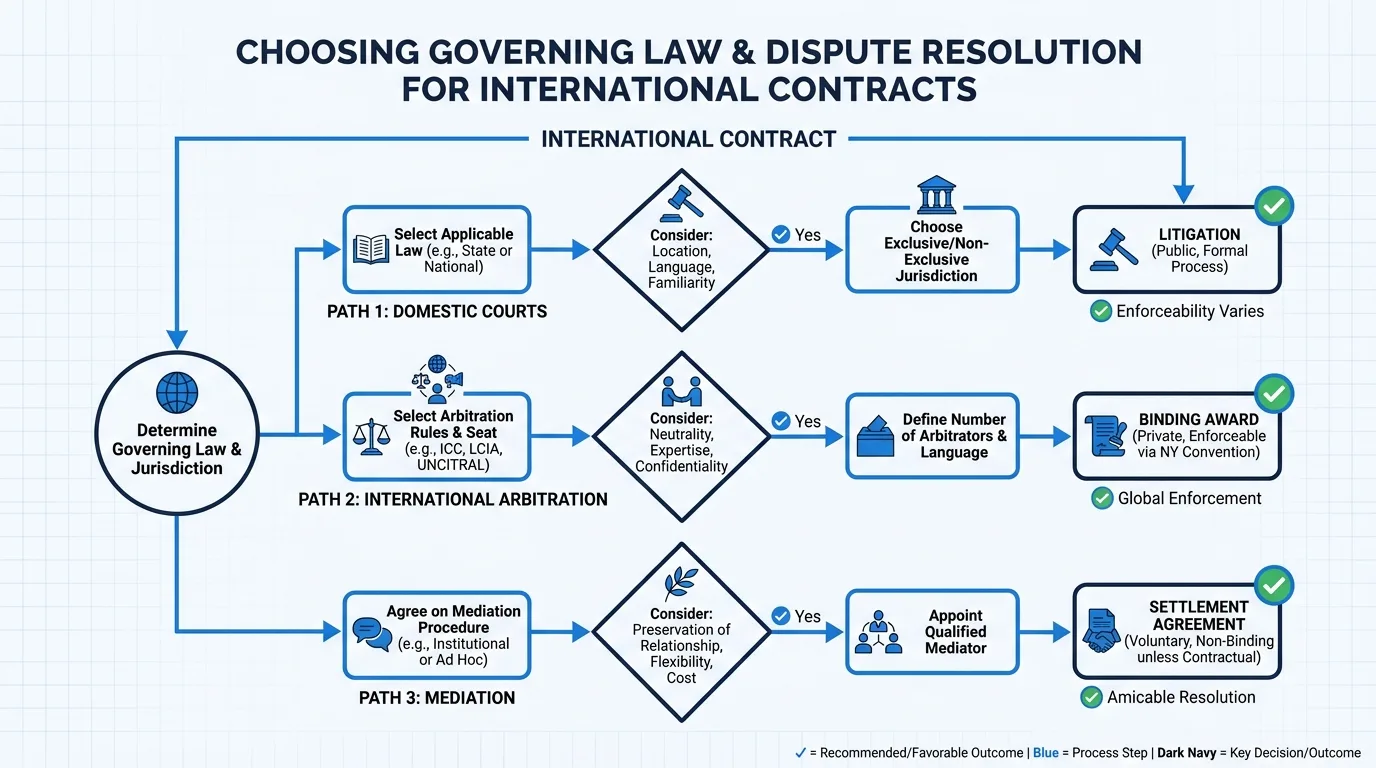
Governing law: Choose the legal system that will interpret the contract. Most freelancers pick their home jurisdiction for simplicity, but mid-size clients may push back. A neutral option is the law of a commercially stable country like England & Wales or Singapore.
Dispute resolution: Pick one of three tracks:
- Mediation first: Low cost, preserves the relationship, non-binding.
- Arbitration (e.g., ICC, LCIA, or AAA): Binding, faster than court, internationally enforceable under the New York Convention.
- Courts: Highest cost, longest timeline, but strongest enforcement tools.
State the exact venue, language, and how legal costs are allocated. Most cross-border contracts also include a “pay-when-paid” carve-out that lets you pause work after 15 days of non-payment without breaching the agreement.
Structure Your Payment Terms
Clear payment mechanics reduce chase emails and late invoices. Build these into the contract from day one:
- Milestone triggers: Tie payments to specific deliverables, not calendar dates. “Invoice issued upon acceptance of Phase 2” beats “Payment due March 31” when timelines shift.
- Payment method: Specify bank transfer, Wise, Payoneer, or crypto. Note account details in an appendix so they can’t be changed mid-project without written notice.
- Late payment policy: Add a 1.5% monthly interest charge on overdue balances. It sounds aggressive, but it’s standard in international B2B work and dramatically improves collection rates.
- IP transfer condition: State that copyright or license rights transfer only after full payment clears. This is your strongest leverage when a client stalls.
Quick-Check: Your International Contract Readiness
Before sending your next proposal overseas, run through this list:
- Currency and exchange-rate rule clearly defined
- Gross vs. net tax wording included
- Governing law and dispute forum selected
- Payment milestones tied to deliverables
- Late fee and interest clause added
- IP transfer conditional on full payment
- Signature method compatible with the client’s country (e-signature laws vary)
If you can tick all seven, your agreement covers the four pillars of cross-border freelance work. Platforms like AiDocX generate cross-border-ready contracts you can e-sign in any country, so you spend less time formatting and more time billing.
Final Note
International clients pay premium rates because they need reliability, not just talent. A contract that handles currency, tax, jurisdiction, and payment mechanics upfront signals professionalism and removes friction from every invoice. Draft it once, reuse the structure, and collect on time, every time.
Ready to automate your documents with AI?
Start free with AiDocX — AI contract drafting, meeting minutes, consultation notes, e-signatures, and more in one platform.
Get Started FreeMore from AiDocX Blog
Machine Shop Job Traveler Template: Routing Sheet + Example
Copy a machine shop job traveler template for small job shops. Includes a routing sheet, filled example, traceability fields, sign-offs, and setup tips.
Weekly Status Report Template: 4 Formats + Examples
Copy one of four weekly status report templates for individual work, projects, leadership, or blockers. See a worked example and a practical review checklist.

How to Read a Business Contract: A Founder's Checklist (2026)
A practical way to review parties, scope, money, IP, liability, and exit terms before signing a business contract.
 MinjiLee October 7, 2026 9 min