
How to Write a Contract from Scratch: A 2026 Guide
Learn how to write a contract from scratch with essential clauses, clear structure, practical examples, and common mistakes to avoid.
 James · Content Manager August 21, 2026 17 min read
How to Write a Contract from Scratch: A 2026 Guide
Writing your first contract can feel intimidating, especially when you are not a lawyer or legal professional. The good news is that most practical business contracts follow a predictable structure: identify the parties, describe the agreement, explain payment and responsibilities, and set out what happens if something goes wrong.
This guide explains how to write a contract from scratch for common small-business and freelance arrangements. It is educational information, not legal advice. If the agreement involves significant money, intellectual property, employment, real estate, regulated work, or unusual risk, have a qualified lawyer review it before signing.
Decide What the Contract Must Accomplish
Before writing a single clause, define the business deal in plain language. A contract is easier to draft when you know exactly what the parties have agreed to do.
Start by answering five questions: who is making the agreement, what is each party promising to do, what will be delivered and when, how much will be paid and under what conditions, and what happens if either party does not perform.
For example, a freelance web designer might summarize a project like this: "The designer will create a five-page website for the client, including a mobile layout and two rounds of revisions. The client will provide content by May 10, pay $2,400 in three installments, and approve the final design within five business days."
That summary already contains the foundation of a contract. It identifies the service, deliverables, revision limit, client responsibility, price, payment schedule, and approval process.
The purpose of this first step is to expose uncertainty early. If you cannot describe the deal clearly in a paragraph, the contract will probably contain gaps or contradictions.
Think about the relationship as well. A one-time project may need a simple services agreement. An ongoing relationship might require a master services agreement with separate statements of work. A consultant handling confidential information may need confidentiality and data-security provisions. A business selling physical goods will need delivery, inspection, warranty, and risk-of-loss language.
Do not begin with legal-sounding phrases copied from an unrelated template. Begin with the actual commercial arrangement. The legal wording should support the deal, not hide the fact that the deal itself is unclear.
Start with the Contract's Basic Structure
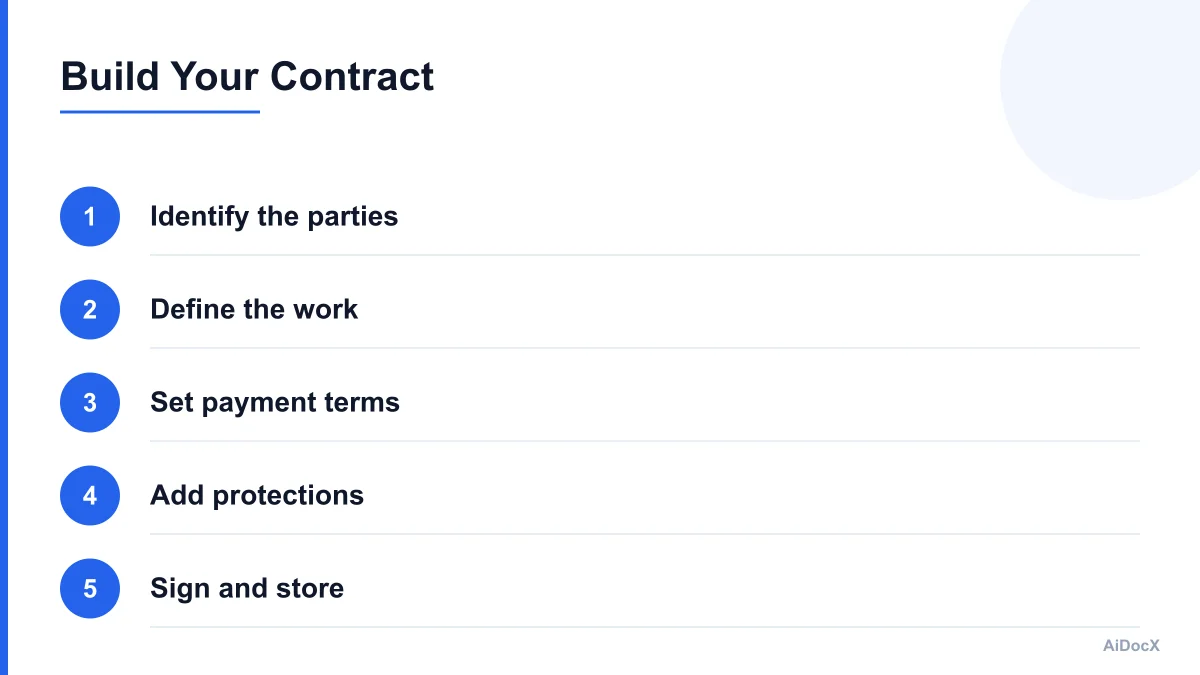
A well-organized contract lets both parties find important information quickly. The exact order can vary, but a straightforward small-business agreement often includes these sections: title, effective date, parties, background or purpose, definitions, scope of work or obligations, deliverables and timeline, payment terms, changes and additional work, confidentiality, intellectual property, representations and warranties, liability and indemnification, term and termination, dispute resolution and governing law, general terms, signatures, and attachments or schedules.
You may not need every section. A simple agreement for a low-risk service may be only a few pages. A larger or more sensitive engagement may require much more detail.
The title should describe the agreement accurately, such as "Freelance Graphic Design Agreement" or "Small Business Consulting Agreement." Avoid calling a document a "Memorandum of Understanding" if you intend it to be binding. Labels do not always determine legal effect, but misleading titles can create confusion.
Next, state the effective date. This is the date from which the obligations begin, and it may be different from the date on which the parties sign. If work begins immediately after signing, use language such as: "This Agreement is effective as of June 1, 2026, regardless of the date on which the parties sign it."
Identify each party using its full legal name and address. If a party is a company, include its legal entity name rather than only its brand name. State who is signing on behalf of the company and, where useful, the signer's title.
For example: "This Freelance Services Agreement is between Bright Oak Studio LLC, a California limited liability company with an address at [address] ('Client'), and Jordan Lee, an independent contractor with an address at [address] ('Contractor')."
After defining short names such as "Client" and "Contractor," use those terms consistently throughout the document.
Definitions are useful when a word has a special meaning or appears repeatedly. Define "Deliverables," "Business Day," "Confidential Information," or "Services" when doing so prevents confusion. Do not create a long dictionary of ordinary terms. Every definition should make a later clause more precise.
The background section, sometimes called recitals, can explain why the parties are entering the agreement. Keep it short. The operative sections, the clauses that create obligations, should contain the actual promises.
Define the Work, Deliverables, and Timeline
The scope of work is often the most important section in a small-business or freelance contract. Many disputes begin because the parties have different ideas about what "complete," "as needed," or "standard support" means.
Describe the work specifically enough that someone who was not part of the original conversation could understand it. Include the tasks or services being provided, the expected format of each deliverable, the number of versions, pages, hours, or units included, deadlines or project milestones, client or customer dependencies, review and approval procedures, and what is expressly excluded.
Consider this weak description: "Contractor will provide marketing support as needed." It leaves almost every important question unanswered. A stronger version might say: "Contractor will create a 30-day content calendar, write eight social media posts, prepare four email newsletters, and attend one monthly planning call. The Services do not include paid advertising management, video production, community management, or weekend support unless added through a written change order."
The second version is not necessarily perfect, but it gives the parties a shared starting point.
Use a table or schedule when the project has several deliverables:
| Deliverable | Due date | Included revisions | Acceptance standard |
|---|---|---|---|
| Brand questionnaire | May 5 | None | Client submits completed form |
| Initial logo concepts | May 19 | One round | Three distinct concepts delivered |
| Final logo files | June 2 | One minor revision | Files supplied in agreed formats |
A timeline should explain what happens when one party causes a delay. For example: "Any deadline dependent on Client materials will be extended by the number of business days that Client's delivery is late."
Include a review process. Without one, a client may continue requesting changes indefinitely or remain silent while the freelancer waits for approval.
A practical clause could state: "Client will review each deliverable within five business days after receipt and either approve it or provide one consolidated list of specific revisions. If Client does not respond within that period, the deliverable will be deemed accepted for scheduling and invoicing purposes."
Be careful with "deemed accepted" language. It may be inappropriate for regulated work, consumer transactions, or projects where approval has legal or safety significance. The point is to create a clear process, not to force an unfair result.
Set a boundary around revisions and additional work. State how many revision rounds are included, what qualifies as a revision, and how extra work is approved and billed. A useful distinction is that a revision changes or refines work within the original brief, while additional work changes the brief, adds a new deliverable, or requires work outside the stated scope.
Set Clear Payment and Expense Terms
Payment language should answer more than "the client will pay $X." It should explain the amount, timing, method, invoice requirements, taxes, expenses, and consequences of late payment.
Choose the pricing model: fixed fee (one agreed amount for a defined scope), hourly (payment based on recorded time), milestone-based (payment when specified stages are completed), retainer (payment for reserved availability or recurring services), or usage-based (payment tied to units, transactions, or volume).
For a fixed-fee project, describe the payment schedule: "The total project fee is $3,600, payable as follows: $1,200 upon signing, $1,200 upon delivery of the first approved concept, and $1,200 upon delivery of the final files."
For hourly work, include the rate and billing increment: "Contractor will bill at $125 per hour in increments of 15 minutes. Contractor will provide a monthly invoice showing the date, description, and time spent on each task."
If there is a spending limit, state whether it is a hard cap or an estimate: "Contractor will not exceed 20 billable hours in a calendar month without Client's prior written approval."
Define when invoices are due. "Net 30" generally means payment is due 30 days after the invoice date, but plain language is better for a first contract: "Client must pay each undisputed invoice within 30 calendar days after receiving it."
Explain how invoice disputes work. Otherwise, a minor dispute about one line item might be used to delay the entire payment.
"If Client disputes part of an invoice, Client must notify Contractor in writing within 10 days and identify the disputed amount and reason. Client will timely pay the undisputed portion."
Address late fees only if they are lawful and commercially appropriate. You can write: "Overdue undisputed amounts may accrue interest at the lesser of 1% per month or the maximum amount permitted by applicable law."
The phrase "maximum amount permitted by law" matters because interest and late-fee rules differ by location and transaction type.
List reimbursable expenses and approval requirements. A freelancer may expect travel, printing, stock assets, or specialist services to be reimbursed, while a client may assume those costs are included.
"Client will reimburse reasonable, documented travel expenses that Client approves in writing before they are incurred. Ordinary office expenses are included in the project fee."
State whether taxes are included. A contractor may be responsible for their own income taxes, while sales tax, VAT, or similar transaction taxes may depend on the service and location. Avoid making broad tax claims without checking the relevant rules.
Add the Clauses That Protect Both Parties
Once the commercial terms are clear, add clauses that manage risk and define ownership.
Confidentiality
A confidentiality clause explains what information must be protected, how it may be used, and when it may be disclosed. Define confidential information broadly enough to be useful but include reasonable exclusions.
Typical exclusions cover information that is already public through no breach of the agreement, was already known to the receiving party, is independently developed without using confidential information, is lawfully received from another source, or must be disclosed by law or court order.
Also state how long confidentiality obligations last and what happens when the relationship ends. A short project may require the return or deletion of files after completion. Trade secrets may need protection for as long as they remain trade secrets.
Intellectual property
Do not assume that payment automatically answers who owns the work. State whether the creator retains ownership, grants a license, or assigns rights after full payment.
A client-friendly assignment may say: "Upon Contractor's receipt of full payment, Contractor assigns to Client all transferable rights in the final Deliverables created specifically for Client under this Agreement."
That clause should distinguish final deliverables from pre-existing tools, templates, methods, code libraries, fonts, stock assets, and third-party materials. A freelancer may need to retain ownership of those materials while giving the client a license to use them as part of the deliverables.
For example: "Contractor retains ownership of pre-existing materials, general skills, know-how, reusable tools, and third-party materials. To the extent any such materials are incorporated into the Deliverables, Contractor grants Client a perpetual, worldwide, non-exclusive license to use them as part of the Deliverables."
Do not promise ownership of material that cannot legally be assigned, such as certain third-party assets. Confirm that required licenses are available.
Independent contractor status
If the relationship is intended to be independent contracting, say so, but understand that a label alone does not determine classification. The actual working relationship and applicable law matter.
A basic provision might state: "Contractor is an independent contractor and is responsible for determining how to perform the Services, subject to the deadlines and specifications in this Agreement. Nothing in this Agreement creates an employment, partnership, joint venture, or agency relationship."
Avoid clauses that contradict this arrangement by controlling every detail of when, where, and how the person works.
Warranties and disclaimers
A warranty is a promise about quality, performance, authority, or compliance. Be specific. "Work will be professional" may be useful, but it is open to interpretation.
You might state that each party has authority to enter the agreement and that the contractor will perform services with reasonable care and skill. If you offer a limited correction period, define it.
Do not include an absolute promise that the work will produce a particular business result unless you are prepared to guarantee that outcome.
Liability and indemnification
These clauses determine who bears certain losses. They can be complex, and they deserve legal review for higher-value agreements.
A limitation of liability may exclude indirect or consequential damages or cap liability at a stated amount. If you use a cap, consider exceptions for unpaid fees, confidentiality breaches, intellectual property infringement, fraud, willful misconduct, or other risks that should not be capped.
Indemnification generally requires one party to defend or reimburse the other for specified third-party claims. Define the trigger and procedure instead of writing "Party A indemnifies Party B for everything."
Handle Changes, Termination, and Disputes
A good contract explains how the relationship can change or end.
Changes
Require changes to the scope, price, or schedule to be approved in writing. Email may be enough if the contract permits it. A simple change-order clause could say: "Any change to the Services, Deliverables, fees, or deadlines must be agreed in writing by both parties. The written change must describe the adjustment and its effect on the project schedule and price."
Decide whether a client may verbally request work and whether the contractor can rely on that request. If verbal instructions are common, establish a process for confirming them by email.
Termination for convenience
This allows one or both parties to end the agreement without proving a breach. State the required notice period and what happens to work already performed.
"Either party may terminate this Agreement for convenience by giving 14 days' written notice. Client will pay for Services performed and approved expenses incurred through the termination date."
Termination for cause
This addresses serious breaches. Give the breaching party a chance to fix a curable problem: "Either party may terminate this Agreement if the other party materially breaches it and does not cure the breach within 10 days after receiving written notice describing the breach."
Some events, such as insolvency, fraud, or unlawful conduct, may justify immediate termination, but use such language carefully.
After termination
State which provisions survive termination. Payment obligations, confidentiality, intellectual property rights, dispute provisions, and liability clauses often continue after the project ends.
Disputes
Set out the process for handling disagreement. A practical sequence might be: the parties discuss the issue in good faith, a senior representative reviews the dispute, the parties attempt mediation, and a court or arbitrator resolves the remaining dispute.
State the governing law and venue, but do not choose a location casually. The choice can affect cost, procedure, and enforceability. Arbitration clauses can also have significant consequences, so use them only when you understand the tradeoffs.
Make the Contract Easy to Interpret
Precision is more valuable than impressive legal language. Write short sentences and give each clause one job.
Use "must" for obligations and "may" for permissions. Avoid relying on "shall" when it could be read as either a duty or a future event. Replace vague phrases with measurable standards.
Vague: "Contractor will respond promptly." Clearer: "Contractor will acknowledge support requests within one business day and will provide an estimated resolution time when the issue cannot be resolved during the initial response."
Vague: "Client will pay shortly after completion." Clearer: "Client will pay the final invoice within 15 calendar days after receiving it."
Watch for internal contradictions. A contract might say payment is due on delivery in one section and net 30 in another. It might promise unlimited revisions while listing two included rounds in an attachment. Create a simple term sheet before drafting, then compare every clause against it.
Use consistent terms. If you define "Services," do not switch between "work," "project," and "deliverables" when the distinction matters. Capitalize defined terms consistently.
Number sections and subsections. Cross-references should point to exact sections rather than "the paragraph above." Use attachments for detailed specifications, pricing tables, technical requirements, or project schedules. The main agreement should state which attachments are part of the contract and what happens if they conflict.
Include an order-of-precedence clause when multiple documents form the agreement: "If there is a conflict between this Agreement and a Statement of Work, this Agreement controls unless the Statement of Work expressly identifies the provision it overrides."
Keep formatting professional and accessible. Use readable fonts, sufficient spacing, page numbers, and a version date. Avoid hiding important terms in tiny text or dense blocks.
Electronic signatures may be valid in many jurisdictions, but the parties should retain a complete copy showing the signed version, signature dates, and any authentication record. Make sure all referenced attachments are included in that final copy.
Avoid These Common First-Contract Mistakes
The most common problems are not usually dramatic legal errors. They are missing details, unclear assumptions, and terms that do not match the actual business relationship.
One mistake is using the wrong legal name. A brand name may not be the entity that owes payment or owns the contract rights. Confirm the legal identity of each party before signing.
Another is leaving the scope open-ended. "Unlimited support" and "all reasonable requests" can create unlimited obligations. Define hours, response times, channels, included tasks, and exclusions.
Do not promise a deadline that depends entirely on the other party without addressing delays. If the client must provide approvals, data, credentials, or content, say how those dependencies affect the schedule.
Avoid treating an estimate as a fixed price by accident. Write "estimated" when the amount may change, and explain the billing method and approval threshold.
Do not copy clauses from an unrelated template without understanding them. A construction indemnity clause may be inappropriate for a copywriter. A consumer privacy clause may not address the data your business actually handles. Templates are starting points, not substitutes for judgment.
Watch for one-sided cancellation terms. A client may want to cancel at any time, while the freelancer may need compensation for reserved capacity or non-cancellable commitments. A fair termination clause should explain the financial result for both sides.
Do not ignore ownership of source files. For design, software, video, and content projects, specify whether the client receives editable files, source code, working files, or only final exports.
Avoid defining every dispute as a material breach. A missed email should not automatically allow termination of a major agreement. Use materiality, notice, and cure periods where appropriate.
Do not forget practical administration. A contract that lacks notice addresses, invoice instructions, contact persons, or a process for updating details may be difficult to operate.
Finally, do not sign while key terms remain in brackets or comments. Search the document for placeholders such as "[insert amount]," "[company name]," and "TBD." A complete-looking document can still contain unfinished drafting.
Review the Contract Before Signing
Before sending the contract, read it once as the person who will perform the work and once as the person who will pay for it. Ask what each party would reasonably expect to happen next.
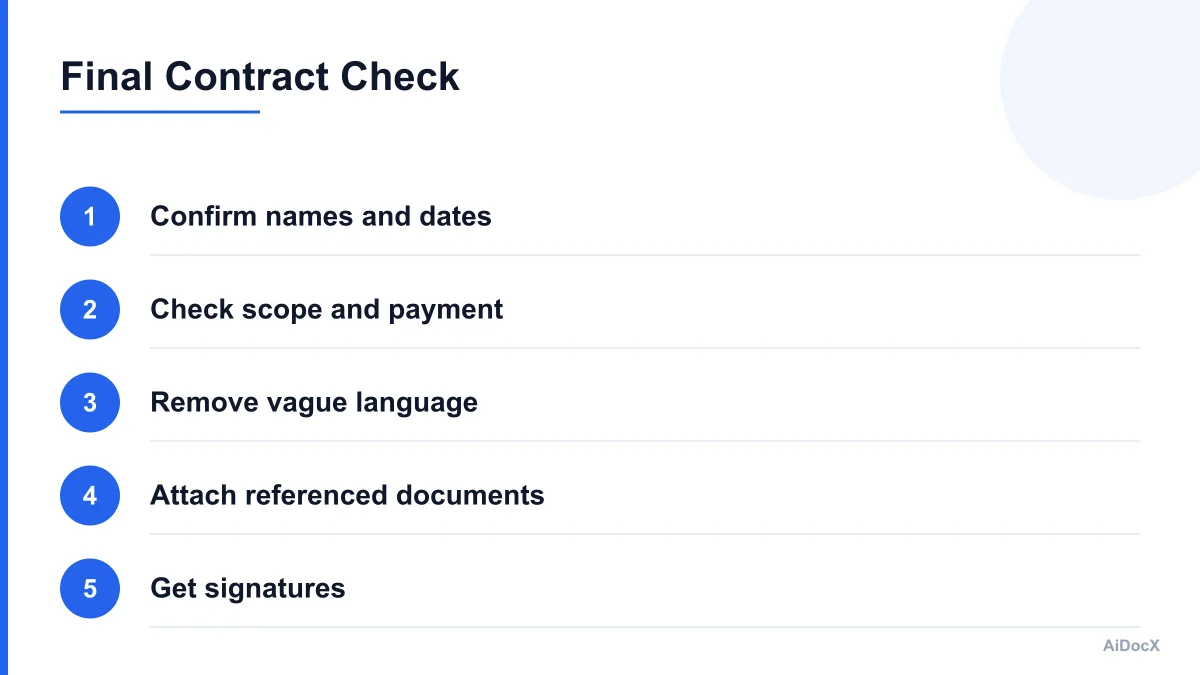
Use this review sequence: confirm the parties' legal names and contact details, confirm the effective date and project dates, compare the scope with the original proposal or email, verify every deliverable, quantity, format, and deadline, check the price, payment schedule, invoice process, taxes, and expenses, confirm the revision, acceptance, and change-order rules, review confidentiality, data handling, and security requirements, confirm intellectual property ownership and licenses, check warranties, liability limits, indemnities, and insurance requirements, confirm termination rights and post-termination payment, review governing law, venue, and dispute procedures, check attachments, definitions, cross-references, and page numbers, remove all placeholders, tracked changes, and internal comments, and confirm that every party signs the same final version.
A second reader can catch issues that the drafter overlooks. Ask someone to explain the agreement back to you in plain language. If their summary differs from your understanding, revise the relevant clause.
For agreements with meaningful financial or legal risk, a lawyer's review can be more valuable than adding another page of generic terms. Tell the lawyer what matters most to you, such as getting paid, limiting liability, protecting customer data, or retaining ownership of reusable work. Focused review is often more efficient than asking for a document to be "checked" without context.
- Are the parties identified by their legal names?
- Is the scope specific enough to measure?
- Are deliverables, deadlines, and dependencies clear?
- Are payment terms and late-payment rules complete?
- Are revisions and extra work addressed?
- Is intellectual property ownership explicit?
- Are confidentiality and data obligations appropriate?
- Do termination and dispute clauses match the relationship?
- Are all attachments included and consistent?
- Have placeholders and comments been removed?
- Has each party signed and received the final copy?
For a simple agreement, you can draft the first version in a document editor using this structure and then refine it through review. If you want to move faster, AiDocX's AI contract generator can create a structured starting draft from the deal terms you provide. Treat the generated document as a draft to inspect and customize, especially for local law, unusual risk, and industry-specific requirements.
A contract is successful when it makes the business relationship easier to understand and manage. Start with the actual deal, define the work and money precisely, add protections that fit the risks, and review the final document carefully before signing.
Ready to automate your documents with AI?
Start free with AiDocX — AI contract drafting, meeting minutes, consultation notes, e-signatures, and more in one platform.
Get Started FreeMore from AiDocX Blog
Weekly Status Report Template: 4 Formats + Examples
Copy one of four weekly status report templates for individual work, projects, leadership, or blockers. See a worked example and a practical review checklist.

How to Read a Business Contract: A Founder's Checklist (2026)
A practical way to review parties, scope, money, IP, liability, and exit terms before signing a business contract.
 MinjiLee October 7, 2026 9 min
ESIGN vs eIDAS: What Founders Should Know About E-Signatures (2026)
What U.S. ESIGN and EU eIDAS actually say, where exceptions apply, and what founders should keep to document an electronic signing.
MinjiLee October 7, 2026 7 min