Independent Contractor vs Employee: Avoid Misclassification in 2026
Small business owners: avoid IRS penalties in 2026. Learn the key differences between independent contractors and employees, plus a checklist to protect your business.
 James · Content Manager August 8, 2026 14 min read
Independent Contractor Agreement vs Employee: How Small Businesses Avoid Misclassification Risk in 2026
Misclassification is one of the most expensive mistakes a small business can make. In 2026, with the IRS and Department of Labor actively auditing gig-economy models and traditional hiring practices, the line between a contractor and an employee has never been more scrutinized. A single misclassified worker can trigger back taxes, penalties, interest, and even criminal charges in extreme cases of willful evasion.
For small business owners, the temptation to hire a "1099" worker is often driven by simplicity and cost savings. There are no payroll taxes, no benefits administration, and less paperwork. However, this convenience comes with a significant legal risk. If the worker is deemed an employee by law, your business is liable for every tax and benefit they should have received from day one.
This guide breaks down exactly how to distinguish between an independent contractor and an employee under current 2026 regulations. We will walk you through the three primary tests used by federal agencies, provide a practical assessment framework, and show you how to structure your agreements and business practices to minimize risk.
The Core Difference: Control and Relationship
At its heart, the distinction between an independent contractor and an employee boils down to one question: Who controls the work?
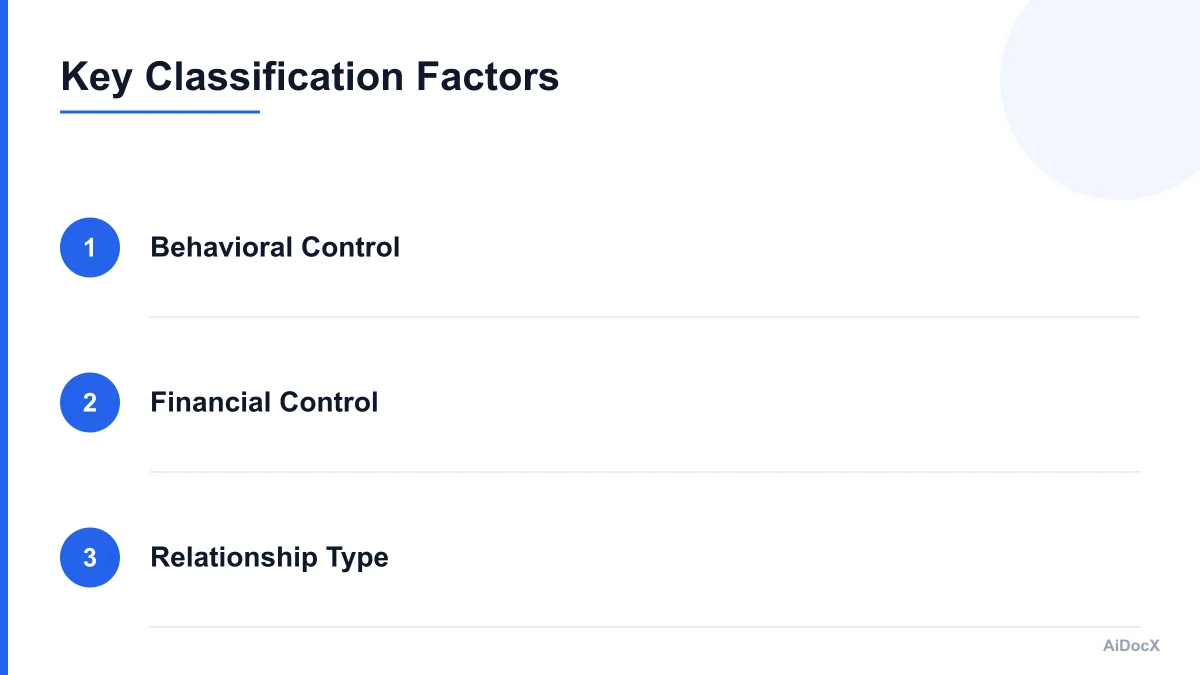
The IRS does not use a single rigid definition. Instead, it uses a "common law" test that looks at the entire relationship between the worker and the business. While there are hundreds of factors, they generally fall into three broad categories: Behavioral Control, Financial Control, and the Type of Relationship.
Behavioral Control
Behavioral control asks whether the business has the right to direct and control how the worker performs the task. This is divided into two subcategories:
- Instructions: If the business tells the worker when, where, and how to work, it is likely an employment relationship.
- Employee Example: You require the worker to follow specific company procedures, use specific tools provided by the company, or report in daily.
- Contractor Example: The worker decides how to achieve the result. You only care about the final deliverable, not the process.
- Training: If the business provides training on methods, procedures, or rules, it suggests an employer-employee relationship. Independent contractors are expected to bring their own expertise and methods to the job.
Financial Control
Financial control examines whether the business has the right to control the business aspects of the worker’s job. Key factors include:
- Significant Investment: Does the worker have their own office, equipment, or tools? If they provide their own laptop, software, and vehicle, they are more likely a contractor.
- Unreimbursed Expenses: Contractors typically bear their own business expenses.
- Opportunity for Profit or Loss: Can the worker make a profit by managing their expenses, or can they lose money if their methods are inefficient? Employees generally receive a set wage regardless of the company’s profitability.
- Services Available to the Market: Does the worker offer their services to the general public or other businesses? A true contractor markets their services to multiple clients. An employee works exclusively for one company.
Type of Relationship
This factor looks at how the worker and business perceive their interaction. Consider:
- Written Contracts: Does the contract describe the relationship as independent contractor or employee? (Note: The label on the contract is not definitive; the actual practice matters more.)
- Benefits: Does the business provide insurance, pension plans, vacation pay, or sick leave? These are strong indicators of employment.
- Permanency: Is the relationship indefinite or ongoing? Contractors are often hired for a specific project or time period.
- Key Aspect of Business: Is the work performed a key aspect of the business? If you run a software company and hire a coder, that coder is performing a core business function, which leans toward employee status. If you hire a plumber to fix a leak, that is a peripheral service, leaning toward contractor status.
The Three Major Tests: IRS, DOL, and State Laws
It is a common misconception that if the IRS says a worker is a contractor, the state or Department of Labor will agree. They often do not. In 2026, small businesses must navigate a complex web of overlapping regulations.
1. The IRS Common Law Test (Form SS-8)
The IRS uses the "Common Law" test described above. This is primarily focused on tax liability. If the IRS reclassifies a worker as an employee, the business owes:
- Social Security and Medicare taxes (both the employer and employee share).
- Federal income tax withholding.
- Federal unemployment tax (FUTA).
- Potential penalties for failure to file correct forms (1099 vs. W-2).
2. The Fair Labor Standards Act (FLSA) – Economic Reality Test
The Department of Labor (DOL) uses the "Economic Reality" test, which is often stricter than the IRS test. It focuses on whether the worker is economically dependent on the employer or in business for themselves. The DOL considers:
- Opportunity for Profit or Loss: Based on managerial skill, not just effort.
- Investments by the Worker and Employer: Comparison of relative investments.
- Degree of Permanence: Suggests employment if the relationship is indefinite and continuous.
- Nature and Degree of Control: Who controls the work?
- Integral Part of Business: Is the work essential to the principal’s business?
- Skill and Initiative: Does the worker use specialized skills in connection with business-like initiative?
3. State-Specific Laws (ABC Test)
Many states, including California (AB5), Massachusetts, New Jersey, and others, use the ABC Test. This is the strictest standard and places the burden of proof squarely on the hiring entity. To classify a worker as an independent contractor under the ABC test, you must prove all three of the following:
- (A) Control: The worker is free from the control and direction of the hiring entity in connection with the performance of the work, both under the contract and in fact.
- (B) Business: The worker performs work that is outside the usual course of the hiring entity’s business.
- (C) Independent Trade: The worker is customarily engaged in an independently established trade, occupation, or business of the same nature as the work performed.
The Trap: If you hire a graphic designer for your marketing agency, you might pass the IRS test, but you will likely fail the ABC test in states like California because graphic design is the core business of a marketing agency.
Step-by-Step: The 20-Point Assessment
To reduce anxiety and increase accuracy, use this practical assessment framework before hiring any new worker. This is not a legal opinion, but a risk-mitigation tool.
Phase 1: The Nature of the Work
- Is the work outside your core business? (e.g., a bakery hiring a lawyer vs. a bakery hiring a baker).
- Is the worker specialized? Does the worker have unique skills not easily found in the general labor market?
- Is the project finite? Is there a clear start and end date, or a specific deliverable?
- Does the worker provide their own tools? (Laptop, software, vehicle, insurance).
- Does the worker have other clients? Can you verify they serve multiple customers?
Phase 2: The Relationship Dynamics
- Do you control the schedule? Must they work 9-5, or can they set their own hours?
- Do you control the method? Do you dictate how the task is done, or just the result?
- Do you provide training? Do you teach them how to do the job?
- Is the relationship ongoing? Is it a one-off project or a recurring engagement?
- Do you provide benefits? Health insurance, PTO, retirement plans?
Phase 3: Financial Arrangements
- How are they paid? Hourly/flat fee (contractor) vs. Salary/wage (employee)?
- Do they submit invoices? Do they bill you monthly like a vendor?
- Can they lose money? If they work slower, do they earn less?
- Do they invest in their business? Do they have a separate LLC or DBA?
- Do they advertise their services? Do they have a website or LinkedIn profile marketing their services?
Phase 4: Legal and Compliance
- What does the contract say? Does it explicitly state independent contractor status?
- Do you withhold taxes? You should not withhold income or payroll taxes for contractors.
- Do you report them on Form 1099-NEC? Yes, if payments exceed $600.
- Have you checked state laws? Does your state use the ABC test?
- Have you consulted a professional? For high-risk roles, get a legal opinion.
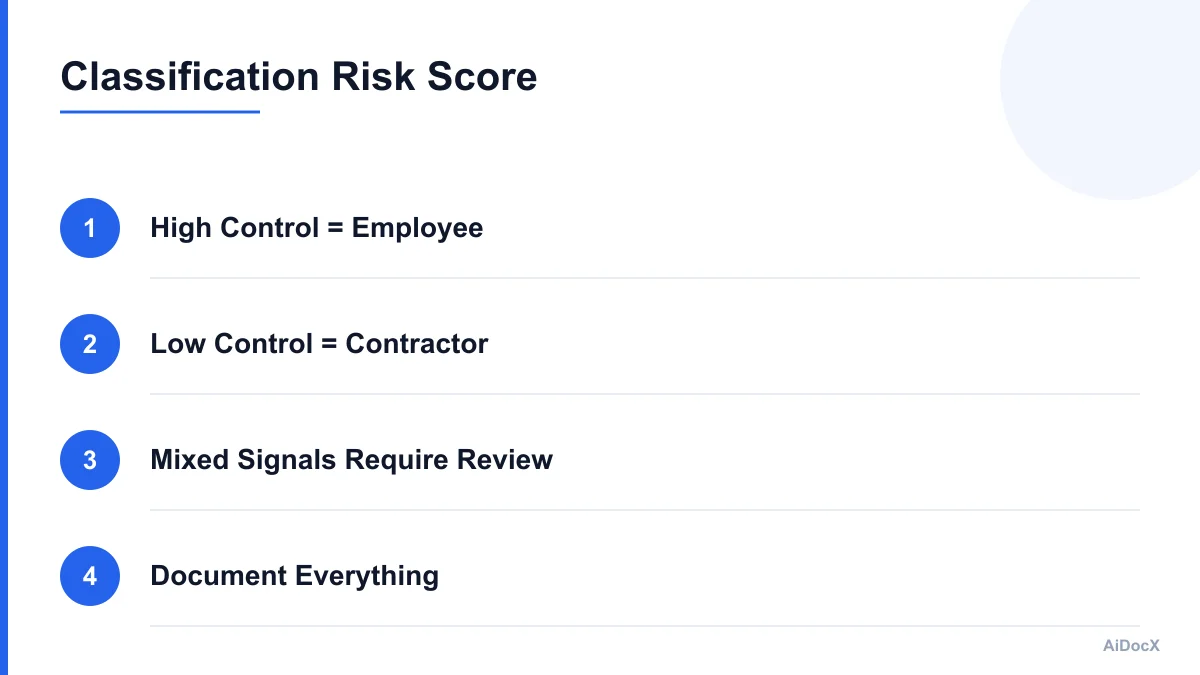
Scoring Guide:
- Mostly "No" to Employee Traits / "Yes" to Contractor Traits: Low Risk.
- Mixed Signals: Medium Risk. Document why you lean one way.
- Mostly "Yes" to Employee Traits: High Risk. Re-classify as an employee or restructure the engagement.
Common Mistakes Small Business Owners Make
Even well-intentioned business owners fall into traps that invite misclassification audits. Recognizing these patterns is the first step to avoiding them.
Mistake 1: The "Labeling" Fallacy
Many owners believe that if they sign a contract titled "Independent Contractor Agreement," the worker is automatically a contractor. This is false. The IRS and courts look at the substance of the relationship, not the label. If you treat the worker like an employee (set their hours, provide equipment, supervise their work), the label is irrelevant. The agreement will not protect you in an audit.
Mistake 2: Mixing Contractor and Employee Duties
A common scenario involves hiring a "contractor" to help with a project, but then integrating them into the team. You might give them a company email address, invite them to team meetings, or ask them to train other employees. These actions signal employee status. Keep contractors at arm's length. Do not include them in internal communications meant for employees. Do not provide them with company-branded materials unless necessary for the specific deliverable.
Mistake 3: Ignoring State Laws
A business operating in Texas might feel secure using the IRS Common Law test. But if they hire a remote worker who lives in California, California law may apply. Under California’s AB5, the worker could be deemed an employee regardless of the IRS determination. Small businesses must check the worker’s location and the business’s location laws.
Mistake 4: Over-reliance on Gig Platforms
Some businesses use platforms like Upwork or Fiverr and assume the platform handles classification. While these platforms often act as the employer of record for certain types of work, if you hire a contractor outside the platform or direct them in a way that bypasses platform protections, you may assume liability. Always read the Terms of Service of the platform you use.
Structuring the Engagement: Best Practices for 2026
If you have determined that a worker is a legitimate independent contractor, you must structure the engagement to reflect that reality. Your contract and daily operations must align.
1. Draft a Robust Independent Contractor Agreement
Your agreement should include specific clauses that reinforce the independent nature of the relationship:
- Scope of Work: Clearly define the deliverables, not the hours. Use language like "Provider shall deliver X by Y date" rather than "Provider shall work Z hours per week."
- Control Clause: Explicitly state that the contractor has the right to control the manner and means of performing the work.
- No Benefits: State that the contractor is not eligible for employee benefits, including health insurance, paid time off, or retirement plans.
- Tax Responsibility: Clarify that the contractor is responsible for all federal, state, and local taxes, including self-employment tax.
- Right to Subcontract: Allow the contractor to hire assistants or subcontractors to perform the work. This is a strong indicator of independence.
- Termination: Define termination terms that are project-based, not disciplinary.
Note on AiDocX: When drafting these terms, precision matters. AiDocX drafts a contractor agreement with the scope, control, and payment terms that support proper classification, then keeps a signed, timestamped copy on file if a hire is ever questioned. This ensures your documentation is consistent and defensible.
2. Manage the Relationship Correctly
- Do Not Set Hours: Let the contractor decide when to work. If they choose to work nights or weekends to meet a deadline, that is their business decision.
- Do Not Provide Equipment: If they need a laptop, let them buy it. If you must provide one for security reasons, lease it and treat it as a business expense, not a perk.
- Do Not Supervise: Manage the output, not the person. Have weekly status meetings to review progress, but avoid daily check-ins or micromanagement.
- Do Not Integrate: Keep them separate from the employee handbook. Do not invite them to employee-only events.
- Pay via Invoice: Require them to submit a monthly invoice. Pay them as a vendor, not through payroll.
3. Document Everything
In 2026, digital footprints are critical. Keep records of:
- The signed contract.
- Invoices received and payments made.
- Communications that show the contractor’s autonomy (e.g., emails where they propose their own methods).
- Records of the contractor’s other clients (if possible, via LinkedIn or portfolio).
The Cost of Misclassification: What’s at Stake
Why does this matter? Because the penalties are severe.
Financial Penalties
- Back Taxes: You may owe the employer’s share of Social Security and Medicare taxes (7.65%) for all wages paid, plus the employee’s share (7.65%) that should have been withheld.
- Unemployment Taxes: You may owe FUTA and state unemployment taxes.
- Interest: The IRS charges interest on unpaid taxes from the date they were due.
- Penalties: Penalties can range from 20% to 100% of the tax due, depending on whether the misclassification was reasonable cause or willful.
Non-Financial Risks
- Labor Lawsuits: Misclassified workers can sue for unpaid overtime, minimum wage violations, and vacation pay. In California, the Private Attorneys General Act (PAGA) allows workers to sue on behalf of themselves and other misclassified employees, leading to massive statutory penalties.
- Reputational Damage: Public exposure of misclassification practices can harm your brand and make it difficult to attract top talent.
- Loss of Credibility: Audits can disrupt business operations and distract leadership from growth.
Step-by-Step: The 20-Point Assessment
(Note: This section serves as a practical checklist for the reader to implement immediately.)
Use this checklist to audit your current workforce. If you answer "Yes" to more than 3 questions in the "Employee Risk" column, consult an employment lawyer.
Behavioral Control Checklist
- Does the business dictate the worker’s schedule? (Yes = Risk)
- Does the business provide training on how to do the work? (Yes = Risk)
- Does the business control the methods and tools used? (Yes = Risk)
- Is the worker subject to disciplinary action for poor performance? (Yes = Risk)
Financial Control Checklist
- Does the worker provide their own significant tools and equipment? (No = Risk)
- Does the worker have other clients who constitute their primary income? (No = Risk)
- Can the worker realize a profit or loss based on managerial skill? (No = Risk)
- Is the worker paid by the hour or salary rather than by project? (Yes = Risk)
Relationship Type Checklist
- Is the work performed a key aspect of the business? (Yes = Risk)
- Is the relationship indefinite or ongoing? (Yes = Risk)
- Does the business provide benefits (insurance, PTO)? (Yes = Risk)
- Is the worker integrated into the company structure (e.g., on Slack, email)? (Yes = Risk)
Conclusion: Prioritize Compliance Over Convenience
Hiring an independent contractor can be a smart, cost-effective strategy for small businesses. It allows you to access specialized skills without the long-term commitment of full-time employment. However, the convenience of a 1099 arrangement must not come at the cost of compliance.
In 2026, the regulatory environment is stricter than ever. The IRS, DOL, and state agencies are leveraging data analytics to identify misclassification patterns. The burden of proof is on you.
To protect your business:
- Understand the tests: Know the difference between IRS, DOL, and state laws.
- Assess rigorously: Use a structured framework to evaluate each worker.
- Structure correctly: Draft clear agreements and manage the relationship with appropriate distance.
- Document everything: Keep records that prove the independent nature of the relationship.
Remember, a misclassification audit is not just about fines; it’s about the integrity of your business practices. By taking the time to get it right, you build a sustainable foundation for growth.
If you are unsure where to start, consider using a tool like AiDocX to draft a contractor agreement that aligns with proper classification standards. It helps ensure your scope, control, and payment terms are legally sound, and it securely stores a signed, timestamped copy on file if a hire is ever questioned. Don’t leave your compliance to chance—get it documented, get it right, and focus on growing your business.
Ready to automate your documents with AI?
Start free with AiDocX — AI contract drafting, meeting minutes, consultation notes, e-signatures, and more in one platform.
Get Started FreeMore from AiDocX Blog
Affiliate Agreement Template (2026): Protect Your Business When Paying Commissions
Free affiliate agreement template for 2026: key clauses, FTC disclosure requirements, affiliate vs referral agreement compared, a worked example, and a copy-paste version.
James September 22, 2026 11 min
AI Receipt Generator (2026): Create Professional Payment Receipts in Seconds
Generate professional payment receipts with AI in seconds. Receipt vs invoice vs credit note explained, the fields to include, a worked example, and a copy-paste template.
James September 22, 2026 9 min
Bill of Sale Template (2026): Free Generator for Cars, Trailers & Personal Property
Free bill of sale template for 2026: the fields to include, state notarization rules, federal odometer disclosure, a worked example, and a copy-paste version.
James September 22, 2026 10 min