Investor-Ready Pitch Deck Outline 2026: The Slide Order That Wins
Master the 2026 pitch deck structure. Learn the exact slide order, content depth, and analytics tips to secure your second meeting with investors.
 James · Content Manager August 8, 2026 11 min read
Investor-Ready Pitch Deck Outline 2026: The Slide Order That Wins
The landscape of startup fundraising in 2026 has shifted. Investors are no longer seduced by vague visions or massive, unvalidated TAMs. They are looking for capital efficiency, clear unit economics, and founders who understand the mechanics of their business inside out. A pitch deck is no longer just a presentation; it is a diagnostic tool that proves you have solved the right problem in the right way.
For first-time founders, the anxiety of "what goes where" often overshadows the substance of the content. This guide strips away the noise. It provides the exact slide order that respects an investor’s time, highlights the metrics that actually matter in the current market, and helps you structure a narrative that compels a second meeting. We will walk through the anatomy of a winning deck, the common pitfalls that kill momentum, and how to leverage modern tools to refine your story before you ever hit send.
The Core Narrative Arc: Slides 1-4
The first four slides are your handshake. In 2026, attention spans are shorter, and skepticism is higher. If you lose the investor here, the rest of the deck doesn’t matter. You must establish context, relevance, and urgency immediately.
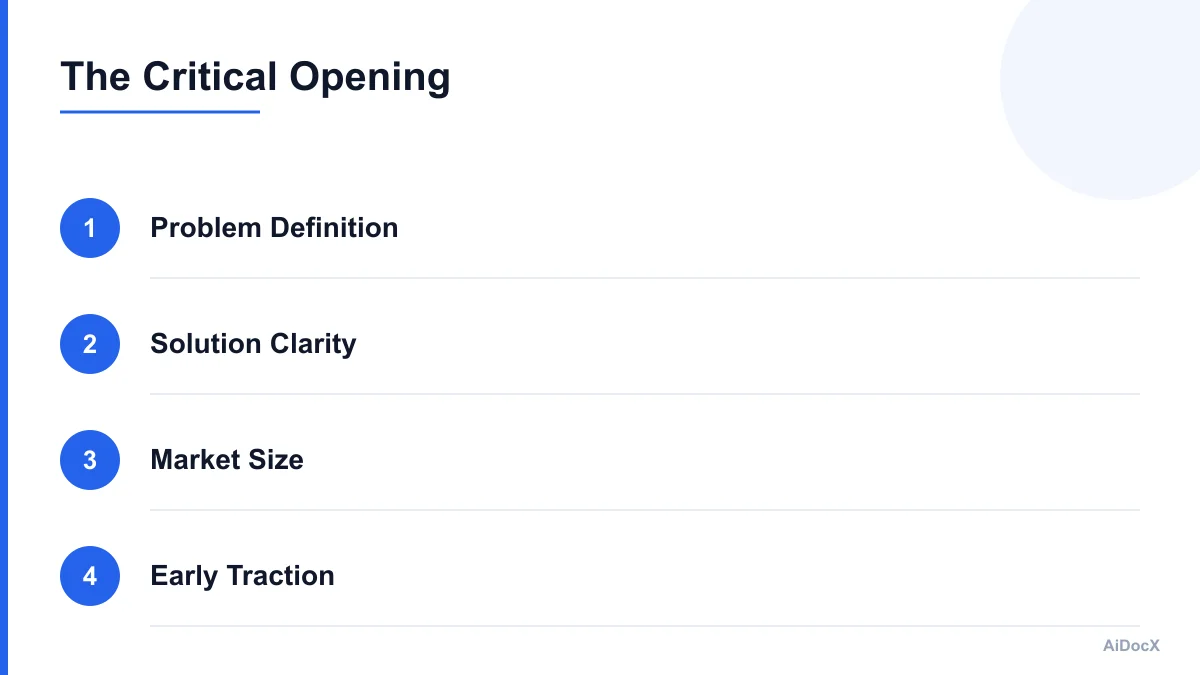
1. Title Slide Keep it clean. Company name, logo, tagline, and your name/contact info. No fluff. The tagline should be a clear value proposition, not marketing jargon. For example, instead of "Empowering synergistic solutions," use "AI-driven inventory management for mid-sized retailers."
2. The Problem Define the pain point clearly. Who is experiencing it? How frequent is the pain? How much does it cost them (time or money)? Use concrete data. Avoid abstract statements. Show, don’t just tell. If you can quantify the problem in dollars lost per year, do it.
3. The Solution Present your product as the direct antidote to the problem stated above. Keep it simple. Focus on the core benefit, not every feature. Why is your solution better? Is it 10x faster? 50% cheaper? Or does it solve a problem no one else can? Highlight the "magic moment" where the user realizes the value.
4. Why Now? This slide is often skipped but is critical in 2026. Why has this problem become urgent recently? Has regulation changed? Has technology (like LLMs or edge computing) made the solution possible? Has consumer behavior shifted post-pandemic? Investors want to know you are riding a wave, not trying to create one from scratch.
The Market Opportunity: Size and Strategy
Investors need to know the ceiling. However, the era of "if we build it, they will come" is over. You must demonstrate that you understand your specific segment of the market.
Total Addressable Market (TAM), Serviceable Addressable Market (SAM), and Serviceable Obtainable Market (SOM) Do not just list a billion-dollar number. Break it down.
- TAM: The total revenue opportunity if you achieved 100% market share.
- SAM: The segment of the TAM within your geographical reach or product scope.
- SOM: The portion of SAM you can realistically capture in the next 3-5 years. This should be grounded in your current sales velocity and marketing budget.
Market Trends Back up your market size with trends. Is the industry growing at 20% CAGR? Are competitors failing to meet demand? Show that the market is moving in your favor. Use recent data sources (2024-2026 reports) to establish credibility.
Competitive Landscape Avoid a simple 2x2 matrix unless it offers genuine insight. Instead, use a feature comparison table or a "magic quadrant" approach. Highlight your unique value proposition (UVP). What do you do that incumbents cannot? Is it proprietary technology, a unique business model, or superior customer experience? Be honest about competitors; investors know you don’t have zero competition. Focus on your moat.
Product and Technology: The Engine
This is where you prove you have built something real. In 2026, investors are wary of "vaporware." You must demonstrate that your product works, scales, and is defensible.
Product Demo or Screenshots Include high-quality visuals of your product in action. If it’s a complex B2B platform, show the dashboard. If it’s a consumer app, show the user flow. Keep text minimal. Let the visuals speak. If possible, include a short video embed or GIF that shows the core value proposition in under 30 seconds.
Technology Stack and IP Briefly mention the technology behind the product. Is it proprietary? Do you have patents or pending IP? What is the technical moat? If your moat is data, explain how you are collecting and leveraging it. If it’s algorithmic efficiency, highlight the performance metrics.
Roadmap Show where the product is going. What are the key features coming in the next 6-12 months? This demonstrates that you have a vision and a plan for continuous improvement. It also helps investors see how the product evolves to capture more value over time.
Traction and Validation: Proof It Works
Traction is the most important slide for many investors in the current climate. It de-risks the investment. You don’t need to be profitable, but you need to show momentum.
Key Metrics Choose the metrics that matter for your business model.
- SaaS: MRR/ARR, Churn Rate, LTV/CAC Ratio, Net Revenue Retention (NRR).
- Marketplace: GMV, Take Rate, Liquidity Ratio, Repeat Purchase Rate.
- Hardware: Units Sold, Distribution Channels, Pre-orders.
Growth Rate Show month-over-month (MoM) or year-over-year (YoY) growth. Investors want to see a hockey stick curve, but a steady, justified growth line is acceptable if the unit economics are strong.
Customer Validation Include logos of key customers, testimonials, or case studies. Quantify the impact for your customers. "Client X saved $50k in annual costs" is more powerful than "Client X is happy." If you have pilot programs, mention the conversion rate from pilot to paid.
Early Signals If you are pre-revenue, show other signals of traction: waitlist size, letter of intent (LOI) from strategic partners, or awards/recognitions. Be specific about what these signals mean for future revenue.
Business Model: How You Make Money
Investors need to understand the economics. How does your company generate revenue? Is it scalable? What are the margins?
Revenue Streams Be explicit. Subscription fees? Transaction fees? Licensing? Advertising? Hybrid models are fine, but explain them clearly.
Pricing Strategy How do you price your product? Is it per user, per transaction, or flat fee? Justify your pricing. Show that you have tested different price points and found the optimal level. Mention any discounts or volume tiers.
Unit Economics This is non-negotiable in 2026. Show your Customer Acquisition Cost (CAC) and Customer Lifetime Value (LTV). Calculate your payback period. Investors want to see that you can acquire a customer for less than they are worth, and that you recoup that cost within a reasonable timeframe (ideally <12 months). If your CAC is high, explain why and how you plan to reduce it.
Gross Margins What are your gross margins? High gross margins (70%+) are preferred for software, while lower margins are acceptable for hardware or marketplaces if the volume is high. Be honest about your costs.
Team: The Drivers
Investors invest in people first, ideas second. Why is your team the right one to execute this vision?
Founders Highlight relevant experience. Have you built and sold a company before? Do you have deep industry expertise? Do you have technical skills? Show that you have the stamina and the skill set to navigate the ups and downs of startup life.
Advisors and Board If you have notable advisors or board members, list them. This adds credibility and signals that you have access to valuable networks and guidance.
Hiring Plan Show that you know who you need to hire next. Are you looking for a CTO? A Head of Sales? This demonstrates that you have a plan for scaling the team alongside the business.
The Ask and The Close
This is where you make the request. Be clear, specific, and realistic.
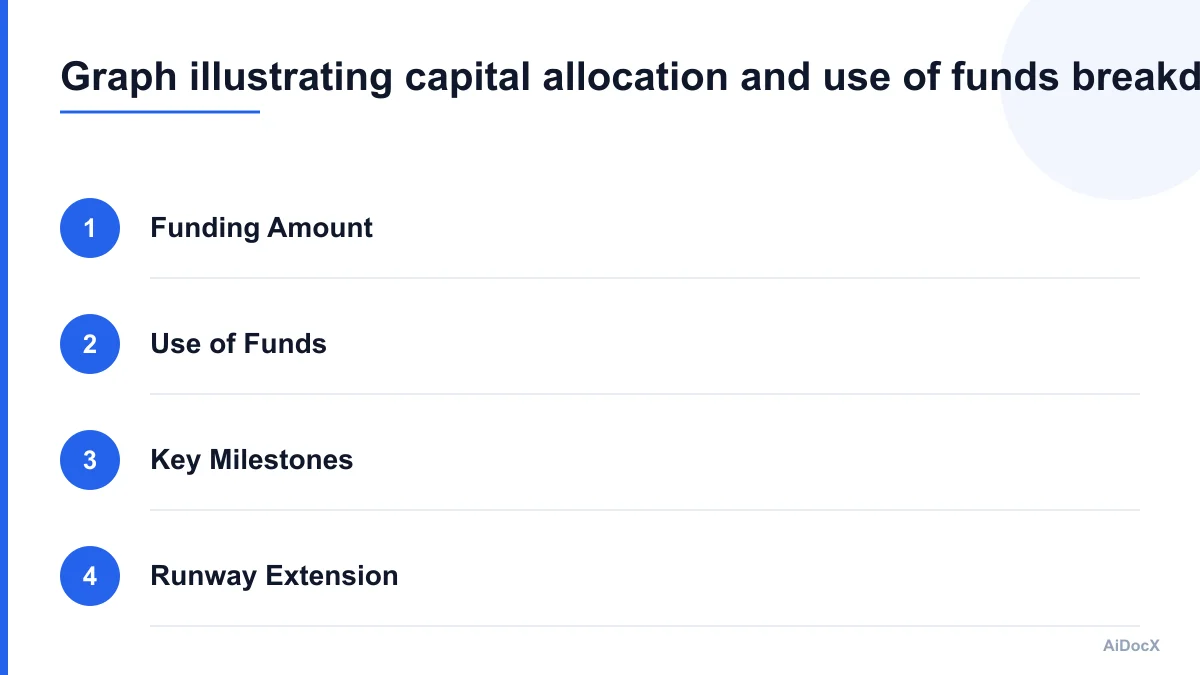
Funding Amount State exactly how much you are raising. Do not be vague. "Raising $2M" is better than "Seeking seed funding."
Use of Funds Break down how you will spend the money. A common split is:
- 40-50% Product/Engineering
- 30-40% Sales/Marketing
- 10-20% Operations/General
Show that you understand the costs associated with each function.
Milestones What will you achieve with this money? "Reach $1M ARR," "Launch in Europe," "Hire 5 engineers." Tie the funding to specific, measurable outcomes. This shows that you are disciplined and focused on growth.
Runway How many months of runway will this provide? Aim for 18-24 months. This gives you enough time to hit the next major milestone and raise again if necessary.
Common Mistakes to Avoid
Even with a perfect slide order, execution matters. Here are the most common pitfalls that cause founders to lose investor interest.
1. Overloading Slides Do not put paragraphs of text on slides. Use bullet points. Use visuals. Investors should listen to you, not read. If they are reading, they are not engaging with your narrative.
2. Ignoring the Competition Saying "we have no competitors" is a red flag. It suggests you haven’t done your homework. Acknowledge competitors and explain your differentiation.
3. Unrealistic Financial Projections Do not project $100M in revenue in year two if you are making $10k now. Investors know how businesses scale. Show realistic, data-backed projections. Explain the assumptions behind them.
4. Focusing on Features, Not Benefits Don’t list every feature. Focus on the problems you solve and the value you deliver. Features are means to an end; benefits are the end.
5. No Clear Call to Action End with a clear next step. "We are looking for a second meeting to discuss this in detail" or "We are available for a demo next week." Make it easy for them to say yes.
Leveraging Analytics to Refine Your Deck
In the past, founders sent PDFs into the void and hoped for a response. In 2026, data-driven pitching is the norm. This is where modern tools like AiDocX come into play.
AiDocX’s deck editor allows you to turn a rough outline into a structured, investor-ready deck with tracked viewer analytics. This means you don’t just send a file; you send a measurable asset. You can see exactly which slide an investor spends the most time on, and more importantly, which slide causes them to close the deck.
Imagine sending your deck and receiving an alert: "Investor X viewed Slide 3 (Problem) for 2 minutes but skipped Slide 4 (Solution)." This data is invaluable. It tells you that your problem statement resonated, but your solution clarity needs work. You can iterate on that slide before your next pitch, ensuring that your narrative is tight and compelling.
By using a platform that provides these insights, you move from guessing to knowing. You can A/B test different versions of your problem slide or your financials. You can tailor your follow-up email based on what the investor actually engaged with. This level of preparation signals professionalism and seriousness, qualities that investors highly value.
Pre-Pitch Checklist
Before you hit send on your next pitch, run through this checklist to ensure your deck is investor-ready.
- Problem Slide: Is the pain point quantified and relatable?
- Solution Slide: Is the value proposition clear and concise?
- Market Size: Are TAM/SAM/SOM realistic and backed by data?
- Traction: Are key metrics highlighted and growth evident?
- Business Model: Are unit economics (LTV/CAC) calculated and positive?
- Team: Is relevant experience highlighted?
- The Ask: Is the funding amount, use of funds, and milestones clear?
- Design: Is the deck visually clean and free of typos?
- Analytics: Have you enabled tracking to monitor viewer engagement?
- Follow-up: Do you have a clear call to action for the next step?
Final Thoughts
Building a pitch deck is not just about creating a presentation; it is about clarifying your business strategy. The slide order outlined above provides a logical flow that respects the investor’s mental model. It starts with the problem, moves through the solution, validates with data, and ends with a clear request.
In 2026, the founders who succeed are those who combine a compelling narrative with rigorous data. They use every tool available to refine their message and understand their audience. By structuring your deck correctly and leveraging analytics to iterate on your content, you increase your chances of moving from the initial send to the second meeting.
Remember, the goal of the first deck is not to raise money; it is to raise interest. Make it easy for investors to say yes to that next conversation. Start with a strong problem, prove your solution works, and show them you have the team and the traction to execute. With the right structure and the right tools, you can turn your pitch into a powerful asset for growth.
Ready to automate your documents with AI?
Start free with AiDocX — AI contract drafting, meeting minutes, consultation notes, e-signatures, and more in one platform.
Get Started FreeMore from AiDocX Blog
Affiliate Agreement Template (2026): Protect Your Business When Paying Commissions
Free affiliate agreement template for 2026: key clauses, FTC disclosure requirements, affiliate vs referral agreement compared, a worked example, and a copy-paste version.
James September 22, 2026 11 min
AI Receipt Generator (2026): Create Professional Payment Receipts in Seconds
Generate professional payment receipts with AI in seconds. Receipt vs invoice vs credit note explained, the fields to include, a worked example, and a copy-paste template.
James September 22, 2026 9 min
Bill of Sale Template (2026): Free Generator for Cars, Trailers & Personal Property
Free bill of sale template for 2026: the fields to include, state notarization rules, federal odometer disclosure, a worked example, and a copy-paste version.
James September 22, 2026 10 min