Letter of Intent Template for Business Purchase: How to Write One That Gets Accepted in 2026
Get your business acquisition deal moving. Use this step-by-step guide and free LOI template to draft a professional Letter of Intent that sellers actually accept.
 James · Content Manager August 19, 2026 10 min read
Letter of Intent Template for Business Purchase: How to Write One That Gets Accepted in 2026
In the world of small business acquisitions and franchise buyouts, the Letter of Intent (LOI) is often the make-or-break document. It is the bridge between a casual inquiry and a formal binding agreement. Many buyers lose deals not because the price was wrong, but because their LOI lacked professional structure, clarity, or the specific protections needed to move forward.
A well-drafted LOI signals to the seller that you are serious, organized, and financially capable. It sets the stage for due diligence, establishing the ground rules for how the next 30 to 90 days will proceed. This guide provides a practical framework for writing an LOI that gets accepted, complete with a structured template you can adapt for your specific deal.
Why the LOI Matters More Than You Think
Many first-time buyers view the LOI as a mere formality—a polite letter to show interest. This is a dangerous misconception. In practice, the LOI serves three critical functions:
- It defines the scope of the deal: It clarifies exactly what is being sold (assets vs. stock) and what is included (inventory, IP, contracts).
- It establishes exclusivity: It prevents the seller from shopping your offer to other buyers while you are conducting due diligence.
- It sets the legal tone: Even if most terms are non-binding, the LOI often contains binding clauses regarding confidentiality and exclusivity. If you get these wrong, you can create legal liabilities before the deal is even signed.
For small business buyers, the LOI is also a filter. If a seller refuses to sign an LOI with standard exclusivity and confidentiality terms, it is often a red flag that they are either not serious or are trying to keep multiple offers alive to drive up the price.
The Anatomy of a Strong Business Purchase LOI
A professional LOI is not a novel; it is a structured document. While the length can vary, a standard business purchase LOI typically runs between 3 and 6 pages. It must contain specific sections to be considered complete.
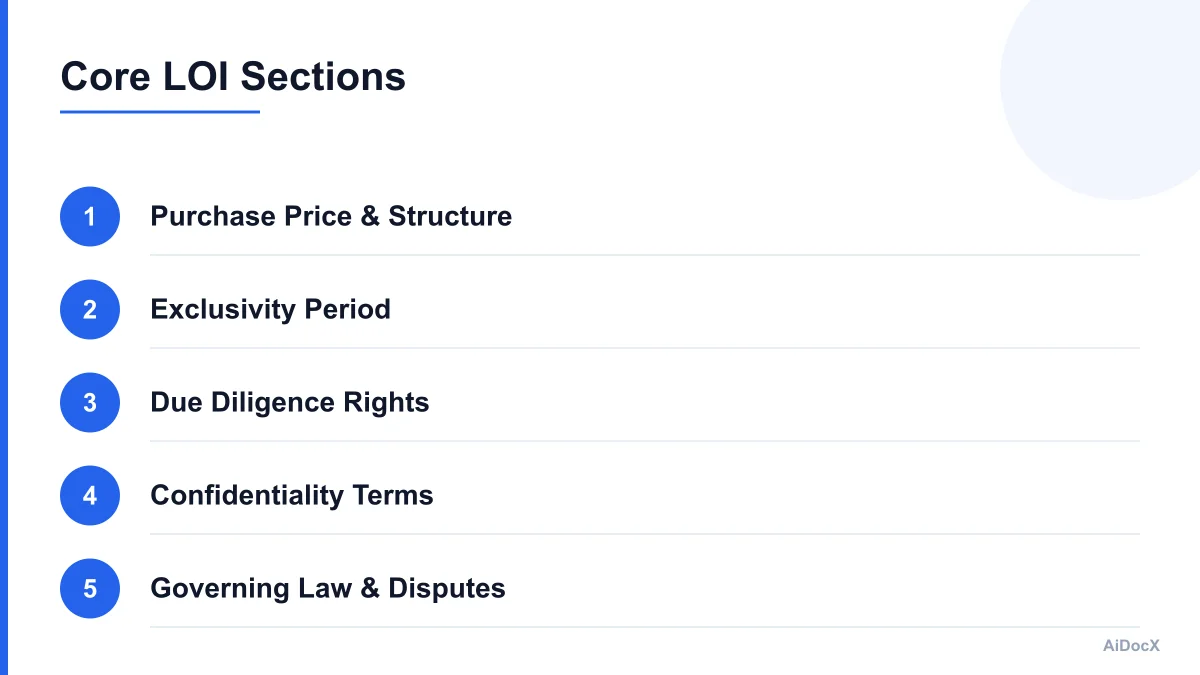
Here is the standard structure you should follow:
- Header & Introduction: Clearly identifies the parties (Buyer and Seller), the date, and the specific entity being acquired.
- Statement of Intent: A concise paragraph stating the Buyer’s intent to acquire 100% of the equity (or specific assets) of the Target Company.
- Purchase Price & Payment Structure: The most sensitive section. It outlines the total consideration, the split between cash at closing and earn-outs or seller notes, and any adjustments for working capital.
- Due Diligence Rights: Specifies the Buyer’s right to inspect books, records, contracts, and meet with key employees.
- Exclusivity Period: Defines the window (typically 30–60 days) during which the Seller agrees not to negotiate with other parties.
- Confidentiality: Reaffirms that all information shared during due diligence will be kept secret and used only for the purpose of evaluating the deal.
- Governing Law & Dispute Resolution: Specifies which state’s laws apply and how disputes will be handled (e.g., arbitration vs. litigation).
- Non-Binding Nature: A crucial disclaimer stating that, except for exclusivity, confidentiality, and expenses, the LOI is non-binding.
Including these sections demonstrates that you understand the mechanics of M&A. It moves the conversation from "I’m interested" to "Here is how I propose we structure this transaction."
Drafting the Purchase Price Section
The purchase price is the heart of the LOI, but it is often where buyers make their biggest mistakes. Do not write a single, fixed number without context. Instead, use a range or a formula.
The "Ballpark" Approach: If you have only just started your valuation, state a range.
- Example: "The Purchase Price shall be in the range of $1.2M to $1.4M, subject to adjustment based on the final working capital calculation at closing."
The "Earn-Out" Structure: For businesses with volatile revenue or founder-dependent relationships, propose a split.
- Example: "$800,000 cash at closing and $400,000 payable over 24 months as an earn-out based on EBITDA performance."
Working Capital Adjustments: Small business deals often hinge on Net Working Capital (NWC). You must specify a "Target NWC" level.
- Example: "The Purchase Price is subject to a dollar-for-dollar adjustment for any excess or deficiency in Net Working Capital relative to the Target Level of $150,000 as of the Closing Date."
Pro Tip: Be specific about what is included in the price. Does it include all inventory? What about prepaid expenses? What about outstanding liabilities? Vague language here leads to disputes later.
Structuring Due Diligence and Exclusivity
This section protects your investment and your time. You are asking the seller to pause their sales efforts to work with you. In exchange, you are committing to a timeline.
Exclusivity Period: Standard practice is 30 to 60 days. If you are a cash buyer, you can often negotiate a shorter period (30 days). If you are seeking financing, you may need 60–90 days.
- Drafting Note: "Seller agrees to negotiate exclusively with Buyer for a period of 45 days from the date of this LOI (the 'Exclusivity Period'). If the parties do not execute a definitive Purchase Agreement within the Exclusivity Period, the exclusivity shall terminate automatically."
Due Diligence Access: You need broad access rights. Do not limit yourself to "financials."
- Drafting Note: "During the Exclusivity Period, Seller shall provide Buyer with reasonable access to all material books, records, contracts, leases, and personnel of the Company. Buyer shall have the right to interview key employees and management."
Confidentiality: Even if the seller is quiet, you must protect yourself.
- Drafting Note: "All information disclosed by Seller to Buyer in connection with the transaction (the 'Confidential Information') shall be kept strictly confidential and used solely for the purpose of evaluating the transaction. This obligation shall survive the termination of this LOI for a period of two (2) years."
Legal Nuances: Binding vs. Non-Binding
One of the most common questions from small business buyers is: "Is the LOI legally binding?"
The answer is: It depends on what you sign.
In a well-drafted LOI, most commercial terms (price, structure, closing date) are non-binding. They are expressions of intent. However, certain clauses are almost always binding:
- Exclusivity: The promise not to talk to other buyers is binding.
- Confidentiality: The promise to keep secrets is binding.
- Expenses: Often, the LOI states that each party bears their own legal and due diligence costs. This is usually binding.
Why this distinction matters: If you sign an LOI where the price is binding, you have essentially signed a contract to buy the business at that price, even if due diligence reveals fatal flaws. Always ensure the LOI states that the agreement to purchase is contingent upon the execution of a definitive Purchase and Sale Agreement (PSA).
Example Clause: "Except for the sections titled 'Exclusivity,' 'Confidentiality,' and 'Expenses,' this Letter of Intent is non-binding and does not create any legal obligation for either party to enter into a definitive agreement."
Practical Template: How to Fill It Out
Below is a simplified structure you can use to draft your LOI. Replace the bracketed text with your deal specifics.
LETTER OF INTENT
Date: [Date]
To: [Seller Name/Entity] ("Seller") From: [Buyer Name/Entity] ("Buyer")
Re: Intent to Acquire [Target Company Name] ("Company")
Dear [Seller Name],
This Letter of Intent ("LOI") summarizes the key terms and conditions under which Buyer intends to acquire 100% of the issued and outstanding shares of the Company (the "Transaction").
1. Purchase Price Buyer intends to purchase the Company for a total consideration of $[Total Amount] (the "Purchase Price"), subject to adjustment. The Purchase Price shall be paid as follows:
- $[Cash Amount] in cash at Closing;
- $[Earn-Out Amount] payable as an earn-out over [Number] months, based on [Metric, e.g., EBITDA]; and
- $[Note Amount] in the form of a promissory note, bearing interest at [Rate]%.
The Purchase Price is subject to a dollar-for-dollar adjustment for Net Working Capital in excess of or less than $[Target NWC].
2. Due Diligence Buyer shall have the right to conduct due diligence on the Company, including access to financial records, contracts, and management, for a period of [30-60] days.
3. Exclusivity Seller agrees to negotiate exclusively with Buyer for [30-60] days from the date of this LOI. If a definitive agreement is not executed by this date, exclusivity shall lapse.
4. Confidentiality Buyer agrees to keep all information regarding the Company confidential and to use it only for the purpose of evaluating the Transaction.
5. Non-Binding Except for the terms in Sections 3 and 4, this LOI is non-binding and does not constitute an offer to buy or sell.
6. Governing Law This LOI shall be governed by the laws of the State of [State].
Sincerely,
[Buyer Signature] [Buyer Name]
Note: This is a template for educational purposes. For high-value transactions, always have an attorney review the final document.
Leveraging Technology for Speed and Accuracy
Drafting an LOI from scratch can take days of back-and-forth with legal counsel, slowing down your competitive advantage. Speed is critical in M&A; the first buyer to present a clean, structured offer often holds the upper hand.
This is where tools like AiDocX can be helpful. By inputting basic deal terms—such as price range, exclusivity duration, and due diligence scope—AiDocX generates a structured LOI with standard M&A sections pre-filled. This allows buyers to move from "interested" to "proposed" in hours rather than weeks, without needing a lawyer to draft every sentence from scratch. It’s not a replacement for legal advice on complex structures, but it is an excellent accelerator for getting the initial document right.
Common Mistakes That Get LOIs Rejected
Even with a good template, buyers can shoot themselves in the foot with specific drafting errors. Avoid these common pitfalls:
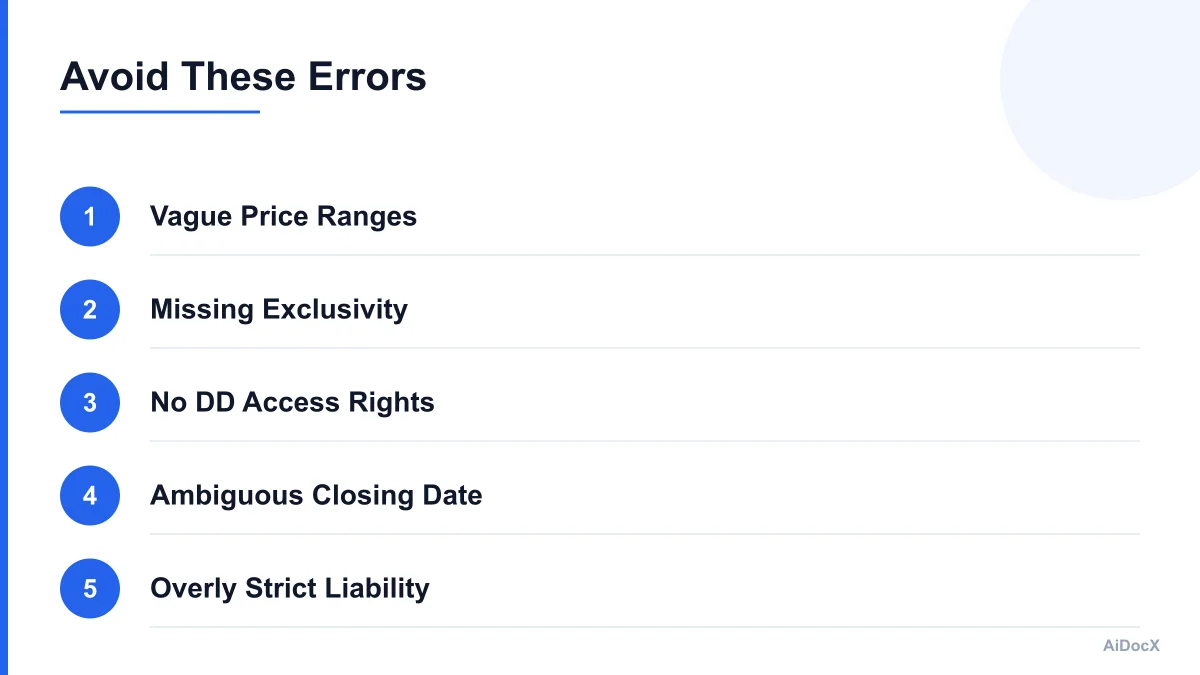
- Vague Price Language: Writing "Price to be determined" is unprofessional. Always provide a range or a formula.
- Missing Exclusivity: If you don’t ask for exclusivity, the seller will keep talking to other buyers while you spend thousands on due diligence.
- No "Out" Clause: Ensure the LOI allows you to walk away if due diligence reveals material adverse changes.
- Ambiguous Closing Date: Specify a target closing date (e.g., "within 90 days of signing the PSA").
- Overly Strict Liability: Do not agree to indemnify the seller for pre-closing liabilities in the LOI. That is for the PSA.
Pre-Submission Checklist
Before you hit send on your LOI, run through this final checklist to ensure you are ready to submit a professional document.
- Valuation Confirmed: Have you done a rough DCF or multiple-based valuation to ensure your price range is realistic?
- Financing Pre-Approved: If you are using a loan, do you have a pre-approval letter or term sheet to attach?
- Entity Structure: Have you formed an LLC or Corp to buy the business? (Do not buy in your personal name.)
- Legal Review: Has an attorney reviewed the binding clauses (Exclusivity/Confidentiality)?
- Professional Format: Is the document on letterhead, properly formatted, and free of typos?
- Cover Letter: Have you included a brief, polite cover letter expressing enthusiasm and respect for the business?
Conclusion: Turning Intent into Action
A Letter of Intent is more than a document; it is a signal of your professionalism and seriousness. By structuring your LOI with clear purchase terms, robust due diligence rights, and protective exclusivity clauses, you position yourself as a credible buyer.
Whether you are acquiring a local franchise, a tech startup, or a manufacturing plant, the principles remain the same: clarity, fairness, and structure. Use the template provided, customize it for your deal, and leverage tools like AiDocX to streamline the process. When you present a well-crafted LOI, you are not just asking for a chance to buy; you are demonstrating that you are ready to close.
Start drafting your LOI today. The sooner you get it on the table, the sooner you can start due diligence and secure your next business acquisition.
Ready to automate your documents with AI?
Start free with AiDocX — AI contract drafting, meeting minutes, consultation notes, e-signatures, and more in one platform.
Get Started FreeMore from AiDocX Blog
How to Read a Business Contract: A Founder's Checklist (2026)
A practical way to review parties, scope, money, IP, liability, and exit terms before signing a business contract.
 MinjiLee October 7, 2026 9 min
ESIGN vs eIDAS: What Founders Should Know About E-Signatures (2026)
What U.S. ESIGN and EU eIDAS actually say, where exceptions apply, and what founders should keep to document an electronic signing.
MinjiLee October 7, 2026 7 min
Does Document Automation Pay Off? An ROI Worksheet for Founders (2026)
Estimate document automation ROI with your own volume, time, labor, and software costs. Includes a clearly labeled example and break-even formula.
 Chloe October 7, 2026 8 min