Limitation of Liability Clauses: Cap Your Risk in 2026
Learn how to draft limitation of liability clauses that protect founders and service providers from uncapped financial exposure in any contract.
 James · Content Manager July 4, 2026 5 min read
Limitation of Liability Clauses: Cap Your Risk in 2026
Every contract you sign carries financial exposure. Without a clear ceiling on that exposure, a single dispute or project failure can easily erase years of profit. A well-drafted limitation of liability clause gives you a predictable maximum payout, protects your cash flow, and keeps negotiations moving forward. This guide breaks down how to set that ceiling without leaving your business vulnerable.
What a liability cap actually does
A limitation of liability clause sets a hard maximum on the amount one party can be required to pay the other for certain losses. It does not shield you from bad faith or intentional harm, but it does convert open-ended risk into a known cost of doing business.
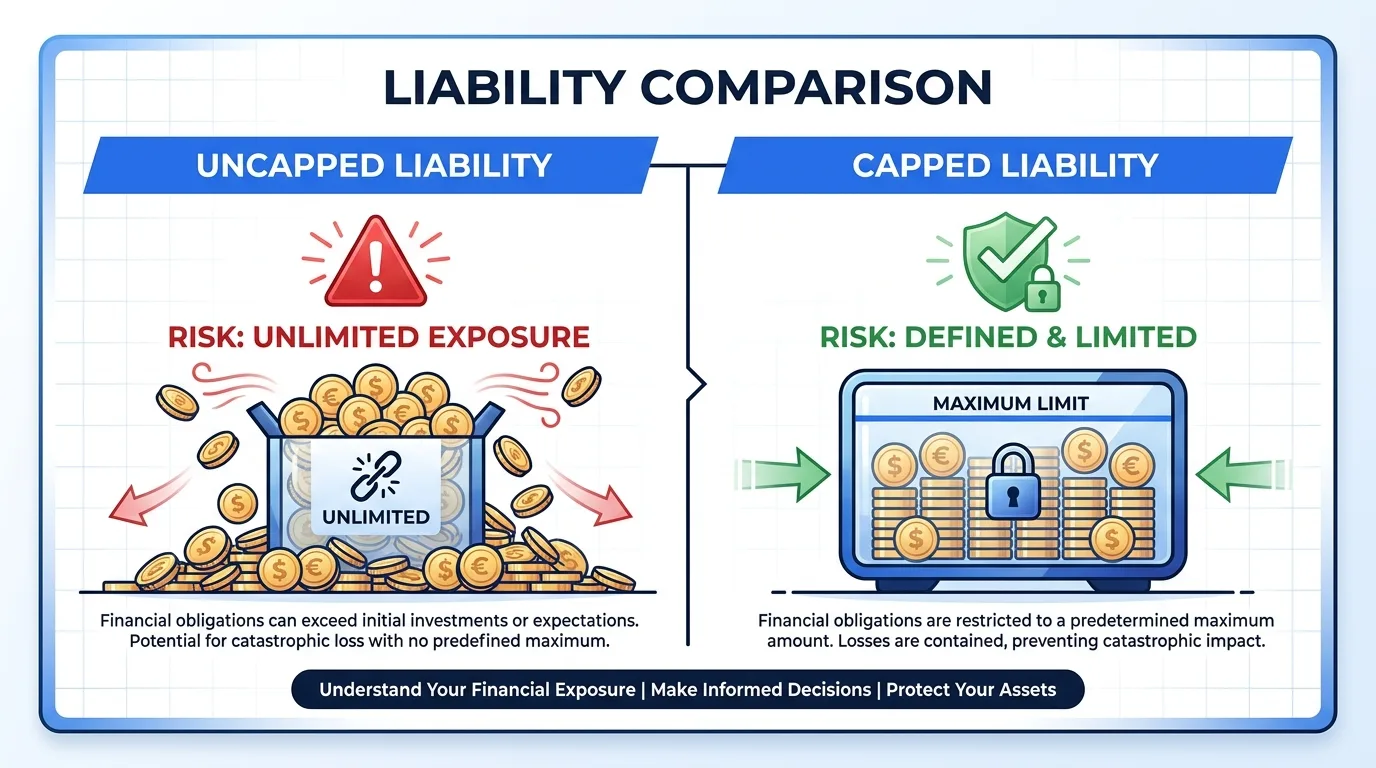
Without it, courts can award consequential, indirect, or speculative damages that dwarf the original deal. A properly structured cap ensures the payout stays proportional to the contract value, turning an unpredictable legal threat into a manageable line item.
Most standard service agreements, SaaS terms, and consulting contracts include this clause. The question is never whether to include it, but how to structure it so it actually protects you.
Where most founders and service providers get burned
Uncapped liability is the fastest way to turn a profitable engagement into a cash flow crisis. The traps are usually predictable:
- Accepting a client’s boilerplate terms that remove the cap entirely
- Agreeing to a cap that is too low, which actually discourages the counterparty from signing
- Overlooking carve-outs that silently reinstate unlimited exposure for specific claims
- Assuming indemnification and liability caps are the same thing (they are not)
- Forgetting that a cap only protects against direct damages unless consequential damages are also addressed
If you are reviewing a stack of vendor agreements or client proposals, AiDocX flags missing liability caps when it reviews your contract so you never have to spot them manually.
The standard formula for setting the cap
The most common and defensible approach ties the cap to the fees paid under the agreement. This keeps the risk proportional to the reward and gives both sides a clear reference point.
Typical ranges depend on your position and the contract duration:
- Service providers and vendors: 12 to 24 months of fees paid or payable
- Founders hiring contractors: 6 to 12 months of the total contract value
- High-risk projects (data, compliance, infrastructure): Negotiate a higher tier or a separate sub-cap for specific deliverables
Pair the monetary cap with an explicit exclusion of indirect, incidental, and consequential damages. Together, these two mechanisms form the actual safety net. A cap without a consequential damages waiver still leaves you exposed to lost profits, downstream penalties, and reputation claims.
Which claims should break the cap
No responsible founder or service provider should agree to a blanket cap that covers everything. Certain breaches are too severe to limit financially, and courts often refuse to enforce caps that try to shield them anyway.
Standard carve-outs that should remain uncapped include:
- Fraud, gross negligence, or willful misconduct
- Breach of confidentiality or data protection obligations
- Indemnification claims for third-party IP infringement
- Violations of applicable law or regulatory fines
- Payment obligations (you cannot cap what a client owes you)
Draft these exclusions explicitly. Silence in the clause is usually interpreted against the party that drafted it.
Negotiating the cap with your counterparty
Liability caps are almost always a negotiation point, not a take-it-or-leave-it term. The goal is mutual predictability, not one-sided protection.
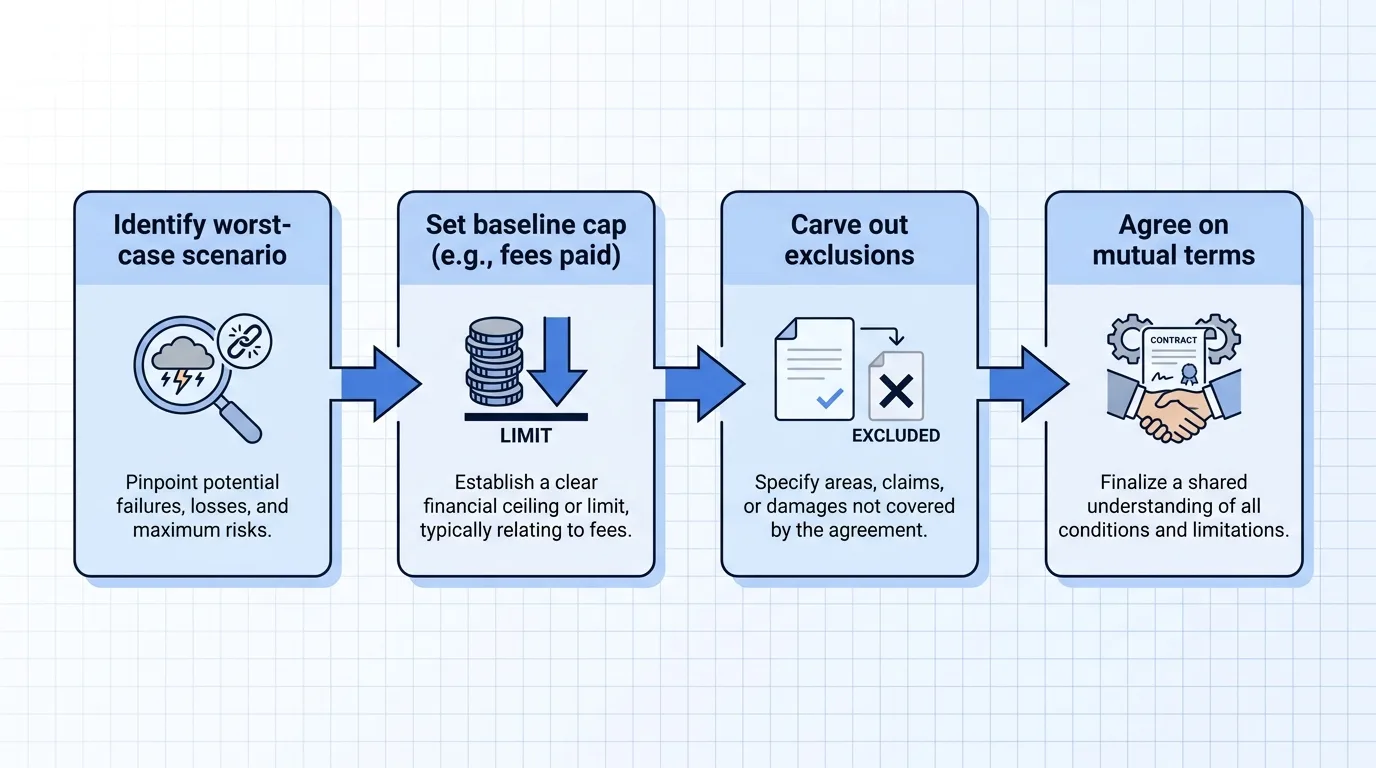
- Map your worst-case scenario. What is the realistic maximum loss your counterparty could claim if the project fails?
- Propose a baseline tied to fees. Start with 12 months of contract value and adjust based on risk and margin.
- Push back on asymmetric terms. If they want unlimited liability for you, they should accept unlimited liability for themselves, or you should negotiate a higher cap.
- Separate high-risk buckets. If a specific deliverable carries outsized exposure, create a sub-cap or a separate insurance requirement rather than inflating the overall limit.
- Document the agreed tier. Keep a clean version of the clause in your contract repository so future renewals do not silently revert to uncapped language.
Quick checklist before you sign
Run through this list before initialing any agreement that contains a limitation of liability clause:
- The cap is expressed as a clear dollar amount or a formula tied to fees paid
- Indirect, incidental, and consequential damages are explicitly excluded
- Carve-outs cover fraud, confidentiality, IP indemnification, and payment obligations
- The cap applies to both parties, or you have a documented business reason for an asymmetric limit
- The clause survives termination or expiration of the agreement
- Insurance requirements, if any, are compatible with the agreed cap level
- No hidden cross-references reinstate unlimited exposure elsewhere in the document
Final word
A limitation of liability clause is not a legal formality. It is a risk management tool that keeps your business solvent when things go wrong. Set the cap proportional to the deal, exclude the claims that should never be capped, and negotiate symmetrically. Treat every signature as a chance to tighten your exposure, and your margins will reflect the discipline.
Ready to automate your documents with AI?
Start free with AiDocX — AI contract drafting, meeting minutes, consultation notes, e-signatures, and more in one platform.
Get Started FreeMore from AiDocX Blog
Machine Shop Job Traveler Template: Routing Sheet + Example
Copy a machine shop job traveler template for small job shops. Includes a routing sheet, filled example, traceability fields, sign-offs, and setup tips.
Weekly Status Report Template: 4 Formats + Examples
Copy one of four weekly status report templates for individual work, projects, leadership, or blockers. See a worked example and a practical review checklist.
How to Read a Business Contract: A Founder's Checklist (2026)
A practical way to review parties, scope, money, IP, liability, and exit terms before signing a business contract.
 MinjiLee October 7, 2026 9 min