LLC Operating Agreement Template 2026: Single vs Multi-Member
Learn what to include in an LLC operating agreement template for 2026. Compare single-member vs multi-member rules, state requirements, and essential clauses.
 James · Content Manager August 14, 2026 12 min read
LLC Operating Agreement Template 2026: Single-Member vs Multi-Member
Forming an LLC is a milestone for founders and small business owners, but the paperwork often lags behind the excitement. While many states do not require you to file an Operating Agreement with the Secretary of State, nearly all experts agree that you cannot legally operate a multi-member LLC without one, and single-member LLCs are heavily advised to have one for liability protection. In 2026, the legal landscape around business formation has become more stringent regarding corporate formalities. Relying on state default statutes is a risky gamble that can strip you of limited liability protection and create ambiguous ownership structures.
This guide breaks down exactly what an LLC Operating Agreement is, the critical differences between single-member and multi-member structures, and what specific clauses you must include to protect your business. Whether you are a solo founder or a co-founding team, understanding these documents is the first step toward a secure, professional business foundation.
What Is an LLC Operating Agreement?
An Operating Agreement is the internal rulebook for your Limited Liability Company (LLC). Think of it as the constitution for your business. While the Articles of Organization are filed with the state to legally create the entity, the Operating Agreement dictates how the LLC will function on a day-to-day basis. It outlines the ownership structure, member responsibilities, voting power, profit distribution, and procedures for adding or removing members.
In the eyes of the law, the Operating Agreement is a contract between the members (owners) and the LLC itself. If you do not have one, your LLC is governed by your state’s default LLC statutes. These default rules are often outdated, rigid, and rarely tailored to the specific needs of modern businesses. For example, a state default might dictate that profits are split equally regardless of capital contribution, or that major decisions require a unanimous vote, which could paralyze a business with three active founders.
Having a written Operating Agreement serves three primary purposes:
- Protects Limited Liability Status: It reinforces the separation between you and the business, which is crucial for maintaining the "corporate veil" in court.
- Clarifies Ownership and Profit: It prevents disputes by clearly defining who owns what percentage of the company and how profits are distributed.
- Establishes Management Structure: It defines who has the authority to sign contracts, open bank accounts, and make strategic decisions.
Single-Member vs. Multi-Member: The Core Differences
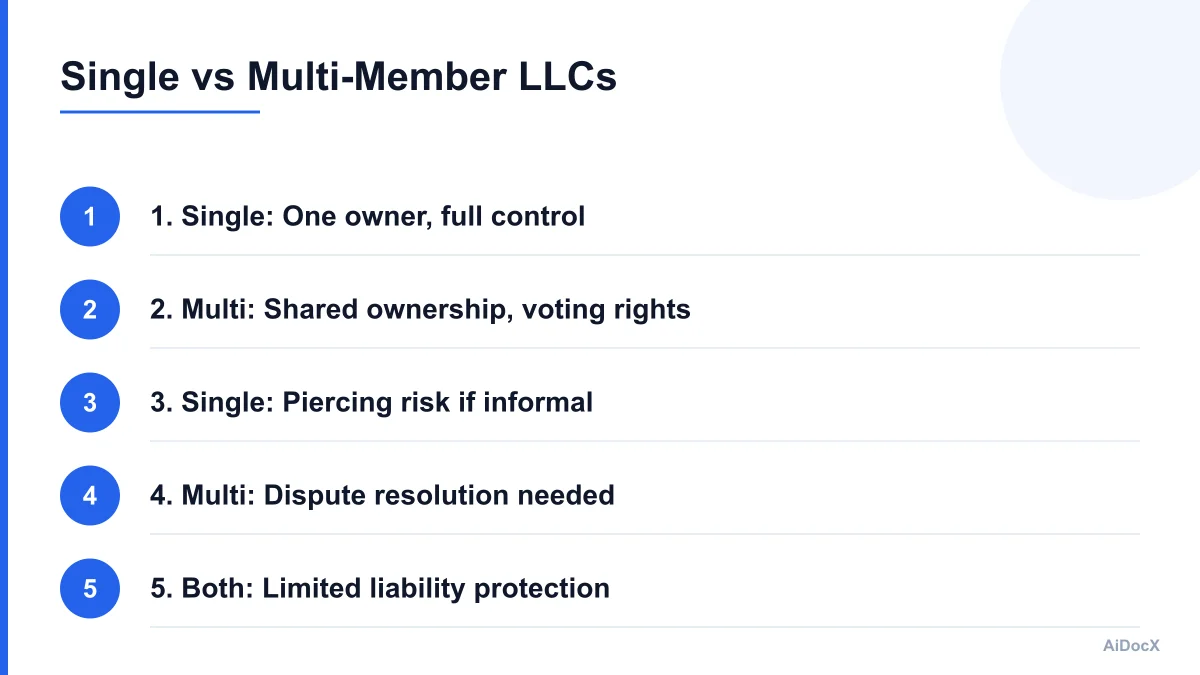
The complexity of your Operating Agreement depends entirely on the number of members in your LLC. A single-member LLC (SMLLC) is owned by one person, while a multi-member LLC has two or more owners. The legal requirements and strategic considerations differ significantly between the two.
Single-Member LLCs
For single-member LLCs, the Operating Agreement might seem unnecessary because you are the only owner. You might assume you can make all decisions unilaterally without a formal document. However, this is a common misconception. Courts have pierced the corporate veil in SMLLCs when owners failed to treat the business as a separate entity. A formal Operating Agreement proves that you are maintaining the legal separation between your personal assets and the business.
Key considerations for SMLLCs include:
- Succession Planning: What happens to the business if you become incapacitated or pass away? The Operating Agreement can name a successor manager or member.
- Creditor Challenges: In some jurisdictions, creditors of a single-member LLC might argue that the LLC is an alter ego of the owner. A well-drafted agreement helps counter this.
- Simplicity: The document can be shorter, focusing on your sole authority and the separation of assets.
Multi-Member LLCs
For multi-member LLCs, the Operating Agreement is not just advisable; it is critical. Disputes among co-founders are the number one cause of small business failure. Without a clear roadmap for decision-making, profit sharing, and exit strategies, minor disagreements can escalate into costly litigation.
Key considerations for multi-member LLCs include:
- Voting Rights: Will decisions be based on ownership percentage or equal voting rights?
- Capital Contributions: How much is each member contributing, and what happens if one member fails to contribute their share?
- Dispute Resolution: How will deadlocks be broken? Options include mediation, arbitration, or a tie-breaking vote by a third-party director.
- Transfer of Interest: Can a member sell their share to an outsider, or must they offer it to existing members first (Right of First Refusal)?
| Feature | Single-Member LLC | Multi-Member LLC |
|---|---|---|
| Primary Focus | Asset protection and succession | Governance and dispute prevention |
| Decision Making | Sole discretion | Defined voting thresholds (majority/unanimous) |
| Profit Distribution | 100% to the single owner | Defined by ownership % or special allocations |
| Legal Risk | Piercing the veil if informal | High risk of partner disputes without clarity |
| Complexity | Low to Moderate | Moderate to High |
What States Require: Do You Need to File It?
One of the most common questions founders ask is: "Does my state require an Operating Agreement?" The short answer is that no state requires you to file the Operating Agreement with the Secretary of State. It is a private internal document.
However, several states have specific statutes that reference Operating Agreements, effectively requiring that one exists to govern the company if you want to opt out of default rules. For example:
- California: Requires an Operating Agreement for all LLCs, though it does not need to be filed publicly. Failure to have one can lead to tax complications and loss of liability protection.
- New York: Requires newly formed LLCs to publish a notice of formation in two newspapers within 120 days. While the Operating Agreement itself isn't filed, the lack of one can complicate the proof of good standing.
- Missouri: Explicitly states that if an LLC does not have an Operating Agreement, it will be governed by the Missouri Revised Statutes, which may not align with your business goals.
- Delaware: The most popular state for incorporation, Delaware’s LLC Act is highly flexible. It encourages the use of Operating Agreements to define terms but does not mandate filing them.
Important: Even if your state does not explicitly "require" it, operating without one means you are subject to that state’s default laws. These defaults are often unfavorable. For instance, some states default to equal profit sharing regardless of investment size, or they require unanimous consent for major decisions, which can stall business operations.
Essential Clauses Every Operating Agreement Must Have
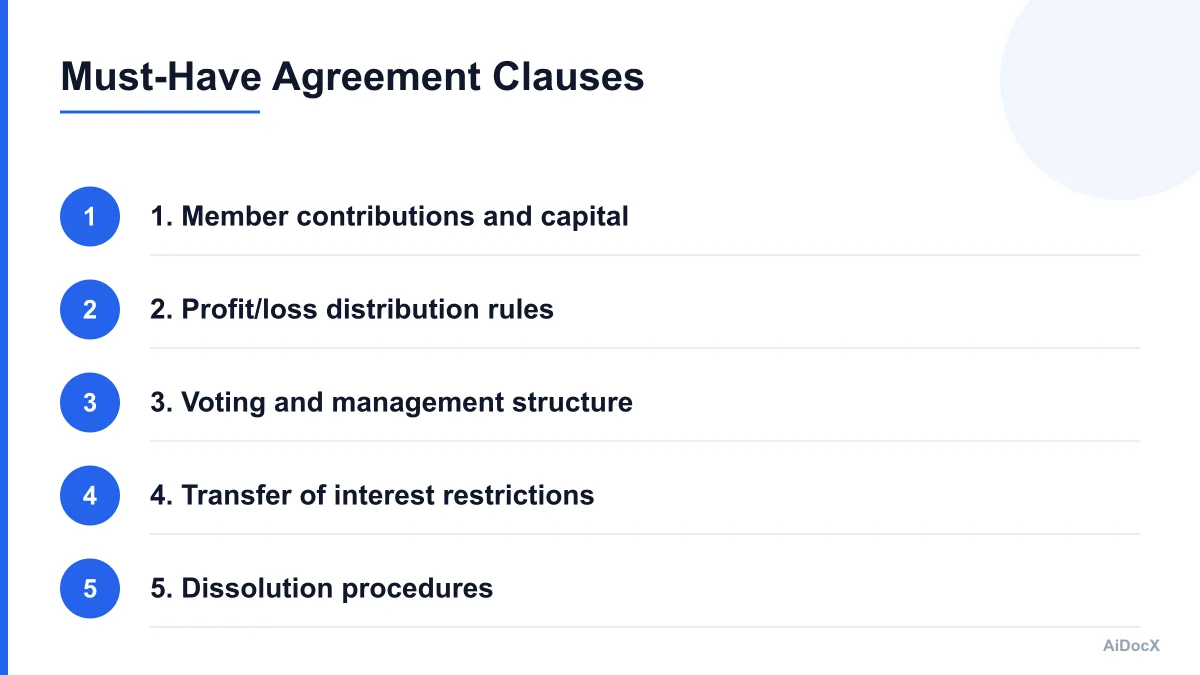
Whether you are using a generic template or generating a custom draft, your Operating Agreement must contain specific clauses to be legally robust and practically useful. Omitting these can leave your business vulnerable.
1. Member Information and Capital Contributions
This section identifies all members and their ownership percentages. It must detail what each member is contributing to the LLC. Contributions can be cash, property, services, or intellectual property.
- Valuation: If contributing non-cash assets, how is the value determined?
- Future Contributions: Are members required to contribute more capital in the future? What happens if they don't?
2. Profit and Loss Distribution
This is often the most contentious area. By default, profits and losses are allocated in proportion to ownership interests. However, you can create "special allocations" if justified by substantial economic effect (subject to IRS rules).
- Distribution Timing: When are profits distributed? Quarterly? Annually?
- Reinvestment: Can the manager decide to reinvest profits rather than distribute them?
3. Management Structure
You must define whether the LLC is Member-Managed or Manager-Managed.
- Member-Managed: All members participate in day-to-day operations and decision-making. Common for small, active businesses.
- Manager-Managed: Members appoint one or more managers (who may or may not be members) to run the business. This is common in larger LLCs or when passive investors are involved.
4. Voting and Decision Making
Define what decisions require a vote and what percentage of votes are needed.
- Majority Rule: >50% of ownership interests.
- Supermajority: >66% or >75% for significant decisions (e.g., selling the company, taking on debt over $10,000).
- Unanimous Consent: Required for fundamental changes like amending the Operating Agreement or admitting new members.
5. Transfer of Interest (Buy-Sell Provisions)
This clause controls who can become a new member. Without it, a member could sell their interest to a competitor or an unwanted third party.
- Right of First Refusal: Existing members have the first option to buy the interest before it is offered to outsiders.
- Tag-Along Rights: If a majority member sells, minority members can join the sale.
- Drag-Along Rights: If a majority of members want to sell the company, they can force minority members to sell too.
6. Dissolution and Winding Up
No one wants to think about the end of the business, but you must plan for it. This section outlines the events that trigger dissolution (e.g., death of a member, court order, or unanimous vote) and the process for selling assets, paying creditors, and distributing remaining funds.
Common Mistakes to Avoid When Drafting
Using a free template found online is a starting point, but blindly copying and pasting text can lead to serious legal pitfalls. Here are the most common errors founders make:
1. Using a Generic Template Without Customization
State laws vary. A template designed for a California LLC might not comply with Delaware or Texas requirements. Furthermore, a template for a real estate holding company will differ vastly from one for a tech startup. Generic templates often lack specific clauses relevant to your industry, such as non-compete agreements for tech founders or intellectual property assignment clauses.
2. Ignoring Tax Implications
The IRS has specific rules about how LLCs are taxed. While an LLC can choose to be taxed as a corporation, the default is usually a pass-through entity. Your Operating Agreement should clarify tax treatment and ensure that profit allocations align with tax reporting requirements. Misaligned allocations can trigger IRS audits.
3. Failing to Update the Agreement
An Operating Agreement is a living document. If you bring on a new partner, issue equity to an employee, or change your management structure, you must amend the Operating Agreement. Many founders draft it once and forget it, leading to inconsistencies between the written agreement and actual business practices.
4. Overlooking Dispute Resolution
Most multi-member Operating Agreements fail to include a clear mechanism for resolving deadlocks. Without a defined process for mediation or arbitration, disputes can quickly turn into expensive lawsuits. Always include a "buy-sell" provision or a "shotgun clause" that allows one member to buy out the other at a fair price if they cannot agree on key issues.
How to Draft Your Agreement: Step-by-Step
Creating a robust Operating Agreement doesn't have to involve expensive legal fees for every draft. Here is a practical workflow to get it done efficiently.
Step 1: Gather Your Information
Before writing, collect the necessary details:
- Full legal names and addresses of all members.
- Business name and principal place of business.
- Registered agent information.
- Capital contribution amounts and types for each member.
- Desired management structure (Member vs. Manager).
Step 2: Choose Your Drafting Method
You have three main options:
- DIY with a Template: Use a state-specific template from a legal resource site. Risk: High. You must manually edit every section, which is time-consuming and error-prone.
- Hire an Attorney: Best for complex structures, significant capital, or high-risk industries. Cost: $500–$2,000+.
- AI-Powered Document Generation: Use a platform like AiDocX to generate a state-aware draft. This method combines the cost-effectiveness of DIY with the accuracy of legal templates. AiDocX generates a state-aware LLC operating agreement draft in minutes and routes it straight to e-signature for every member, instead of editing a generic Word template by hand.
Step 3: Review and Customize
If using a template or AI draft, review it carefully. Ensure all blanks are filled, and specific clauses (like voting thresholds) reflect your actual agreements. Pay special attention to the "Transfer of Interest" and "Dissolution" sections.
Step 4: Sign and Notarize
All members must sign the Operating Agreement. While not always legally required to be notarized, having it notarized adds an extra layer of authenticity, which can be helpful if the document is ever challenged in court.
Step 5: Store and Maintain
Keep the original signed copy in your corporate records book. Provide copies to all members. Set a calendar reminder to review the agreement annually or whenever a major business change occurs.
Checklist for Your 2026 LLC Operating Agreement
Before finalizing your document, run through this checklist to ensure you haven’t missed anything critical.
- State Compliance: Does the agreement comply with your state’s specific LLC statutes?
- Member Details: Are all members’ names, addresses, and ownership percentages clearly listed?
- Capital Contributions: Is it clear what each member contributed and when?
- Profit/Loss Allocation: Are distribution rules defined and aligned with tax goals?
- Management Structure: Is it clearly defined as Member-Managed or Manager-Managed?
- Voting Rights: Are thresholds for major decisions (supermajority/unanimous) specified?
- Transfer Restrictions: Are there Right of First Refusal or Tag-Along provisions?
- Dispute Resolution: Is there a mechanism for resolving deadlocks or disputes?
- Dissolution Process: Are the steps for winding up the business clearly outlined?
- Signatures: Have all members signed and dated the agreement?
Buyout terms often sit in a dedicated section of the operating agreement or a separate document; our buy-sell agreement template walks through triggers, valuation and funding.
Final Thoughts: Protect Your Business Early
The LLC Operating Agreement is the backbone of your business’s legal structure. For single-member LLCs, it is a shield against liability; for multi-member LLCs, it is the foundation of partnership harmony. In 2026, as regulatory scrutiny on small businesses increases, having a clear, professional, and legally sound Operating Agreement is not just a best practice—it is a necessity.
Don’t leave your business’s future to chance or state default laws. Take the time to draft a comprehensive agreement that reflects your unique business needs. If you want to streamline the process, consider using a tool like AiDocX to generate a state-aware LLC operating agreement draft in minutes and route it straight to e-signature for every member, ensuring accuracy and speed without the hassle of manual editing.
Start today. Protect your assets, clarify your ownership, and build a business that is ready for growth.
Ready to automate your documents with AI?
Start free with AiDocX — AI contract drafting, meeting minutes, consultation notes, e-signatures, and more in one platform.
Get Started FreeMore from AiDocX Blog
Buy Sell Agreement Template (2026): Triggers, Valuation and Funding for Co-Owners
A free buy sell agreement template for co-owners, with triggering events, valuation methods, insurance funding and cross-purchase vs. redemption structures.
James September 26, 2026 12 min
Consignment Agreement Template (2026): Commission, Title, Risk of Loss and Unsold Goods
Free consignment agreement template for makers, artists and boutiques: commission split, title, insurance and how to protect consigned inventory.
James September 26, 2026 9 min
Distribution Agreement Template (2026): Territory, Exclusivity, Minimums and Reseller Terms
Free distribution agreement template (works as a reseller agreement template too): territory, exclusivity, minimums, pricing, IP and termination.
James September 26, 2026 13 min