MOU Template 2026: What to Include & When It's Binding
Learn how to draft a 2026 MOU template. Discover if it’s legally binding, key sections to include, and how it differs from a full contract for startups.
 James · Content Manager August 21, 2026 12 min read
MOU Template 2026: What to Include & When It's Binding
A Memorandum of Understanding (MOU) is often the first formal step between two parties who intend to work together but haven't yet locked down the granular details of a full contract. For small business owners and startup founders, the MOU serves as a roadmap. It aligns expectations, defines the scope of collaboration, and establishes a framework for negotiation. However, many founders hesitate to sign one because they are unsure if it creates legal obligations or if it is merely a polite gesture. Understanding the nuances of an MOU in 2026 is critical to protecting your business while moving forward with partnerships, joint ventures, or preliminary service agreements.
This guide breaks down exactly what belongs in a modern MOU, explains the legal thresholds that make it binding, and clarifies how it differs from a definitive agreement. We will also look at practical tips for drafting one that protects your interests without stalling momentum.
What Is a Memorandum of Understanding?
At its core, an MOU is a written agreement that outlines the terms and conditions of a relationship between two or more parties. It is less formal than a contract but more structured than a handshake deal. In the context of startups and small businesses, MOUs are frequently used in three scenarios:
- Preliminary Partnerships: When two companies agree to collaborate but need time to finalize IP rights, revenue sharing, or exclusivity clauses.
- Service Agreements: When a client wants to start work immediately but the full Statement of Work (SOW) or Master Service Agreement (MSA) is still being negotiated.
- Joint Ventures: When parties agree to form a new entity or project but the corporate structure and capital contributions are still being defined.
The primary value of an MOU is alignment. It ensures both parties are working toward the same goal and have a written record of what was agreed upon during initial discussions. It reduces the risk of "he said, she said" scenarios early in the relationship.
However, an MOU is not a magic shield. Its legal weight depends entirely on its language and the intent of the parties. A poorly drafted MOU can accidentally become a binding contract, while a well-drafted one can remain a non-binding expression of intent. The key is to be precise about what is final and what is still open for negotiation.
Essential Sections of a Standard MOU
While MOUs vary by industry, certain sections are standard practice in 2026. Omitting these can lead to confusion or unintended liability. Here is what a robust MOU template should include:
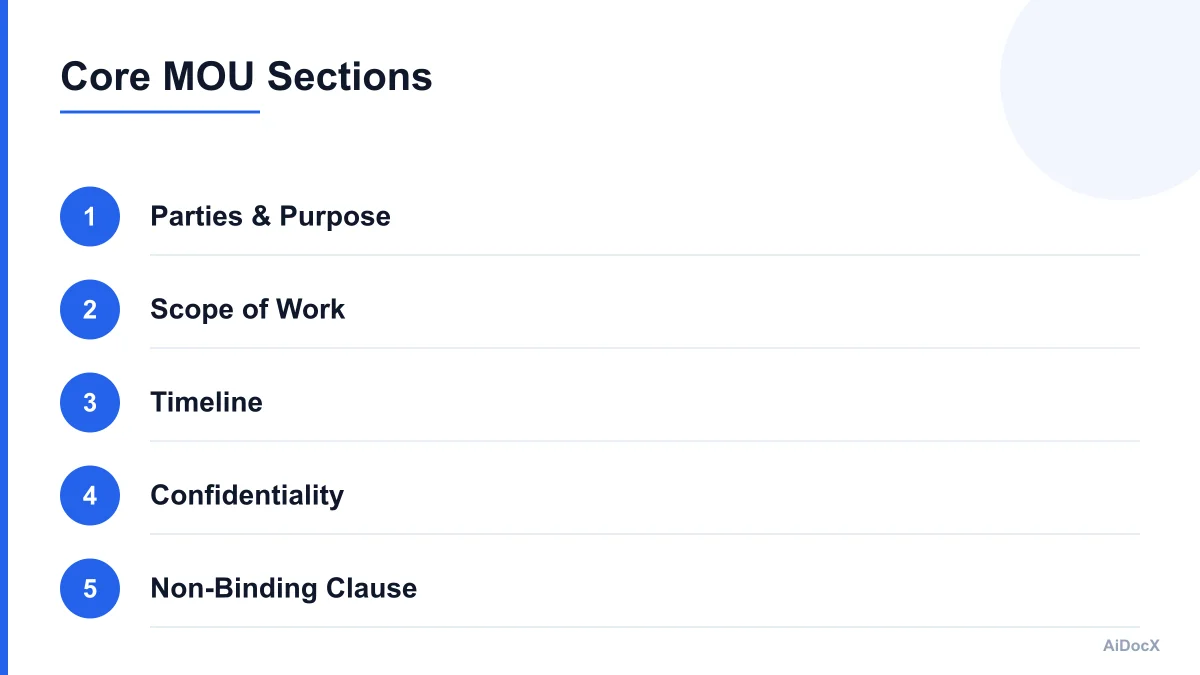
1. Parties and Purpose
Clearly identify the legal entities involved, including their registered names, addresses, and key representatives. State the specific purpose of the MOU. For example, "This MOU outlines the preliminary terms for the co-development of the Alpha Mobile App." Vague purposes like "general business cooperation" are dangerous because they leave too much room for interpretation.
2. Scope of Collaboration
Define what each party will do. This is the "meat" of the document.
- Party A Responsibilities: e.g., "Party A will provide the initial codebase and API documentation by March 15."
- Party B Responsibilities: e.g., "Party B will handle UI/UX design and user testing."
Be specific. Avoid broad statements like "Party A will support the project." Instead, specify the level of support, the deliverables, and the frequency of updates.
3. Timeline and Milestones
MOUs often serve as a project roadmap. Include a high-level timeline with key milestones.
- Start Date: When does the collaboration officially begin?
- Key Deliverables: What are the major checkpoints? (e.g., Prototype completion, Beta launch, Final delivery).
- End Date: When does the MOU period end? Note that MOUs often have a sunset clause, meaning they expire after a certain period unless replaced by a full contract.
4. Confidentiality and Intellectual Property
Even if the MOU is non-binding regarding the final deal, the confidentiality and IP clauses within it are often intended to be binding.
- Confidentiality: Define what information is confidential (e.g., trade secrets, financial data, user lists) and how long the obligation lasts.
- IP Ownership: Clarify who owns the background IP (what they brought to the table) and how foreground IP (what is created together) will be handled. A common approach is to state that all IP remains with the creating party until a definitive agreement is signed, or that joint IP will be owned jointly.
5. Non-Binding Clause
This is the most critical section for avoiding accidental liability. Include a clear statement that the MOU is not a binding agreement, except for specific sections (like confidentiality).
- Example Language: "This MOU is an expression of intent and does not constitute a legally binding contract, except for the provisions regarding Confidentiality and Intellectual Property. The parties intend to negotiate a definitive agreement, which will supersede this MOU."
6. Termination and Expiration
Specify how the MOU ends. Does it end when the definitive contract is signed? Does it expire after 60 days if no contract is signed? Who can terminate it, and with how much notice?
When Is an MOU Legally Binding?
This is the question that keeps founders up at night. The short answer is: It depends on the language and the jurisdiction.
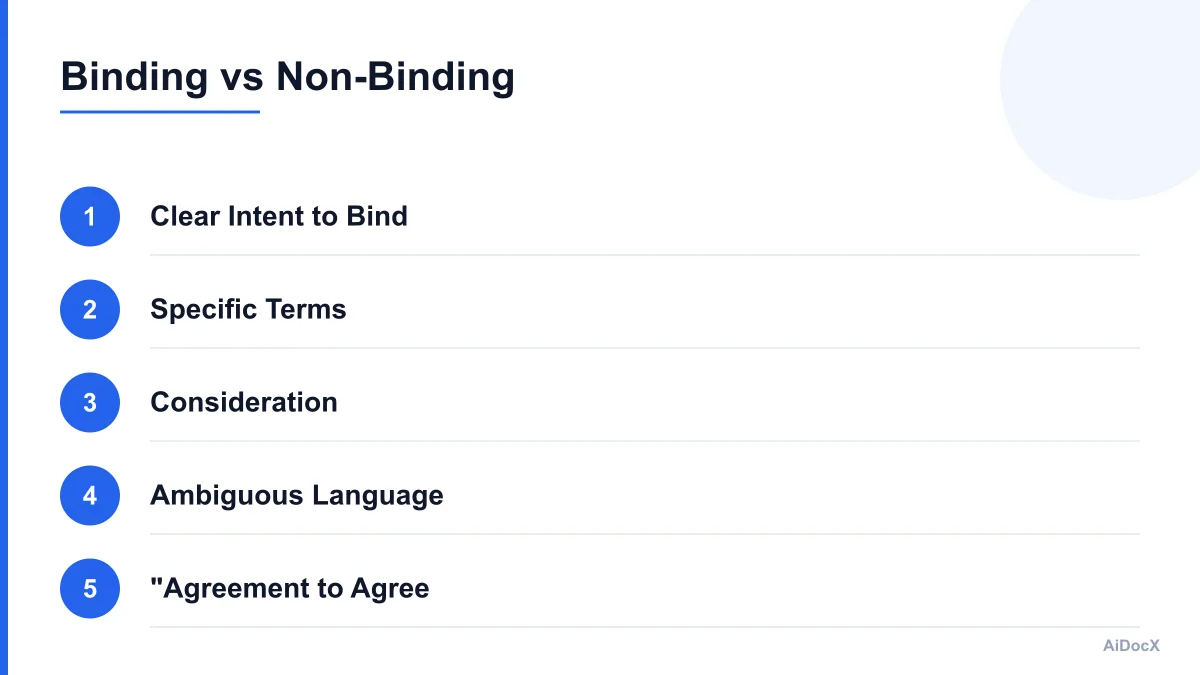
In most common law jurisdictions (including the US, UK, Canada, and Australia), a contract is formed when there is:
- Offer and Acceptance: One party proposes terms, the other agrees.
- Consideration: Something of value is exchanged (money, services, goods).
- Intention to Create Legal Relations: The parties intend to be legally bound.
An MOU can become binding if it meets these three criteria. Here is how to assess the risk:
The "Agreement to Agree" Problem
If your MOU says, "The parties agree to sign a contract by June 30," this is often unenforceable because the main terms (price, scope, liability) are missing. You cannot enforce an agreement to negotiate further if the essential terms are absent. However, if the MOU includes specific prices, detailed deliverables, and clear payment terms, a court may view it as a binding contract in disguise.
Exceptions to the Non-Binding Rule
Even if the main body of the MOU is non-binding, certain clauses are almost always treated as binding:
- Confidentiality: Courts expect parties to keep sensitive information secret, regardless of whether the final deal falls through.
- Intellectual Property: If you share your proprietary code or data, the recipient usually cannot claim they had no legal obligation to protect it.
- Dispute Resolution: Clauses specifying where and how disputes will be handled are often enforceable.
Red Flags That Suggest Binding Intent
If your MOU contains the following, it is likely to be seen as a binding contract:
- Specific monetary amounts and payment schedules.
- Detailed service levels (SLAs) with penalties.
- Language like "The parties hereby agree to..." rather than "The parties intend to...".
- No explicit statement that the document is non-binding.
Practical Tip: If you are unsure, assume the MOU is binding. Draft it with that level of care. If you want it to be non-binding, use explicit "expression of intent" language and exclude specific financial commitments until the final contract.
MOU vs. Full Contract: Key Differences
Understanding the distinction between an MOU and a full contract is crucial for managing risk.
| Feature | Memorandum of Understanding (MOU) | Full Contract / Agreement |
|---|---|---|
| Purpose | Aligns parties on high-level terms; facilitates negotiation. | Defines exact rights, obligations, and liabilities. |
| Detail | High-level scope, timeline, and roles. | Granular deliverables, payment terms, penalties, and remedies. |
| Legal Status | Often non-binding (except for confidentiality/IP). | Legally binding and enforceable in court. |
| Duration | Short-term; expires when the final contract is signed or after a set period. | Long-term; continues until fulfilled or terminated. |
| Complexity | Simpler; fewer clauses. | Complex; includes indemnification, limitation of liability, force majeure, etc. |
| Risk | Lower risk if drafted correctly; higher risk if ambiguous. | Higher initial effort, but lower long-term risk. |
When to Use an MOU
- Early Stage: When you need to start work but don't have time to negotiate a 50-page MSA.
- Exploratory Phase: When you are testing the viability of a partnership.
- Internal Alignment: When two departments within the same organization need to agree on a project roadmap.
When to Skip the MOU
- High-Stakes Deals: If the project involves significant capital, IP transfer, or exclusive rights, go straight to a full contract. The cost of legal errors in a high-stakes deal far outweighs the time saved by using an MOU.
- Simple Transactions: If the scope is clear and the price is fixed, a simple Purchase Order or Service Agreement is more efficient than an MOU.
How to Draft a Safe MOU: Step-by-Step
Drafting an MOU doesn't require a law degree, but it does require precision. Follow these steps to create a safe and effective document:
- Define the "Must-Haves": Before writing, list the 3-5 non-negotiable terms. What must be true for this partnership to work? (e.g., "We must own 50% of the IP," "We must be paid monthly").
- Use Clear, Plain Language: Avoid legalese. If a non-lawyer can't understand it, it's too complex. Use active voice. Instead of "It is agreed that the party shall..." write "Party A will deliver..."
- Separate Binding and Non-Binding Clauses: Create a section titled "Binding Provisions" and another titled "Non-Binding Provisions." This makes it clear to any reader (or judge) which parts carry legal weight.
- Include a "Sunset" Clause: State that the MOU expires on a specific date if a definitive agreement is not signed. This prevents the MOU from lingering indefinitely and creating accidental obligations.
- Review with Legal Counsel: Even if you draft the MOU yourself, have a lawyer review it for 30 minutes. The cost is low compared to the cost of a lawsuit.
Pro Tip: Use a digital platform to manage the process. Tools like AiDocX allow you to generate a structured MOU from a plain-English description of the deal. This ensures that all standard sections are included and that the language is consistent. You can then e-sign the document the same day, keeping the momentum while maintaining a clear legal record.
Common Mistakes to Avoid
Even experienced founders make mistakes with MOUs. Here are the most common pitfalls and how to avoid them:
1. Vague Scope of Work
- Mistake: "Party A will provide technical support."
- Fix: "Party A will provide 10 hours of technical support per month, available via email and phone during business hours."
2. Missing Confidentiality Clause
- Mistake: Assuming that because the MOU is non-binding, confidentiality isn't needed.
- Fix: Always include a robust confidentiality clause. It is the one part of the MOU that should be binding.
3. Ignoring IP Ownership
- Mistake: Not specifying who owns the work product created during the MOU period.
- Fix: Clearly state that background IP remains with the owner, and foreground IP will be addressed in the final contract. If the MOU expires without a final contract, specify what happens to the IP (e.g., "All IP created during the MOU period reverts to the creating party").
4. Forgetting the Sunset Clause
- Mistake: Leaving the MOU open-ended.
- Fix: Add a clause like, "This MOU shall expire on [Date] unless a definitive agreement is executed prior to that date."
5. Confusing the MOU with the Final Contract
- Mistake: Treating the MOU as the final agreement and starting work without a full contract.
- Fix: Use the MOU as a bridge, not a destination. Ensure that the final contract is drafted and signed before major resources are committed.
Checklist: Before You Sign an MOU
Use this checklist to review your MOU before sending it for signature:
- Parties Clearly Identified: Legal names and addresses are correct.
- Purpose Stated: The specific goal of the collaboration is defined.
- Scope Defined: Responsibilities of each party are specific and measurable.
- Timeline Included: Key milestones and end dates are listed.
- Confidentiality Clause: Present and clearly marked as binding.
- IP Ownership: Background and foreground IP are addressed.
- Non-Binding Statement: Explicitly states that the MOU is not a binding contract (except for specific clauses).
- Sunset Clause: The MOU expires if a final contract is not signed by a specific date.
- Dispute Resolution: Specifies jurisdiction and method for resolving disputes.
- Signatures: Both parties have signed and dated the document.
Conclusion: The MOU as a Strategic Tool
An MOU is not just a formality; it is a strategic tool for aligning expectations and building trust. When used correctly, it allows small businesses and startups to move quickly, test partnerships, and protect sensitive information without the overhead of a full contract. However, it requires careful drafting to avoid unintended legal obligations.
By focusing on clarity, specificity, and explicit non-binding language, you can create an MOU that serves as a safe foundation for your business relationships. Remember, the goal of the MOU is to facilitate the final contract, not to replace it. Use it to bridge the gap between initial discussions and a definitive agreement.
Ready to draft your next MOU? With AiDocX, you can generate a structured, legally sound MOU from a simple description of your deal. The platform ensures all critical sections are included, allows for same-day e-signatures, and keeps the MOU linked to your eventual full contract. This seamless workflow ensures that nothing gets lost between drafts, giving you the speed of a startup with the rigor of a legal team. Start your next partnership with confidence.
Ready to automate your documents with AI?
Start free with AiDocX — AI contract drafting, meeting minutes, consultation notes, e-signatures, and more in one platform.
Get Started FreeMore from AiDocX Blog
How to Read a Business Contract: A Founder's Checklist (2026)
A practical way to review parties, scope, money, IP, liability, and exit terms before signing a business contract.
 MinjiLee October 7, 2026 9 min
ESIGN vs eIDAS: What Founders Should Know About E-Signatures (2026)
What U.S. ESIGN and EU eIDAS actually say, where exceptions apply, and what founders should keep to document an electronic signing.
MinjiLee October 7, 2026 7 min
Does Document Automation Pay Off? An ROI Worksheet for Founders (2026)
Estimate document automation ROI with your own volume, time, labor, and software costs. Includes a clearly labeled example and break-even formula.
 Chloe October 7, 2026 8 min