Mutual vs One-Way NDA: Best Choice for Startups 2026
Discover whether a mutual or one-way NDA protects your startup better. Learn key differences, use cases, and how to draft the right agreement quickly.
 James · Content Manager August 3, 2026 12 min read
Mutual NDA vs One-Way NDA: Which Small Businesses and Startups Should Actually Use
Choosing between a mutual and one-way non-disclosure agreement (NDA) is one of the first legal decisions a founder makes. It seems simple, but the wrong choice can leave your intellectual property exposed or kill a promising partnership before it starts. A one-way NDA protects information you share with others. A mutual NDA protects information both parties share. Most founders default to the one-way version out of habit, even when they are the ones receiving sensitive data from a partner or vendor.
This guide breaks down exactly when to use each type. We will look at real-world scenarios, legal implications, and practical drafting tips. By the end, you will know which agreement fits your specific situation. You will also understand how to get these documents signed quickly and securely, ensuring your sensitive conversations are protected from the very first meeting.
The Core Difference: Direction of Protection
At its heart, an NDA is about controlling the flow of confidential information. The distinction between "one-way" and "mutual" is not just semantic; it defines who has obligations and who has rights.
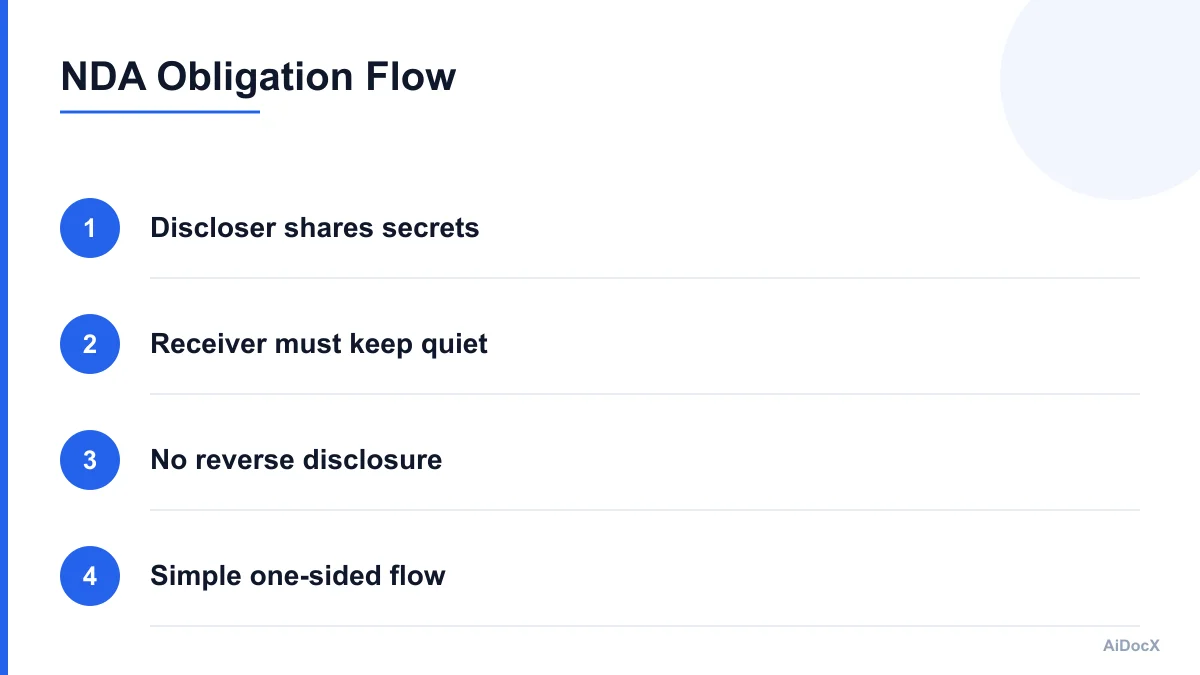
A One-Way NDA (also called a unilateral NDA) is a one-sided contract. Only one party—the "Disclosing Party"—shares confidential information. The other party—the "Receiving Party"—is legally bound to keep that information secret. The Receiving Party does not share any sensitive information in this context.
A Mutual NDA (or bilateral NDA) is a two-sided contract. Both parties are simultaneously Disclosing Parties and Receiving Parties. Each side agrees to protect the other’s confidential information. This is common when two companies are exploring a joint venture, merger, or deep technical integration where both sides need to see under the hood.
For small businesses and startups, this distinction matters because it affects negotiation leverage, legal costs, and the perception of trust. Using a one-way NDA when a mutual one is appropriate can signal distrust. Using a mutual NDA when a one-way is sufficient can create unnecessary administrative overhead.
When to Use a One-Way NDA
A one-way NDA is the standard tool for protecting your own intellectual property when you are the primary source of sensitive information. It is simple, fast to execute, and clearly delineates responsibility. If you are the one holding the cards in terms of data flow, use a one-way NDA.
Pitching to Investors (Pre-Due Diligence)
Many founders believe they need an NDA before pitching to venture capitalists. In reality, most top-tier VCs will not sign an NDA for early-stage pitches. However, if you are pitching to an angel investor, a corporate venture arm, or a smaller fund that might sign, a one-way NDA is appropriate.
In this scenario, you are disclosing your business model, financial projections, and product roadmap. The investor is not disclosing their proprietary algorithms or internal strategies. You are the Disclosing Party; they are the Receiving Party. A one-way NDA ensures they cannot take your idea and give it to a competitor.
Hiring Freelancers or Contractors
When you bring in a freelance developer, designer, or consultant to build a prototype, you are sharing your source code, design files, and customer lists. The freelancer is providing a service, not sharing their own trade secrets in the same context.
A one-way NDA protects your IP. It prevents the freelancer from taking your code snippets and selling them to another client or using them in their portfolio without permission. It is cleaner than a mutual agreement because the freelancer has no proprietary business information relevant to your project that needs protection.
Sharing Data with Vendors
If you are onboarding a cloud storage provider, a payroll service, or a marketing agency, you are handing over sensitive data. The vendor needs this data to perform their service. They do not need you to protect their data, unless you are also sharing their proprietary integration keys or specific business metrics that constitute their trade secrets.
In most vendor onboarding scenarios, a one-way NDA is sufficient. It keeps the contract focused on protecting your data. It avoids the complexity of defining "mutual" confidential information, which can lead to disputes over what is actually confidential.
When to Use a Mutual NDA
A mutual NDA is essential when the relationship is collaborative and information flows in both directions. It levels the playing field and signals that both parties are equal partners in the conversation. Using a mutual NDA in these situations builds trust and prevents accusations of one-sided exploitation.
Exploring Joint Ventures or Partnerships
If Company A and Company B are considering a partnership where both will contribute technology, customer bases, or operational processes, a mutual NDA is mandatory.
Imagine a startup developing a new AI model partnering with a large enterprise that has vast datasets. The startup shares its algorithm (Disclosing); the enterprise shares its training data (Disclosing). Both parties are receiving sensitive information from the other. A one-way NDA would be inadequate because it would only protect one side’s assets. A mutual NDA ensures both the algorithm and the dataset are legally protected.
Mergers and Acquisitions (M&A) Due Diligence
During M&A discussions, the target company and the acquirer exchange deep financial records, legal histories, and operational metrics. Both sides are disclosing sensitive information. The acquirer needs to see the target’s books; the target needs to see the acquirer’s integration plans and financial capacity.
A mutual NDA is standard in M&A. It protects both parties from competitive harm if the deal falls through. Without it, either party could potentially use the other’s leaked data to gain a market advantage.
Technical Integrations and API Access
If your startup is building an integration with another platform, you may need to share your API documentation, while the other platform shares their authentication protocols or rate-limiting structures. Both sides are revealing technical secrets.
A mutual NDA clarifies that both sets of technical information are confidential. It prevents either side from reverse-engineering the other’s integration logic beyond the scope of the partnership.
Key Differences in Legal Obligations
Understanding the legal mechanics of each NDA type helps you draft better terms and negotiate more effectively. The differences extend beyond just who shares information; they affect definitions, duration, and remedies.
Definition of Confidential Information
In a one-way NDA, the definition of "Confidential Information" is tailored specifically to the Disclosing Party’s assets. It might include "all source code, customer lists, and financial projections of [Company Name]."
In a mutual NDA, the definition must be broad enough to cover both parties’ assets. It typically defines Confidential Information as "any non-public information disclosed by either party." This requires careful drafting to ensure it doesn’t inadvertently include publicly available information or information that is independently developed.
Duration of Confidentiality
One-way NDAs often have a fixed term, such as 2-5 years, after which the obligations expire. This is practical for vendor relationships or short-term projects.
Mutual NDAs in strategic partnerships or M&A often have longer durations, sometimes extending indefinitely for trade secrets. This is because the value of the shared information (like a joint algorithm or merger strategy) may remain sensitive for a longer period.
Return or Destruction of Materials
Both types usually include a clause requiring the return or destruction of confidential materials upon termination. However, in a mutual NDA, this clause applies to both sides. It is crucial to specify how the information must be returned. For digital assets, this might mean secure deletion with a certificate of destruction. For physical assets, it means certified mail return.
Common Mistakes in NDA Drafting
Even the right type of NDA can fail if drafted poorly. Founders often copy-paste templates from the internet without adjusting for their specific context. These mistakes can render the NDA unenforceable or leave gaps in protection.
Vague Definitions of Confidential Information
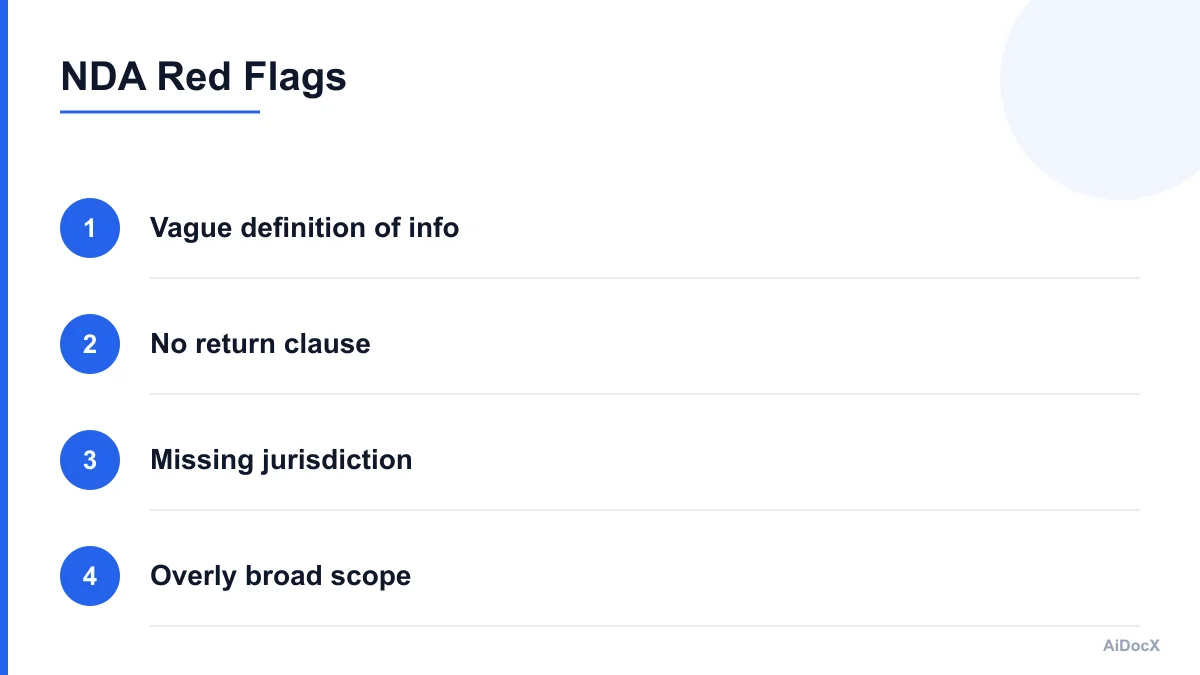
If your NDA defines "Confidential Information" too broadly, it may be deemed unenforceable for lack of specificity. Conversely, if it is too narrow, it may not cover the actual data you are sharing.
Mistake: Defining confidential information as "all information discussed in meetings." Fix: Define it as "written, oral, or electronic information marked as 'Confidential' or that a reasonable person would understand to be confidential, including but not limited to source code, financial data, and customer lists."
Missing Exclusions
Every NDA must exclude information that is not actually confidential. Standard exclusions include information that is:
- Already in the public domain.
- Known to the Receiving Party prior to disclosure.
- Independently developed by the Receiving Party.
- Received from a third party without breach of confidentiality.
Failing to include these exclusions can create legal ambiguity and make the NDA look like an attempt to silence legitimate business operations.
Overly Broad Non-Compete Clauses
Some NDAs try to sneak in non-compete clauses, prohibiting the other party from working with competitors. While related, non-competes are a separate legal issue and are heavily regulated or banned in many jurisdictions (like California).
Mistake: Including a clause that says "The Receiving Party agrees not to work with any competitors of the Disclosing Party for 2 years." Fix: Keep the NDA focused on confidentiality. If you need non-compete protection, draft a separate non-compete agreement or consult a lawyer about its enforceability in your jurisdiction.
How to Choose the Right NDA for Your Situation
Deciding between a mutual and one-way NDA comes down to a simple flowchart of information flow. Ask yourself these three questions before sending any document.
1. Who is Sharing the Secrets?
If only you are sharing sensitive information, choose a One-Way NDA. This is the case for most vendor onboarding, freelancer hiring, and early-stage pitching (if an NDA is even considered).
If both parties are sharing sensitive information, choose a Mutual NDA. This is the case for partnerships, joint ventures, M&A, and technical integrations.
2. What is the Relationship Dynamics?
Is the relationship hierarchical or collaborative? A one-way NDA implies a hierarchy where one party holds the IP and the other provides a service or capital. A mutual NDA implies equality and collaboration. Using a mutual NDA in a collaborative setting builds trust and encourages open dialogue.
3. What is the Risk of Reverse Engineering?
In a one-way NDA, the risk is that the Receiving Party steals your IP. In a mutual NDA, the risk is bidirectional. If you are sharing proprietary algorithms with a partner who is also sharing their data, the risk of misuse is higher on both sides. A mutual NDA provides balanced protection against this bidirectional risk.
Practical Steps to Draft and Sign Your NDA
Once you have determined the type of NDA you need, the next step is drafting and executing it. Manual drafting is error-prone and time-consuming. Using a specialized tool can streamline this process and ensure legal compliance.
Step 1: Gather Necessary Information
Before drafting, collect the following details:
- Full legal names of both parties.
- Entity types (LLC, Corporation, Sole Proprietorship).
- Jurisdiction of governing law (usually the state where the company is incorporated).
- Specific types of confidential information being shared (e.g., source code, financials, customer lists).
Step 2: Draft the Agreement
Use a trusted legal template or an AI-powered platform to generate the NDA. Ensure it includes:
- Clear definition of Confidential Information.
- Exclusions from confidentiality.
- Term and duration of the agreement.
- Obligations of the Receiving Party.
- Remedies for breach.
- Governing law and jurisdiction.
AiDocX drafts the correct NDA type in minutes, whether mutual or one-way, and gets it signed with a verifiable audit trail before any sensitive conversation starts. This ensures that you are not sharing a single byte of data without legal protection in place.
Step 3: Review and Negotiate
Have a lawyer review the draft, especially if the deal is high-stakes. For standard vendor or freelancer NDAs, a review by a legal professional can take only a few hours and cost significantly less than custom drafting.
Be prepared for minor edits. The other party may request changes to the governing law or the duration. These are common negotiation points.
Step 4: Sign and Store
Use an e-signature platform that provides a verifiable audit trail. This is critical for enforcing the NDA in court. The audit trail proves who signed, when, and from what IP address. Store the signed NDA in a secure, accessible location.
Checklist: Before You Share Sensitive Data
Before you send any confidential documents, run through this quick checklist. If any item is unchecked, pause and address the gap.
- Identified NDA Type: Determined if a one-way or mutual NDA is required based on information flow.
- Defined Confidential Information: Specific types of data are clearly listed or defined in the NDA.
- Exclusions Included: Public domain and independently developed information are excluded.
- Duration Specified: Clear start and end dates for the confidentiality obligation.
- Governing Law Selected: Jurisdiction is specified and favorable to your business.
- Signed and Stored: Both parties have signed the NDA, and the document is securely stored.
- Audit Trail Verified: If using e-signatures, the audit trail is confirmed to be intact.
Conclusion
Choosing between a mutual and one-way NDA is not just a legal formality; it is a strategic decision that impacts your relationships and protects your intellectual property. A one-way NDA is your shield when you are sharing your secrets. A mutual NDA is your handshake when you are sharing secrets with a partner.
Do not leave this decision to chance. Use the right tool for the job. AiDocX drafts the correct NDA type in minutes, whether mutual or one-way, and gets it signed with a verifiable audit trail before any sensitive conversation starts. Protect your startup’s future by ensuring your legal foundations are solid from day one.
Ready to automate your documents with AI?
Start free with AiDocX — AI contract drafting, meeting minutes, consultation notes, e-signatures, and more in one platform.
Get Started FreeMore from AiDocX Blog
AI Press Release Generator: Write One in Minutes (+ Template)
Learn what a press release is, the AP-style format, and how to use an AI press release generator to draft one in minutes with a fill-in template.
James September 21, 2026 10 min
Angel Investment Agreement (2026): Key Terms + Template Guide
Angel investor agreement explained: the four structures founders actually sign, key terms, securities basics, a closing checklist and a summary term sheet.
James September 21, 2026 12 min
Artist Commission Contract Template (2026): Free Template + Guide
Free artist commission contract template with license tiers, deposit, revision, refund and AI-training clauses, plus a guide to getting it e-signed.
James September 21, 2026 12 min