NDA vs Confidentiality Agreement: Which One Do You Need in 2026?
Stop guessing which document protects your IP. We break down the differences between NDAs and confidentiality agreements, plus the clauses that protect your startup.
 James · Content Manager July 4, 2026 6 min read
NDA vs Confidentiality Agreement: Which One Do You Need in 2026?
If you are sharing proprietary ideas, customer data, or early-stage product specs with a contractor, partner, or investor, you need a signed document before the conversation starts. But should it be called an NDA or a confidentiality agreement? The short answer: in most practical cases, you do not need to choose a different document. The terms are often used interchangeably, but the legal weight depends entirely on the clauses inside, not the title.
This guide cuts through the naming confusion so you can pick the right document for your startup or small business without hiring a lawyer for every handshake deal.
The Short Answer: They’re Often the Same Thing
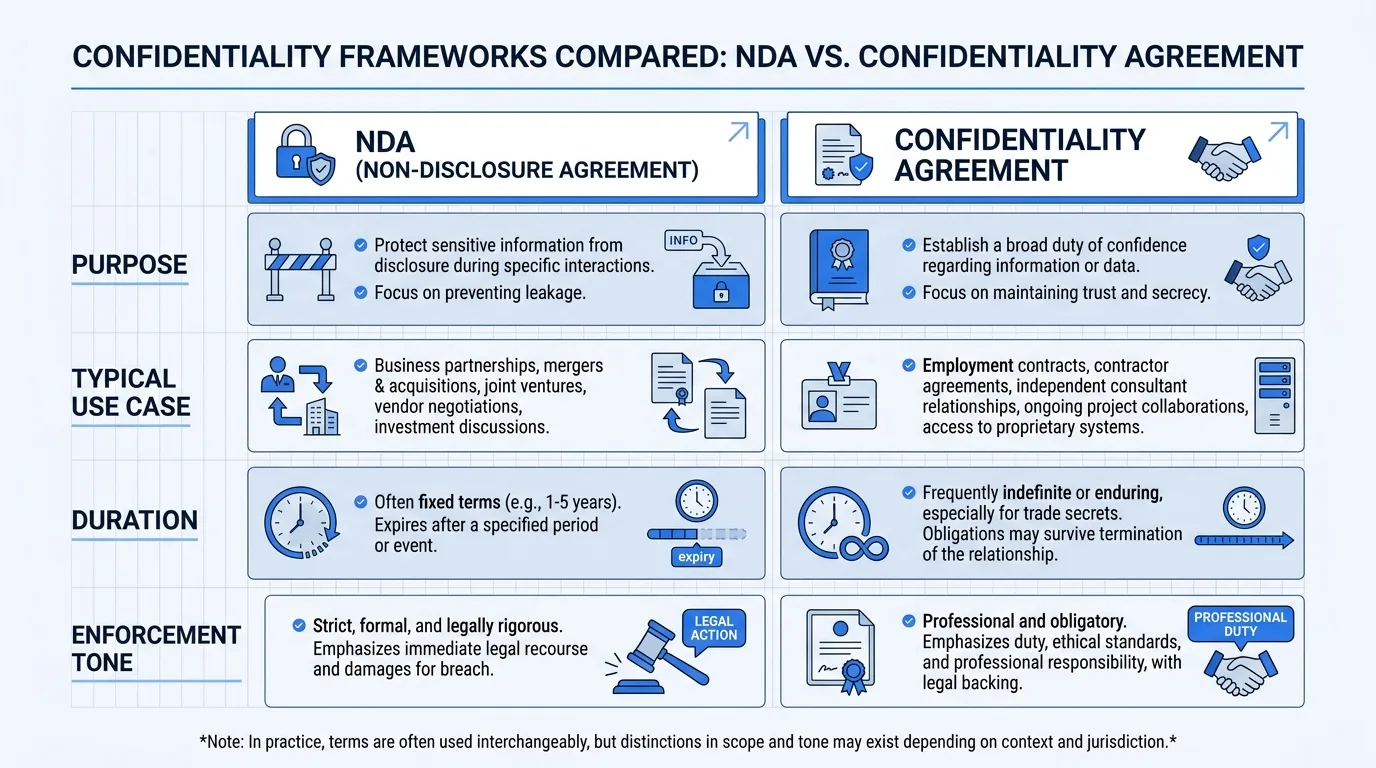
In everyday business practice, an NDA (Non-Disclosure Agreement) and a confidentiality agreement serve the exact same function: they legally bind one or both parties to keep specified information private. Courts generally look at the substance of the contract, not the heading.
Why does the naming confusion exist? Historically, NDAs were tied to employment or contractor relationships, while confidentiality agreements were used for business-to-business partnerships. Today, that line has blurred completely. A SaaS founder pitching to an enterprise buyer will use the same document as a hardware startup sharing schematics with a contract manufacturer.
What actually matters is whether the document clearly defines:
- What information qualifies as confidential
- What exceptions apply (public knowledge, independently developed, legally compelled)
- How long the obligation lasts
- What happens if someone breaches it
If those elements are present, the title on the first page is irrelevant.
When an NDA Actually Means Something Different
There are a few specific contexts where the distinction still holds weight. In employment law, an NDA often refers to a standalone clause embedded in an offer letter or contractor agreement, whereas a confidentiality agreement is usually a standalone, more comprehensive contract.
You will also see the term NDA used when discussing government contracts, pharmaceutical trials, or M&A due diligence. In those high-stakes environments, an NDA tends to be stricter, shorter in duration, and paired with immediate injunctive relief clauses. If you are negotiating a partnership that involves sharing trade secrets, customer lists, or unreleased financial data, lean toward a standalone confidentiality agreement rather than a lightweight NDA clause.
For day-to-day operations—onboarding freelancers, talking to potential investors, or vetting suppliers—a standard NDA template is usually sufficient.
Key Clauses That Actually Protect Your Business
The title does not protect you. The clauses do. Whether you call it an NDA or a confidentiality agreement, your document needs these five components to be enforceable in 2026:
- Definition of Confidential Information: Be specific. List categories like source code, pricing models, roadmaps, and customer data. Vague language like “all business information” gets thrown out in disputes.
- Exclusions: Standard carve-outs for publicly available data, information already known to the recipient, and material independently developed without your input.
- Term & Survival: How long does the obligation last? Standard is 2–5 years for business info, but trade secrets should be protected indefinitely.
- Permitted Use: Restrict the information to a specific purpose. “For evaluation purposes only” prevents recipients from leveraging your data for competing products.
- Remedies & Injunctive Relief: Money damages are hard to collect. Explicitly state that a breach causes irreparable harm, allowing you to seek a court order to stop the leak immediately.
Mutual vs. One-Way: Which Fits Your Stage?
Not all NDAs flow in a single direction. Choosing the wrong structure can leave you exposed or make counterparties walk away.
- One-Way NDA: Only one party discloses confidential information. Use this when you are sharing your roadmap with a potential investor, handing specs to a manufacturer, or onboarding a new hire.
- Mutual NDA: Both parties exchange sensitive information. Use this for joint ventures, co-development partnerships, or supplier negotiations where you will also receive their proprietary data.
Founders often default to mutual NDAs out of fairness, but that can backfire. If you only need to protect your side, a mutual NDA gives your counterparty an excuse to claim your data is theirs to use. Match the structure to the actual flow of information.
Red Flags in NDA Drafts Founders Should Avoid
Before signing or sending an NDA, scan for these common pitfalls:
- Overbroad definitions: “Any information disclosed, whether written or oral” without a documentation requirement is unenforceable in many jurisdictions.
- Unlimited duration: Some templates demand perpetual secrecy. Unless it is a true trade secret, cap it at 3–5 years to keep the agreement reasonable.
- Non-solicitation disguised as confidentiality: If the NDA also prevents you from hiring the recipient’s colleagues for two years, it is a non-compete in disguise. Push back or negotiate separate terms.
- No jurisdiction clause: Without a specified governing law, enforcement becomes a jurisdictional nightmare if a dispute crosses state or national lines.
- Missing return/destruction clause: Require that all confidential materials be returned or destroyed within 30 days of termination.
How to Draft, Sign, and Store an NDA in Minutes
You do not need a custom-drafted contract for every new vendor or advisor. A well-structured template, customized for your specific use case, will cover 95% of founder scenarios.
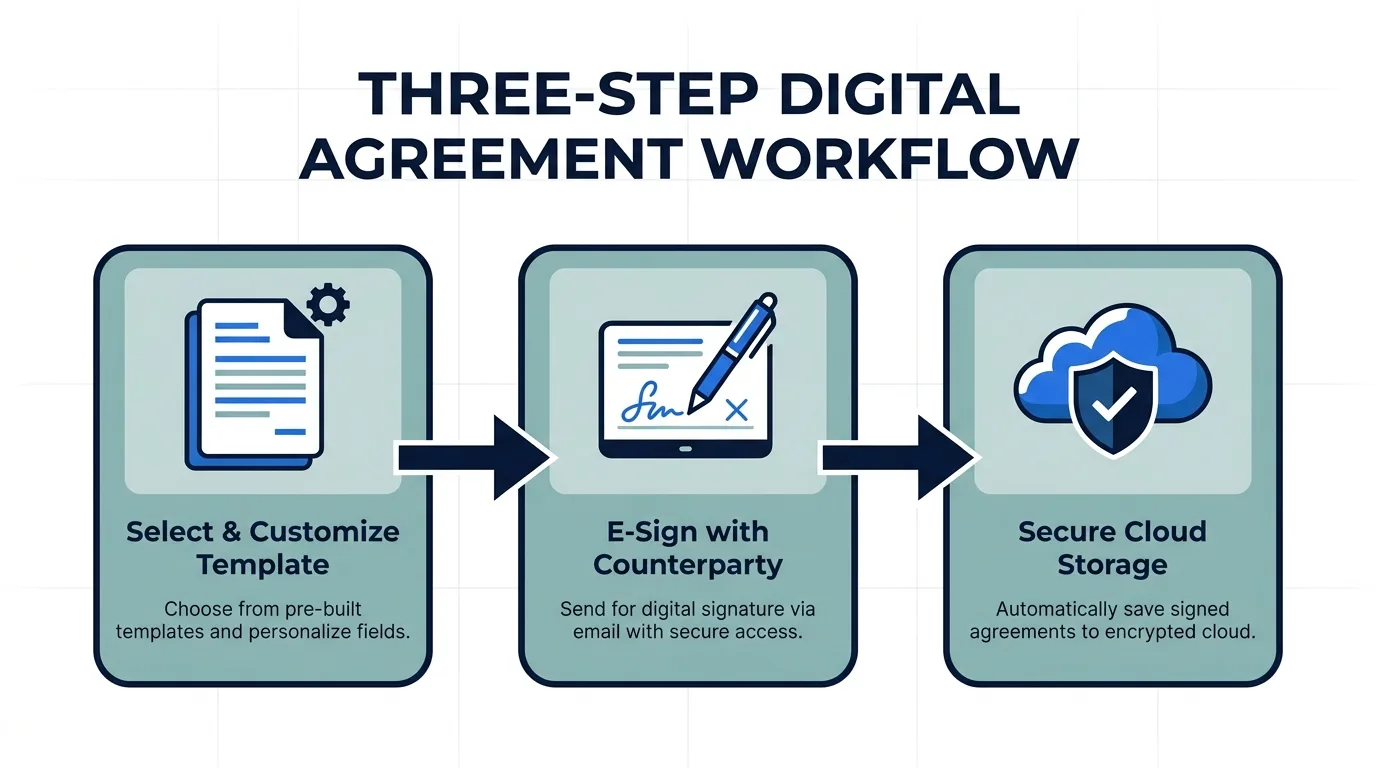
The workflow is straightforward:
- Select a vetted template that matches your scenario (one-way, mutual, employment, or partnership).
- Customize the definitions and term to reflect what you are actually sharing.
- E-sign with your counterparty so both sides have a time-stamped, tamper-proof copy.
- Store it in a centralized repository linked to the counterparty’s profile for easy retrieval during audits or disputes.
Platforms like AiDocX give founders ready NDA templates you can customize and e-sign without waiting on external counsel. The goal is speed with compliance, not perfection on the first draft.
Quick Pre-Sign Checklist
Before you hit send, run through this list:
- Confidential information is clearly defined with specific categories
- Exclusions match standard legal carve-outs
- Term length is reasonable (2–5 years for general info, indefinite for trade secrets)
- Permitted use is restricted to your stated purpose
- Injunctive relief and breach remedies are explicitly stated
- Governing law and jurisdiction are specified
- Return/destruction clause is included
- Both parties have signed and received a certified copy
Bottom Line
The NDA vs confidentiality agreement debate is mostly semantic. Pick the document that matches your actual information flow, load it with the five enforceable clauses, and sign it before the first sensitive conversation. Treat it as a standard operational step, not a legal hurdle.
If you want a clean, founder-tested starting point, AiDocX offers customizable NDA templates you can adapt to your exact scenario and e-sign in minutes. No legal jargon, no unnecessary back-and-forth—just a document that actually protects what matters.
Ready to automate your documents with AI?
Start free with AiDocX — AI contract drafting, meeting minutes, consultation notes, e-signatures, and more in one platform.
Get Started FreeMore from AiDocX Blog
Machine Shop Job Traveler Template: Routing Sheet + Example
Copy a machine shop job traveler template for small job shops. Includes a routing sheet, filled example, traceability fields, sign-offs, and setup tips.
Weekly Status Report Template: 4 Formats + Examples
Copy one of four weekly status report templates for individual work, projects, leadership, or blockers. See a worked example and a practical review checklist.
How to Read a Business Contract: A Founder's Checklist (2026)
A practical way to review parties, scope, money, IP, liability, and exit terms before signing a business contract.
 MinjiLee October 7, 2026 9 min