Net 30 Invoice Template 2026: Get Paid On Time
Master Net 30 payment terms with our 2026 invoice template. Learn how to set clear deadlines, avoid late payments, and streamline your billing process today.
 James · Content Manager August 3, 2026 7 min read
Net 30 Invoice Template 2026: How to Set Terms That Actually Get You Paid On Time
Net 30 is the standard for B2B transactions, but "standard" doesn't mean "easy." For small business owners and freelancers, chasing late invoices is often the most time-consuming part of the job. The gap between delivering value and receiving payment is where cash flow dies. This guide explains how to structure your invoices in 2026 so that "Net 30" isn't just a suggestion, but a binding, understood agreement that results in timely payments.
Why Net 30 Is Still the Standard (And Why It Fails)
"Net 30" means the buyer has 30 calendar days from the invoice date to pay. It is the default because it aligns with most corporate accounting cycles. However, it fails when it is ambiguous. If your invoice says "Due Upon Receipt" but you previously agreed to Net 30, or if the due date isn't calculated correctly, you lose leverage. In 2026, clarity is your primary asset. Clients are busy; if they have to guess when to pay, they will delay until they are forced.
The Anatomy of a Perfect Net 30 Invoice
Your invoice is not just a bill; it is a legal document and a project management tool. Every field must serve a purpose. A messy invoice invites delays. A clean, explicit invoice sets expectations.
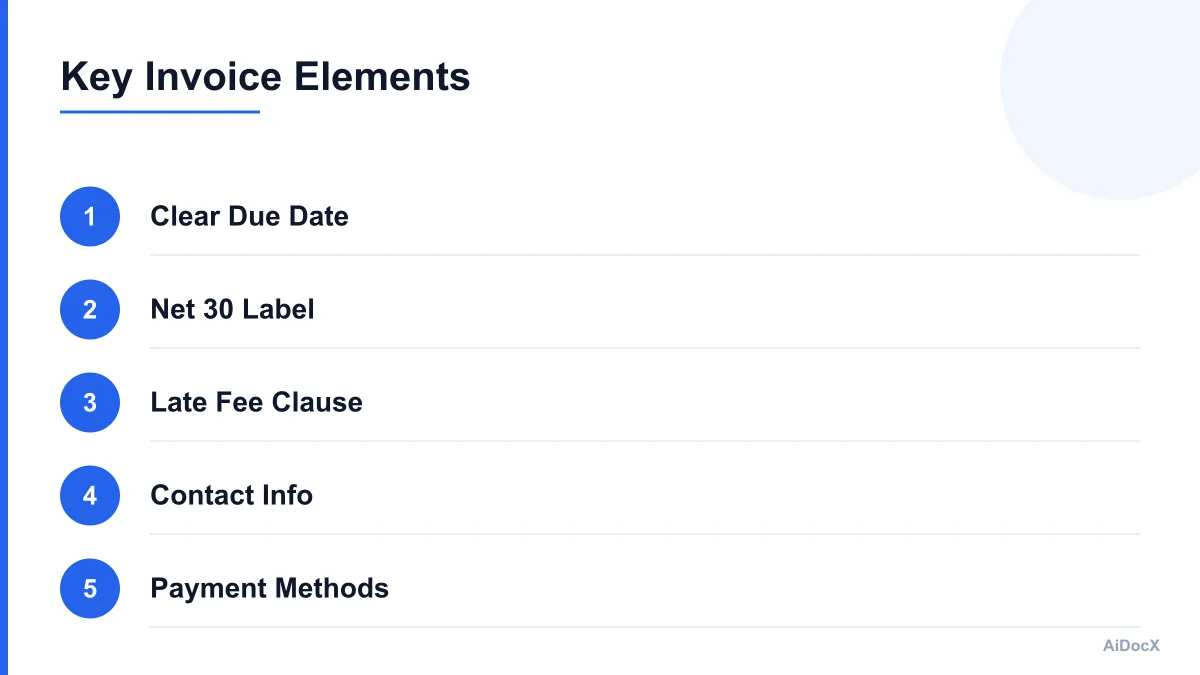
Here is what your 2026 Net 30 invoice must include:
- Clear "Net 30" Label: Do not hide this. Put it in the header or next to the due date.
- Exact Due Date: Do not just write "Net 30." Calculate and display the specific date (e.g., "Due: October 15, 2026").
- Late Fee Clause: A stated penalty (e.g., 1.5% per month) encourages on-time payment.
- Payment Methods: Make it easy. Include links to bank transfer, PayPal, or credit card processing.
- Purchase Order (PO) Number: If the client requires a PO, this must be prominent to avoid internal approval delays.
Drafting the Invoice: A Step-by-Step Guide
Creating an invoice that enforces terms starts with the template. You need a format that leaves no room for interpretation.
- Header: Your logo, business name, address, and contact info. Include your EIN or Tax ID.
- Client Details: Name, address, and specific contact person for accounts payable.
- Invoice Number: Use a sequential system. This helps with tracking and legal enforcement.
- Date of Issue: The day you send the invoice. This starts the 30-day clock.
- Due Date: The calculated date (Issue Date + 30 days).
- Line Items: Describe services clearly. Vague descriptions like "Consulting" can lead to disputes. Use "Q3 Marketing Strategy Session" instead.
- Subtotal, Tax, Total: Break these down clearly.
- Terms & Conditions: A brief section reiterating Net 30 and any late fees.
How to Communicate Terms Before the Invoice Arrives
The invoice is the final step. The real work happens before you hit send. If you agree to Net 30 verbally without documenting it, you have no ground to stand on.
- Contracts First: Your master service agreement (MSA) or proposal must state payment terms. Never start work without a signed contract.
- Onboarding Email: When you onboard a new client, send a one-pager explaining your billing process. Include a sample invoice.
- Pre-Invoice Reminder: If a project is large, send a "Final Deliverable" email 3 days before invoicing. Say, "I will send the invoice on Friday for Net 30 payment." This primes the client's accounting team.
Common Mistakes That Delay Payment
Even with good terms, mistakes happen. Avoid these common pitfalls that frustrate clients and delay cash flow.
- Incorrect Due Date Calculation: If you send an invoice on Jan 31, Net 30 is not Feb 30. It is March 2. Use software to calculate this automatically.
- Missing PO Numbers: Large companies will not pay without a PO. If you don't ask for it, they will ask you, delaying payment by weeks.
- Vague Descriptions: If a client disputes a line item, they may withhold the entire payment. Be specific.
- No Late Fee Clause: Without a penalty, late payment is just an inconvenience, not a cost.
- Ignoring Email Opens: If you don't know if they saw the invoice, you can't follow up effectively.
Tracking Invoice Status: The Modern Approach
In 2026, sending an email and hoping for the best is obsolete. You need visibility. Knowing when a client opens your invoice allows you to time your follow-ups perfectly. If they open it on Day 5, you wait until Day 25. If they open it on Day 29, you follow up immediately.
This is where modern tools make a difference. Platforms like AiDocX draft an invoice with clear payment terms and shows exactly when the client opens it, so late payment stops being a mystery. This level of insight transforms billing from a passive activity into an active management process.
5 Steps to Enforce Net 30 Terms Without Losing Clients
Enforcement is not about being aggressive; it's about being consistent. Here is a professional workflow for handling late payments.
- Day 1: Send Invoice. Include clear terms and a link to pay.
- Day 5: Confirm Receipt. If you have tracking, and they haven't opened it, send a polite nudge: "Just ensuring this landed in your inbox."
- Day 25: Pre-Due Reminder. Send a friendly reminder. "Invoice #123 is due on Day 30. Please confirm payment date."
- Day 31: Late Notice. If payment is late, send a formal notice. "Payment is now overdue. Please remit immediately to avoid late fees."
- Day 45: Escalation. If still unpaid, pause work or send a final demand letter.
The Role of Technology in Streamlining Billing
Manual invoicing is prone to error and lacks data. Using dedicated software helps you track metrics like "Average Days to Pay" (ADP). If your ADP is 35, you know your Net 30 terms are effectively Net 35. You can then adjust your pricing or terms accordingly.
Look for tools that:
- Automate reminders.
- Track email opens and clicks.
- Integrate with accounting software (QuickBooks, Xero).
- Allow one-click payments.
Checklist: Before You Send Your Next Invoice
Use this checklist to ensure your invoices are optimized for timely payment.
- Invoice number is sequential and unique.
- Due date is clearly stated and correctly calculated.
- "Net 30" is explicitly mentioned.
- Late fee clause is included.
- Payment methods are listed and functional.
- PO number is included (if required).
- Line items are specific and descriptive.
- Client contact for AP is verified.
- Invoice is attached as a PDF (not an image).
- Email subject line is clear: "Invoice #123 for [Project] - Due [Date]"
Conclusion: Take Control of Your Cash Flow
Net 30 terms are not a promise; they are a deadline. By setting clear expectations, using precise language, and leveraging technology to track engagement, you can significantly reduce the time between work and payment. Don't let late invoices drain your energy or your bank account.
Start by auditing your current invoice template. Is it clear? Is it professional? If you want to streamline this process, consider using a platform like AiDocX to handle the technical details, allowing you to focus on delivering value. Clear terms, clear tracking, and consistent follow-up are the keys to getting paid on time, every time.
Frequently Asked Questions
What happens if a client refuses to pay Net 30 terms? Check your contract. If they signed an agreement stating Net 30, you have legal standing. Start with a formal demand letter, then consider small claims court or a collections agency.
Can I charge interest on late payments? Yes, if your contract or invoice explicitly states a late fee or interest rate. This must be reasonable and compliant with local laws.
Should I offer early payment discounts? Yes. Offering a 2% discount for payment within 10 days (2/10 Net 30) can improve cash flow significantly and incentivize faster payment.
How do I handle clients who always pay late? Have a conversation. If a client consistently pays on Day 40, adjust your terms to Net 15 or require a deposit. Your time is valuable; don't subsidize their cash flow.
Ready to automate your documents with AI?
Start free with AiDocX — AI contract drafting, meeting minutes, consultation notes, e-signatures, and more in one platform.
Get Started FreeMore from AiDocX Blog
AI Press Release Generator: Write One in Minutes (+ Template)
Learn what a press release is, the AP-style format, and how to use an AI press release generator to draft one in minutes with a fill-in template.
James September 21, 2026 10 min
Angel Investment Agreement (2026): Key Terms + Template Guide
Angel investor agreement explained: the four structures founders actually sign, key terms, securities basics, a closing checklist and a summary term sheet.
James September 21, 2026 12 min
Artist Commission Contract Template (2026): Free Template + Guide
Free artist commission contract template with license tiers, deposit, revision, refund and AI-training clauses, plus a guide to getting it e-signed.
James September 21, 2026 12 min