One-Page Contract Template 2026: Simple Deals Made Safe
Discover when a one-page contract is enough for small business deals in 2026. Learn what to include, legal pitfalls to avoid, and how to stay protected without legal fees.
 James · Content Manager August 3, 2026 8 min read
One-Page Contract Template 2026: Simple Deals Made Safe
In 2026, speed is currency. Small business owners and freelancers can no longer afford to wait weeks for legal review on straightforward transactions. Yet, brevity should never come at the cost of security. This guide explores when a short, simple contract is not just convenient, but legally sufficient, ensuring you protect your interests without the bureaucratic bloat of traditional agreements.
Why Short Contracts Are Winning in 2026
The traditional legal landscape is shifting. As digital transactions become the norm, the friction of lengthy documentation is becoming a bottleneck for growth. Buyers and sellers alike prefer clarity over complexity. A one-page contract forces both parties to focus on the core essentials: what is being done, for how much, and by when. This reduction in word count often leads to better comprehension and faster execution.
However, "short" does not mean "incomplete." A well-drafted one-page agreement contains all the critical legal protections necessary to enforce rights and resolve disputes. The key is precision. In 2026, with remote work and global freelancing becoming standard, having a clear, concise document that can be signed digitally is a competitive advantage. It signals professionalism and respect for the client’s time.
When Is a One-Page Contract Enough?
Not every business relationship can be summarized on a single sheet. Complex mergers, intellectual property licensing, or high-risk construction projects require detailed, multi-page frameworks. However, for many common small business scenarios, a one-page template is not only adequate but preferred.
Consider these typical use cases where a short contract shines:
- Freelance Services: Writing, graphic design, or consulting projects with a clear scope and fixed fee.
- Simple Sales Agreements: Selling a used vehicle, equipment, or digital assets where the transaction is one-off.
- Service Retainers: Monthly marketing or administrative support with a predefined set of tasks.
- Partnership Introductions: Non-binding memorandums of understanding that outline the intent to collaborate before deeper negotiations.
If the deal involves significant ongoing liability, complex regulatory compliance, or multiple deliverables with interdependent timelines, you may need a more comprehensive agreement. But for the majority of day-to-day transactions, simplicity wins.
The Anatomy of a Perfect One-Page Contract
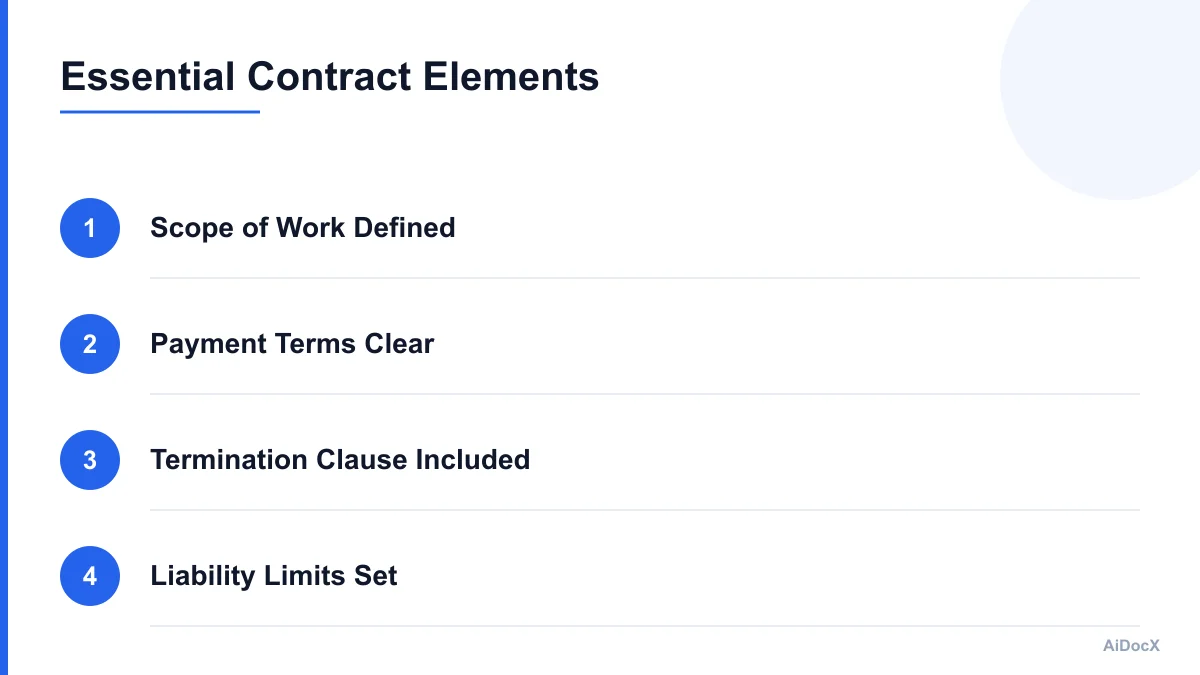
To keep a contract to one page, every word must earn its place. You cannot afford fluff, but you also cannot omit critical protections. A robust one-page contract typically includes the following sections:
1. Parties and Date
Clearly identify who is entering the agreement. Include full legal names and contact information. The date establishes when the terms become effective.
2. Scope of Work (The "What")
Describe the deliverables in plain language. Avoid vague terms like "assistance" or "support." Instead, use specific terms like "design three logo concepts" or "write two blog posts of 800 words each."
3. Payment Terms (The "How Much")
State the total amount, the payment schedule (e.g., 50% upfront, 50% on completion), and the method of payment. Include late fee clauses if applicable.
4. Timeline (The "When")
Specify the start date, the deadline for completion, and any milestone dates. This creates accountability and helps manage expectations.
5. Termination Clause
Outline how either party can end the agreement. Common terms include "termination for convenience" with notice, or immediate termination for breach of contract.
6. Intellectual Property (IP) Ownership
Clarify who owns the work product upon full payment. For freelancers, this usually means transferring rights to the client. For buyers, it means securing the assets they paid for.
7. Limitation of Liability
Protect yourself from catastrophic claims. A clause stating that liability is limited to the amount paid under the contract can prevent excessive damages in case of minor errors or misunderstandings.
Drafting Without a Lawyer: Key Clauses to Include
You do not need a lawyer to draft a simple contract, but you do need to know which clauses are non-negotiable. Here is a breakdown of the essential protections:
The Indemnification Clause
This clause protects you if a third party sues the other party because of something you did or didn’t do. In a simple service agreement, it often means the client agrees not to hold the freelancer liable for issues arising from the client’s own materials or instructions.
The "No Warranty" Clause
Unless you are guaranteeing a specific outcome (like a software bug-free guarantee), state that services are provided "as is." This prevents clients from claiming they paid for a result that was never promised.
Dispute Resolution
Specify how disagreements will be handled. Will you mediate first? Will you go to arbitration? Defining this upfront can save thousands in legal fees if things go south.
Governing Law
State which state or country’s laws apply to the contract. This is crucial if you are working with clients in different jurisdictions.
Common Mistakes in Short Contracts
Even with the best intentions, small business owners often make critical errors when drafting one-page agreements. These mistakes can render a contract unenforceable or leave you vulnerable.
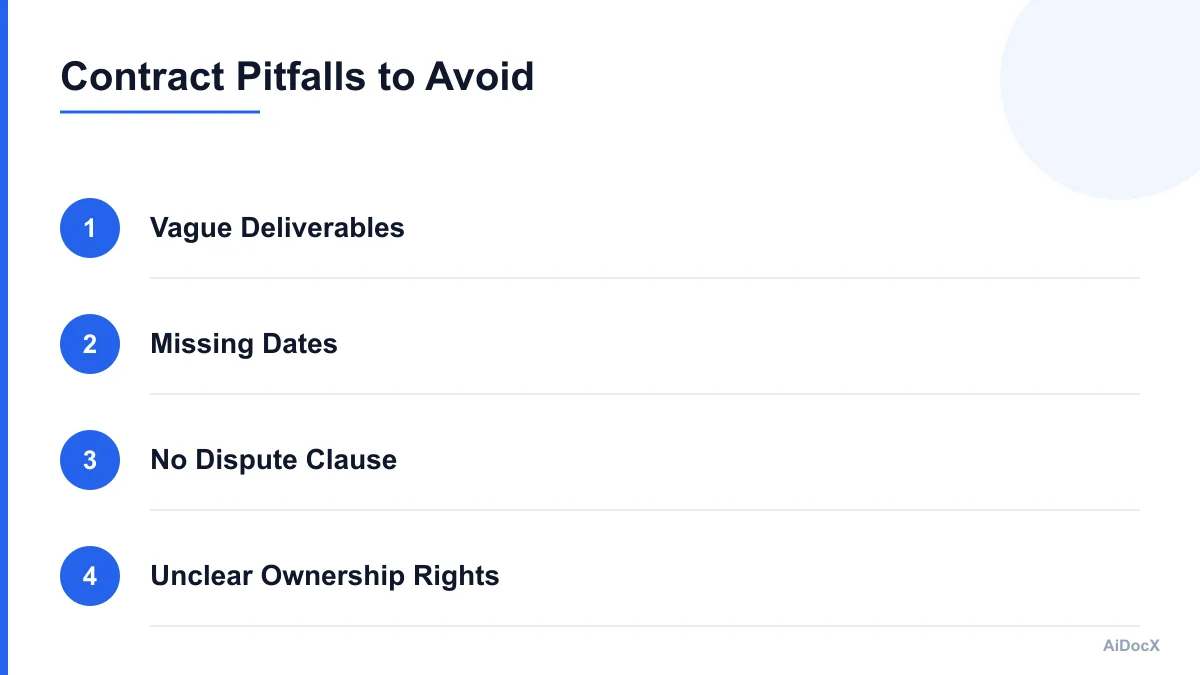
Vague Deliverables
Ambiguity is the enemy of enforcement. If the scope of work is unclear, the client can claim you didn’t deliver what was promised. Always attach a detailed exhibit or description if the scope is complex, even if the main contract is one page.
Missing Dates
A contract without a start date or end date is difficult to enforce. Ambiguity around timelines can lead to scope creep, where the client expects endless revisions without additional pay.
No Dispute Clause
Assuming you will always get along is a dangerous strategy. Without a pre-agreed method for resolving conflicts, you may find yourself in court before you even realize the relationship is over.
Unclear Ownership Rights
Failing to specify who owns the final work product can lead to IP disputes. Always explicitly state that rights transfer upon full payment.
How to Use AiDocX for Quick, Safe Agreements
Drafting a contract from scratch takes time and legal knowledge. Using a generic template found online can be risky, as it may not reflect current laws or specific industry standards. This is where tools like AiDocX can simplify the process. AiDocX drafts a clean one-page contract for straightforward deals and still adds e-signature and an audit trail, so short doesn't mean unprotected.
By using an AI-powered platform, you can generate a customized agreement in minutes. The system ensures that all necessary clauses are included, tailored to your specific transaction type. This reduces the risk of missing critical protections while maintaining the brevity that makes one-page contracts effective.
Furthermore, digital platforms provide an audit trail. Every view, edit, and signature is recorded, creating a verifiable history of the agreement. This level of documentation is invaluable if a dispute arises, providing clear evidence of mutual consent and the terms agreed upon.
Best Practices for Signing and Storing Contracts
Once the contract is drafted, the process doesn’t end with signature. Proper execution and storage are vital for long-term protection.
Use E-Signatures
Electronic signatures are legally binding in most jurisdictions, including under the U.S. ESIGN Act and the EU eIDAS regulation. They provide a faster, more secure way to finalize agreements than printing, signing, and scanning. Look for platforms that offer authentication features, such as email verification or SMS codes, to ensure the signer’s identity.
Store Contracts Securely
Keep digital copies of all signed agreements in a secure, backed-up location. Cloud storage with encryption is ideal. Avoid storing sensitive contracts on personal devices or unsecured email accounts.
Review Period
Allow the client a reasonable time to review the contract before signing. This transparency builds trust and reduces the likelihood of post-signature disputes.
Update Regularly
As laws change, so should your contracts. Review your templates annually to ensure they comply with current regulations.
Checklist: Is Your One-Page Contract Ready?
Before sending your contract, run it through this quick checklist to ensure it is robust and enforceable.
- Are the full legal names and contact details of both parties included?
- Is the scope of work described in specific, measurable terms?
- Are the payment amount, schedule, and method clearly stated?
- Is the timeline for delivery and payment defined?
- Is there a clear clause on who owns the intellectual property?
- Is there a termination clause explaining how the agreement can be ended?
- Is there a limitation of liability clause?
- Is the governing law specified?
- Are there spaces for both parties to sign and date the document?
- Have you reviewed the contract for clarity and ambiguity?
Conclusion: Simplicity with Security
A one-page contract is not a compromise; it is a strategic choice. For small businesses and freelancers, it offers clarity, speed, and professionalism. By focusing on the essential terms and avoiding unnecessary jargon, you create agreements that are easy to understand and enforce.
Remember, the goal is not just to have a piece of paper, but to have a clear understanding of the deal. Tools like AiDocX can help you achieve this balance, ensuring that your simple contracts are also secure contracts. In 2026, protecting your business doesn’t have to be complicated. It just has to be clear.
Take the time to draft a solid one-page agreement for your next deal. It will save you time, money, and stress, allowing you to focus on what you do best: growing your business.
Ready to automate your documents with AI?
Start free with AiDocX — AI contract drafting, meeting minutes, consultation notes, e-signatures, and more in one platform.
Get Started FreeMore from AiDocX Blog
AI Press Release Generator: Write One in Minutes (+ Template)
Learn what a press release is, the AP-style format, and how to use an AI press release generator to draft one in minutes with a fill-in template.
James September 21, 2026 10 min
Angel Investment Agreement (2026): Key Terms + Template Guide
Angel investor agreement explained: the four structures founders actually sign, key terms, securities basics, a closing checklist and a summary term sheet.
James September 21, 2026 12 min
Artist Commission Contract Template (2026): Free Template + Guide
Free artist commission contract template with license tiers, deposit, revision, refund and AI-training clauses, plus a guide to getting it e-signed.
James September 21, 2026 12 min