Operating Agreement vs Articles of Organization: 2026 Guide
Understand the difference between Articles of Organization and Operating Agreements. Learn why both are essential for your LLC’s legal protection and clarity in 2026.
 James · Content Manager August 14, 2026 12 min read
Operating Agreement vs Articles of Organization: What’s the Difference and Why an LLC Needs Both
If you have just formed an LLC, you likely filed your Articles of Organization with the state and received a certificate of formation. You might assume that’s it—that the paperwork is done. However, most states also require, or strongly recommend, a second document called an Operating Agreement.
Confusion between these two documents is common. Many new business owners think the Articles of Organization cover all their legal bases. In reality, the Articles simply announce your existence to the public. The Operating Agreement is the rulebook that governs your business internally. Without it, you risk losing liability protection and facing internal disputes.
What Are Articles of Organization?
The Articles of Organization (sometimes called a Certificate of Formation or Certificate of Incorporation, depending on the state) is the foundational document you file with your state’s business filing office, usually the Secretary of State. This is the document that officially creates your Limited Liability Company (LLC) as a legal entity.

Think of the Articles of Organization as your LLC’s birth certificate. Once the state accepts and stamps this document, your LLC exists in the eyes of the law. You cannot operate as an LLC without this filing.
Key Characteristics
- Public Record: The Articles of Organization are a matter of public record. Anyone can view them online through the Secretary of State’s database. This includes your business name, registered agent, principal address, and sometimes the names of the members or managers.
- State Mandated: You must file this document to comply with state law. Each state has specific forms and filing fees associated with this process.
- Minimal Content: The information required is basic. Most states only ask for the LLC’s name, address, registered agent, and whether it will be member-managed or manager-managed. They do not ask for your internal operating rules, profit-sharing ratios, or voting procedures.
Why It Matters
The primary purpose of the Articles of Organization is to establish the LLC’s legal identity. It provides the "limited liability" shield by proving that your business is a separate entity from you, the owner. Without this document, you are not an LLC; you are a sole proprietorship (if you are the only owner) or a general partnership (if you have partners), and you would be personally liable for all business debts and lawsuits.
What Is an Operating Agreement?
An Operating Agreement is an internal legal document that outlines the ownership and operational procedures of your LLC. Unlike the Articles of Organization, the Operating Agreement is not filed with the state. It is a private contract between the LLC members (owners) or between the members and the manager.
If the Articles of Organization are the birth certificate, the Operating Agreement is the constitution. It dictates how the business will run day-to-day, how decisions are made, and how disputes are resolved.
Key Characteristics
- Private Document: The Operating Agreement is not public. Only the members, managers, and attorneys involved with the LLC have access to it. This allows you to keep sensitive financial and operational details confidential.
- Customizable: State laws provide default rules for LLCs if you do not have an Operating Agreement. However, these default rules often do not reflect the specific needs of your business. The Operating Agreement allows you to customize these rules.
- Flexible Content: You can include virtually any provision that is legal and not unconscionable. Common sections include capital contributions, profit and loss distribution, voting rights, transfer of membership interests, and dissolution procedures.
Why It Matters
The Operating Agreement serves several critical functions. First, it clarifies the rights and responsibilities of each member. Second, it helps maintain the "corporate veil" that protects your personal assets. Third, it provides a clear roadmap for resolving internal conflicts before they escalate into litigation.
Key Differences Between the Two Documents
Understanding the distinction between the Articles of Organization and the Operating Agreement is crucial for proper LLC management. Here is a breakdown of the key differences:
| Feature | Articles of Organization | Operating Agreement |
|---|---|---|
| Purpose | To legally form the LLC with the state. | To govern the internal operations of the LLC. |
| Filing Requirement | Required by state law. | Not required by law in most states, but highly recommended. |
| Public Access | Public record. Available to anyone. | Private document. Not available to the public. |
| Content | Basic info: name, address, registered agent. | Detailed rules: profits, voting, management, transfers. |
| Creator | The founder(s) file it with the state. | The members draft it among themselves. |
| Amendments | Filed with the state (usually via Articles Amendment). | Amended internally by the members (per the agreement’s terms). |
The Legal Relationship
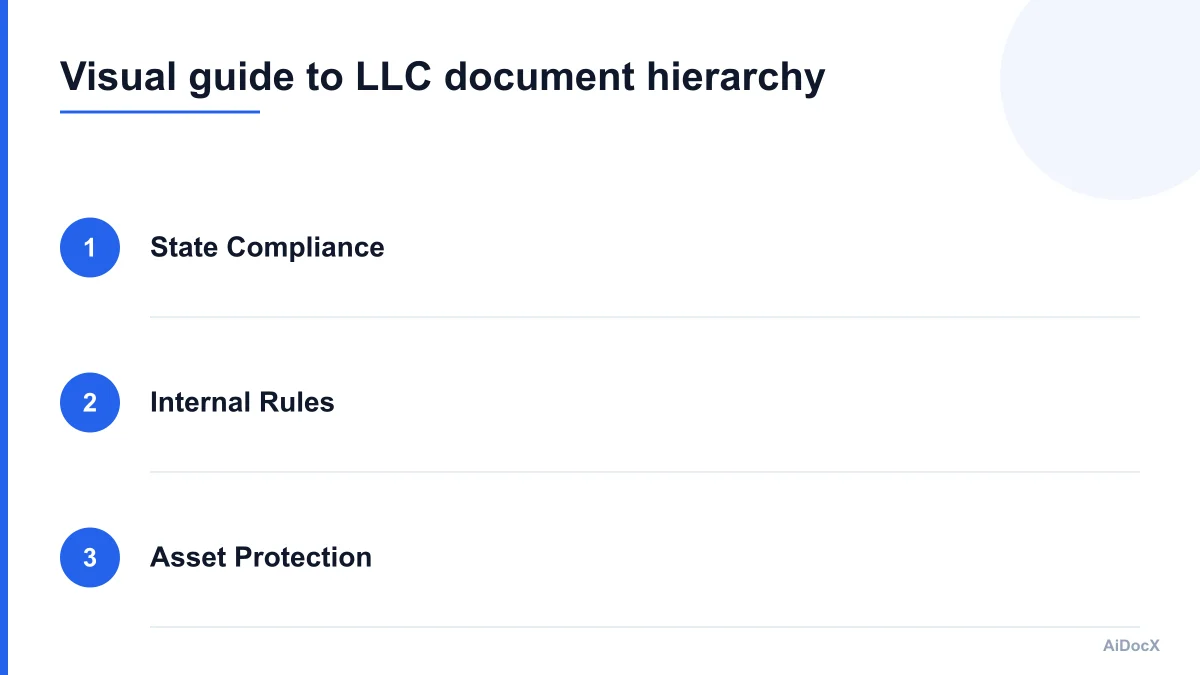
The Operating Agreement cannot contradict the state law or the Articles of Organization. If there is a conflict, the state law and the filed Articles generally take precedence. However, the Operating Agreement can provide additional details that the Articles do not cover. For example, the Articles might state that the LLC is "member-managed," but the Operating Agreement will specify what "member-managed" actually means in practice, such as how many votes a member has or what constitutes a quorum.
Why You Need Both Documents
Some new LLC owners, particularly single-member LLCs, wonder if they need an Operating Agreement if they have already filed the Articles. The short answer is yes. Here is why both documents are essential for a robust business structure.
1. Maintaining Limited Liability Protection
The most significant reason for having an Operating Agreement is to preserve your limited liability status. Courts look at whether you are treating your LLC as a separate entity. If you have no Operating Agreement, a court may view your business as a "disregarded entity" or a mere alter ego of the owner, especially in multi-member LLCs. This can pierce the corporate veil, making you personally liable for business debts.
Having a well-drafted Operating Agreement demonstrates that you are taking the LLC seriously as a separate legal entity. It shows that you have established formal rules and procedures, which is a key factor in court decisions regarding liability.
2. Customizing State Default Rules
Every state has default LLC laws that apply if you do not have an Operating Agreement. These default rules are one-size-fits-all and may not work for your specific situation. For example:
- Profit Distribution: State laws often require profits to be distributed in proportion to ownership percentage. If you want to distribute profits differently (e.g., based on effort or capital contribution), you need an Operating Agreement to override the default rule.
- Management: If you want a manager to make day-to-day decisions without member approval, your Operating Agreement must clearly define the manager’s powers.
- Succession: State laws may not address what happens if a member dies or becomes disabled. An Operating Agreement can include buy-sell provisions that ensure the business continues smoothly.
3. Preventing Internal Disputes
In multi-member LLCs, ambiguity is the enemy. Without an Operating Agreement, disagreements over money, decision-making, and roles can quickly escalate into lawsuits. An Operating Agreement acts as a preemptive strike against conflict by setting clear expectations. It outlines how to resolve disputes, how to admit new members, and how to remove a member.
4. Professionalism and Credibility
Having an Operating Agreement signals to banks, investors, and vendors that your business is professional and well-organized. Many banks require an Operating Agreement to open a business bank account. Investors will want to see it before providing capital. It shows that you have thought through the legal and operational aspects of your business.
Common Mistakes to Avoid
Even when LLC owners understand the difference between the Articles and the Operating Agreement, they often make mistakes in execution. Here are some common pitfalls to avoid.
Mistake 1: Waiting Too Long
Many founders file the Articles and then put off drafting the Operating Agreement. This leaves the LLC in a vulnerable state during the critical early months. Draft the Operating Agreement as soon as possible after forming the LLC.
Mistake 2: Using a One-Size-Fits-All Template
While free templates exist, they are often generic and may not address your specific needs. They might not comply with your state’s specific requirements or may include irrelevant provisions. Consider using a reputable service or consulting an attorney to ensure your agreement is tailored to your business.
Mistake 3: Not Signing the Agreement
An Operating Agreement is only valid if it is signed by all members. An unsigned draft is not a binding contract. Ensure that every member signs the final version and keep copies in your business records.
Mistake 4: Ignoring Amendments
Life changes. You might bring in a new partner, sell a portion of your business, or change your management structure. If you do not update your Operating Agreement to reflect these changes, you risk having an outdated document that contradicts your current reality. Amend the agreement promptly when changes occur.
Mistake 5: Confusing the Two Documents
As discussed, the Articles and the Operating Agreement serve different purposes. Do not try to put all your internal rules in the Articles. Keep the Articles simple and public, and keep the detailed rules in the private Operating Agreement.
How to Draft an Operating Agreement
Drafting an Operating Agreement can seem daunting, but it is a manageable process if you break it down. Here is a step-by-step guide.
Step 1: Identify the Members
List all the members (owners) of the LLC. Include their full legal names, addresses, and ownership percentages. If you have classes of membership (e.g., Class A and Class B shares), define them here.
Step 2: Define the Business Purpose
State the purpose of the LLC. This can be broad (e.g., "to engage in any lawful activity") or specific (e.g., "to provide consulting services"). Most states allow broad purposes, which provides flexibility.
Step 3: Outline Capital Contributions
Detail how much each member has contributed to the LLC, both in cash and property. Also, specify if members are required to make additional contributions in the future. Define what happens if a member fails to make a required contribution.
Step 4: Establish Profit and Loss Distribution
Explain how profits and losses will be allocated among the members. This does not have to be proportional to ownership percentage. You can allocate profits differently if you wish, as long as it is clearly stated in the agreement.
Step 5: Determine Management Structure
Decide if the LLC will be member-managed or manager-managed.
- Member-Managed: All members participate in day-to-day decisions.
- Manager-Managed: One or more managers (who may or may not be members) handle operations.
Step 6: Set Voting Rights
Define how decisions are made. Will decisions require a simple majority, a supermajority, or unanimous consent? Specify which decisions require which level of approval (e.g., selling the business, taking on debt, admitting new members).
Step 7: Plan for Transfers and Buyouts
Include provisions for what happens if a member wants to sell their interest. Do you have a right of first refusal? What is the valuation method for the membership interest? These clauses prevent unwanted outsiders from becoming partners.
Step 8: Address Dissolution
Outline the process for dissolving the LLC. When can the LLC be dissolved? How are assets distributed after debts are paid? Having a plan for the end makes the beginning clearer.
Keeping Your Documents Organized with AiDocX
One of the biggest challenges for new LLC owners is keeping track of their legal documents. You have the filed Articles of Organization, which are public, and the Operating Agreement, which is private. You may also have amendments, resolutions, and membership certificates. Without a centralized system, these documents can get lost, leading to confusion and errors.
AiDocX keeps the internal operating agreement and any amendments in the same workspace as the filed articles, so founders can see at a glance which document governs which decision. This integration ensures that your internal rules are always aligned with your public filings. When you update your Operating Agreement, you can easily track the version history and ensure that all members are aware of the changes.
This centralized approach reduces the risk of using outdated documents and provides a clear audit trail for your business operations. It is a practical solution for founders who want to maintain compliance without getting bogged down in administrative chaos.
Checklist for New LLC Owners
Use this checklist to ensure you have covered all the bases regarding your LLC’s legal documents.
- File Articles of Organization with the state
- Receive Certificate of Formation from the state
- Draft an Operating Agreement tailored to your business
- Have all members sign the Operating Agreement
- Store the original Operating Agreement in a safe place
- Open a business bank account
- Obtain an EIN from the IRS
- Set up a system for tracking amendments and updates
- Review the Operating Agreement annually with your team
Conclusion
The Articles of Organization and the Operating Agreement are both essential components of a well-structured LLC. The Articles establish your legal existence with the state, while the Operating Agreement governs your internal operations. Confusing the two or neglecting one can lead to legal vulnerabilities, internal disputes, and loss of liability protection.
By understanding the differences and ensuring you have both documents, you protect your business and your personal assets. Take the time to draft a comprehensive Operating Agreement that reflects your unique business needs. And consider using a platform like AiDocX to keep your documents organized and accessible. A solid legal foundation is the best investment you can make in your LLC’s long-term success.
Ready to automate your documents with AI?
Start free with AiDocX — AI contract drafting, meeting minutes, consultation notes, e-signatures, and more in one platform.
Get Started FreeMore from AiDocX Blog

Buy Sell Agreement Template (2026): Triggers, Valuation and Funding for Co-Owners
A free buy sell agreement template for co-owners, with triggering events, valuation methods, insurance funding and cross-purchase vs. redemption structures.
James September 26, 2026 12 min
Consignment Agreement Template (2026): Commission, Title, Risk of Loss and Unsold Goods
Free consignment agreement template for makers, artists and boutiques: commission split, title, insurance and how to protect consigned inventory.
James September 26, 2026 9 min
Distribution Agreement Template (2026): Territory, Exclusivity, Minimums and Reseller Terms
Free distribution agreement template (works as a reseller agreement template too): territory, exclusivity, minimums, pricing, IP and termination.
James September 26, 2026 13 min