
Personal Training Agreement & Waiver Template 2026
Secure your independent training business with a comprehensive personal training agreement and liability waiver template for 2026. Protect yourself legally before the first session.
 James · Content Manager August 9, 2026 11 min read
Personal Training Agreement and Liability Waiver Template 2026: What Independent Trainers Need Before a Client's First Session
The fitness industry is booming, but the legal landscape for independent trainers is becoming increasingly complex. In 2026, relying on handshake deals or generic internet downloads is a liability risk that can cost you everything. This guide provides the definitive framework for a personal training agreement and liability waiver that protects your business, clarifies expectations, and keeps your clients safe.
Why You Need a Signed Agreement Before the First Rep
Many independent trainers hesitate to present legal documents to potential clients, fearing it will kill the vibe or make them seem untrustworthy. However, a professional contract does the opposite: it establishes authority, clarity, and mutual respect. Without a signed agreement, you are operating as a sole proprietor with unlimited personal liability. If a client is injured, sues for negligence, or simply refuses to pay for completed sessions, you have no legal recourse.
A robust training agreement serves three primary purposes:
- Legal Protection: It defines the scope of your services and explicitly limits your liability for injuries related to normal athletic activities.
- Expectation Management: It outlines cancellation policies, payment schedules, and communication boundaries, preventing "scope creep" where clients expect 24/7 availability for free.
- Professionalism: It signals that you run a legitimate business, not just a hobby. Clients who sign a contract are often more committed to their goals because they have made a formal commitment.
In 2026, with digital literacy at an all-time high, clients expect a seamless, paperless onboarding process. The combination of a well-drafted contract and a digital signature solution is no longer a luxury—it is an industry standard.
The Core Components of a Bulletproof Training Agreement
A "liability waiver" is often the headline, but the full "Personal Training Agreement" is the body that holds the legal weight. A standalone waiver is rarely sufficient on its own; it must be part of a broader contract that defines the relationship. Here are the essential clauses every independent trainer must include in their 2026 template.
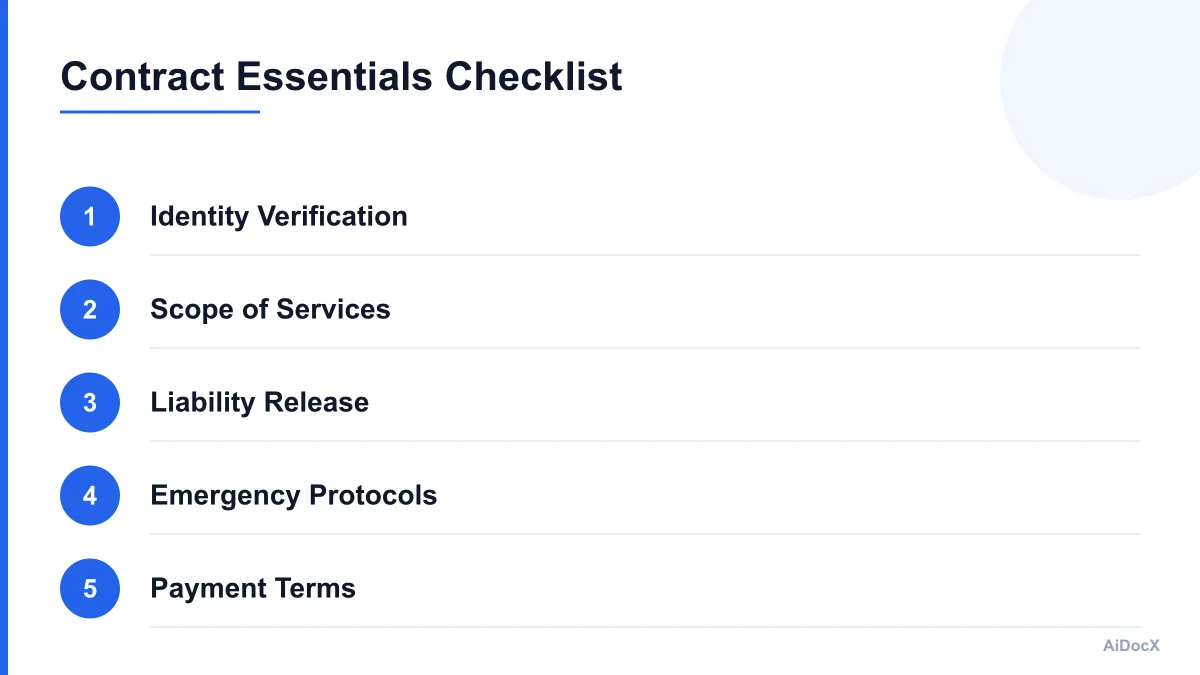
1. Identification and Contact Information
Clearly state the legal names of both parties. Include current addresses, phone numbers, and email addresses. This seems basic, but it is crucial for legal service of process if things go wrong. For the client, include an emergency contact person who is not living at the same address.
2. Scope of Services
Be extremely specific about what you do and, more importantly, what you do not do.
- Included: Personal instruction, program design, nutritional guidance (if certified), and motivational support.
- Excluded: Medical diagnosis, physical therapy, psychological counseling, and diet prescription (unless you are a Registered Dietitian).
- Liability Limitation: Clearly state that the client participates at their own risk and that the trainer is not liable for injuries resulting from the client’s failure to follow instructions or pre-existing conditions not disclosed.
3. Health Disclosure and Medical Clearance
This is the most critical section for risk management. Require the client to disclose any medical conditions, past injuries, surgeries, or medications. Include a clause stating that the client warrants they are in good health and have obtained medical clearance from their physician if they have any known conditions.
Pro Tip: Do not just ask "Are you healthy?" Ask specific questions: "Do you have a history of heart disease?" "Are you currently pregnant?" "Have you had surgery in the last 6 months?" Specificity creates a stronger legal defense than a vague "yes/no."
4. Cancellation and No-Show Policies
Time is your product. If a client cancels with less than 24 hours' notice, you lose that revenue and cannot fill the slot. Your policy should state:
- Cancellations made less than 24 hours in advance will be charged 100% of the session fee.
- No-shows are charged 100% of the session fee.
- Rescheduling must be done at least 24 hours in advance.
- Trainer-initiated cancellations result in a credit or reschedule at no cost to the client.
5. Payment Terms and Refund Policy
Specify how and when payment is collected. Do you bill weekly, monthly, or per session? Do you require prepayment? Clearly state that all sales are final unless otherwise agreed in writing. Avoid vague language like "refundable if unhappy." Instead, use "No refunds for unused sessions once the contract is active."
6. Photo and Video Release
If you plan to use client progress photos or videos for your marketing (social media, website, testimonials), you need a separate, explicit release. Never assume consent. This clause should allow the client to opt-out at any time.
7. Termination Clause
How can either party end the relationship?
- For Cause: Immediate termination for breach of contract (e.g., non-payment, abusive behavior).
- Without Cause: Termination with X days' written notice.
- Post-Termination: Clarify that outstanding fees are still due and that the trainer is not obligated to continue programming after termination.
8. Governing Law and Jurisdiction
Specify which state laws govern the agreement. This prevents legal battles over which court has jurisdiction if a lawsuit is filed.
9. Dispute Resolution
Consider including a mandatory mediation or arbitration clause. Litigation is expensive and time-consuming. Requiring mediation first can save you thousands of dollars in legal fees and resolve issues faster.
Why Generic PDFs Are No Longer Enough in 2026
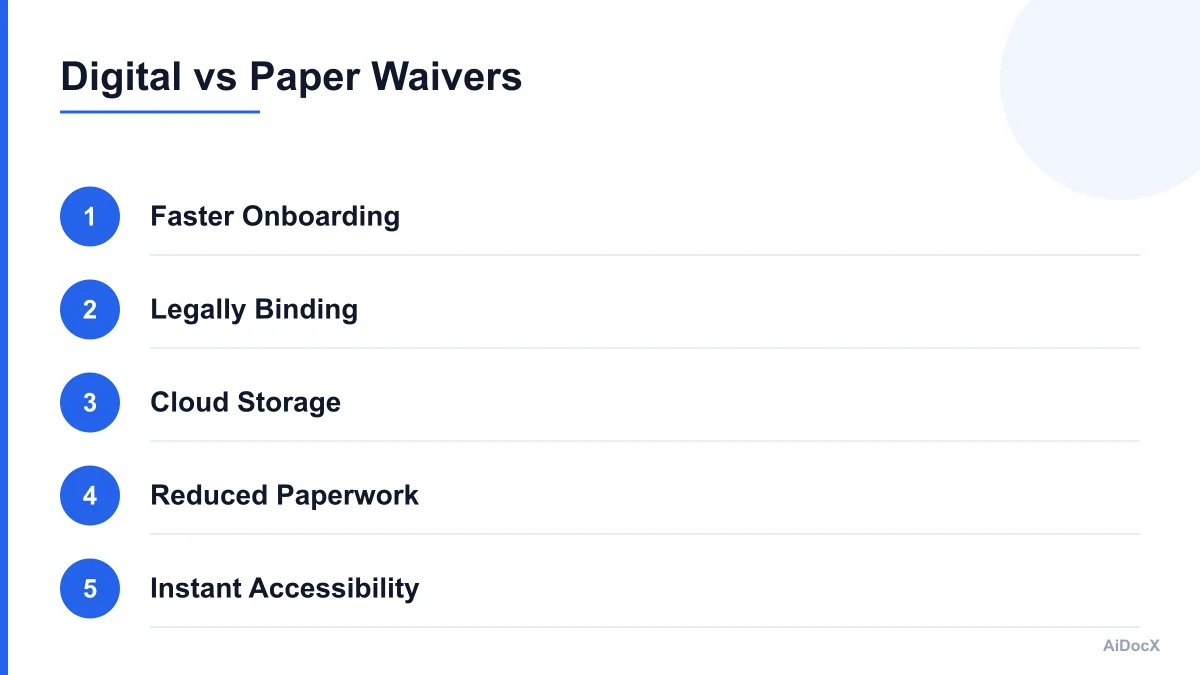
Ten years ago, printing a PDF, handing it to a client, and waiting for them to mail it back was acceptable. In 2026, this method is legally vulnerable and operationally inefficient. Here is why static documents are failing modern fitness businesses.
The "Signer Identity" Problem
With a paper PDF, how do you prove who signed it? If a client claims their signature was forged or that they signed under duress, a simple signature line offers little protection. Digital signature platforms (like DocuSign, HelloSign, or integrated tools) provide an audit trail that includes:
- The exact timestamp of signing.
- The IP address of the device used.
- Email verification steps.
- Device information.
This forensic data is invaluable in court if a client disputes the validity of their signature.
Accessibility and Storage
Paper contracts get lost in filing cabinets, damaged by water, or thrown away by clients who "forgot" they signed them. Digital contracts are stored in the cloud, accessible from any device, and easily searchable. If you need to pull up a client’s agreement five years later for a tax audit or legal dispute, it is one click away.
The Integration Gap
A PDF is a dead end. It doesn’t connect to your scheduling software, your CRM, or your payment processor. In 2026, seamless integration is key. When a client signs a digital agreement, it should automatically:
- Add them to your client list.
- Trigger a welcome email.
- Schedule the first session.
- Set up the payment profile.
Using a platform like AiDocX drafts a training agreement with a liability waiver built in and collects a client's signature on a tablet before the first session, so no workout starts without paperwork on file. This eliminates the friction between "yes, I want to train" and "let’s get started."
Step-by-Step: Implementing Your New Onboarding Process
Having the document is only half the battle. How you present and manage it matters. Follow this workflow to ensure 100% compliance and a professional client experience.
Step 1: Customize Your Template
Take a legally vetted template (like the one provided by AiDocX or a lawyer-reviewed draft) and customize it. Fill in your business name, your specific cancellation policy, your jurisdiction, and your unique service offerings. Never use a template that is too generic; specificity protects you.
Step 2: Create a Digital Workflow
Upload your finalized PDF or use a digital contract platform. Set up the fields so that the client only sees what they need to see. Ensure the "Sign" button is prominent. Test the workflow yourself: send the contract to your own email, sign it, and verify that the completed copy is saved correctly.
Step 3: Send the Contract Before the First Session
Do not wait until the client walks in the door. Send the agreement via email or SMS link at least 48-72 hours before the first session. Include a brief, friendly note:
"Hi [Client Name], I’m excited to get started! To ensure we’re both protected and aligned on our goals, please review and sign the attached training agreement. This only takes 2 minutes and allows us to focus on your fitness journey when we meet."
Step 4: Review During the First Session
When the client arrives, have the signed document ready (either digitally on a tablet or printed). Briefly walk them through the key points: the waiver, the cancellation policy, and the emergency contact form. This reinforces that these are important business practices, not just bureaucratic hurdles.
Step 5: Store and Secure
Ensure the signed contract is stored in a secure, backed-up location. If using a digital platform, verify that the provider is HIPAA compliant if you are handling any sensitive health data, and GDPR compliant if you have international clients.
Common Mistakes Independent Trainers Make
Even with a good template, trainers often undermine their own legal protection. Avoid these common pitfalls.
Mistake 1: Using "Waiver" Language That Is Too Broad
Courts often strike down waivers that attempt to release a trainer from liability for gross negligence or intentional misconduct. You cannot waive your responsibility to provide a safe environment or to act within your scope of competence. Ensure your waiver covers "ordinary negligence" and "inherent risks of exercise," but not reckless behavior.
Mistake 2: Forgetting the Emergency Contact
If a client collapses or has a medical emergency, you need to know who to call. A waiver without an emergency contact section is incomplete. Always include a separate, simple form for emergency contacts and medical information.
Mistake 3: Not Updating the Contract Annually
Laws change. Your business structure might change. Your services might expand. Review your contract annually. If you start offering nutrition coaching, update the scope of services to reflect that. If you move to a new state, update the governing law clause.
Mistake 4: Assuming Email Consent Is Enough
A client replying "I agree" to an email is not a legally binding signature in most jurisdictions. You need a clear, affirmative action that indicates consent to the specific terms. Digital signature platforms are designed to capture this affirmation explicitly.
Mistake 5: Ignoring Data Privacy
Collecting health data (like injury history) makes you a data handler. Ensure your contract includes a privacy clause explaining how you store, use, and protect this data. Comply with local laws such as HIPAA (US), GDPR (EU), or PIPEDA (Canada).
Checklist: Is Your Business Ready for 2026?
Before you accept your next client, run through this quick checklist.
- Legal Review: Has a local attorney reviewed my contract for compliance with state laws?
- Scope Definition: Does my contract clearly list what I do and do not do?
- Waiver Validity: Does my liability waiver exclude gross negligence and intentional harm?
- Digital Signature: Do I use a platform that provides an audit trail and IP tracking?
- Emergency Form: Do I have a separate, signed emergency contact and medical form?
- Cancellation Policy: Is my cancellation policy clearly stated and enforced?
- Storage Security: Are signed contracts backed up in a secure, cloud-based location?
- Privacy Policy: Do I have a clause explaining how I handle client health data?
- Testimonial Release: Do I have a separate opt-in for using client photos/videos?
Conclusion: Protect Your Passion, Protect Your Business
Your passion for fitness is your greatest asset. But passion does not protect you from lawsuits, non-payment, or operational chaos. A solid personal training agreement and liability waiver are not just legal formalities; they are the foundation of a sustainable, professional business.
By implementing a structured, digital-first onboarding process, you reduce risk, save time, and project an image of competence that clients trust. In 2026, the trainers who thrive are those who treat their business with the same seriousness as their training programs.
Don’t leave your livelihood to chance. Use a comprehensive template, leverage digital signatures for enforceability, and focus on what you do best: helping clients achieve their goals.
Ready to streamline your client onboarding? Avoid the hassle of printing, scanning, and losing paper contracts. AiDocX drafts a training agreement with a liability waiver built in and collects a client's signature on a tablet before the first session, so no workout starts without paperwork on file. Secure your business today and start every session with confidence.
Ready to automate your documents with AI?
Start free with AiDocX — AI contract drafting, meeting minutes, consultation notes, e-signatures, and more in one platform.
Get Started FreeMore from AiDocX Blog

Buy Sell Agreement Template (2026): Triggers, Valuation and Funding for Co-Owners
A free buy sell agreement template for co-owners, with triggering events, valuation methods, insurance funding and cross-purchase vs. redemption structures.
James September 26, 2026 12 min
Consignment Agreement Template (2026): Commission, Title, Risk of Loss and Unsold Goods
Free consignment agreement template for makers, artists and boutiques: commission split, title, insurance and how to protect consigned inventory.
James September 26, 2026 9 min
Distribution Agreement Template (2026): Territory, Exclusivity, Minimums and Reseller Terms
Free distribution agreement template (works as a reseller agreement template too): territory, exclusivity, minimums, pricing, IP and termination.
James September 26, 2026 13 min