Photography Contract Template: Shoots, Rights & Releases 2026
Protect your business and clients with a clear photography contract template. Learn how to handle usage rights, model releases, and on-set e-signatures.
 James · Content Manager July 4, 2026 4 min read
Photography Contract Template: Shoots, Rights & Releases 2026
A clear photography contract template removes guesswork from every session. Whether you are shooting a wedding, a brand campaign, or a family portrait, written agreements protect your business, set client expectations, and clarify how images will be used. This guide breaks down the essential components, usage rights, and model release requirements you need to know for 2026.
Why Every Photography Shoot Needs a Written Agreement
Verbal agreements work for quick favors, not for paid work. A written contract establishes scope, prevents scope creep, and provides legal recourse if a project goes off track. Clients also expect professionalism—having a contract ready signals that you take your craft seriously. Beyond liability, a contract streamlines communication. When pricing, timelines, and deliverables are documented upfront, there is less back-and-forth during editing and delivery. In short, a contract is not a barrier to trust; it is the foundation of it.
Key Sections of a Photography Contract Template
A solid template covers the logistics before the first shutter click. Each clause should be specific enough to avoid ambiguity.
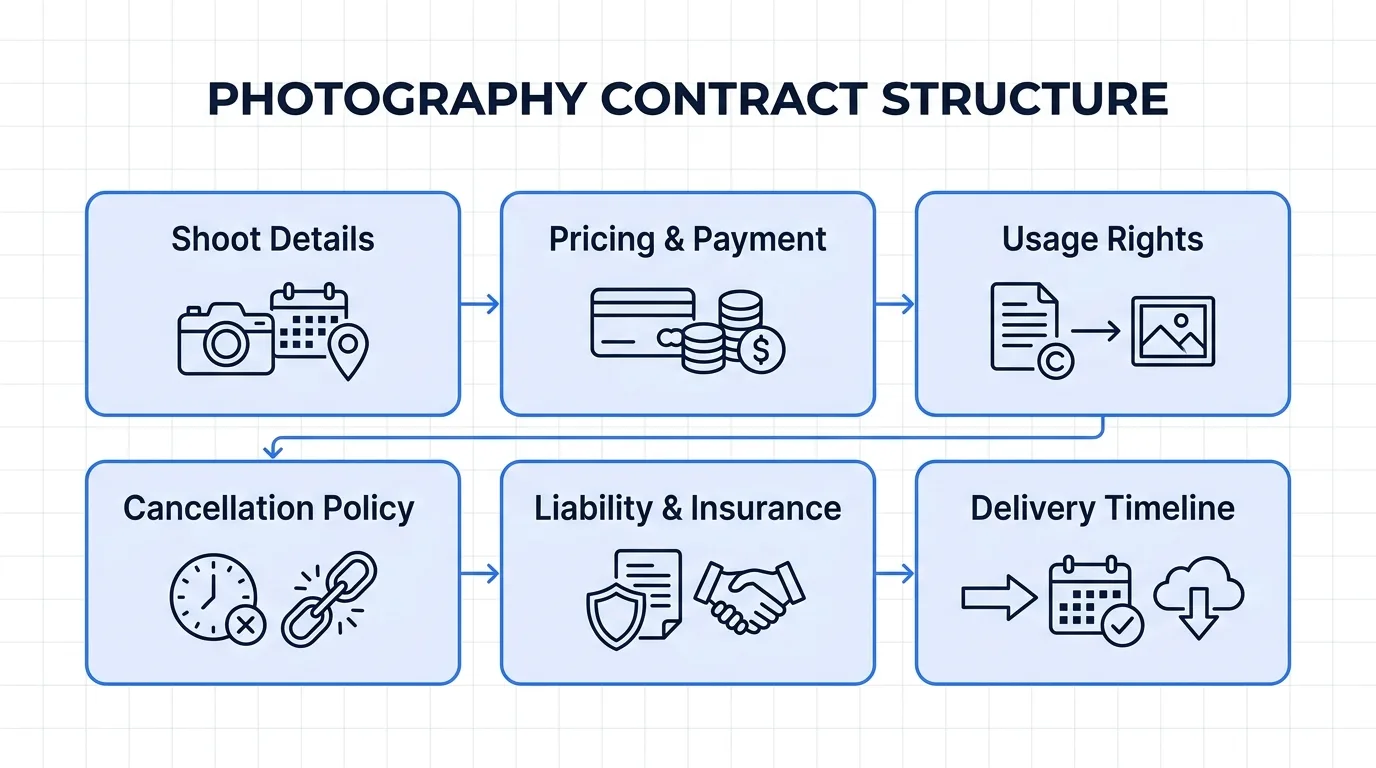
- Shoot Details: Date, location, duration, and number of photographers.
- Pricing & Payment Terms: Deposit amount, final balance due date, accepted payment methods, and late fees.
- Cancellation & Rescheduling Policy: Notice requirements, refund thresholds, and force majeure handling.
- Delivery Timeline: Number of edited images, format (JPEG, RAW, print-ready), and delivery method.
- Liability & Insurance: Equipment loss, third-party injury coverage, and limitation of liability.
- Intellectual Property Clause: Explicit statement that the photographer retains copyright unless otherwise licensed.
[IMAGE1_AFTER: Key Sections of a Photography Contract Template] [IMAGE1_ALT: Photography contract structure diagram] [IMAGE1_PROMPT: Clean flat infographic showing a 6-box checklist layout titled "Photography Contract Structure". Each box contains a simple line icon and label: Shoot Details, Pricing & Payment, Usage Rights, Cancellation Policy, Liability & Insurance, Delivery Timeline. Soft neutral colors, sans-serif English labels, minimal style, white background.]
Understanding Usage Rights and Licensing
Copyright automatically belongs to the photographer upon creation. However, clients usually need permission to share, print, or adapt the images. Usage rights define exactly what they can and cannot do.
- Personal Use License: Allows printing for home display and sharing on personal social media. Typically excludes commercial promotion.
- Commercial License: Permits use in advertisements, websites, product packaging, or paid campaigns. Often priced higher due to broader exposure.
- Exclusive vs. Non-Exclusive: Exclusive rights prevent the photographer from licensing the same images to competitors. Non-exclusive rights allow multiple clients to use the assets.
- Duration & Territory: Specify how long the license lasts (perpetual vs. time-bound) and where it applies (local, national, global).
Always state these boundaries in the contract. Vague language like “client may use images” leads to disputes later.
Model Releases: When You Need Them and What They Cover
A model release is a separate document that grants permission to use a person’s likeness in your portfolio, marketing, or commercial projects. You need one whenever a recognizable subject appears and you plan to publish the images beyond private delivery.
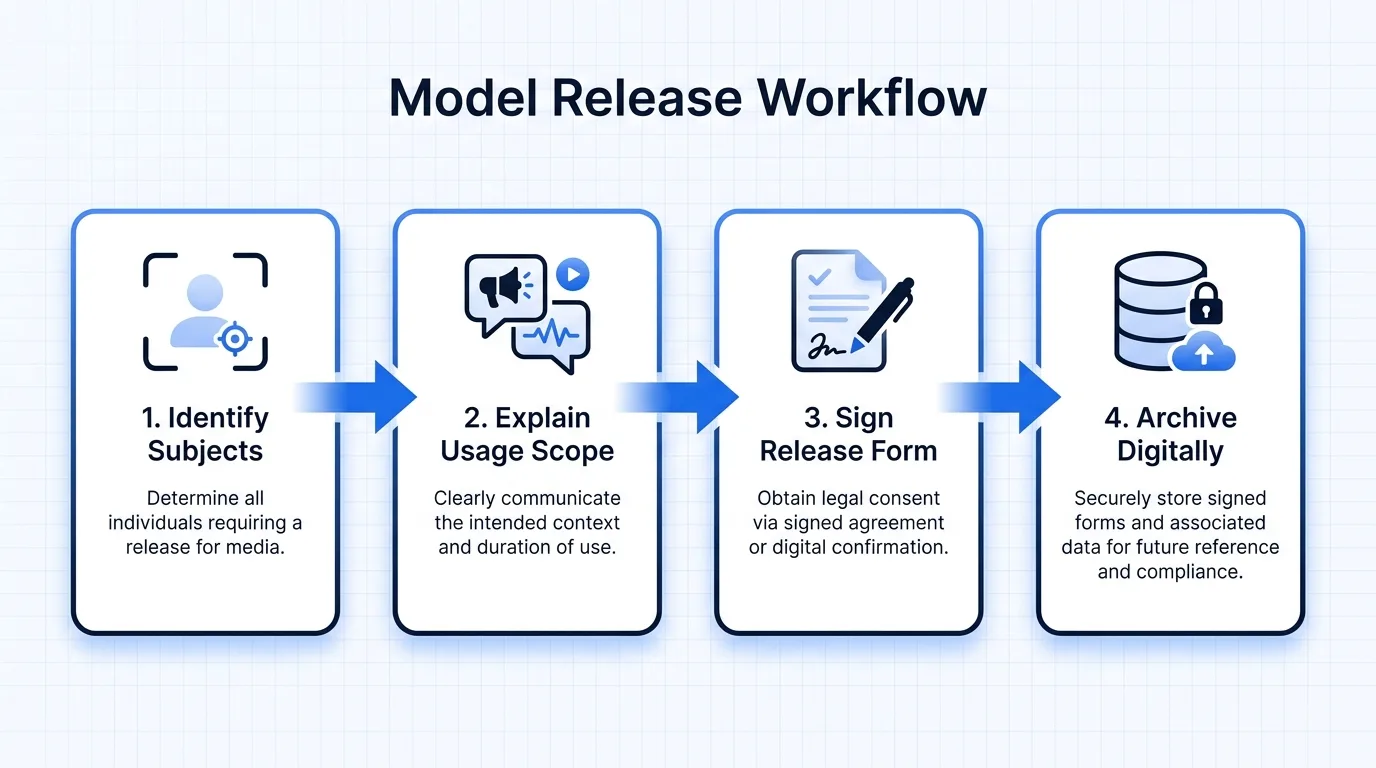
- Who Signs It: Every identifiable adult. Minors require a parent or legal guardian signature.
- What It Covers: Publication in portfolios, social media, websites, print ads, and educational materials.
- Compensation Clause: State whether the release is unpaid or includes a model release fee.
- Revocation Rights: Clarify whether the subject can withdraw consent later and under what conditions.
If you are shooting behind-the-scenes content or candid event photography, include a blanket release clause in the main contract so you are not chasing signatures mid-session.
[IMAGE2_AFTER: Model Releases: When You Need Them and What They Cover] [IMAGE2_ALT: Model release workflow diagram] [IMAGE2_PROMPT: Horizontal step-flow infographic titled "Model Release Workflow". Four connected cards with icons: 1. Identify Subjects, 2. Explain Usage Scope, 3. Sign Release Form, 4. Archive Digitally. Clean flat design, soft blue accents, English labels, no clutter, white background.]
On-Set Workflow: Signing Contracts and Releases Efficiently
Paperwork should never delay the shoot. Build a smooth signing workflow into your pre-production process. Send the contract and release forms 48–72 hours before the session, leaving time for questions or edits. On set, have a tablet or laptop ready for digital signatures. Tools like AiDocX generate photography contracts and release forms you can e-sign on set, keeping everything organized without printing or scanning. Store signed copies in a cloud folder labeled by client name and shoot date. This reduces admin time and ensures you have proof of consent if questions arise later.
Photography Contract Checklist
Before every shoot, run through this quick verification:
- Contract customized for shoot type and location
- Payment schedule and deposit collected
- Usage rights clearly defined in writing
- Model releases prepared for all subjects
- Cancellation and rescheduling terms acknowledged
- Delivery timeline and format confirmed
- Signed documents backed up to cloud storage
A photography contract template is only useful if it matches your actual workflow. Review your current agreements annually, update them for new services or tax requirements, and keep digital copies accessible. If you want to generate tailored contracts and release forms in minutes, AiDocX builds them from your project details and lets clients e-sign directly from their phone.
If you also shoot video, see the videographer contract template, and for people in your photos use a model release form.
Ready to automate your documents with AI?
Start free with AiDocX — AI contract drafting, meeting minutes, consultation notes, e-signatures, and more in one platform.
Get Started FreeMore from AiDocX Blog
Machine Shop Job Traveler Template: Routing Sheet + Example
Copy a machine shop job traveler template for small job shops. Includes a routing sheet, filled example, traceability fields, sign-offs, and setup tips.
Weekly Status Report Template: 4 Formats + Examples
Copy one of four weekly status report templates for individual work, projects, leadership, or blockers. See a worked example and a practical review checklist.
How to Read a Business Contract: A Founder's Checklist (2026)
A practical way to review parties, scope, money, IP, liability, and exit terms before signing a business contract.
 MinjiLee October 7, 2026 9 min