Product Warranty Agreement Template 2026: Clear Terms for Small Biz
Stop warranty disputes with clear terms. Use our 2026 product warranty agreement template to limit liability, define claims, and protect your small business.
 James · Content Manager August 8, 2026 10 min read
Product Warranty Agreement Template 2026: How Small Businesses Set Clear Terms Without Overpromising
Warranty disputes are not just legal headaches; they are cash-flow killers that erode customer trust before you even have a chance to fix the problem. For small product and equipment businesses, the line between excellent customer service and financial loss is drawn by the clarity of your warranty terms. In 2026, with consumer protection laws tightening and e-commerce returns becoming more complex, having a written, specific warranty agreement is no longer optional—it is essential risk management.
This guide provides a practical framework for drafting a warranty agreement that protects your bottom line while maintaining customer confidence. We will break down exactly what to include, what to exclude, and how to structure your claims process to minimize disputes. By the end, you will have a clear roadmap to create a document that serves as your first line of defense against unfair claims.
Why Small Businesses Need a Written Warranty Agreement
Many small business owners operate under the assumption that a verbal promise or a generic "satisfaction guaranteed" tagline is sufficient. This is a dangerous misconception. Without a written agreement, you are subject to implied warranties that vary by jurisdiction and can extend far beyond what you intended to offer.
A written warranty agreement serves three critical functions:
- Legal Protection: It defines the specific scope of your liability, preventing customers from claiming damages for issues you never promised to cover.
- Operational Clarity: It sets clear expectations for both your team and the customer regarding how claims are submitted, verified, and resolved.
- Dispute Resolution: It provides a paper trail that can be used in mediation or court if a disagreement escalates.
In 2026, the standard for consumer expectations has shifted. Customers are more literate about their rights and more willing to dispute charges. A robust, transparent warranty agreement demonstrates professionalism and reduces the ambiguity that leads to chargebacks and negative reviews.
The Anatomy of a Bulletproof Warranty Clause
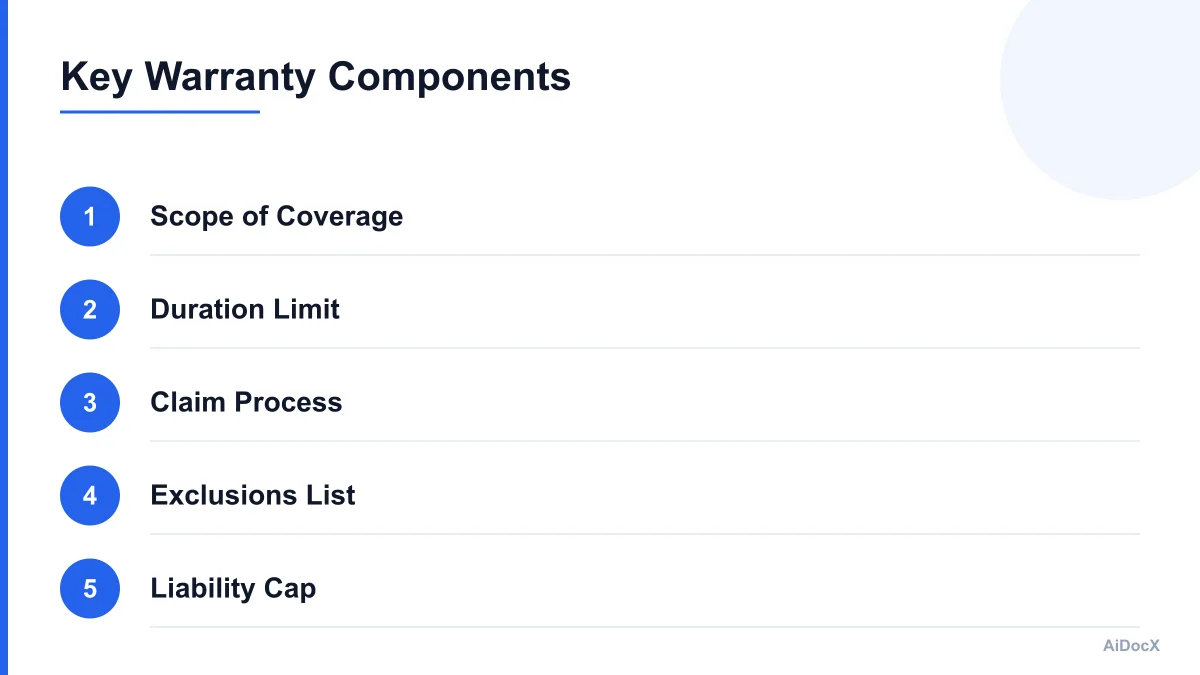
A weak warranty clause is vague, leaving room for interpretation that favors the consumer. A strong clause is specific, unambiguous, and legally enforceable. When drafting your product warranty agreement template, ensure every section addresses the following core elements.
1. Clear Definition of the Product
Do not just say "the product." Specify the model number, serial number range, or specific component covered. For equipment businesses, clarify if the warranty covers the entire system or only individual parts. Vague definitions allow customers to claim coverage for accessories or third-party modifications that were never part of the original sale.
2. Duration and Commencement Date
State exactly how long the warranty lasts and when it begins. Common pitfalls include using terms like "one year from purchase" without defining what constitutes a purchase date. Does it start on the order date, the shipping date, or the delivery date? For B2B equipment, clarify if the clock starts upon installation or commissioning.
3. Scope of Coverage
Explicitly state what is covered. Is it parts only? Labor? Shipping costs for return? Be specific. If you offer a "full warranty," define what that means in your context. If it is a "limited warranty," list the exclusions clearly. Ambiguity here is the primary driver of dispute.
4. Claim Procedure
Outline the step-by-step process a customer must follow. This should include:
- Required documentation (proof of purchase, photos of damage, serial numbers).
- Timeframes for reporting an issue (e.g., within 30 days of discovery).
- Authorized contact channels (email, portal, phone).
5. Remedies
Define what the customer will receive if a claim is valid. Will you repair, replace, or refund? Is the refund prorated? Does the replacement come with a new warranty period or does it inherit the original expiration date? Stating this upfront prevents arguments at the point of resolution.
Essential Clauses to Limit Liability
While you want to be fair, your warranty agreement must protect your business from excessive liability. These clauses are standard in professional agreements and are crucial for small businesses with limited resources.
Exclusion of Consequential Damages
One of the most important clauses in any product warranty is the exclusion of consequential or incidental damages. This means you are not liable for indirect losses caused by the product's failure. For example, if a piece of equipment fails and causes production downtime in a factory, you are typically not liable for the lost profits from that downtime. This clause must be conspicuous and clearly written to be enforceable in many jurisdictions.
Limitation of Remedies
You should cap your liability at the purchase price of the product. This ensures that your maximum exposure is known and manageable. Any clause stating that the sole remedy is repair or replacement, and that all other remedies are excluded, helps prevent customers from seeking large monetary damages for minor defects.
Transferability
Decide whether your warranty is transferable. If you sell a product to a business that might resell it or give it away, you need to know if the warranty follows the product. Non-transferable warranties limit your liability to the original purchaser, which is easier to manage and track.
Compliance with Consumer Laws
Your warranty cannot override mandatory consumer protection laws. For example, in the United States, the Magnuson-Moss Warranty Act requires that warranties be clearly labeled as "full" or "limited" and prohibits tying warranty service to the use of specific services or parts unless provided free of charge. In the EU, the Consumer Rights Directive provides a two-year minimum guarantee that cannot be waived. Your agreement must comply with these local laws while providing additional protections where permitted.
Common Warranty Mistakes That Cost Money
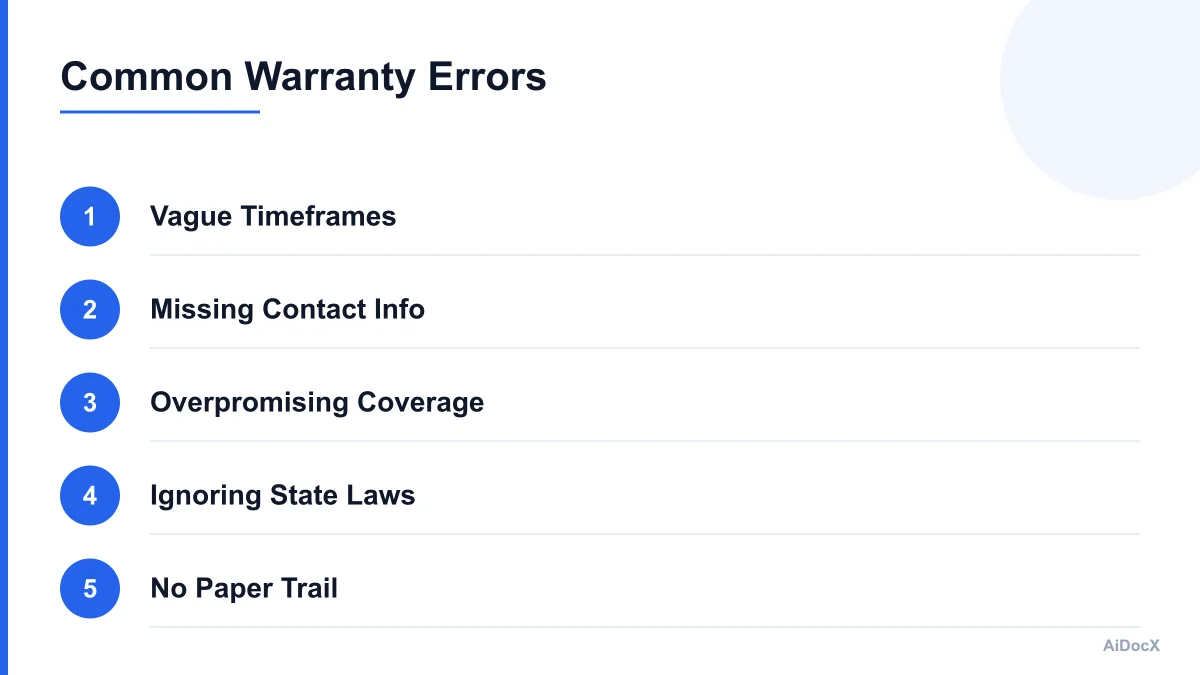
Even well-intentioned small business owners make errors that weaken their position in a dispute. Avoid these common pitfalls to ensure your warranty agreement holds up.
Mistake 1: Using Overly Broad Language
Phrases like "free from defects in materials and workmanship" are standard but can be interpreted broadly. If a customer argues that a cosmetic scratch is a "defect," you are in a weak position. Instead, specify what constitutes a defect. For example, "functional failure due to manufacturing error" is more precise than "defect."
Mistake 2: Ignoring the "Reasonable Expectation" Standard
Courts often look at whether the warranty terms are reasonable. If your warranty is so restrictive that it effectively provides no coverage, it may be deemed unconscionable. Balance your protections with fairness. For instance, offering a 90-day warranty on a product expected to last five years may be seen as unreasonable and could invite regulatory scrutiny.
Mistake 3: Failing to Update Terms for New Products
A template used for simple consumer goods may not work for complex equipment. If you expand your product line, ensure your warranty terms are tailored to the specific risks and lifecycles of each product. A one-size-fits-all approach often leaves gaps in coverage or overpromises on durability.
Mistake 4: Not Linking Warranty to Sales
The biggest operational failure is having a great warranty policy that is never communicated at the point of sale. If the warranty terms are buried in a PDF on your website but not presented during checkout or on the invoice, you may not have a valid contract. The customer must have the opportunity to review and accept the terms.
How to Structure Your Claims Process
A clear claims process reduces the volume of disputes and speeds up resolution. Your warranty agreement should serve as the user manual for handling problems.
Step 1: Intake and Verification
Require customers to submit claims through a dedicated channel. This could be an email address, a web form, or a customer portal. The intake form should require:
- Order number or serial number.
- Description of the issue.
- Supporting evidence (photos, videos, logs).
This step filters out invalid claims early and ensures you have the necessary data to make a decision.
Step 2: Assessment
Define your internal timeline for assessment. For example, "Claims will be reviewed within 5 business days." This sets expectations for the customer and prevents them from escalating the issue prematurely. During this phase, determine if the claim falls within the scope of the warranty.
Step 3: Resolution
Once a claim is validated, execute the remedy defined in the warranty. If it is a replacement, provide tracking information. If it is a refund, specify the timeline for the refund to appear in their account. Communicate this clearly and promptly.
Step 4: Closure
Close the ticket once the remedy is complete. This creates a final record of the interaction. If the customer is dissatisfied, refer them to your dispute resolution process, which should be outlined in the warranty agreement.
Integrating Digital Tools for Warranty Management
In 2026, manual tracking of warranties is a recipe for disaster. Spreadsheets are error-prone and difficult to scale. As your business grows, you need a system that automates warranty tracking and ensures compliance.
Automated Tracking
Use software that automatically registers warranties upon purchase. This system should track expiration dates and send automated reminders to customers before their warranty expires. This not only helps with customer retention but also ensures you never miss a valid claim window.
Centralized Documentation
All warranty agreements should be stored in a central repository. When a claim is made, your team should have instant access to the specific terms agreed upon by the customer. This eliminates disputes over "which version of the policy applied."
Electronic Signatures
For high-value equipment or B2B sales, consider using electronic signatures to capture explicit acceptance of warranty terms. This creates a legally binding record that the customer reviewed and agreed to the specific limitations and conditions.
Implementing Your Strategy with AiDocX
Drafting a comprehensive warranty agreement from scratch can be time-consuming and risky if you miss key legal nuances. This is where specialized tools can streamline the process. AiDocX drafts a warranty agreement with clear coverage limits and claim terms, then keeps a signed copy tied to each sale so a warranty dispute has a paper trail.
By using a platform like AiDocX, small businesses can generate customized warranty templates that reflect their specific products and legal requirements. The platform ensures that your terms are consistent, up-to-date with current laws, and easily accessible. More importantly, it integrates the agreement into your sales workflow, ensuring that every customer interaction is backed by a clear, enforceable contract.
This integration reduces the administrative burden on your team and provides the legal confidence needed to handle disputes efficiently. Instead of spending hours searching for documents or arguing over verbal promises, you have a digital record that supports your position.
Checklist: Finalizing Your Warranty Agreement
Before publishing your warranty agreement, run through this checklist to ensure it is robust and effective.
- Define the Product Scope: Are model numbers and components clearly specified?
- Set Clear Duration: Is the start date and end date unambiguous?
- Limit Liability: Are consequential damages excluded and remedies capped?
- Outline Claims Process: Is the step-by-step procedure easy to follow?
- Compliance Check: Does the agreement adhere to local consumer laws (e.g., Magnuson-Moss, EU Consumer Rights)?
- Conspicuous Presentation: Are key limitations highlighted in bold or caps?
- Integration Plan: Is the agreement linked to your sales and CRM systems?
- Staff Training: Are your customer service team trained on the terms and how to communicate them?
Conclusion
A well-drafted warranty agreement is not just a legal formality; it is a strategic business tool. It protects your assets, clarifies customer expectations, and streamlines your operations. By avoiding common mistakes, limiting liability appropriately, and leveraging digital tools for management, small businesses can turn warranty management from a source of stress into a competitive advantage.
Start by reviewing your current terms. Identify the ambiguities that lead to disputes. Then, draft a new agreement that is clear, concise, and compliant. Consider using specialized platforms like AiDocX to ensure your documents are professional and integrated into your workflow. In 2026, clarity is your best defense. Protect your business, keep your customers happy, and sleep better at night knowing your terms are solid.
Ready to automate your documents with AI?
Start free with AiDocX — AI contract drafting, meeting minutes, consultation notes, e-signatures, and more in one platform.
Get Started FreeMore from AiDocX Blog

Affiliate Agreement Template (2026): Protect Your Business When Paying Commissions
Free affiliate agreement template for 2026: key clauses, FTC disclosure requirements, affiliate vs referral agreement compared, a worked example, and a copy-paste version.
James September 22, 2026 11 min
AI Receipt Generator (2026): Create Professional Payment Receipts in Seconds
Generate professional payment receipts with AI in seconds. Receipt vs invoice vs credit note explained, the fields to include, a worked example, and a copy-paste template.
James September 22, 2026 9 min
Bill of Sale Template (2026): Free Generator for Cars, Trailers & Personal Property
Free bill of sale template for 2026: the fields to include, state notarization rules, federal odometer disclosure, a worked example, and a copy-paste version.
James September 22, 2026 10 min