Promissory Note Template 2026: Enforceable Terms Explained
Learn how a promissory note differs from a loan agreement, which clauses matter, and how small businesses can create an enforceable repayment record.
 James · Content Manager August 21, 2026 14 min read
Promissory Note Template 2026: Enforceable Terms Explained
A promissory note gives a private loan a written structure: who owes money, how much is owed, when it must be repaid, and what happens if payments are missed. It is usually shorter and more focused than a full loan agreement, making it practical for lending between friends, family members, business partners, or small companies.
This guide explains what a promissory note should contain, how it differs from a loan agreement, and what makes it more likely to hold up if repayment becomes disputed. Laws vary by jurisdiction, so treat this as practical information rather than legal advice.
What Is a Promissory Note?
A promissory note is a written promise by one party—the maker or borrower—to pay a specified amount to another party—the payee or lender. The promise normally includes the principal amount, interest rate, payment dates, maturity date, and consequences of default.
The document is primarily about the debt itself. It records the borrower's obligation and the lender's right to receive payment. That makes it useful when the parties already understand the basic arrangement and do not need a long document covering every aspect of an ongoing lending relationship.
For example, a business owner may borrow $15,000 from a sibling to purchase inventory. The parties might agree informally on 8% annual interest and monthly payments over 18 months. A promissory note can turn that understanding into a clear record.
A note generally identifies:
- The legal names and addresses of the borrower and lender
- The original principal amount
- The interest rate and how interest is calculated
- The repayment schedule
- The final maturity date
- Accepted payment methods and payment location
- Late fees or other permitted charges
- Events that constitute default
- The lender's remedies after default
- Whether the debt is secured or unsecured
- Governing law and notice details
- Signatures and the date of execution
A promissory note can be secured or unsecured. In an unsecured note, the lender relies primarily on the borrower's promise and general legal remedies. In a secured note, specific collateral—such as equipment, a vehicle, or business assets—supports the obligation. A security interest may require a separate security agreement and, depending on the asset and jurisdiction, a public filing or other perfection step.
The word "promissory" matters because the document should express a promise to pay, not merely describe a future negotiation. A vague statement such as "the parties will work out repayment later" does not provide the same certainty as "the borrower promises to pay the principal balance in 18 monthly installments beginning June 1, 2026."
Under U.S. commercial law, some promissory notes may qualify as negotiable instruments if they meet specific requirements, including an unconditional promise to pay a fixed amount of money, payable on demand or at a definite time. Not every document labeled "promissory note" is automatically negotiable, and negotiability is not the same thing as enforceability. The underlying contract, applicable state law, and facts surrounding the transaction still matter.
Promissory Note vs. Loan Agreement: What's the Difference?
A promissory note and a loan agreement can document the same financial transaction, but they serve different purposes.
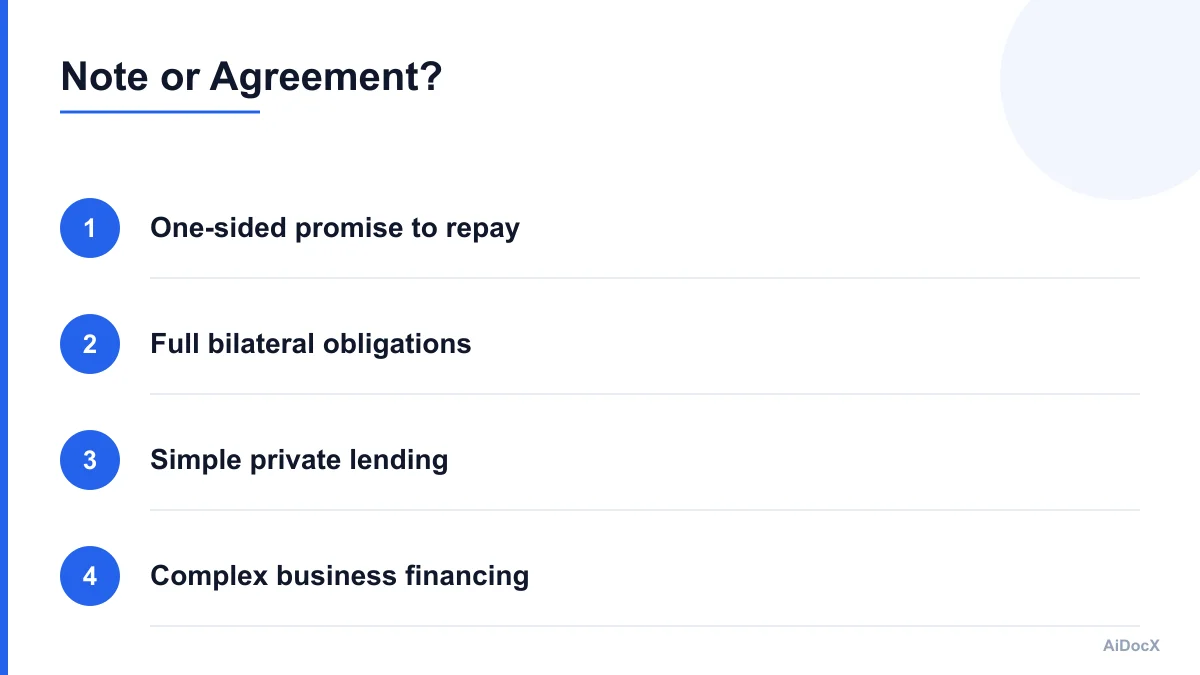
A promissory note is usually a borrower's written promise to repay. It is often shorter, more standardized, and centered on payment terms. A loan agreement is a broader contract between the lender and borrower that can include detailed promises, conditions, restrictions, reporting duties, collateral arrangements, and remedies.
The practical difference is scope.
| Promissory note | Loan agreement |
|---|---|
| Focuses on the promise to repay | Covers the complete lending relationship |
| Often signed mainly by the borrower | Usually signed by all contracting parties |
| Shorter and easier to administer | Longer and more detailed |
| Common for simple private loans | Common for commercial or complex financing |
| States principal, interest, and repayment | May include covenants, conditions, and disclosures |
| May refer to collateral documents | Often coordinates multiple related documents |
Imagine two scenarios.
In the first, a founder borrows $10,000 from a friend. The lender does not want voting rights, business reports, or control over how the money is spent. The parties only need a definite repayment plan and a record of the interest rate. A promissory note may be sufficient.
In the second, a company receives a $250,000 working-capital facility from an investor. The investor wants monthly financial statements, limits on additional debt, insurance requirements, personal guarantees, collateral, early repayment rights, and detailed default remedies. A loan agreement, often accompanied by a promissory note and security documents, is more appropriate.
A note can also be used alongside a loan agreement. The agreement may establish the broader relationship, while the note evidences the specific debt. This structure is common when a transaction involves several borrowers, multiple advances, collateral, guarantors, or continuing obligations.
Choose a promissory note when:
- The loan has one borrower and one lender
- The principal amount is known
- Repayment is straightforward
- The parties do not need extensive operating covenants
- The loan is unsecured or collateral is documented separately
- Both sides want a concise written record
Consider a loan agreement when:
- The lender will make multiple advances
- The loan supports a complex business relationship
- The borrower must satisfy ongoing conditions
- Collateral, guarantees, or subordination rights are important
- The lender needs financial reporting or inspection rights
- Several legal documents must work together
The shorter format is not automatically safer. A simple note with ambiguous payment terms can create more risk than a longer agreement with carefully defined obligations.
The Essential Clauses in a Promissory Note Template
A useful template should make the financial arrangement specific enough that a neutral reader can calculate what is owed without asking the parties what they meant.
Start with the parties and transaction date. Use each party's correct legal name rather than a nickname. If the borrower is a company, identify the entity type and jurisdiction of formation. If an individual is signing on behalf of a company, state the company's name and the signer's title.
Principal amount
State the original amount in both numbers and words where practical. For example:
"Borrower promises to pay Lender the principal sum of Fifteen Thousand Dollars ($15,000)."
If the amount will be advanced in stages, a single simple note may not be enough. Define when advances occur, how they are recorded, and whether the outstanding balance changes as payments are made.
Interest
Specify whether the interest rate is fixed or variable, the annual percentage, and the method of calculation. Avoid saying only "reasonable interest" or "the usual rate." Those phrases leave room for disagreement.
Clarify whether payments apply first to accrued interest, then fees, then principal, or in another order. State whether unpaid interest compounds and whether that practice is allowed under applicable law.
Interest must also comply with usury limits and any rules that apply to consumer, business-purpose, or regulated lending. A rate that is acceptable for one type of transaction may be unlawful for another. If the loan involves a consumer, residential property, or repeated lending activity, obtain legal advice before using a generic template.
Repayment schedule
The schedule should answer four questions:
- When is the first payment due?
- How much is each payment?
- How often are payments due?
- When is the entire balance due?
A schedule might require 18 monthly payments of $888.30 beginning June 1, 2026, with a final payment due November 1, 2027. If the final payment may be different because of rounding, say so.
For interest-only payments, balloon payments, seasonal payments, or irregular installments, attach a payment table. A table is often clearer than a paragraph.
Maturity date
State when the remaining balance becomes due. Even if the borrower makes regular installments, the note should identify the final date. "Payable over approximately two years" is less useful than "all unpaid principal, accrued interest, and permitted charges are due on November 1, 2027."
Prepayment
Decide whether the borrower may pay early without penalty. Most informal business loans allow prepayment, but the note should say so. If a prepayment fee applies, describe how it is calculated and confirm that it is legally permitted.
Default and remedies
Define default objectively. Common events include:
- Failure to make a payment within a stated grace period
- Insolvency, bankruptcy, or assignment for creditors
- A material misrepresentation in the note
- Breach of a separate written obligation
- Unauthorized sale or transfer of pledged collateral
Then state what the lender may do after default. Remedies may include demanding the overdue amount, charging a permitted late fee, accelerating the unpaid balance, enforcing collateral, and recovering reasonable collection costs where allowed.
Do not assume that acceleration is automatic. If the lender wants the entire balance to become due after a missed payment, the note should say when and how that right is triggered. Some jurisdictions require notice or an opportunity to cure before certain remedies are exercised.
Notices
Identify how formal notices must be delivered and where. Email may be useful for routine payment reminders, but a note may require notice by personal delivery, recognized courier, or mail for default notices. Include an address for each party and a procedure for updating it.
How to Make a Promissory Note Enforceable
A signed document is not automatically enforceable. Enforceability depends on the applicable law and the facts, but several practices consistently reduce uncertainty.
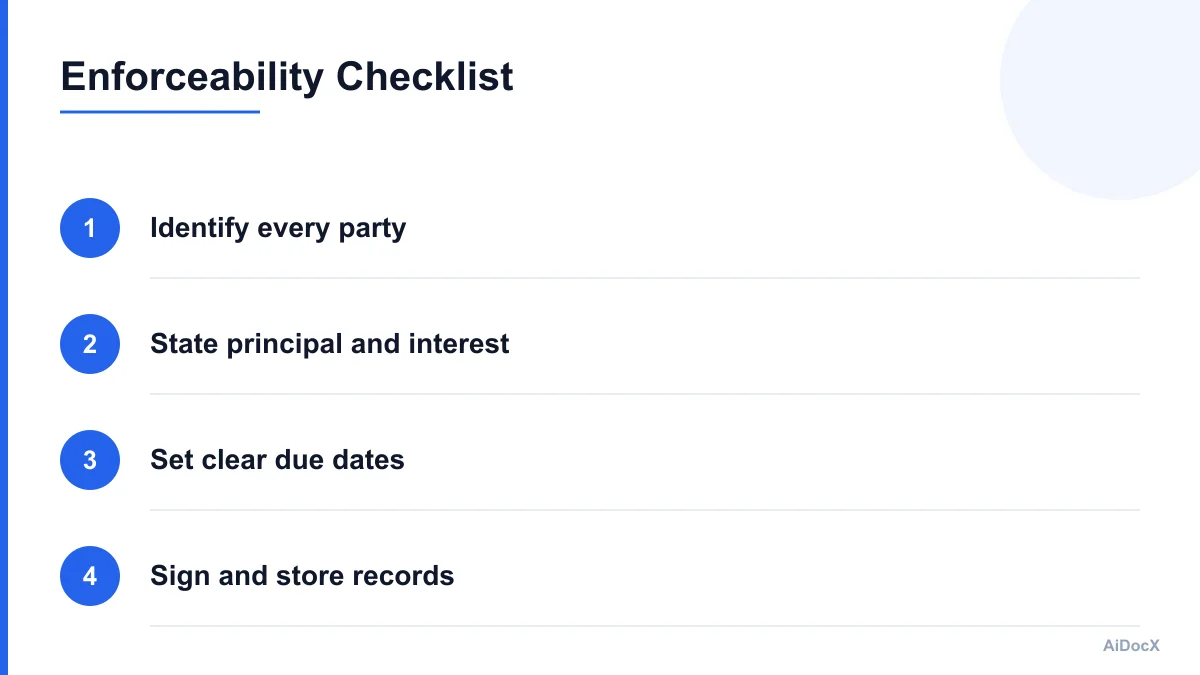
Identify the parties precisely
Use full legal names and current addresses. Confirm the borrower's entity status through the appropriate business registry if a company is involved. If a guarantor or co-borrower is included, identify that person separately and explain the scope of the obligation.
State a definite obligation
The note should contain a clear promise to pay a definite principal amount, plus interest and permitted charges. Avoid open-ended language and undefined references to oral promises.
If the note refers to another document, make the relationship clear. For example, a security agreement may describe collateral rights, while the promissory note states the payment obligation. The two documents should not contradict each other.
Include consideration and funding evidence
Consideration is the value exchanged for the promise. In a loan, it is usually the lender's advance of money and the borrower's promise to repay. Keep evidence of the transfer, such as a bank record, wire confirmation, or receipt.
The note should state the funding date or explain whether the borrower acknowledges receipt of the loan proceeds. If the note is signed before funds are transferred, record the actual funding date separately.
Use valid signatures
Each required party should sign in the correct capacity. A company signature should include the entity name, signer's name, and title. Electronic signatures may be valid under applicable law, but the process should preserve the final signed document, signer identity, timestamps, and evidence of consent.
A notarization is not universally required for a promissory note. It can help authenticate signatures and may be required for related collateral documents or local procedures. Do not add a notary block as a substitute for clear terms.
Make the payment date unambiguous
A note that says "payments begin next month" becomes unclear if the signing date changes. Use exact dates, preferably with the month written out. Also specify what happens if a payment date falls on a weekend or holiday.
Comply with applicable law
Review state rules concerning:
- Maximum interest rates and usury
- Late fees and collection costs
- Consumer lending disclosures
- Electronic signatures
- Required notices
- Collateral and lien perfection
- Statutes of limitation
- Community-property or spousal-consent rules
- Licensing requirements for lenders
A template is a starting point, not a guarantee. The more unusual the transaction, the more important jurisdiction-specific review becomes.
Building a Clear Repayment Schedule
A repayment schedule is where many informal notes fail. The parties agree on the total amount but do not explain how the balance changes over time.
For a standard amortizing loan, calculate the periodic payment using the principal, interest rate, payment frequency, and number of payments. Include a schedule showing:
- Payment number
- Due date
- Total payment
- Interest portion
- Principal portion
- Remaining balance
For example, a $12,000 loan at 6% annual interest over 12 monthly payments will not normally be repaid with 12 payments of exactly $1,000 because interest accrues. The first payment may contain more interest than the last. The note should state whether the schedule is controlling if a minor rounding difference appears.
Also address payment mechanics:
- Bank account, payment portal, check, or another method
- Time by which payment must be received
- Whether partial payments are accepted
- Who pays transfer or processing fees
- Whether the borrower receives a receipt
- How the parties handle failed or reversed payments
If the borrower's cash flow is seasonal, build the seasonality into the schedule rather than relying on a verbal understanding. If the loan includes a balloon payment, highlight the final amount and due date so the borrower cannot reasonably claim surprise.
The lender should maintain a payment ledger. Each entry should record the date received, amount, allocation to fees, interest, and principal, and the resulting balance. The borrower should keep matching records and request a current payoff statement before making a final payment.
AiDocX can generate a promissory note with principal, interest, default, and repayment-schedule clauses in minutes, then route it for e-signature. The value is not merely speed; it is preserving a dated record of what both parties reviewed and accepted.
Secured, Unsecured, and Guaranteed Notes
An unsecured promissory note does not give the lender a specific claim to an identified asset. If the borrower defaults, the lender may pursue the remedies available under the note and applicable law, but recovery may be difficult if the borrower has limited assets or other creditors.
A secured note identifies collateral. Common examples include:
- Business equipment
- A vehicle
- Inventory
- Accounts receivable
- Investment assets
- Specific intellectual property rights, where appropriate
The note should not vaguely say "all assets" unless the parties have prepared the documents and filings needed to make that security interest effective. A separate security agreement may be necessary, and the lender may need to file a financing statement or take possession of certain collateral.
A personal guarantee is different from collateral. A guarantor promises to pay if the primary borrower does not. The guarantee should be written, signed, and clear about whether it covers principal only or also interest, fees, and enforcement costs.
Before using collateral or a guarantee, consider the relationship consequences. A friend or family member may be willing to sign a simple unsecured note but not pledge a home, vehicle, or business assets. The document should reflect an agreement the parties actually understand and intend to honor.
Common Promissory Note Mistakes to Avoid
The most common mistakes are not dramatic drafting errors. They are small gaps that become important when the relationship changes.
Using only first names
"Alex lends Sam $20,000" is not enough if either person owns a business, has a common name, or moves. Use legal names and addresses.
Leaving the interest rate blank
A blank rate creates uncertainty and can lead to disputes over whether the loan was interest-free, subject to a later agreement, or governed by a default rate.
Writing "payable monthly" without dates
Monthly payments still need a first due date, final due date, amount, and treatment of weekends and holidays.
Mixing principal and interest
State whether the borrower owes a fixed total amount or principal plus interest calculated over time. These are not interchangeable.
Adding an unlawful late fee
A late fee should compensate for a reasonable administrative or collection burden where permitted, not function as an excessive penalty.
Forgetting what happens after default
A note should explain notice, cure periods, acceleration, collection costs, and collateral enforcement. Otherwise, the lender may have to rely on default legal rules.
Signing before changing the final document
Do not alter the principal, interest rate, or schedule after signing without a written amendment signed by the affected parties. Keep the final version and any amendments together.
Treating a template as legal review
A generic form may not address state-specific lending limits, tax treatment, secured transactions, consumer protections, or business-entity authority. Ask a qualified attorney to review the note when the amount or risk is significant.
Failing to document payment
A note proves the agreed obligation, but payment records prove what has already been paid. Keep bank records, receipts, payoff statements, and written notices.
Promissory Note Signing Checklist
Use this checklist before money changes hands:
- Confirm the legal names and addresses of all parties
- Verify the borrower's authority to sign for a business
- State the principal in numbers and words
- Specify the interest rate and calculation method
- List every payment date and payment amount
- State the maturity date and any balloon payment
- Explain prepayment rights and penalties
- Define default, notice, cure, and acceleration
- Identify collateral or attach a separate security agreement
- Add any personal guarantee as a separate signed obligation
- Choose governing law and notice methods
- Check usury and other applicable legal requirements
- Sign the final version with reliable date and identity records
- Give each party an identical completed copy
- Record the loan funding and every repayment
After signing, the lender should send or transfer the funds in a traceable way. The borrower should confirm receipt in writing. Both parties should store the signed note, payment schedule, transaction record, and later amendments in a location they can access independently.
For a two-way arrangement that also covers an installment schedule, default and acceleration, see our payment plan agreement template.
Final Thoughts: When a Promissory Note Is the Right Tool
A promissory note is often the right middle ground between a handshake and a highly negotiated loan agreement. It gives a small private loan a defined principal, interest rate, repayment schedule, and default process without requiring a lengthy financing contract.
Its strength comes from clarity and execution. Identify the parties, describe the debt precisely, set dates and amounts, comply with applicable law, sign the final version, and maintain payment records. If the loan involves substantial money, collateral, a guarantee, a consumer borrower, or a complicated business relationship, have a lawyer review the structure before signing.
For a straightforward loan between people or small businesses, AiDocX helps turn the agreed terms into a structured promissory note and routes it for e-signature, giving the lender and borrower a dated record of the obligation. A clear written agreement cannot guarantee repayment, but it can prevent many avoidable disputes about what was promised.
Ready to automate your documents with AI?
Start free with AiDocX — AI contract drafting, meeting minutes, consultation notes, e-signatures, and more in one platform.
Get Started FreeMore from AiDocX Blog
How to Read a Business Contract: A Founder's Checklist (2026)
A practical way to review parties, scope, money, IP, liability, and exit terms before signing a business contract.
 MinjiLee October 7, 2026 9 min
ESIGN vs eIDAS: What Founders Should Know About E-Signatures (2026)
What U.S. ESIGN and EU eIDAS actually say, where exceptions apply, and what founders should keep to document an electronic signing.
MinjiLee October 7, 2026 7 min
Does Document Automation Pay Off? An ROI Worksheet for Founders (2026)
Estimate document automation ROI with your own volume, time, labor, and software costs. Includes a clearly labeled example and break-even formula.
 Chloe October 7, 2026 8 min