2026 Real Estate E-Sign Rules: What Agents Can Sign Remotely
Navigate 2026 e-signature laws for real estate. Learn which closing docs require wet ink or notarization and how small brokerages can stay compliant and efficient.
 James · Content Manager August 9, 2026 11 min read
2026 Real Estate E-Sign Rules: What Agents Can Sign Remotely
The landscape of real estate transactions in 2026 is defined by a paradox: technology has made signing instantaneous, but regulatory scrutiny has made verification stricter. For independent agents and small brokerages, the old assumption that "digital means easy" is no longer safe. While the Uniform Electronic Transactions Act (UETA) and the federal ESIGN Act provide a broad framework for e-signatures, state-specific real estate codes and closing protocols have diverged significantly.
Agents are now walking a tightrope between speed and compliance. You can draft a listing agreement on your phone between showings, but you cannot simply email a closing disclosure for a signature without meeting specific identity and notarization standards. Misunderstanding these boundaries leads to delayed closings, rejected documents, and potential liability. This guide clarifies exactly what is safe to e-sign and what still demands physical presence or advanced remote notarization protocols in 2026.
The 2026 Compliance Landscape: Why Rules Have Shifted
In previous years, the question of e-signatures in real estate was largely settled by the general acceptance of digital signatures under federal law. However, 2026 has brought a new layer of complexity driven by two factors: the normalization of Remote Online Notarization (RON) and increased fraud prevention mandates.
Lenders and title companies are no longer accepting a simple click-to-sign for high-stakes documents without robust identity proofing. The shift is not about banning e-signatures, but about raising the bar for authentication. For small brokerages that lack the dedicated compliance teams of large national firms, this shift can feel overwhelming. The key is understanding that "e-signature" is not a single legal standard; it is a category of documents with varying levels of required verification.
Agents must distinguish between documents that require a "simple electronic signature" (often just an email reply or a click) and those requiring a "qualified electronic signature" or physical/wet ink execution. The latter category has shrunk but not disappeared, particularly in states that have not fully adopted RON or where specific statutory forms mandate wet ink.
Which Documents Can Be E-Signed in 2026?
For most transactional paperwork, the answer is yes. The vast majority of pre-closing documents are fully e-signable, provided the platform used maintains an audit trail. This includes the foundational agreements that start the relationship and the addendums that modify terms.
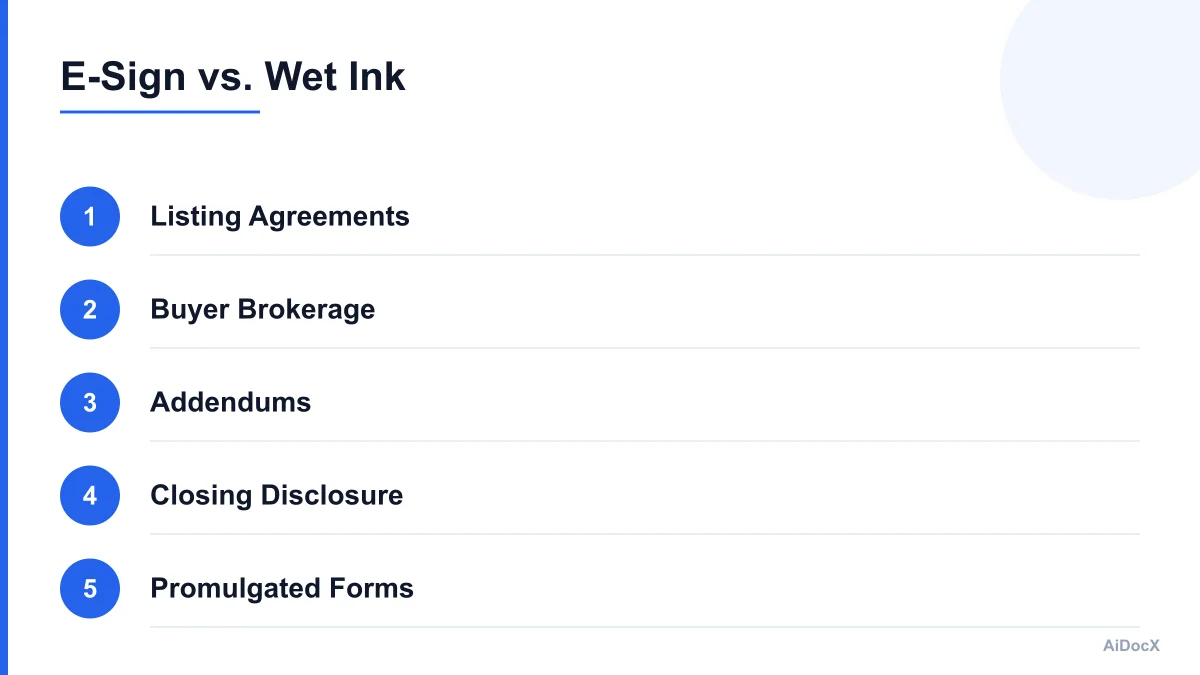
Listing Agreements and Buyer Brokerage Agreements These are the first contracts in a transaction. In 2026, it is standard practice to execute these entirely digitally. Agents can draft these documents using compliant platforms, send them via secure links, and collect signatures via mobile devices. The critical factor is ensuring the signature captures the signer’s intent and IP address timestamp, which most modern e-sign platforms handle automatically.
Purchase and Sale Agreements (PSA) and Addendums Once a property is under contract, the volume of paperwork increases. Addendums for inspections, financing contingencies, and repair requests are routinely e-signed. However, agents must ensure that all parties sign the same version of the document. In 2026, version control is automated by most legal tech platforms, reducing the risk of a party signing an outdated clause.
Disclosures (Federal and State) Most federal disclosures, such as the Lead-Based Paint disclosure, are e-signable. State-specific property disclosures (e.g., California’s NHD, Texas’s TREC forms) are also generally e-signable, provided the state’s real estate commission has explicitly authorized digital execution for that specific form. Agents should never assume a promulgated form is e-signable; they must check the current year’s instructions on the form itself or consult their state association’s guidelines.
Loan Applications and Pre-approval Letters While the actual loan documents (like the Promissory Note) have specific restrictions (see below), the preliminary steps of the financing process, including pre-approval letters and initial loan application acknowledgments, are fully digital.
Which Documents Still Require Wet Ink or Physical Presence?
Despite the digital trend, certain documents remain stubbornly analog. These are typically documents that require notarization in states where RON is not available, or documents that involve complex identity verification that cannot be easily satisfied remotely.
Promissory Notes and Deeds of Trust/Mortgages This is the most common point of confusion. While the application for the loan is digital, the actual promissory note (the IOU) and the security instrument (the mortgage or deed of trust) often require wet ink signatures. This is because these documents are recorded in public records, and many county recorders still require physical signatures to ensure the integrity of the deed chain. However, this is changing rapidly in states with active RON laws. In those states, a digital signature on a promissory note is valid if accompanied by a remote notary’s digital seal.
Closing Disclosures (CD) and Loan Estimates (LE) Under the TILA-RESPA Integrated Disclosure (TRID) rules, borrowers must receive the Closing Disclosure at least three business days before closing. While the delivery is often electronic, the signature on the CD is a gray area. Some lenders accept e-signatures on the CD, but many still require wet ink or a notarized copy to ensure the borrower acknowledges the final numbers. Agents should never assume the CD is e-signable; they must follow the lender’s specific closing instructions.
Documents Requiring Physical Notarization in Non-RON States If you are transacting in a state that has not adopted the Uniform Real Property Electronic Recording Act (URPERA) or does not permit Remote Online Notarization for real estate transactions, certain documents must be signed in the presence of a notary public. This includes many deeds, powers of attorney, and certain affidavits. In 2026, approximately 30-35 states allow RON for real estate, but the remaining states require physical presence.
Title Transfer Documents in Specific Jurisdictions Some counties or states have local recording rules that mandate wet ink signatures for deeds to prevent fraud. Even if state law allows e-signatures, the local recorder’s office may reject them. This is a technical hurdle, not a legal one, but it can delay closings by weeks.
The Role of Remote Online Notarization (RON)
Remote Online Notarization (RON) is the primary driver of change in 2026. RON allows a notary public to witness the signing of documents via live audio-video connection, rather than in person. For agents and brokers, this expands the pool of documents that can be signed remotely.
How RON Works in Real Estate
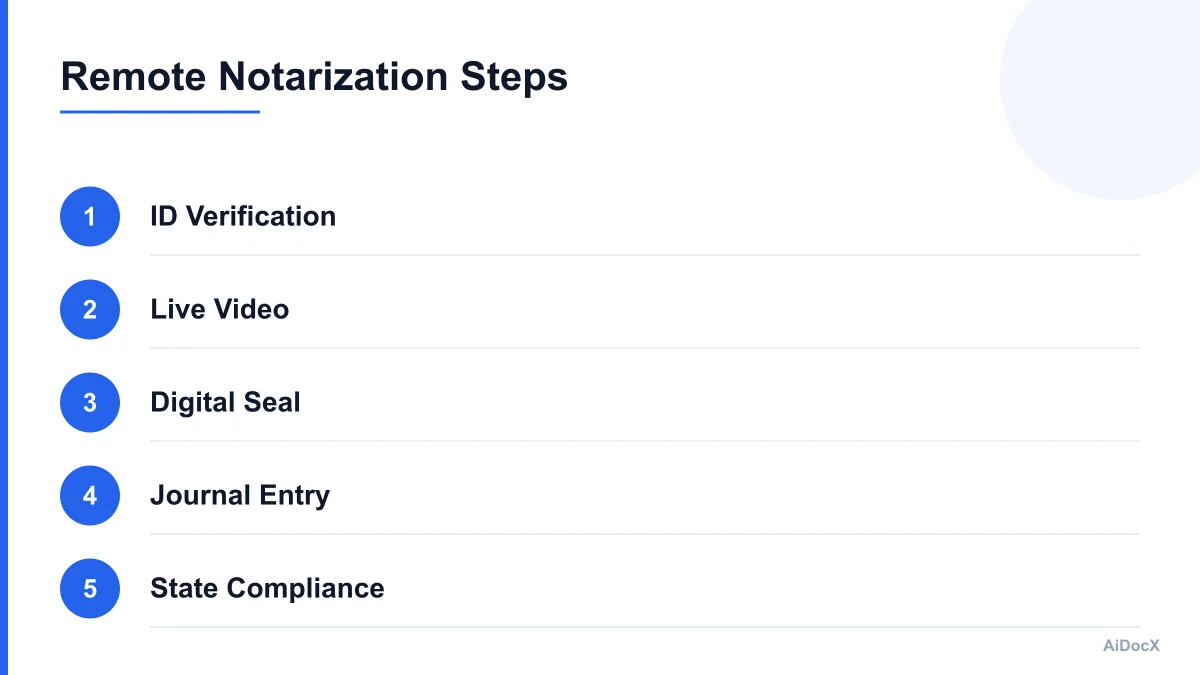
- Identity Verification: The signer must verify their identity through knowledge-based questions (KBA) and credential analysis (scanning a driver’s license).
- Live Audio-Video: The signer and notary must see and hear each other in real-time.
- Digital Seal and Journal: The notary applies a digital seal and records the act in an electronic journal.
State-by-State Variability Not all states allow RON for real estate transactions. Some states permit RON for general documents but exclude real estate closings. Others have strict requirements, such as mandating that the notary be located in the same state as the signer. Agents must know the laws of both the state where the property is located and the state where the notary is located.
The Benefit for Small Brokerages RON eliminates the need to coordinate physical meetings with busy clients. An agent can send a closing package, have the client sign electronically, and then schedule a 10-minute video call with a notary. This speeds up the closing process and reduces the logistical burden on small teams.
Common Mistakes Agents Make with E-Signatures
Even with compliant tools, agents can make errors that invalidate signatures or delay closings. These mistakes often stem from a lack of understanding of the specific requirements for each document type.
Using Non-Compliant Platforms Not all e-signature tools are created equal. Simple email signatures or basic PDF annotation tools do not provide the audit trail required for legal enforceability. Agents must use platforms that comply with ESIGN and UETA, including features like IP logging, timestamping, and multi-factor authentication. Using a generic tool for a promissory note can render the signature invalid in the event of a dispute.
Failing to Verify Identity for Notarized Docs When using RON, agents often assume the platform handles all identity checks. While the platform does the heavy lifting, the agent must ensure that the signer is who they claim to be. If the signer is not present during the video call, or if they are using someone else’s ID, the notarization is void. Agents should remind clients to have their government-issued ID ready before the video call begins.
Ignoring State-Specific Form Requirements Many states have promulgated forms that include specific instructions about e-signatures. For example, a form might state, "This form must be signed in wet ink." If an agent ignores this instruction and e-signs, the document may be rejected by the title company or lender. Always read the fine print on promulgated forms.
Mixing Wet Ink and E-Signatures Incorrectly In some transactions, a hybrid approach is necessary. For example, a buyer might e-sign the purchase agreement but need to wet-in the promissory note. Agents must ensure that all parties are aware of which documents require which method. Miscommunication here can lead to a situation where one party is ready to close, but another is missing a required wet-ink signature.
How Small Brokerages Can Streamline the Process
For independent agents and small brokerages, time is money. Streamlining the signing process is not just about convenience; it is about competitive advantage. Here is how to optimize your workflow in 2026.
Choose the Right Technology Stack Your document management system should integrate with your CRM and e-signature platform. Look for tools that offer automated workflows, such as triggering a document generation when a lead becomes a client. The system should also flag documents that require notarization, alerting the agent early in the process.
Train Your Team on Compliance Even small teams have support staff or transaction coordinators. Ensure everyone understands the difference between e-signable and wet-ink documents. Regular training on state law changes and platform updates is essential. A simple misunderstanding can cost thousands in delayed closing fees.
Build Relationships with Local Notaries While RON is expanding, not all states support it. Building relationships with local notaries who are willing to travel or who specialize in real estate closings can be a valuable backup. In states where RON is not available for real estate, having a trusted notary network ensures you can still close deals efficiently.
Communicate Clearly with Clients Clients are often confused about why some documents need wet ink. Provide clear, simple explanations. For example, "This document is a legal contract that can be signed digitally. This one is a loan document that requires a notary’s signature, which we can do via video call." Setting expectations reduces friction and builds trust.
Practical Checklist for Agents in 2026
Before sending any document for signature, run it through this checklist to ensure compliance and efficiency.
- Verify Platform Compliance: Does the e-signature tool meet ESIGN and UETA standards? Does it provide an audit trail with IP and timestamps?
- Check State Law: Is e-signature allowed for this specific document type in the state where the property is located? Check your state real estate commission’s website.
- Identify Notarization Needs: Does this document require notarization? If yes, is Remote Online Notarization (RON) permitted in this state for this document type?
- Review Promulgated Forms: Do any attached forms have specific instructions regarding wet ink or physical signatures?
- Confirm Lender Requirements: Has the lender specified any additional requirements for e-signatures on loan documents? Some lenders have stricter internal policies than state law.
- Prepare Clients: Have you explained to the client which documents they can sign on their phone and which require a video call or physical meeting?
- Document the Process: Keep a record of all communications related to the signing process, including emails confirming the client’s intent to sign digitally.
Conclusion: Balancing Speed with Security
The future of real estate transactions is digital, but it is not lawless. In 2026, the ability to close deals remotely depends on an agent’s understanding of the nuanced differences between e-signable documents and those requiring wet ink or notarization. For small brokerages, leveraging technology like AiDocX can simplify the drafting and distribution of listing agreements and disclosures, allowing agents to focus on client relationships rather than paperwork logistics. However, technology is only as good as the compliance framework behind it.
By staying informed about state-specific laws, using compliant e-signature platforms, and clearly communicating with clients and lenders, agents can enjoy the speed of digital transactions without sacrificing legal integrity. The key is to view e-signatures not as a shortcut, but as a tool that requires careful handling. As remote notarization continues to expand, the line between wet ink and digital will blur further, but the core principle remains: verify identity, document intent, and follow the law.
For agents ready to streamline their document workflow, AiDocX offers a secure platform to draft and send listing agreements and disclosures for e-signature directly from a phone between showings. The platform intelligently flags documents that still require in-person notarization, ensuring you never send a non-compliant document by mistake. Stay compliant, close faster, and focus on what matters most: your clients.
Ready to automate your documents with AI?
Start free with AiDocX — AI contract drafting, meeting minutes, consultation notes, e-signatures, and more in one platform.
Get Started FreeMore from AiDocX Blog
Buy Sell Agreement Template (2026): Triggers, Valuation and Funding for Co-Owners
A free buy sell agreement template for co-owners, with triggering events, valuation methods, insurance funding and cross-purchase vs. redemption structures.
James September 26, 2026 12 min
Consignment Agreement Template (2026): Commission, Title, Risk of Loss and Unsold Goods
Free consignment agreement template for makers, artists and boutiques: commission split, title, insurance and how to protect consigned inventory.
James September 26, 2026 9 min
Distribution Agreement Template (2026): Territory, Exclusivity, Minimums and Reseller Terms
Free distribution agreement template (works as a reseller agreement template too): territory, exclusivity, minimums, pricing, IP and termination.
James September 26, 2026 13 min