Real Estate Purchase Agreement Template: Key Clauses for 2026
Learn what a real estate purchase agreement should include, how contingencies protect buyers and sellers, and what to review before closing.
 James · Content Manager August 21, 2026 14 min read
Real Estate Purchase Agreement Template: Key Clauses for 2026
A real estate purchase agreement is the written contract that records a buyer's offer and a seller's acceptance of the sale. It sets the price, deadlines, included property, contingencies, and responsibilities that guide the transaction through closing. This guide explains the clauses buyers, sellers, agents, and small investors should review before signing or customizing a template.
What Is a Real Estate Purchase Agreement?
A real estate purchase agreement, sometimes called a purchase and sale agreement or sales contract, is a legally binding agreement between a buyer and seller. Once properly signed and accepted, it generally creates an obligation to proceed with the transaction according to the stated terms.
The agreement is more detailed than a basic offer letter. It answers practical questions such as:
- Who is buying and selling the property?
- What exactly is included in the sale?
- How much will the buyer pay?
- When will the buyer deposit earnest money?
- Which inspections or approvals must occur?
- What happens if financing fails?
- Who pays taxes, fees, repairs, and other closing costs?
- When will ownership and possession transfer?
The contract usually comes before the deed. The purchase agreement establishes the parties' obligations, while the deed is the document that transfers legal title at closing.
A standard agreement may be prepared using a state-approved form, a brokerage form, an attorney-drafted contract, or a customized template. The correct choice depends on the property, transaction structure, and local law. Residential purchases, commercial properties, vacant land, investment properties, foreclosures, and seller-financed transactions can require substantially different language.
A template is a starting point, not a substitute for legal review. Real estate contracts are governed largely by state and local law, and some jurisdictions require specific disclosures, notices, signatures, or attorney involvement.
Key Clauses in a Real Estate Purchase Agreement
A useful agreement should be specific enough that the parties can understand what must happen, when it must happen, and what happens if a deadline or condition is not met.
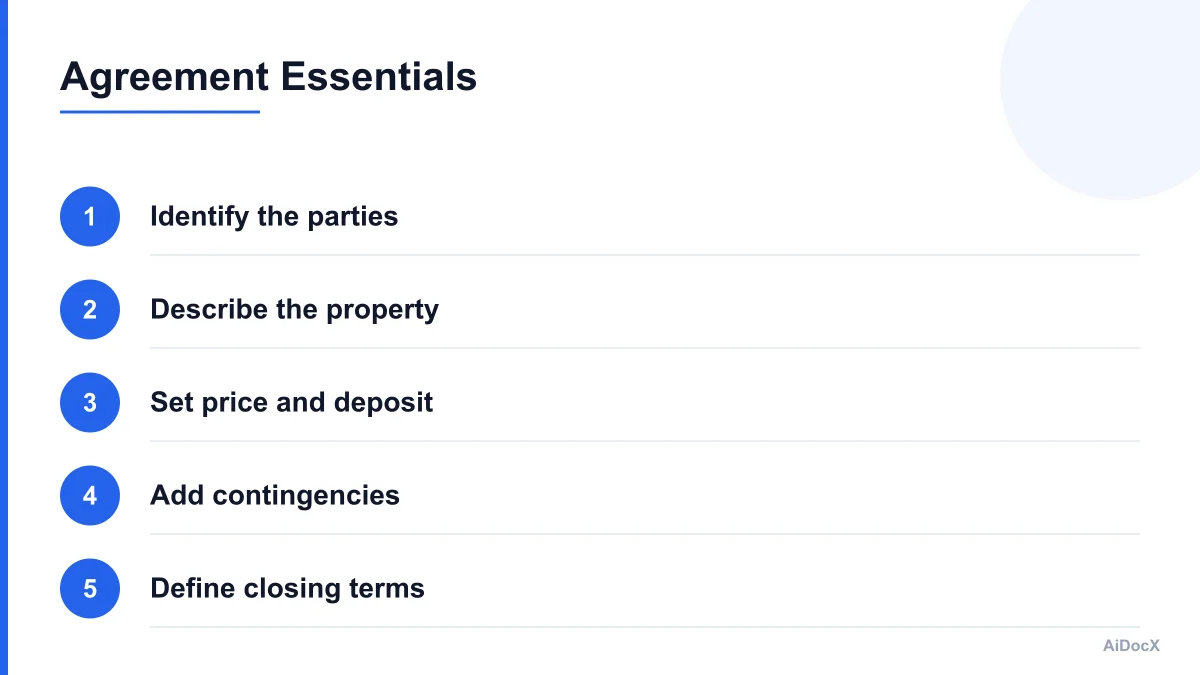
1. Names and authority of the parties
List the full legal names of every buyer and seller. If a seller is a company, trust, estate, partnership, or limited liability company, identify the legal entity and confirm that the person signing has authority to bind it.
For buyers, the agreement should clarify whether title will be held by one individual, multiple individuals, a married couple, a business entity, a trust, or a nominee or assignment entity, if permitted.
This matters because the names in the contract may need to match the names on the deed, loan documents, title commitment, and closing statement.
If there are multiple buyers, specify whether they will hold title as joint tenants, tenants in common, community property, or another legally recognized form. The agreement itself may not determine the final ownership structure, but identifying the intended structure early helps prevent closing delays.
2. Property description
Include the property's street address, legal description, parcel number, and any unit, lot, or building identifiers. The legal description should come from a reliable title, tax, or recorded property document rather than an informal description copied from a listing.
The agreement should also explain what is included in the sale. Depending on the property, this may include land and buildings, attached appliances, built-in shelving, light fixtures and ceiling fans, window treatments, security systems, landscaping equipment, garage remotes, solar panels, water softeners, leased equipment, and parking spaces or storage units.
If an item is important to the buyer, name it directly. "All appliances" may not answer whether a refrigerator, washer, dryer, wine cooler, or outdoor kitchen equipment is included. If an item is excluded, list it as well.
For investment or commercial property, include leases, tenant deposits, service contracts, permits, signage, fixtures, and personal property that will transfer with the property.
3. Purchase price and payment terms
State the total purchase price in both numbers and words where appropriate. Then explain how the price will be paid.
Common payment components include an earnest money deposit, down payment, mortgage or other loan proceeds, seller financing, buyer credits, assumed loan balance, and additional cash due at closing.
For example, an agreement might state that the purchase price is $425,000, with $8,500 deposited as earnest money, $80,000 provided by the buyer at closing, and the balance paid through an approved mortgage.
The contract should identify when and where the earnest money must be deposited, who will hold it, and how it will be applied at closing. It should also state what happens to the deposit if the agreement is terminated under a valid contingency or if one party defaults.
Earnest money is not automatically the same as a penalty. Its treatment depends on the contract, applicable law, and the reason the transaction ends. A buyer who cancels under an express contingency may have a right to a refund, while a buyer who breaches without contractual protection may risk losing the deposit.
4. Closing date and possession
State the target closing date, the location or method of closing, and when possession will transfer.
Possession may occur at signing, when the deed is recorded, when sale proceeds are disbursed, on a specified date after closing, after the seller vacates, or after a tenant's lease ends.
If the seller will remain in the property after closing, use a separate post-closing occupancy or leaseback provision. It should address rent, utilities, insurance, security deposits, maintenance, damage, and the deadline for moving out.
Avoid vague phrases such as "closing in approximately 30 days." Use a date or a clearly defined method for calculating the date. If the date can be extended, identify who may extend it, for how long, and under what circumstances.
The contract should also address what happens if the closing agent, lender, title company, or recording office causes a delay that is not the fault of either party.
5. Title and conveyance
The seller generally agrees to transfer title in a specified condition, such as marketable title or title insurable by a recognized title company. The exact standard varies by jurisdiction.
The title clause may cover existing mortgages and liens, easements, covenants and restrictions, unpaid taxes, judgment liens, boundary issues, probate or estate claims, ownership disputes, and rights of tenants or occupants.
The buyer may receive a title commitment or preliminary title report before closing. The buyer should review it promptly and object to unacceptable exceptions within the contractual deadline.
The agreement should state whether the seller must cure title defects, whether the buyer may accept them, and what happens if the defects cannot be resolved. It should also identify who pays for the owner's title policy, lender's title policy, survey, recording fees, and other title-related expenses.
6. Disclosures and property condition
The seller should provide legally required property disclosures within the applicable time frame. Depending on local law, these may address known defects, environmental hazards, prior flooding, structural issues, lead-based paint, water damage, insurance claims, or other material facts.
A disclosure form does not replace the buyer's inspection. It reports what the seller knows; an inspection evaluates the property's condition through a professional examination.
The agreement should explain whether the property is sold in its present condition, subject to specific repairs, with a seller warranty, with a right to inspect and request remedies, or with certain systems required to be operational at closing.
"Sold as-is" does not necessarily allow a seller to conceal known defects or disregard disclosure obligations. It also does not eliminate every buyer protection. The meaning of an as-is clause depends on the contract language and local law.
For new construction, renovations, or investor purchases, the agreement may need additional warranties covering workmanship, permits, materials, code compliance, or completion of specified work.
Common Contingencies and How They Work
A contingency makes one party's obligation dependent on a defined event or approval. A well-drafted contingency identifies the deadline, required action, decision standard, notice procedure, and remedy.
Financing contingency
A financing contingency protects a buyer who needs a mortgage or other loan. It should specify the loan type, minimum loan amount, maximum interest rate, required term, application deadline, approval deadline, required buyer cooperation, and notice and cancellation procedure.
A buyer should apply promptly and respond to lender requests. Waiting until the last minute can create a default risk if the contract's financing deadline passes.
A financing contingency is not always a guarantee that the buyer can cancel for any reason. Some agreements require the buyer to make a good-faith effort to obtain financing. Others limit cancellation if the buyer changes jobs, applies for a different loan, misses deadlines, or fails to provide requested documents.
Appraisal contingency
An appraisal contingency addresses the risk that the property appraises for less than the purchase price. The parties may agree that the buyer can cancel and recover the deposit, request a price reduction, pay the difference in cash, split the difference with the seller, waive the appraisal protection, or proceed only if the lender approves the loan anyway.
For example, if the contract price is $500,000 but the appraisal is $475,000, the buyer and seller need a written process for deciding whether to renegotiate or proceed. Without one, a disagreement may delay closing.
Inspection contingency
An inspection contingency gives the buyer time to examine the property. It may cover a general home inspection and separate evaluations for roof condition, foundation and structure, plumbing, electrical systems, HVAC, mold, pests, sewer or septic systems, wells, radon, environmental hazards, chimneys, pools, and solar equipment.
The contract should state whether the buyer may cancel for any reason during the inspection period or only for specified defects. It should also explain whether the seller must make repairs, offer a credit, reduce the price, or provide no remedy.
A buyer should avoid relying on oral promises such as "the seller will fix the roof." Put the repair, contractor standard, completion deadline, permits, receipts, and inspection rights in a signed amendment.
Sale-of-existing-home contingency
A buyer may need to sell an existing home before buying another. This contingency can be important for cash flow but may make the offer less attractive to the seller.
The agreement should state whether the buyer must list the current home, accept an offer, close the sale, or simply provide proof of financing. A seller may retain a right to continue showing the property or invoke a kick-out clause if another qualified offer appears.
Title contingency
A title contingency gives the buyer time to review title evidence and object to unacceptable defects or restrictions. It should identify the title review period and the process for resolving objections.
Buyers should pay attention to easements, access rights, shared driveways, utility restrictions, homeowner association covenants, mineral rights, leases, and boundary concerns. A property can have "clear" ownership while still being subject to restrictions that affect its use.
Home-sale, insurance, and other contingencies
Other contingencies may cover buyer obtaining homeowner's insurance, review and approval of condominium or HOA documents, government or zoning approvals, environmental testing, well and septic results, flood or wildfire insurance availability, sale of an investment property, completion of repairs, verification of rental income, and satisfactory review of leases and operating records.
Every contingency should have an objective deadline. An open-ended clause creates uncertainty for both sides.
Buyer and Seller Responsibilities Before Closing
Signing the agreement begins the transaction; it does not finish it. Both parties must complete their obligations and monitor deadlines.
Buyer workflow
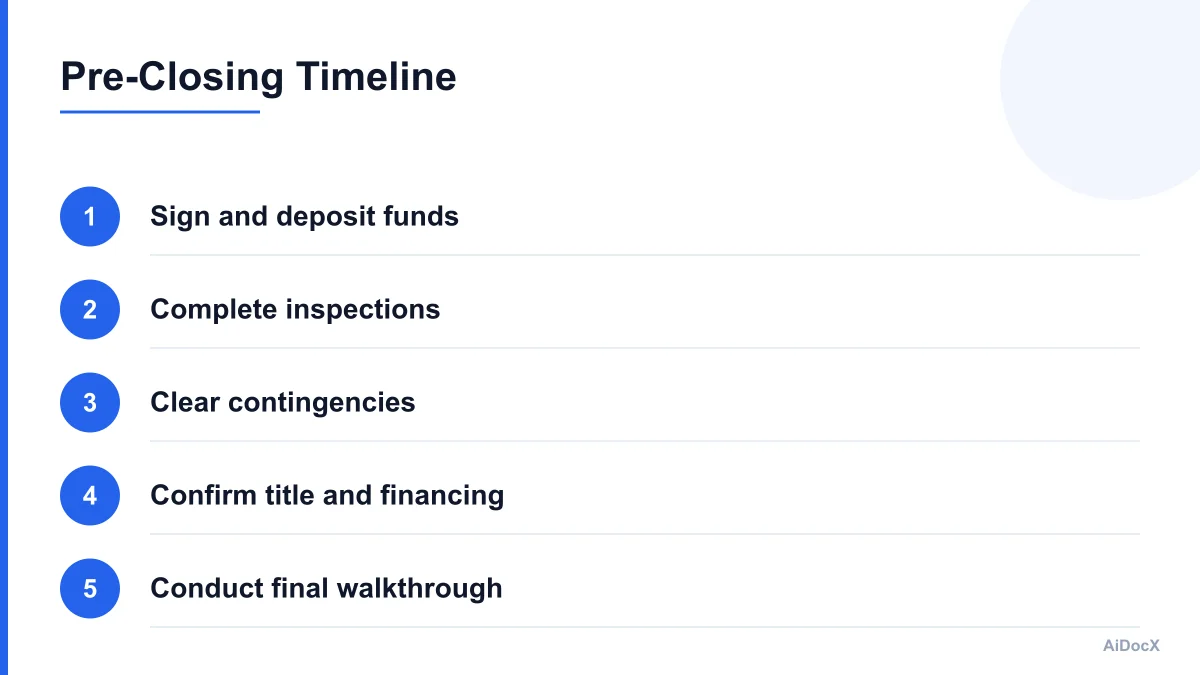
A practical buyer timeline looks like this: deposit earnest money by the stated deadline, submit the mortgage application and required documents, schedule inspections and order specialized tests, review disclosures, title materials, surveys, and association documents, send any repair requests or contingency notices in writing, obtain insurance and satisfy lender conditions, review the closing disclosure and final settlement figures, confirm the wire instructions through a trusted phone number, conduct the final walkthrough, and sign closing documents and confirm possession arrangements.
Buyers should review closing documents carefully and compare them with what they expected. Buyers should not sign blank documents or documents containing material terms they do not understand.
Seller workflow
A practical seller timeline includes providing required disclosures and available property records, gathering permits, warranties, surveys, leases, and utility information, completing agreed repairs and keeping receipts, responding to title requests and lien payoff questions, maintaining the property in substantially the agreed condition, keeping utilities on through the final walkthrough or closing, removing personal property and debris, vacating by the possession deadline, reviewing the settlement statement and payoff amounts, and signing the deed and other transfer documents.
The seller should not make major changes to the property, remove fixtures, cancel insurance, or enter a new lease without checking the agreement first.
The role of agents, attorneys, lenders, and settlement providers
The buyer's and seller's agents may coordinate documents, deadlines, inspections, and communications, but they do not necessarily provide legal advice. A real estate attorney can help interpret or customize contract language, especially for unusual transactions.
The lender focuses on loan approval and underwriting. The title company, escrow agent, settlement agent, or closing attorney handles title, funds, documents, and recording according to local practice. These roles vary by state, so the agreement should identify the responsible parties clearly.
Common Mistakes That Create Closing Problems
Many disputes come from unclear details rather than dramatic disagreements. Watch for these recurring mistakes.
Leaving blanks or using inconsistent dates
A missing deadline can be as problematic as a missed deadline. Check that the offer date, acceptance date, inspection period, financing deadline, title objection period, closing date, and possession date are consistent.
Describing included items vaguely
If the buyer expects a hot tub, mounted television, generator, or shed to remain, list it. If the seller intends to take a fixture, identify the exclusion before signing.
Treating contingencies as informal promises
A buyer who tells an agent about a financing problem but does not send the required written notice may not have properly exercised a contractual right. Follow the agreement's notice method exactly.
Ignoring title and survey documents
A buyer may focus on the house and overlook an access easement, shared driveway, boundary encroachment, or restrictive covenant. Review these documents before the objection deadline expires.
Assuming an inspection contingency guarantees repairs
An inspection clause may provide a cancellation right but no right to demand repairs. Read the remedy carefully. A seller may agree to a credit, a repair, a price reduction, or nothing.
Failing to plan for delays
Loan underwriting, title clearance, repairs, appraisals, and municipal inspections can take longer than expected. Build realistic deadlines into the agreement and document extensions in writing.
Wiring money based on an email alone
Real estate wire fraud is a serious risk. Confirm payment instructions using a known phone number for the settlement provider. Do not rely solely on a last-minute email, even if it appears to come from a familiar contact.
Using a generic form for a specialized transaction
A standard residential form may not address tenant estoppel certificates, assignment rights, seller financing, 1031 exchange language, environmental conditions, commercial leases, or entity authority. Specialized transactions deserve specialized review.
A Practical Agreement Review Checklist
Use this checklist before signing or accepting a real estate purchase agreement:
- Confirm every buyer and seller's legal name.
- Verify signing authority for trusts, estates, and companies.
- Check the street address, parcel number, and legal description.
- List fixtures, appliances, personal property, and exclusions.
- Confirm the purchase price and payment sources.
- State the earnest money amount, holder, and deposit deadline.
- Review financing type, loan amount, and approval deadlines.
- Set inspection dates and define the buyer's remedies.
- Include appraisal and title review provisions when appropriate.
- Confirm required disclosures and delivery dates.
- Identify the closing date, location, and possession terms.
- Allocate taxes, utilities, commissions, title costs, and other fees.
- Address existing tenants, leases, deposits, and rental income.
- Confirm repair standards, permits, and completion evidence.
- Define default remedies, notice, and dispute procedures.
- Review amendment and notice requirements.
- Confirm insurance and lender conditions.
- Plan the final walkthrough.
- Obtain legal advice for unusual or high-value transactions.
The checklist is useful for a first review, but it does not replace the agreement itself. Every checked item should correspond to clear language in the contract or a signed addendum.
How to Prepare and Sign the Agreement Efficiently
A reliable drafting process begins with a transaction summary. Record the parties, property, price, deposit, financing, dates, included items, contingencies, closing provider, and special terms before filling in the agreement.
Next, use the correct local form or a lawyer-reviewed template. Avoid copying clauses from unrelated transactions without understanding how they interact with the rest of the contract. A financing deadline that conflicts with the closing date, for example, can create unnecessary risk.
Then review the agreement in three passes: business terms (confirm the price, dates, property, deposit, included items, and costs), risk terms (review contingencies, title, disclosures, default remedies, and possession), and execution terms (confirm signatures, initials, attachments, notice addresses, and delivery method).
Keep all exhibits and addenda together. A repair addendum, seller disclosure, HOA document, lease assignment, or financing amendment may change the practical meaning of the main agreement.
For teams handling multiple offers or investment purchases, AiDocX can help draft and e-sign a real estate purchase agreement quickly while keeping the latest version and signed records organized. The document should still be reviewed for state-specific requirements and transaction-specific risks before execution.
After signing, send the complete contract to the lender, title company, escrow agent, and relevant agents. Save the final executed copy in a secure location. Any later change should be documented in a written amendment signed by the required parties.
A real estate purchase agreement is the roadmap for the period between accepted offer and closing. Clear property descriptions, payment terms, deadlines, contingencies, title provisions, and possession rules reduce avoidable misunderstandings. Before signing, compare the template with the actual transaction, confirm local requirements, and ask a qualified real estate attorney or settlement professional about any term you do not understand.
Ready to automate your documents with AI?
Start free with AiDocX — AI contract drafting, meeting minutes, consultation notes, e-signatures, and more in one platform.
Get Started FreeMore from AiDocX Blog

How to Read a Business Contract: A Founder's Checklist (2026)
A practical way to review parties, scope, money, IP, liability, and exit terms before signing a business contract.
 MinjiLee October 7, 2026 9 min
ESIGN vs eIDAS: What Founders Should Know About E-Signatures (2026)
What U.S. ESIGN and EU eIDAS actually say, where exceptions apply, and what founders should keep to document an electronic signing.
MinjiLee October 7, 2026 7 min
Does Document Automation Pay Off? An ROI Worksheet for Founders (2026)
Estimate document automation ROI with your own volume, time, labor, and software costs. Includes a clearly labeled example and break-even formula.
 Chloe October 7, 2026 8 min