Refund & Return Policy Template 2026: Protect Your Business
Draft a legally sound refund and return policy for 2026. Learn key clauses, digital product rules, and customer satisfaction tips with our comprehensive guide.
 James · Content Manager August 1, 2026 10 min read
Refund and Return Policy Template 2026: How to Write One That Protects the Business and Keeps Customers Happy
A well-crafted refund and return policy is not just a legal shield; it is a critical component of your customer experience strategy. In 2026, as consumer expectations for transparency and ease of returns continue to rise, having a clear, accessible, and fair policy can significantly reduce chargebacks, decrease customer service inquiries, and build long-term brand loyalty. This guide provides a comprehensive framework for creating a policy that balances operational efficiency with customer satisfaction, ensuring you are protected while keeping your buyers happy.
Why a Clear Policy Matters More Than Ever in 2026
Gone are the days when a vague "No Refunds" sign was sufficient. Today’s consumers are savvy, informed, and increasingly concerned about their rights as buyers. A clear policy serves three primary functions: it sets expectations before the purchase, it provides a roadmap for resolution when things go wrong, and it protects your business from abusive return practices.
When customers know exactly what to expect, they feel more confident in their purchase. This transparency reduces anxiety and lowers the likelihood of disputes. Furthermore, a standardized policy ensures consistency in how your team handles returns, preventing subjective decision-making that can lead to accusations of unfair treatment. In an era where online reviews can make or break a small business, a hassle-free return experience is often the differentiator between a one-time buyer and a loyal advocate.
What Must Be Included in Your Policy
To create a robust policy, you must cover the fundamental elements that govern the return process. Omitting key details can lead to confusion and potential legal issues, particularly under evolving consumer protection laws.
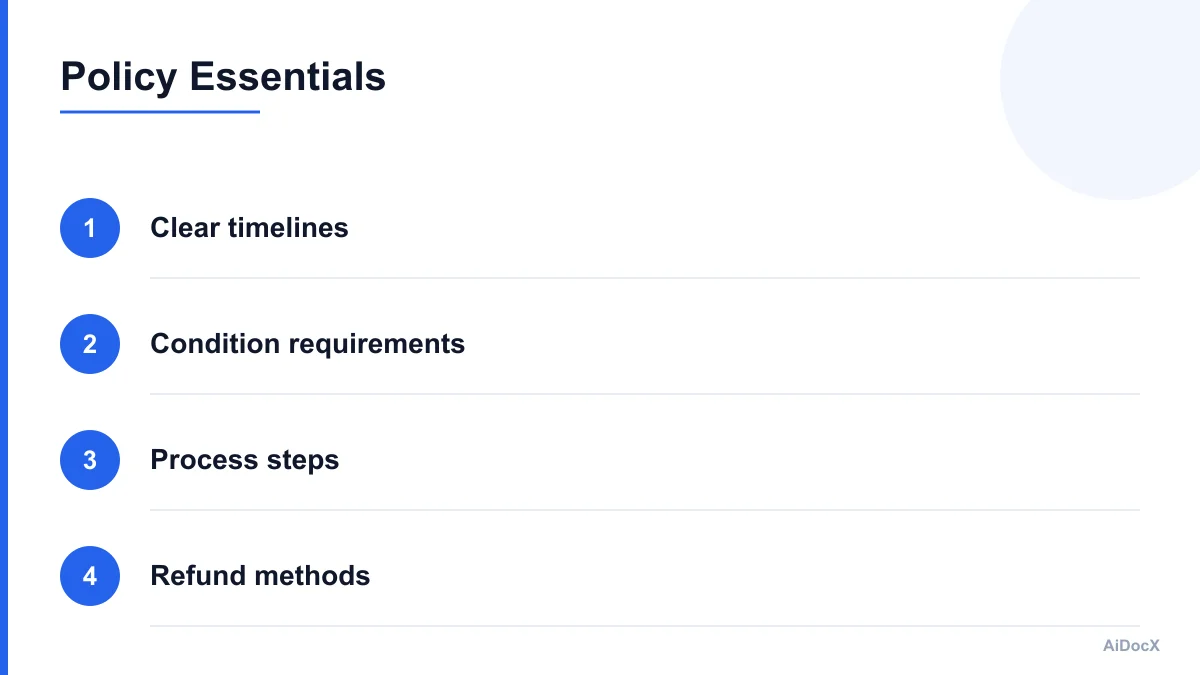
1. Timeframe for Returns
Specify the exact window during which customers can initiate a return. Common timeframes include 7, 14, 30, or 60 days from the date of delivery. Be precise: does the clock start from the order date or the delivery date? The latter is generally more customer-friendly and clearer.
2. Condition of Items
Detail the condition in which items must be returned. For physical goods, this might include original packaging, tags attached, and no signs of wear. For digital services or software, specify that licenses are non-transferable and non-refundable once accessed.
3. Refund Methods
Clarify how refunds will be processed. Will the money go back to the original payment method? Will you offer store credit instead? If you offer store credit, make this optional for the customer, as forcing it can violate consumer rights in many jurisdictions.
4. Return Shipping Costs
State clearly who pays for return shipping. Some businesses offer free returns as a competitive advantage, while others charge the customer. If the customer pays, provide an estimate of the cost.
5. Restocking Fees
If applicable, disclose any restocking fees. These should be reasonable and clearly communicated. A 10-15% fee is common for certain electronics or large items, but it must be stated upfront.
6. Contact Information
Provide a dedicated email address or contact form for returns. Avoid making customers dig through general support pages. A direct line speeds up the process and reduces frustration.
- Define the return window clearly (e.g., 30 days from delivery).
- Specify acceptable condition for returns (original packaging, tags).
- State who pays for return shipping.
- Explain refund methods (original payment vs. store credit).
- Include a dedicated contact email for returns.
Drafting the Policy: Step-by-Step Guide
Creating the policy document is straightforward if you follow a logical structure. You don’t need a law degree, but you do need clarity and consistency.
Step 1: Gather Your Business Rules
Before writing, sit down with your operational team. What is physically possible? Can you accept returns from international customers? Do you have the inventory to process exchanges quickly? Your policy must reflect your actual capabilities, not idealized scenarios.
Step 2: Choose Your Policy Type
Decide on the overall approach:
- Full Refund: The customer gets their money back.
- Exchange Only: The customer can swap the item but not get cash back.
- Store Credit: The customer receives funds to spend on future purchases.
- No Refunds: Typically reserved for digital goods, personalized items, or final sale items.
Step 3: Write in Plain Language
Avoid legalese. Your policy should be readable by a 12-year-old. Use short sentences and active voice. Instead of "It is required that the item be returned within 30 days," write "Return items within 30 days."
Step 4: Integrate Legal Requirements
Ensure compliance with local laws. In the EU, consumers have a 14-day right of withdrawal for online purchases. In the US, there is no federal law requiring returns, but state laws may apply. In Australia, goods must meet "guaranteed outcomes," meaning you must offer a remedy if the product is faulty. Always consult local regulations or a legal professional to ensure compliance.
Step 5: Place the Policy Prominently
Don’t bury your policy in the footer. Link to it from your homepage, product pages, and checkout. Consider adding a summary box near the "Add to Cart" button that highlights key points, such as "30-Day Free Returns." This proactive communication builds trust at the moment of purchase.
Using a tool like AiDocX can streamline this process, allowing you to draft a clear, compliant policy in minutes that is ready to publish or attach to customer agreements. This ensures you don’t miss any critical clauses while maintaining a professional tone.
Common Mistakes to Avoid
Even well-intentioned business owners make errors in their return policies. These mistakes can lead to customer dissatisfaction, increased costs, and legal risks.
1. Being Too Vague
Phrases like "reasonable time" or "good condition" are open to interpretation. Define these terms explicitly. What constitutes "good condition"? Is a minor scratch acceptable? Specificity prevents disputes.
2. Hiding the Policy
If customers have to search for your policy, they may assume it’s unfavorable. Transparency builds trust. Make it easy to find and read.
3. Ignoring Digital Products
Many e-commerce businesses sell digital downloads, subscriptions, or online courses. These require specific clauses stating that once the product is delivered or accessed, it cannot be returned. Ensure this is clearly stated before purchase.
4. Not Accounting for Damaged Items
Your policy should distinguish between a customer’s change of mind and a faulty product. For damaged or defective items, offer a full refund or replacement without requiring the item to be returned, or provide a prepaid shipping label. This enhances customer satisfaction and reduces the cost of return shipping for you.
5. Forgetting to Update
If your business model changes, update your policy. If you start offering international shipping, you must address customs duties and international return logistics. Stale policies can be legally problematic.
Handling Digital Products and Services
Digital goods present unique challenges for return policies. Unlike physical products, digital files cannot be "returned" in the traditional sense. Once downloaded, the customer has the product.
Non-Refundable Clauses
Clearly state that digital products, such as e-books, software, or online courses, are non-refundable once delivered. However, consider offering a preview or sample to reduce buyer’s remorse.
Subscription Services
For recurring billing, specify the cancellation policy. Can customers cancel anytime? Is there a notice period? Are partial refunds available for the unused portion of the month? Be transparent about billing cycles and renewal dates.
Licensing Agreements
If you sell software licenses, include terms that prohibit sharing or transferring the license. This protects your intellectual property and justifies the non-refundable nature of the sale.
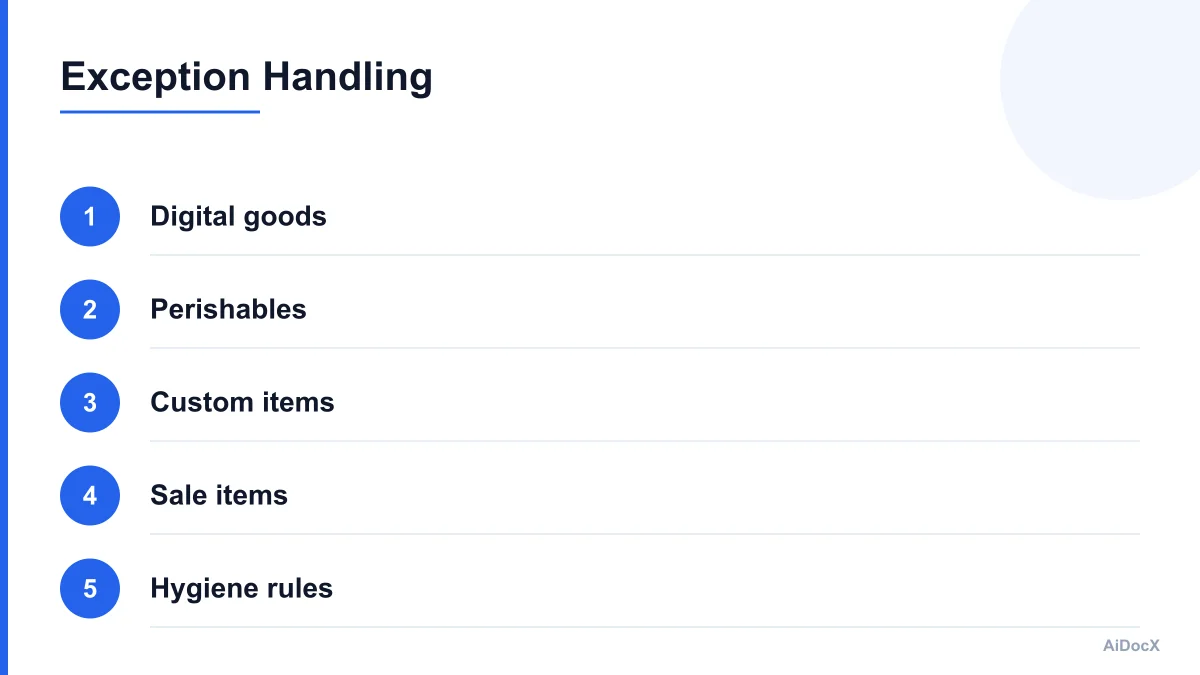
Managing Exceptions and Special Cases
Not all returns fit neatly into standard procedures. Having guidelines for exceptions helps your team handle edge cases consistently.
Perishable Goods
Food, flowers, and other perishable items should have a strict no-return policy unless they arrive damaged. Specify the condition upon arrival and provide a short window (e.g., 24 hours) to report issues.
Custom or Personalized Items
Items made to order or personalized with the customer’s name or details should be non-refundable unless defective. Explain why these items cannot be resold, which justifies the policy.
Sale Items
Decide whether sale items are eligible for return. Some businesses offer "final sale" items at a discount with no returns. If you allow returns on sale items, ensure the refund amount matches the discounted price.
Hygiene-Sensitive Products
For items like underwear, swimwear, or beauty products, hygiene seals must remain intact. State clearly that these items cannot be returned if the seal is broken.
Lost or Stolen Packages
Clarify your responsibility once the item is delivered to the carrier or the customer’s address. Typically, once delivered, the risk transfers to the customer. However, offering assistance in filing claims with the carrier can be a good customer service gesture.
Best Practices for Customer Communication
A policy is only as good as its implementation. How you communicate and execute returns impacts customer perception.
Proactive Communication
Send an email confirmation that includes a link to your return policy. If a customer contacts you with a question, refer them to the policy rather than answering manually each time. This reinforces the rules.
Streamlined Process
Make the return process as easy as possible. Provide a self-service portal where customers can generate return labels and track their returns. Automate this where possible to reduce administrative burden.
Empathy in Rejections
If a return doesn’t meet policy criteria, reject it politely but firmly. Explain the specific reason based on the policy terms. Avoid blaming the customer. Offer alternatives if possible, such as store credit or a discount on a future purchase.
Speed Matters
Process refunds quickly. Once you receive the returned item, issue the refund within 2-3 business days. Delays in processing refunds are a common source of customer complaints.
Legal Compliance and Data Privacy
In 2026, data privacy is paramount. Your return process involves handling customer information, including addresses, payment details, and sometimes personal data.
GDPR and CCPA Compliance
Ensure that your return policy and process comply with data protection laws. Do not store unnecessary personal data. Inform customers how their data is used in the return process.
Accessibility
Ensure your policy is accessible to all users, including those with disabilities. Use clear fonts, high contrast, and screen-reader-friendly formatting.
Dispute Resolution
Include a clause on how disputes will be resolved. Specify the jurisdiction and applicable law. Consider offering mediation or arbitration as a first step before litigation.
Checklist for Launching Your Policy
Before publishing your refund and return policy, use this checklist to ensure completeness and accuracy.
- Clarity Check: Is the language simple and free of jargon?
- Timeframes Defined: Are start and end dates for returns clearly specified?
- Condition Details: Is it clear what condition items must be in?
- Costs Disclosed: Are return shipping costs and restocking fees clearly stated?
- Refund Method: Is the refund method (original payment, credit, etc.) specified?
- Contact Info: Is there a dedicated email or form for returns?
- Exceptions Listed: Are digital, custom, and perishable items addressed?
- Legal Review: Has a legal professional reviewed the policy for compliance?
- Accessibility: Is the policy formatted for easy reading and accessibility?
- Prominence: Is the policy linked from key pages like the homepage and checkout?
Conclusion
A well-drafted refund and return policy is a powerful tool for small business owners and solo operators. It protects your business from abuse, ensures legal compliance, and enhances the customer experience by setting clear expectations. By following the guidelines in this post, you can create a policy that is both fair and effective.
Remember, your policy is a living document. Review it regularly as your business grows and regulations change. For those looking to streamline the creation process, tools like AiDocX can help you generate a professional, customized policy in minutes, allowing you to focus on what you do best—running your business.
Start by auditing your current policy against the checklist above. Identify gaps, clarify ambiguities, and ensure your process is as customer-friendly as it is protective. In 2026, transparency and ease are not just nice-to-haves; they are essential for survival and growth in the competitive e-commerce landscape.
Ready to automate your documents with AI?
Start free with AiDocX — AI contract drafting, meeting minutes, consultation notes, e-signatures, and more in one platform.
Get Started FreeMore from AiDocX Blog
Affiliate Agreement Template (2026): Protect Your Business When Paying Commissions
Free affiliate agreement template for 2026: key clauses, FTC disclosure requirements, affiliate vs referral agreement compared, a worked example, and a copy-paste version.
James September 22, 2026 11 min
AI Receipt Generator (2026): Create Professional Payment Receipts in Seconds
Generate professional payment receipts with AI in seconds. Receipt vs invoice vs credit note explained, the fields to include, a worked example, and a copy-paste template.
James September 22, 2026 9 min
Bill of Sale Template (2026): Free Generator for Cars, Trailers & Personal Property
Free bill of sale template for 2026: the fields to include, state notarization rules, federal odometer disclosure, a worked example, and a copy-paste version.
James September 22, 2026 10 min