
Remote Contractor Agreement Template 2026: Hire Overseas Safely
Hire overseas contractors in 2026 without legal headaches. Use our remote contractor agreement template to secure IP, define payments, and ensure compliance.
 James · Content Manager August 3, 2026 10 min read
Remote Contractor Agreement Template 2026: How Small Businesses Hire and Pay Overseas Contractors Without Legal Headaches
Hiring talent across borders offers small businesses access to global skills and cost efficiencies, but it also introduces complex legal and operational risks. Without a robust remote contractor agreement, you risk intellectual property theft, misclassification lawsuits, and payment disputes that can cripple your operations. In 2026, as remote work becomes the standard rather than the exception, the expectations for clarity, compliance, and security in contractor relationships have never been higher. This guide provides a practical framework for drafting, signing, and managing these agreements, ensuring your business grows securely.
Why Standard Contracts Fail for Remote Workers
Many small business owners make the mistake of using a generic freelance contract or an employee offer letter when hiring overseas talent. These documents often fail to address the specific nuances of cross-border engagements. A standard domestic contract does not account for foreign tax obligations, international data privacy laws like the GDPR, or the specific mechanics of cross-border payments.
When you hire a contractor in Brazil, India, or Poland, you are entering into a legal relationship governed by both your local laws and their jurisdiction’s labor regulations. If your contract does not explicitly define the worker as an independent contractor, you may inadvertently classify them as an employee. This misclassification can lead to severe penalties, including back taxes, social security contributions, and benefits owed by the tax authorities in the contractor’s country.
Furthermore, intellectual property (IP) clauses in generic templates are often vague. In many jurisdictions, if the IP transfer is not explicitly stated in a written contract signed by the creator, the IP may remain with the contractor, not your business. This is a critical risk for software development, content creation, and design projects. A specialized remote contractor agreement must bridge these gaps, providing clear definitions of scope, deliverables, and ownership that hold up in multiple legal systems.
Key Clauses in a Remote Contractor Agreement
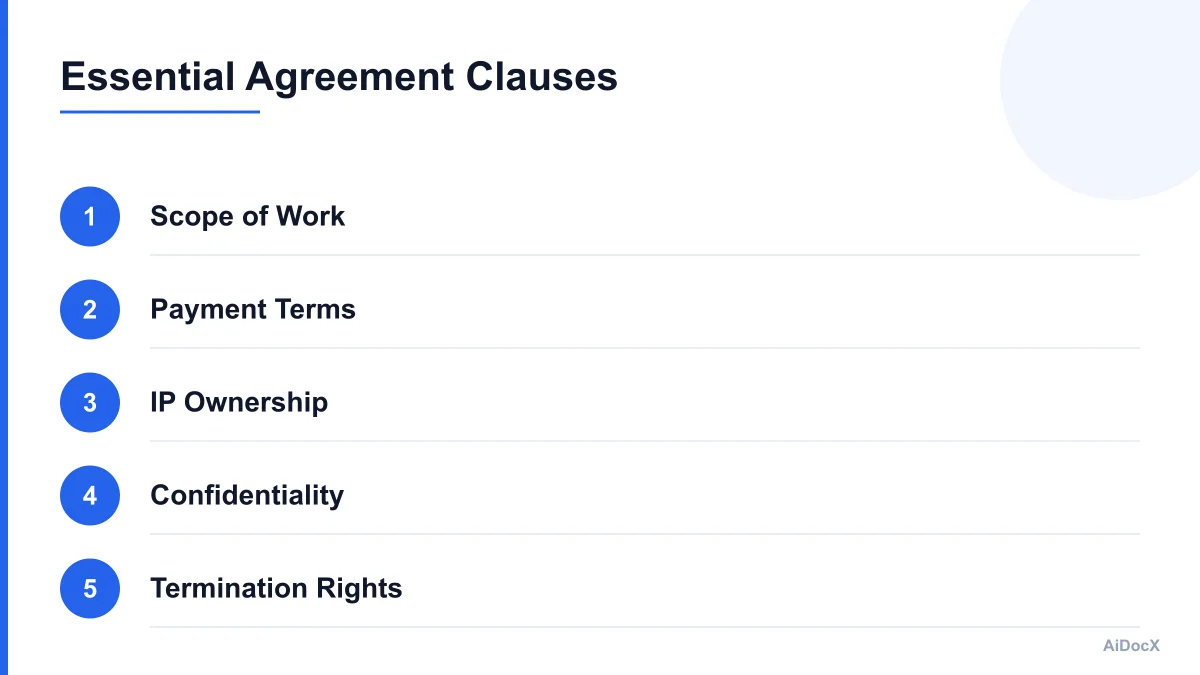
To protect your business, your remote contractor agreement must include specific clauses that address the unique challenges of international hiring. These clauses go beyond standard terms to provide clarity and enforceability.
Scope of Work and Deliverables
Ambiguity in the scope of work is the leading cause of project failure. Your agreement should include a detailed statement of work (SOW) as an exhibit. This SOW must list specific deliverables, acceptance criteria, and deadlines. For example, instead of stating "develop website," specify "design and develop a five-page responsive WordPress site with SEO optimization, to be delivered by March 1st." Clear deliverables prevent scope creep and provide a basis for evaluating performance.
Payment Terms and Currency
Cross-border payments involve currency exchange rates and banking fees. Your agreement should specify the currency of payment (e.g., USD, EUR, GBP) and the exchange rate mechanism if applicable. Define the payment schedule (monthly, milestone-based, or net-30) and the method of payment (Wire transfer, PayPal, Wise, Payoneer). Include clauses that address late payments and who bears the transaction fees. For instance, "All payments shall be made in USD via Wise. The Contractor is responsible for any bank charges associated with receiving the payment."
Intellectual Property Ownership
This is the most critical clause for protecting your business assets. The agreement must explicitly state that all work product, including code, designs, content, and ideas, is "work made for hire" and that all rights, title, and interest in the work product are assigned to your company upon creation and payment. Include a moral rights waiver where applicable, ensuring the contractor cannot claim authorship rights that could restrict your use of the work.
Confidentiality and Non-Disclosure
Remote contractors often have access to sensitive data, customer lists, and proprietary processes. A strong non-disclosure agreement (NDA) clause should define what constitutes confidential information and the duration of the confidentiality obligation, which should survive the termination of the contract. Specify that the contractor must use secure methods for data transfer and storage, aligning with standards like GDPR or CCPA if you handle personal data.
Termination and Exit Strategy
Life happens, and projects change. Define how either party can terminate the agreement. Common terms include "termination for convenience" with a notice period (e.g., 14 days) and "termination for cause" for breach of contract. Specify what happens to unpaid invoices and unfinished work upon termination. Ensure you have the right to reclaim all materials and access to accounts and systems immediately upon termination.
Drafting Your Agreement: A Step-by-Step Guide
Creating a legally sound remote contractor agreement does not require a law degree. By following a structured process, you can create a document that protects your interests and sets clear expectations.
- Identify the Contractor’s Jurisdiction: Determine the country where the contractor resides. This influences tax requirements and local labor laws. Some countries have specific mandatory clauses that must be included in contracts for workers based there.
- Define the Relationship: Explicitly state that the contractor is an independent contractor, not an employee. List factors that support this, such as the contractor’s control over their work schedule, use of their own equipment, and ability to work for other clients.
- Detail the Scope: Attach a comprehensive SOW. Use bullet points for deliverables and set clear deadlines. Define the revision process to manage expectations.
- Set Payment Terms: Choose a reliable payment method. Specify the currency, amount, frequency, and invoicing requirements. Include penalties for late payment if necessary.
- Protect IP and Data: Insert strong IP assignment and confidentiality clauses. Ensure compliance with data privacy laws relevant to your business and the contractor’s location.
- Review and Customize: Use a trusted template as a base, but customize it for the specific project and jurisdiction. If the contract value is high, consider having a local legal expert review it.
- Sign and Store: Use a secure e-signature platform to execute the agreement. Keep a copy in your secure contract management system.
Using a tool like AiDocX can streamline this process significantly. AiDocX drafts a remote contractor agreement covering payment currency, IP ownership, and termination, then routes it for e-signature across time zones. This ensures that your agreements are consistent, comprehensive, and legally robust without manual drafting errors.
Navigating Tax and Compliance Risks
One of the most significant risks in hiring overseas contractors is tax compliance. Misclassifying a contractor as an employee can result in hefty fines and back taxes. To mitigate this risk, you must understand the difference between a contractor and an employee.
Worker Classification
Tax authorities in many countries, including the US (IRS), UK (HMRC), and EU nations, have strict tests for worker classification. They look at the degree of control, integration into the business, and financial risk. To maintain contractor status:
- Do not provide office space or equipment.
- Do not dictate working hours or methods.
- Allow the contractor to work for other clients.
- Pay by project or hour, not by salary.
Tax Forms and Documentation
Depending on your jurisdiction, you may need to collect tax forms from your contractors. For US businesses, this is Form W-8BEN for foreign contractors, which certifies their foreign status and may reduce withholding tax under a tax treaty. For other countries, you may need equivalent forms. Always keep these documents on file as proof of compliance.
Data Privacy Laws
If your remote contractors handle personal data of customers in the EU, they must comply with the General Data Protection Regulation (GDPR). This includes implementing appropriate security measures and signing a Data Processing Agreement (DPA). Similarly, if you handle data from California, you must comply with the California Consumer Privacy Act (CCPA). Your contractor agreement should include clauses that obligate the contractor to comply with these laws and notify you of any data breaches.
Choosing the Right Payment Infrastructure
Paying overseas contractors securely and efficiently is crucial for maintaining good relationships and ensuring timely payments. Traditional bank wires can be slow and expensive, with high fees and unfavorable exchange rates. In 2026, small businesses are increasingly using specialized payment platforms.
Comparison of Payment Methods
| Method | Speed | Cost | Best For |
|---|---|---|---|
| Wire Transfer | 2-5 days | High ($20-$50) | Large, one-time payments |
| PayPal | Instant | High (3-4% fee) | Small, frequent payments |
| Wise | 1-2 days | Low (1-2% fee) | Regular monthly payments |
| Payoneer | 1-3 days | Moderate | Freelancers in specific regions |
| Deel/Remote | 1-2 days | Moderate | Compliance-focused hiring |
Best Practices for Payments
- Use Multi-Currency Accounts: Platforms like Wise allow you to hold and pay in multiple currencies, reducing conversion fees.
- Automate Invoicing: Use accounting software to generate and send invoices automatically. This reduces administrative overhead and ensures consistency.
- Set Clear Invoicing Guidelines: Specify what information must be on the invoice, including the contractor’s name, address, tax ID, and detailed description of services.
- Monitor Exchange Rates: If paying in a volatile currency, consider using forward contracts or paying immediately upon invoice receipt to avoid rate fluctuations.
Managing the Contractor Relationship
A well-drafted agreement is just the beginning. Ongoing management is key to a successful remote working relationship. Clear communication, regular check-ins, and performance reviews help ensure that projects stay on track and expectations are met.
Communication Protocols
Establish clear communication channels and response times. Use tools like Slack for daily communication and Zoom for weekly check-ins. Define the expected response time for emails and messages. Given time zone differences, set overlapping hours for real-time collaboration if needed.
Performance Monitoring
Track progress against the SOW. Use project management tools like Asana, Trello, or Jira to monitor deliverables and deadlines. Provide constructive feedback regularly. Avoid micromanaging, but ensure that the contractor is meeting the agreed-upon standards.
Building Trust and Loyalty
Treat your remote contractors as valued partners. Pay on time, provide clear direction, and respect their work-life balance. Recognize and reward high performance. A positive relationship can lead to long-term collaborations and referrals, reducing the need to constantly search for new talent.
Common Mistakes to Avoid
Even experienced business owners make mistakes when hiring overseas. Avoid these common pitfalls to protect your business.
- Ignoring Local Laws: Assuming that your home country’s laws apply. Always research the labor and tax laws of the contractor’s country.
- Vague Scope of Work: Leading to scope creep and disputes. Always attach a detailed SOW.
- Weak IP Clauses: Failing to explicitly assign IP rights. This can leave you without ownership of the work you paid for.
- Poor Communication: Assuming that time zone differences don’t matter. Establish clear communication protocols.
- No Termination Clause: Failing to define how to end the relationship. This can leave you stuck with an underperforming contractor.
- Ignoring Data Security: Failing to protect sensitive data. Include strong confidentiality and data protection clauses.
- Using Generic Contracts: Relying on templates that don’t address cross-border issues. Use specialized remote contractor agreements.
Checklist for Hiring Remote Contractors
Before onboarding a new remote contractor, use this checklist to ensure you have covered all legal and operational bases.
- Verify the contractor’s identity and tax status (e.g., W-8BEN).
- Draft a detailed Statement of Work (SOW) with clear deliverables.
- Include strong IP assignment and confidentiality clauses.
- Define payment terms, currency, and method.
- Specify the independent contractor relationship status.
- Include a termination clause with notice period.
- Review data privacy compliance (GDPR/CCPA).
- Set up a secure e-signature workflow.
- Store the signed agreement in a secure document management system.
Conclusion
Hiring remote contractors across borders can provide your small business with a competitive advantage, access to global talent, and cost savings. However, it also requires careful attention to legal, tax, and operational details. By using a comprehensive remote contractor agreement template that addresses IP, payment, and compliance, you can mitigate risks and build strong, productive relationships with your overseas talent.
Tools like AiDocX can simplify this process by drafting robust agreements and facilitating seamless e-signatures, allowing you to focus on what matters most: growing your business. Start by reviewing your current hiring practices and ensuring that every remote contractor is covered by a solid, legally sound agreement. In 2026, clarity and compliance are not just best practices—they are essential for sustainable growth.
Ready to automate your documents with AI?
Start free with AiDocX — AI contract drafting, meeting minutes, consultation notes, e-signatures, and more in one platform.
Get Started FreeMore from AiDocX Blog

AI Press Release Generator: Write One in Minutes (+ Template)
Learn what a press release is, the AP-style format, and how to use an AI press release generator to draft one in minutes with a fill-in template.
James September 21, 2026 10 min
Angel Investment Agreement (2026): Key Terms + Template Guide
Angel investor agreement explained: the four structures founders actually sign, key terms, securities basics, a closing checklist and a summary term sheet.
James September 21, 2026 12 min
Artist Commission Contract Template (2026): Free Template + Guide
Free artist commission contract template with license tiers, deposit, revision, refund and AI-training clauses, plus a guide to getting it e-signed.
James September 21, 2026 12 min