Remote Work Policy Template for Small Businesses 2026
A complete 2026 remote work policy template for small businesses. Clear expectations, legal compliance, and dispute prevention. Download your tailored draft today.
 James · Content Manager August 1, 2026 9 min read
Remote Work Policy Template for Small Businesses 2026: What to Cover So Expectations Are Clear and Disputes Don't Happen
The shift from "optional" to "standard" remote work is complete. In 2026, the question isn't if your small business will offer remote or hybrid options, but how you will manage it without losing productivity, creating legal liability, or fostering resentment among in-office staff. A vague email chain is no longer a policy.
For small business owners, the stakes are high. One misstep in classification, data security, or overtime calculation can lead to costly disputes. This guide provides a comprehensive framework for drafting a remote work policy that is legally sound, operationally clear, and employee-friendly. It covers the essential clauses, modern pitfalls, and implementation steps you need to formalize your hybrid structure effectively.
Why Small Businesses Need a Formal Remote Work Policy in 2026
Gone are the days when remote work was a perk granted on a case-by-case basis. In 2026, remote and hybrid work models are structural components of the modern workforce. For small businesses, the lack of a formal policy creates three critical risks:
- Legal Ambiguity: Without clear definitions, "remote employee" status can blur the lines between independent contractors and W-2 employees, triggering tax and labor law violations.
- Operational Inconsistency: When managers make ad-hoc decisions about who can work from home, it breeds perceptions of favoritism and inequity, damaging morale.
- Security Vulnerabilities: Unregulated remote access points are the primary entry point for cyberattacks. A policy is your first line of defense in establishing acceptable use standards.
A formal policy serves as the single source of truth. It protects the business by defining the scope of employment and protects the employee by clarifying their rights and responsibilities. It transforms remote work from a casual arrangement into a professional, scalable operational model.
Core Components of a Modern Remote Work Policy
To create a policy that prevents disputes, you must cover specific operational details. Vague language like "employees may work remotely as needed" is a recipe for conflict. Below are the non-negotiable sections your 2026 policy must include.
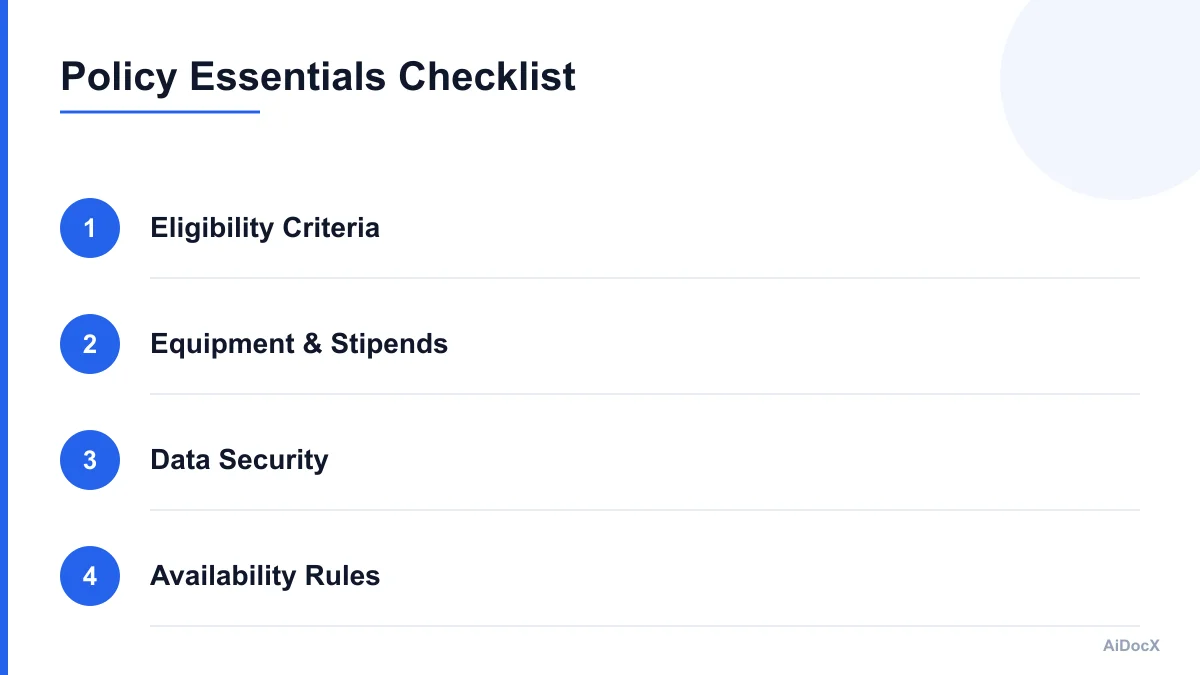
1. Eligibility and Classification
Define exactly who qualifies for remote work. Is it role-based (e.g., all marketing staff) or performance-based? Specify job titles, tenure requirements, and performance metrics. Crucially, clarify that remote work is a work arrangement, not a change in job classification. The employee remains an employee, not an independent contractor, unless explicitly structured otherwise.
2. Work Hours and Availability
Remote work does not mean "anytime, anywhere." Define core collaboration hours (e.g., 10 AM – 3 PM local time) where employees must be available for meetings and quick responses. Clarify time zone expectations for global teams. Address overtime: do remote employees track hours? If they are non-exempt, how will you ensure they are paid for all hours worked, especially in jurisdictions with strict overtime laws?
3. Equipment and Stipends
Who provides the laptop? Who pays for the internet? In 2026, tax implications for home office stipends have become more complex. Clearly state whether the company provides hardware, software, and security tools, or if you offer a monthly stipend for home office expenses. Specify the conditions for returning equipment upon termination.
4. Data Security and IT Requirements
This is your liability shield. Mandate the use of company-approved devices, VPNs, and multi-factor authentication (MFA). Prohibit the use of personal email or cloud storage for company data. Outline procedures for reporting security incidents. Include a clause that the company reserves the right to audit devices used for work, subject to local privacy laws.
5. Communication and Collaboration Standards
How should remote employees communicate? Define expectations for response times on Slack, email, and project management tools. Establish norms for video call etiquette (cameras on/off, mute policies). Clarify how decisions are documented to avoid "he said, she said" disputes later.
6. Performance Expectations and Reviews
Remote work shifts the focus from presence to output. Define measurable KPIs and deliverables. Explain how performance reviews will be conducted remotely. Address the frequency of check-ins and how feedback is given. This section ensures that remote employees are held to the same standards as in-office staff, just measured differently.
7. Health, Safety, and Workers' Compensation
This is a critical, often overlooked area. Clarify that the home office is not a company premises. Define what constitutes a "work-related injury" in a home setting. Require employees to maintain a safe workspace and report any hazards. Ensure your workers' compensation insurance explicitly covers remote employees, as some policies have specific exclusions for home-based injuries.
Common Mistakes to Avoid When Drafting Your Policy
Even well-intentioned business owners make errors that undermine their remote work policies. Avoid these common pitfalls:
- Over-Legalizing: While legal compliance is essential, a policy written solely by a lawyer may be unreadable. Use plain language. If an employee doesn't understand the policy, they can't follow it.
- Ignoring Local Laws: Remote work crosses jurisdictional lines. If an employee lives in California, works from home in Texas, and your company is in New York, you must comply with the labor laws of the employee's location. This includes minimum wage, overtime, and break requirements.
- Creating a Two-Tier System: If in-office employees get perks (e.g., free lunch, gym access) that remote employees cannot access, it creates resentment. Ensure equity in benefits, even if the delivery method differs.
- Failing to Update: A policy drafted in 2020 is obsolete in 2026. Regularly review and update your policy to reflect changes in technology, law, and business needs.
Legal Compliance and Jurisdictional Challenges
One of the most complex aspects of remote work in 2026 is navigating the patchwork of local labor laws. As a small business, you may not have a legal team to monitor every jurisdiction. Here’s how to stay compliant:
The "Nexus" Problem
Your company’s physical presence in one state doesn’t exempt you from the laws of the state where your remote employee resides. If an employee works from home in Illinois, you must comply with Illinois labor laws, even if your HQ is in Florida.
Payroll and Tax Implications
Remote employees may need to be registered in their state of residence for payroll tax purposes. This can create administrative burdens for small businesses. Consider using a professional employer organization (PEO) or automated payroll software that handles multi-state compliance.
Data Privacy Laws
With regulations like GDPR (Europe), CCPA/CPRA (California), and emerging state-level privacy laws in the US, data handling in remote settings is strictly regulated. Ensure your policy includes clauses about data minimization, employee consent, and right to be forgotten.
Pro Tip: Use a tool like AiDocX to generate a remote work policy that automatically adjusts for your specific business location and employee jurisdictions. It routes the final document to every employee for e-signed acknowledgment, creating a legally binding record of their acceptance.
Implementation and Enforcement Strategies
A policy on paper is worthless if not enforced. Here’s how to roll out your remote work policy effectively:
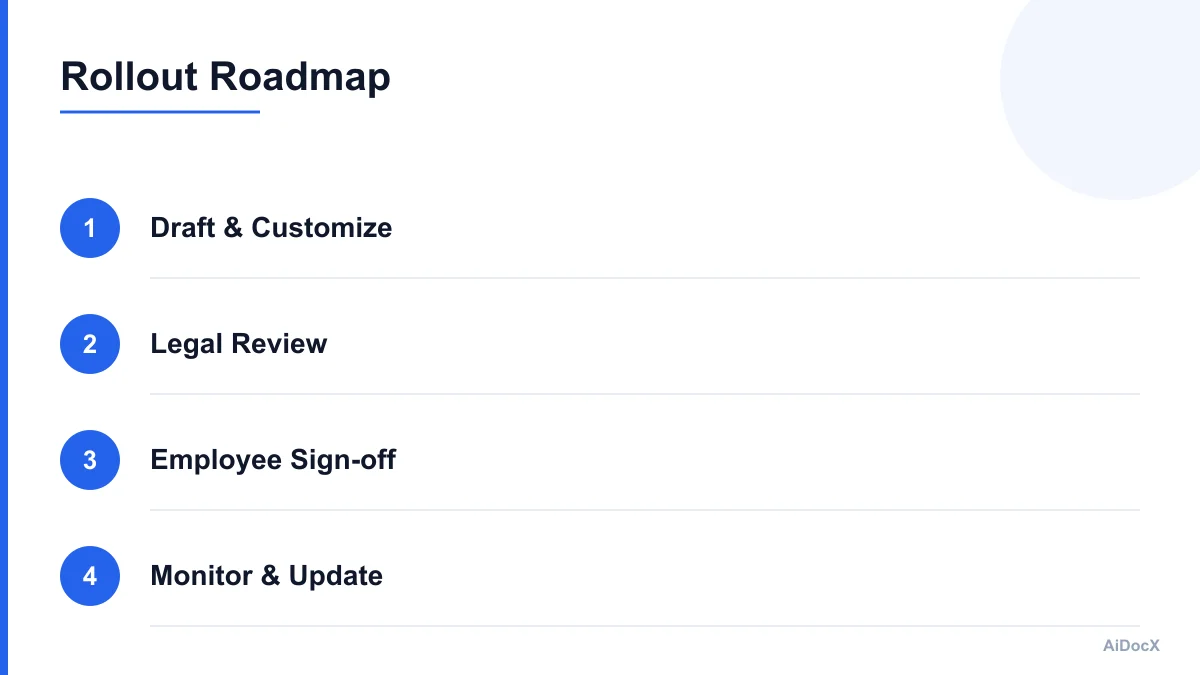
1. Draft and Customize
Start with a template, but customize it for your business. Include your specific tech stack, communication tools, and cultural norms. Have your legal counsel review it for compliance.
2. Communicate the "Why"
Don’t just send an email with an attachment. Hold a town hall meeting or team webinar to explain the rationale behind the policy. Emphasize that it’s designed to support flexibility while maintaining fairness and security.
3. Train Managers
Managers are the frontline of enforcement. Train them on how to manage remote teams, recognize signs of burnout, and handle policy violations. They need to be equipped to enforce the policy consistently.
4. Get Signed Acknowledgment
Every employee must sign the policy. This creates a clear record that they understand and agree to the terms. Use digital signature platforms for efficiency and audit trails.
5. Monitor and Iterate
Remote work is evolving. Collect feedback from employees and managers quarterly. Are there gaps in the policy? Is the equipment stipend sufficient? Adjust the policy as needed to keep it relevant and effective.
The Role of Technology in Policy Management
Technology is both the enabler of remote work and the tool for managing it. Your policy should reference the specific technologies your business uses.
Access Management
Implement role-based access controls. Remote employees should only have access to the data and systems necessary for their role. Regularly review and revoke access for former employees.
Monitoring Software
Be transparent about any employee monitoring. If you use software to track activity, productivity, or keystrokes, disclose this in the policy. Many jurisdictions require explicit consent for monitoring. Frame it as a tool for support and productivity, not surveillance.
Document Collaboration
Use cloud-based document management systems (like Google Workspace or Microsoft 365) to ensure version control and security. Your policy should mandate that all work documents are stored in approved cloud locations, not on local hard drives or personal email.
Checklist: Finalizing Your Remote Work Policy
Before publishing your policy, run through this final checklist to ensure completeness and clarity:
- Eligibility: Clearly defined job titles and performance criteria for remote work.
- Hours: Specified core collaboration hours and time zone expectations.
- Equipment: Detailed list of provided hardware, software, and stipends.
- Security: Mandatory use of VPN, MFA, and approved devices.
- Communication: Defined norms for response times and virtual meetings.
- Performance: Measurable KPIs and remote review process outlined.
- Legal: Compliance with local labor laws and data privacy regulations confirmed.
- Acknowledgment: Process for employee e-signature and record-keeping established.
Conclusion: Clarity Builds Trust
A well-drafted remote work policy is not about restricting freedom; it’s about enabling it safely. By clearly defining expectations, responsibilities, and boundaries, you create an environment where remote employees can thrive and where the business can operate without legal or operational friction.
In 2026, the difference between a successful remote culture and a chaotic one often comes down to documentation. Don’t leave your remote work structure to chance. Take the time to draft a comprehensive, compliant policy, and use tools like AiDocX to streamline the creation and acknowledgment process. Your employees will appreciate the clarity, and your business will benefit from the reduced risk and increased productivity.
Start drafting your policy today. Clear expectations lead to better performance, fewer disputes, and a more resilient business.
Ready to automate your documents with AI?
Start free with AiDocX — AI contract drafting, meeting minutes, consultation notes, e-signatures, and more in one platform.
Get Started FreeMore from AiDocX Blog

AI Press Release Generator: Write One in Minutes (+ Template)
Learn what a press release is, the AP-style format, and how to use an AI press release generator to draft one in minutes with a fill-in template.
James September 21, 2026 10 min
Angel Investment Agreement (2026): Key Terms + Template Guide
Angel investor agreement explained: the four structures founders actually sign, key terms, securities basics, a closing checklist and a summary term sheet.
James September 21, 2026 12 min
Artist Commission Contract Template (2026): Free Template + Guide
Free artist commission contract template with license tiers, deposit, revision, refund and AI-training clauses, plus a guide to getting it e-signed.
James September 21, 2026 12 min