Free Rental Agreement Template for Landlords in 2026
Use this free rental agreement template to cover essential lease clauses, understand residential and commercial differences, and complete every section correctly.
 James · Content Manager August 21, 2026 15 min read
Free Rental Agreement Template for Landlords in 2026
A written rental agreement protects both the landlord and tenant by recording the terms of the tenancy in one place. This guide explains what to include in a free lease agreement template, how residential and commercial leases differ, and how to complete each section accurately. Use it as a practical starting point, then check your local landlord-tenant laws before signing.
What a Rental Agreement Does
A rental agreement, lease agreement, or tenancy agreement sets out the legal relationship between a property owner and the person or business renting the property. It answers basic questions before they become disputes: Who may occupy the property? How much is rent? When is it due? Who handles repairs? What happens if either party wants to end the arrangement?
The document is useful even when the landlord knows the tenant personally. Verbal agreements and informal text messages can leave important details unclear. A written agreement gives both sides a shared reference and creates a record of what they accepted.
A lease usually refers to a fixed-term arrangement, such as 12 months. A rental agreement can also describe a month-to-month tenancy that renews automatically until one party gives proper notice. The exact distinction varies by jurisdiction, so use the terms your local law recognizes.
A complete agreement should be:
- Specific enough to avoid conflicting interpretations
- Consistent with local housing and contract laws
- Clear about money, deadlines, access, and responsibilities
- Signed by every required party
- Stored securely so it can be retrieved later
A template is a starting point, not a substitute for legal advice. Do not copy a clause that conflicts with mandatory local rules, even if it appears in a commonly used form. Some jurisdictions limit deposits, regulate late fees, require disclosures, or prohibit particular termination and waiver clauses.
What to Include in a Rental Agreement
A strong rental agreement covers the full life of the tenancy, from move-in to move-out. The following clauses are the core of most landlord-tenant agreements.
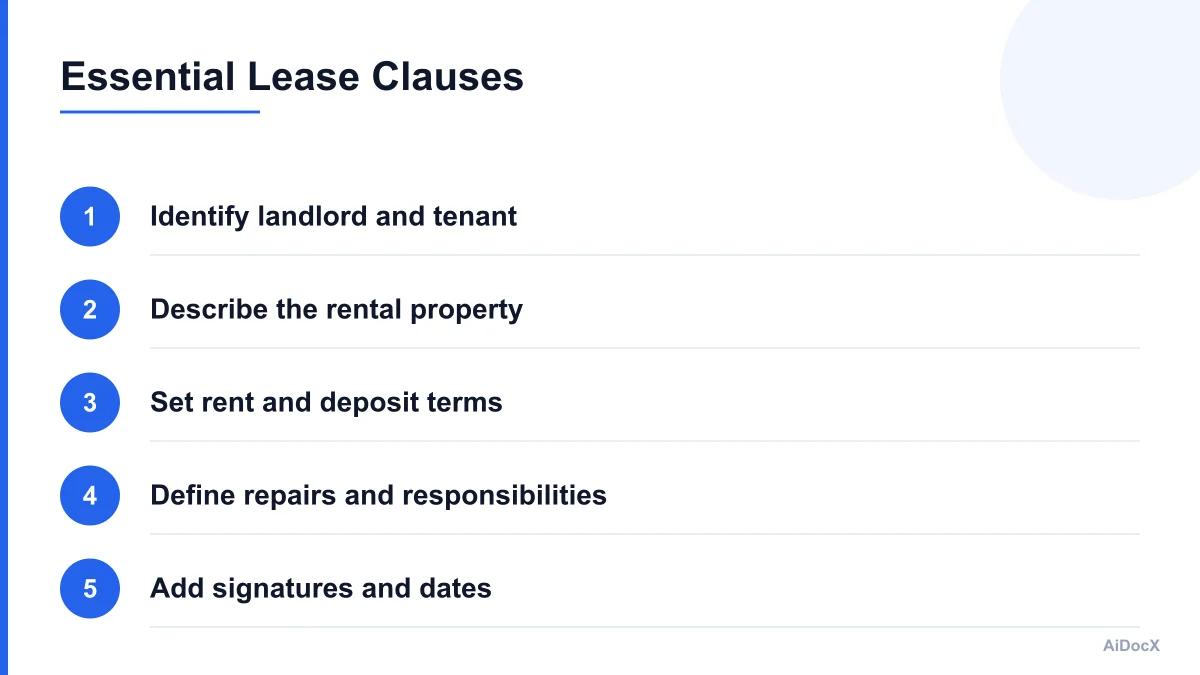
1. Names and contact information
List the legal names of the landlord, property owner, management company, and every adult tenant. If a property manager signs on the owner's behalf, identify the management company and its authority.
Include mailing addresses, email addresses, and phone numbers for notices and routine communication. If local law requires a physical address for formal notices, provide it even if the parties normally communicate electronically.
For a business tenant, use the exact registered business name and identify the individual authorized to sign. Avoid relying only on a brand name or trading name.
2. Property description
Describe the premises precisely enough that someone can identify what is being rented. Include:
- Full street address
- Unit or apartment number
- Parking spaces, storage areas, or other included areas
- Appliances or furniture included with the rental
- Shared facilities the tenant may use
- Areas excluded from the tenancy
For a single-family home, state whether the yard, garage, basement, attic, or exterior storage is included. For an apartment, identify the unit and any assigned parking or storage. If the tenant may use common areas, describe the rules separately or attach building regulations.
3. Term and possession
State the start date and end date for a fixed-term lease. Explain when the tenant may receive keys and take possession. If the property is not available on the promised date, identify the parties' rights and the process for rescheduling possession.
For a month-to-month agreement, state the beginning date and the notice period required to end the tenancy. Do not assume a notice period is valid merely because both sides write it into the contract; local law may impose a minimum.
Address renewal clearly. You might say that the agreement ends on a stated date unless the parties sign a renewal, or that it converts to month-to-month subject to applicable law. If rent may change at renewal, explain how and when notice will be provided.
4. Rent and payment terms
State the exact rent, payment frequency, due date, payment method, and delivery instructions. Clarify whether rent must be received by the due date or merely sent by that date, if local law permits that distinction.
Also explain:
- Accepted payment methods
- Online payment or processing fees
- Prorated rent for a partial first month
- Returned-payment charges
- Late fees and any grace period
- How rent changes will be communicated
Every fee should be lawful, clearly described, and tied to an actual permitted charge. Avoid vague language such as "reasonable administrative fees" without defining when the fee applies and how it is calculated.
If utilities or services are included in rent, list them. If the tenant pays utilities directly, identify which ones. If the landlord bills the tenant for shared utilities, explain the allocation method, billing timing, and access to supporting information.
5. Security deposit and other deposits
State the security deposit amount, the date it is due, where required disclosures or receipts will be provided, and the conditions under which deductions may be made. The agreement should not promise deductions that local law prohibits.
Explain the move-out process, including:
- Cleaning expectations
- Return of keys, remotes, and access cards
- Forwarding-address requirements
- Inspection procedures
- Itemized deduction statements
- Deposit-return timing
If there are separate pet, key, parking, or utility deposits, identify each one and explain whether it is refundable. Do not label a nonrefundable charge as a deposit if local law treats deposits differently.
6. Occupancy and use
Name the approved occupants and state whether additional occupants require written consent. Distinguish between occupants, authorized guests, and tenants. A tenant's partner, child, employee, or caregiver may have different rights depending on local law.
Describe permitted use of the property. A residential tenant may use a home as a private residence, while a commercial tenant may be limited to a particular business activity. Prohibit unlawful activity and address nuisance, excessive noise, hazardous materials, or conduct that materially damages the property.
If you allow home offices, short-term guests, pets, smoking, or subletting, say so directly. Silence can create disagreement later.
7. Repairs, maintenance, and alterations
Explain how tenants report maintenance problems and how emergency repairs should be handled. Identify routine responsibilities without shifting duties that the law places on the landlord.
Typical provisions cover:
- Changing light bulbs and air filters
- Maintaining appliances supplied by the landlord
- Lawn care, snow removal, and pest reporting
- Preventing frozen pipes or water damage
- Repairing tenant-caused damage
- Requesting permission for painting or alterations
Do not use a blanket clause making the tenant responsible for every repair. Landlords generally retain legal duties relating to habitability, safety, structural systems, and essential services. A clear agreement assigns routine tasks while preserving those mandatory obligations.
8. Entry and inspections
State when the landlord may enter the property, how much advance notice is normally required, and when entry without advance notice may be allowed. Common examples include emergencies, suspected abandonment, necessary repairs, inspections, and showings to prospective tenants or buyers.
The clause should respect privacy and local notice requirements. Avoid language giving unlimited access at any time. A landlord who needs to inspect regularly should describe a reasonable scheduling process.
9. Rules, insurance, and disclosures
Attach building rules, parking policies, pet rules, or community regulations when they form part of the agreement. State how future rule changes will be delivered and whether a rule may materially change the bargain.
You may ask tenants to maintain renters insurance where permitted. If so, specify the required coverage, proof of insurance, and whether the landlord's insurance covers the tenant's belongings. Do not imply that the landlord's policy protects personal property if it does not.
Include all required disclosures. Depending on the property and location, these may concern lead-based paint, mold, flood risk, shared utilities, bedbugs, asbestos, registered offenders, or other hazards. Required disclosures often belong in an attachment rather than a general clause.
10. Breach, termination, and dispute procedures
Explain what happens when rent is unpaid, the tenant violates a material term, or the landlord fails to perform a required obligation. The agreement should refer to the notices and remedies allowed by law rather than attempting to create automatic penalties.
Cover early termination, military or statutory termination rights, abandonment, death of a tenant, renewal, and holdover occupancy where relevant. State that formal eviction or recovery of possession must follow the legal process. A contract should not authorize self-help actions such as changing locks, shutting off utilities, or removing belongings without lawful authority.
End with signature blocks for every landlord, owner representative, tenant, and guarantor who must sign. Include printed names, dates, and any required witness or notary information.
Residential vs. Commercial Lease Agreements
Residential and commercial leases share a basic structure, but the risk allocation and level of detail can be very different.
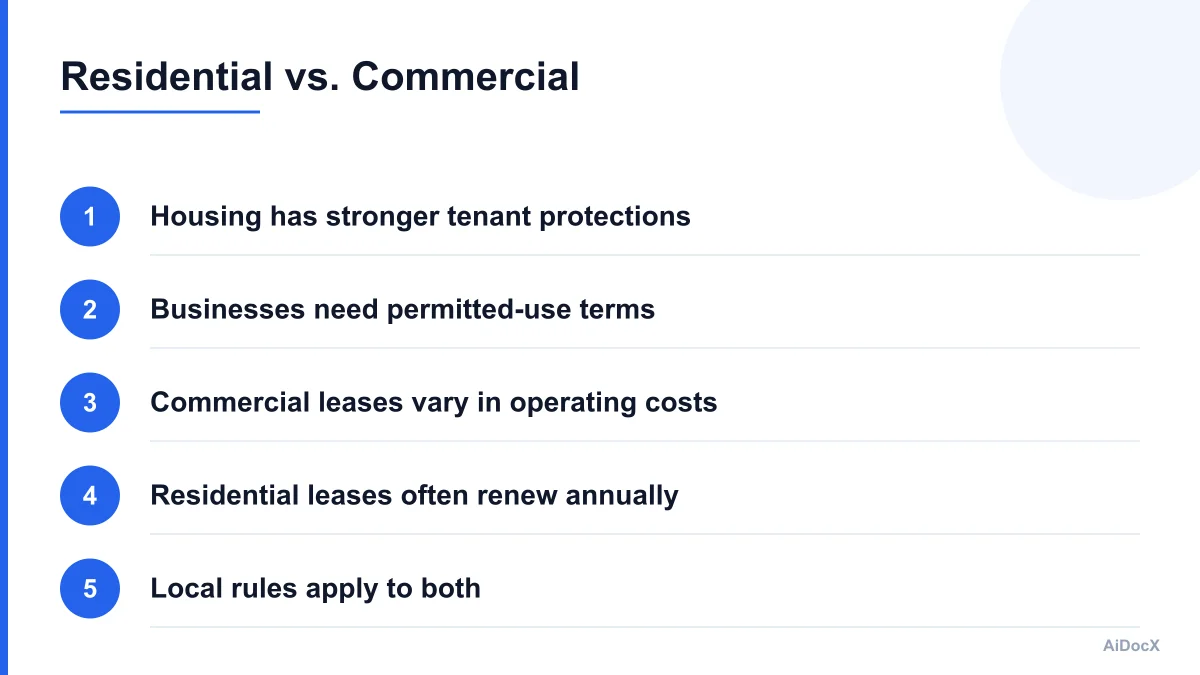
A residential lease concerns a person's home. Housing laws often provide stronger mandatory protections, habitability standards, notice requirements, deposit limits, anti-discrimination rules, and restrictions on waivers. A landlord cannot assume that a tenant has freely negotiated away these protections.
A commercial lease concerns premises used for a business. The tenant may negotiate more terms, but commercial agreements are often longer and more technical. The parties may need to address operating expenses, business hours, signage, insurance, construction, compliance, exclusivity, and assignment.
| Topic | Residential lease | Commercial lease |
|---|---|---|
| Main use | Home or household living | Business or commercial activity |
| Rent structure | Usually a stated monthly amount | Base rent plus possible operating costs |
| Repairs | Landlord retains many legal duties | Responsibilities are heavily negotiated |
| Use clause | Residential occupancy and guests | Specific permitted business use |
| Insurance | Often renters insurance | Liability, property, and business coverage |
| Alterations | Usually limited and approval-based | Build-outs and improvements may be extensive |
| Term | Often one year or month-to-month | Frequently multi-year with options |
| Regulation | Strong tenant-protection framework | Contract and commercial-law rules vary |
Key residential differences
For a residential property, identify every permitted occupant and disclose material property conditions. Make the rent, deposit, utilities, repairs, entry, and termination terms easy to understand. Avoid clauses that attempt to waive habitability, privacy, anti-discrimination, or other mandatory rights.
Pet rules deserve special care. A standard "no pets" clause may not apply to legally protected assistance animals. Use neutral language and follow the applicable accommodation process.
Key commercial differences
For commercial property, define the permitted use narrowly enough to protect the building but broadly enough for the tenant's actual business. A restaurant, warehouse, professional office, and retail store may have very different needs.
Decide whether the lease is:
- Gross: the tenant pays stated rent and the landlord covers listed operating costs
- Net: the tenant pays rent plus some property expenses
- Triple-net: the tenant commonly pays taxes, insurance, and maintenance in addition to rent
- Percentage rent: the tenant pays base rent plus a share of sales, often in retail
Commercial leases should also address signage, zoning, licenses, hazardous materials, delivery access, customer parking, security, construction approvals, restoration at the end of the term, and assignment or subletting. If the business depends on a particular use, confirm zoning and permits before signing.
Do not use a residential template for commercial premises without substantial revision. Likewise, a detailed commercial form can introduce unnecessary complexity and inappropriate terms for a simple residential tenancy.
How to Fill Out the Template Correctly
A template is only useful if its blanks are completed consistently. Work through it in a fixed order and verify each figure against your records.
Step 1: Confirm the parties
Write legal names exactly as they appear on identification, business registration documents, or ownership records. If there are co-tenants, list each one. Decide whether each adult is a tenant with contractual responsibility or merely an authorized occupant.
If a guarantor is required, use a separate guaranty or a clearly drafted section that explains the guarantor's obligations, duration, and notice rights.
Step 2: Confirm the property and included items
Walk through the property with the template. Record the unit, parking space, storage area, appliances, furnishings, keys, remotes, and access cards. Attach an inventory or move-in condition report where appropriate.
Photographs with dates can support the condition report, but photographs do not replace a written description. Note existing stains, scratches, damaged fixtures, missing items, and known defects before possession.
Step 3: Calculate the money
Write the monthly rent in numbers and words where the form allows. Calculate prorated rent using a stated method, such as the daily rate multiplied by the number of days from possession through the end of the month.
List every required payment separately:
- First month's rent
- Prorated rent
- Security deposit
- Pet deposit or fee
- Parking fee
- Utility deposit
- Application or administrative charge, if lawful
Check the total amount due at signing. A tenant should not have to guess whether a listed fee is included in the total.
Step 4: Set dates and notice periods
Verify the start date, end date, rent due date, renewal date, inspection date, and deposit-return deadline. Use actual calendar dates instead of phrases such as "at the beginning of next month."
Confirm notice periods against current local law. If a statutory notice period overrides the contract, the agreement should acknowledge that applicable law controls.
Step 5: Complete operational rules
Decide how maintenance requests are made, where rent is paid, who handles lawn care, whether pets are allowed, and how guests or subletting are handled. Make the agreement match the actual arrangement. Do not include a rule you do not intend to enforce consistently.
If the property is managed by someone else, identify the manager and provide a reliable contact method for emergencies and routine requests.
Step 6: Add attachments and disclosures
Number every attachment and refer to it in the agreement. Examples include:
- Move-in condition report
- Building or homeowners association rules
- Pet addendum
- Parking addendum
- Lead-based paint disclosure
- Utility allocation schedule
- Commercial work letter
- Guaranty
- Furniture inventory
Make sure the tenant receives every attachment before signing. If an attachment is incorporated by reference but never delivered, it may create confusion about what the tenant actually accepted.
Step 7: Review for contradictions
Read the document as if you were a tenant trying to determine what to pay and what to do. Check for contradictions such as:
- One rent amount in the summary and another in the payment clause
- Different start dates in different sections
- A pet addendum that conflicts with the main agreement
- A notice address that does not match the landlord's actual address
- A utility clause that does not identify who pays the bill
- A renewal clause that conflicts with the stated end date
Cross out unused options or mark them "not applicable." Never leave alternative clauses selected in a way that could be interpreted as both applying.
Step 8: Sign and deliver complete copies
Every required party should sign and date the same final version. Electronic signatures can be valid where permitted, but use a system that records the signer, time, document version, and completion history.
Give the tenant a complete copy, including attachments, before or at possession. Store the signed agreement, payment records, inspection report, notices, and repair communications together.
AiDocX's AI document generator can help turn the agreed details into a structured lease, and its e-signature workflow can help the parties complete signing without printing multiple copies. Review the generated document carefully before sending it.
Common Landlord Mistakes to Avoid
Even a well-designed template can cause problems when used carelessly.
Using a generic form without checking local law
A form downloaded from another state, country, or city may contain incorrect notice periods, deposit rules, disclosures, or terminology. Start with a form appropriate to the property's jurisdiction.
Leaving blanks or using vague terms
Blank spaces can create uncertainty and may be completed later without the other party's knowledge. Fill every applicable field and mark unused fields clearly. Replace "reasonable notice" with the notice period required by law or the agreed scheduling procedure.
Making side agreements verbally
If you promise new appliances, free parking, a rent concession, or a repair, record it in writing. An email or signed addendum is better than relying on memory.
Charging illegal or unclear fees
Late fees, application charges, inspection fees, and cleaning charges may be regulated. Confirm that each charge is allowed, explain when it applies, and avoid disguising penalties as deposits.
Ignoring occupants and subtenants
A lease that names one tenant but informally permits several other occupants can create insurance, safety, and enforcement issues. Require written approval where appropriate and follow laws governing occupancy and protected household members.
Overreaching on repairs and entry
The landlord should not transfer every maintenance obligation to the tenant or reserve unlimited access. Clauses that conflict with habitability or privacy rights may be unenforceable and can damage the landlord's position in a dispute.
Failing to document condition
A deposit dispute is harder to resolve without a move-in report, photographs, receipts, and dated communications. Complete the inspection together and have both parties sign or acknowledge it.
Treating e-signatures as an afterthought
Do not send different versions to different parties or allow someone to sign an incomplete document. Use a final locked version and keep the completion certificate with the signed agreement.
A Practical Lease-Preparation Checklist
Use this checklist before delivering the agreement for signature:
- Correct legal names are listed
- Property address and unit are accurate
- Included parking, storage, appliances, and furniture are identified
- Start date, end date, and possession date are clear
- Rent, due date, payment method, and late terms are stated
- Security deposit complies with local limits and deadlines
- Utilities and services are assigned clearly
- Occupants, guests, pets, and subletting rules are addressed
- Repair and maintenance responsibilities are practical and lawful
- Entry and inspection rules follow local notice requirements
- Required disclosures and addenda are attached
- Early termination and renewal terms are understandable
- No conflicting blanks or alternative clauses remain
- All required parties sign and date the same version
- Each party receives the complete signed agreement
Hiring someone else to run the property day to day? Our property management agreement template covers fees, trust accounts and repair authority.
Final Review Before the Tenant Moves In
The best time to resolve uncertainty is before signing, not after the first missed payment or repair request. Set aside enough time to review the agreement with the tenant, answer questions, and correct details while changes are still easy.
For a residential property, pay particular attention to habitability, deposits, entry, disclosures, assistance animals, and legally required notices. For commercial premises, focus on permitted use, operating expenses, insurance, repairs, alterations, signage, assignment, and restoration.
A free rental agreement template gives independent landlords a repeatable foundation, but the final document should reflect the actual property and comply with the law where it is located. Once the terms are accurate, keep the signed agreement and supporting records together throughout the tenancy.
Ready to automate your documents with AI?
Start free with AiDocX — AI contract drafting, meeting minutes, consultation notes, e-signatures, and more in one platform.
Get Started FreeMore from AiDocX Blog

How to Read a Business Contract: A Founder's Checklist (2026)
A practical way to review parties, scope, money, IP, liability, and exit terms before signing a business contract.
 MinjiLee October 7, 2026 9 min
ESIGN vs eIDAS: What Founders Should Know About E-Signatures (2026)
What U.S. ESIGN and EU eIDAS actually say, where exceptions apply, and what founders should keep to document an electronic signing.
MinjiLee October 7, 2026 7 min
Does Document Automation Pay Off? An ROI Worksheet for Founders (2026)
Estimate document automation ROI with your own volume, time, labor, and software costs. Includes a clearly labeled example and break-even formula.
 Chloe October 7, 2026 8 min