RFP Response Template 2026: Win Contracts as a Small Business
Master the 2026 RFP response template. Learn how small agencies structure winning proposals, avoid common pitfalls, and secure contracts with clear, concise pitches.
 James · Content Manager August 8, 2026 10 min read
RFP Response Template 2026: How Small Businesses Write a Proposal That Actually Wins the Contract
Responding to a Request for Proposal (RFP) is often the most stressful part of a small business owner’s sales cycle. You have the expertise, you have the portfolio, but when faced with a blank page or a rigid template, the magic often disappears. In 2026, procurement processes have become faster and more data-driven. Clients no longer have time to sift through vague promises or decorative fluff. They want clarity, specificity, and proof that you understand their unique pain points.
For small agencies and service businesses, the RFP is not just a formality; it is a critical inflection point. A poorly structured proposal can cost you a six-figure contract, while a well-crafted one can establish you as a strategic partner rather than just a vendor. This guide provides a comprehensive, actionable framework for writing an RFP response that stands out in 2026. We will break down the essential structure, highlight common pitfalls, and offer practical steps to turn your rough pitch into a polished, winning document.
The Shift in RFP Evaluation in 2026
Before diving into the template, it is crucial to understand how the landscape has changed. In previous years, RFP responses were often static PDFs that sat in an inbox for weeks. Today, the evaluation process is increasingly digital, tracked, and comparative. Procurement teams are using software to aggregate responses, score them against weighted criteria, and compare them side-by-side.
This shift means that readability and structure are no longer optional; they are strategic necessities. If a client cannot find your answer to a specific requirement within ten seconds, they may assume you do not understand the requirement. Furthermore, the volume of RFPs has increased, meaning decision-makers are scanning, not reading. Your proposal must be scannable, visually clean, and logically ordered. The goal is to reduce cognitive load for the evaluator. By making it easy for them to say "yes," you significantly increase your win rate.
The Anatomy of a Winning RFP Response
A winning RFP response is not a creative writing exercise; it is a structured argument. It follows a logical flow that mirrors the client’s decision-making process. While every RFP will have specific requirements, the core anatomy of a high-converting proposal remains consistent. Below is the standard structure that successful small businesses use to organize their thoughts and present their value proposition effectively.
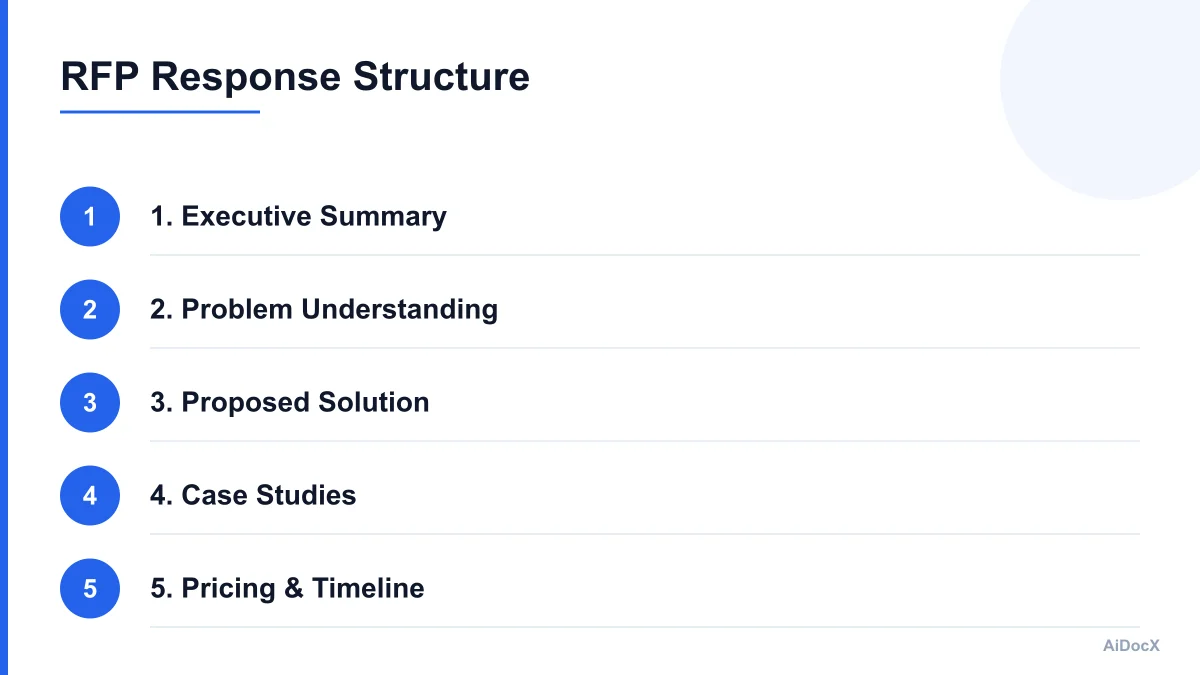
1. Executive Summary
This is the most important section of your entire document. Many busy executives will only read this page. It must capture the essence of your proposal, summarize the client’s problem, and state clearly why you are the best solution. Do not waste this space on company history or generic praise. Focus on the outcome. For example, "We will reduce your customer churn by 15% within six months through our targeted retention strategy."
2. Problem Understanding and Discovery
Demonstrate that you have listened. Reiterate the client’s pain points in your own words. Show that you understand the context, the stakes, and the underlying business drivers. This section builds trust and proves that your solution is tailored to them, not a generic package you sell to everyone.
3. Proposed Solution and Methodology
This is where you detail how you will solve the problem. Break down your approach into clear phases. Use bullet points and numbered lists to make the process easy to follow. Avoid jargon. Explain your methodology in plain language, focusing on deliverables and timelines.
4. Case Studies and Relevant Experience
Proof is persuasive. Include two to three case studies that are directly relevant to the client’s industry or problem. Use the STAR method (Situation, Task, Action, Result) to structure these stories. Highlight specific metrics and outcomes. If you have worked with a competitor or a similar-sized company, emphasize that experience.
5. Team and Key Personnel
Clients buy from people, not logos. Introduce the team members who will actually work on the account. Include brief bios, photos, and relevant experience. If you are a small business, highlight your direct access to senior leadership. Emphasize that the people you pitch are the people who will deliver.
6. Pricing and Commercials
Be transparent and clear. Avoid hidden fees. Structure your pricing in a way that aligns with the value you provide. If the RFP requires a specific format, follow it exactly. If not, consider offering tiered options (e.g., Basic, Standard, Premium) to give the client a sense of control and choice.
7. Terms and Conditions / Next Steps
Include a clear call to action. What do you want the client to do next? Schedule a demo? Sign the agreement? Also, include a brief section on terms, such as payment schedules and timelines, to show professionalism and preparedness.
Step-by-Step Guide to Drafting Your Proposal
Writing the proposal is a process, not an event. Rushing through it leads to errors and missed opportunities. Here is a step-by-step approach to drafting a proposal that wins.
Step 1: Deconstruct the RFP
Before you write a single word, break down the RFP document. Create a spreadsheet or a checklist with every requirement, question, and constraint listed. Assign each item to a team member or note where the answer will be found. This ensures you do not miss any mandatory criteria, which can lead to immediate disqualification.
Step 2: Gather Your Assets
Collect your existing case studies, team bios, and portfolio pieces. Update them if necessary. Ensure you have the latest pricing data and availability schedules. Do not wait until you are writing to gather these; have them ready to plug in.
Step 3: Draft the Content
Start with the sections you are most confident in. This builds momentum. Write the problem understanding section first to ensure you are aligned with the client’s needs. Then, move to the solution and methodology. Keep the language concise and active. Use "we will" instead of "we hope to."
Step 4: Design and Formatting
A messy proposal looks like a messy service. Use a clean, professional template. Incorporate your brand colors and fonts consistently. Use headers, subheaders, and white space to break up text. Add visuals, such as charts or diagrams, to explain complex processes. Ensure the document is mobile-friendly, as evaluators may read it on tablets or phones.
Step 5: Review and Refine
Proofread extensively. Check for consistency in tone, formatting, and pricing. Have someone who has not seen the RFP read the proposal. If they can understand your solution and why you are the best choice, you are on the right track. Also, verify that all mandatory requirements have been met.
Leveraging Technology to Streamline the Process
In 2026, efficiency is a competitive advantage. Small businesses often lack the resources of large agencies, but they can use technology to level the playing field. Manual proposal creation is time-consuming and prone to errors. Using the right tools can transform a rough pitch into a polished, on-brand proposal document in minutes.
Platforms like AiDocX can automate the structuring and formatting of your proposals. Instead of starting from a blank page, you can input your key points, and the tool generates a professional layout. More importantly, these platforms offer analytics. You can see exactly when and how long the client reviewed your proposal. This data is invaluable. It tells you if the client is struggling with a specific section, if they skipped your pricing, or if they are taking too long to decide. With this insight, follow-up timing stops being a guess. You can reach out at the perfect moment, perhaps after they have spent significant time reviewing your case studies, reinforcing your value proposition.
Common Mistakes That Lose You the Contract
Even experienced businesses make mistakes in their RFP responses. Being aware of these pitfalls can help you avoid them.
Ignoring the Requirements
The most common mistake is failing to follow the RFP instructions. If the RFP asks for a specific font size, page limit, or file format, you must follow it. Deviations can be seen as a lack of attention to detail or a disregard for the client’s process.
Generic Pitches
Using the same proposal for every client is a surefire way to lose. Clients can spot a copy-paste job from a mile away. Tailor your language, examples, and solutions to the specific client. Mention their company name, their industry challenges, and their specific goals.
Poor Formatting and Design
A wall of text is intimidating. Use headings, bullet points, and visuals to make the document scannable. Ensure there are no typos or grammatical errors. A sloppy document suggests a sloppy service.
Late Submission
Submitting on time is not just about being punctual; it is about respect. Late submissions are often disqualified or viewed negatively. Plan for technical issues and submit early.
No Clear Call to Action
End your proposal with a clear next step. Do not leave the client wondering what to do. Provide a link to schedule a call, a signature block, or a request for feedback. Make it easy for them to move forward.
The Importance of Follow-Up and Analytics
Sending the proposal is not the end of the process; it is the beginning of the negotiation. Follow-up is critical, but it must be strategic. Instead of sending a generic "checking in" email, use the data from your proposal platform to guide your communication.
If you see that the client has opened your proposal but not clicked on the pricing section, your follow-up should address pricing concerns. If they have spent a lot of time on your case studies, your follow-up should highlight similar success stories. This personalized approach demonstrates that you are attentive and responsive.
Furthermore, the analytics provided by tools like AiDocX allow you to optimize your future proposals. If you notice that clients consistently skip the "Team" section, you might consider shortening it. If they engage deeply with the "Methodology" section, you might expand on that. Over time, this data-driven approach refines your sales process and increases your win rate.
Checklist for Your Next RFP Response
Before you submit your next proposal, run through this checklist to ensure you have covered all bases.
- Have you addressed every requirement in the RFP?
- Is the executive summary clear, concise, and compelling?
- Have you tailored the content to the specific client?
- Is the formatting clean, professional, and scannable?
- Are all case studies relevant and results-oriented?
- Is the pricing transparent and aligned with the value?
- Have you proofread for typos and errors?
- Is there a clear call to action and next steps?
- Have you submitted the file in the correct format?
- Have you set up analytics to track client engagement?
Conclusion
Writing a winning RFP response is a skill that can be learned and refined. It requires a shift from thinking like a vendor to thinking like a partner. By structuring your proposal clearly, tailoring your content, and leveraging technology to enhance your process, you can stand out in a crowded market. Remember, the goal is not just to win the contract, but to demonstrate that you are the best choice to deliver value.
In 2026, the businesses that win are not necessarily the largest; they are the most responsive, the most clear, and the most prepared. Start using a structured template today. Consider tools that not only help you create polished documents but also provide insights into how your clients interact with them. This combination of strategic writing and data-driven follow-up will transform your proposal process from a guessing game into a predictable revenue driver.
Take the time to craft your next proposal with care. The right words, in the right structure, delivered at the right time, can make all the difference. Your next big contract is waiting.
Most tenders also ask for a company profile; our company profile template shows what to include.
Ready to automate your documents with AI?
Start free with AiDocX — AI contract drafting, meeting minutes, consultation notes, e-signatures, and more in one platform.
Get Started FreeMore from AiDocX Blog
Affiliate Agreement Template (2026): Protect Your Business When Paying Commissions
Free affiliate agreement template for 2026: key clauses, FTC disclosure requirements, affiliate vs referral agreement compared, a worked example, and a copy-paste version.
James September 22, 2026 11 min
AI Receipt Generator (2026): Create Professional Payment Receipts in Seconds
Generate professional payment receipts with AI in seconds. Receipt vs invoice vs credit note explained, the fields to include, a worked example, and a copy-paste template.
James September 22, 2026 9 min
Bill of Sale Template (2026): Free Generator for Cars, Trailers & Personal Property
Free bill of sale template for 2026: the fields to include, state notarization rules, federal odometer disclosure, a worked example, and a copy-paste version.
James September 22, 2026 10 min