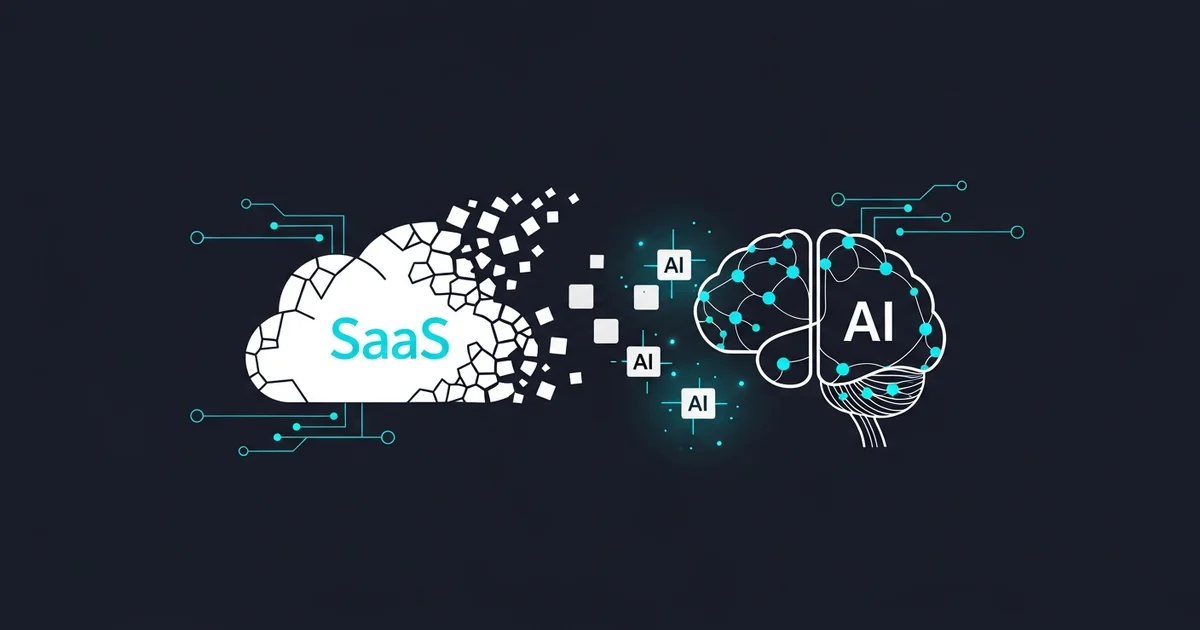
The SaaSpocalypse Is Here — How AI Is Reshaping Enterprise Software
AI coding agents are shaking the SaaS industry to its core. We break down why $1 trillion in market value vanished, what investors no longer fund, and what it takes for software to survive the AI era.
 MinjiLee · Strategic Lead March 2, 2026 8 min read
TL;DR: AI coding agents are triggering a structural shift in the SaaS industry. In February 2026 alone, roughly $1 trillion in market value evaporated from software stocks. VCs have stopped funding "easily replicable" software. The survivors will be those with deep domain expertise, proprietary data, and tight integration into mission-critical workflows.
Not long ago, a startup founder texted his investor with an update: he was replacing his entire customer service team with an AI coding agent. To the investor, the message signaled something bigger — the moment when companies like Salesforce stopped being the automatic default.
In early 2026, one of the hottest buzzwords in Silicon Valley is SaaSpocalypse — the idea that AI is bringing about the end of SaaS as we know it. Is it overblown fear, or is the enterprise software landscape genuinely shifting beneath our feet?
Build vs. Buy — The Balance Has Flipped
The cost of building software has dropped dramatically. Thanks to AI coding agents like Claude Code and OpenAI Codex, what once took months of development can now be done in days.
Aaron Holiday, managing partner at 645 Ventures, puts it bluntly:
"The barriers to entry for creating software are so low now thanks to coding agents, that the build versus buy decision is shifting toward build in so many cases."
Klarna set the precedent in late 2024 by ditching Salesforce's CRM in favor of its own AI-powered system. More companies are following suit. And even when they don't actually build their own alternative, the mere possibility creates downward pressure on SaaS contracts during renewals.
The Market's Verdict: $1 Trillion Gone
Markets have already reacted — harshly.
- Early February 2026: Roughly $1 trillion wiped from software and services stocks
- Anthropic launches Claude Code for cybersecurity → security SaaS stocks drop
- Anthropic releases legal tools → software ETFs including LegalZoom and RELX decline
- Salesforce, Workday and other SaaS blue chips in sustained decline
Abdul Abdirahman, an investor at F-Prime, offered a sobering analysis:
"This may be the first time in history that the terminal value of software is being fundamentally questioned."
No one can guarantee that people will use SaaS products to the same extent in one year, let alone five. That's why every new AI tool launch sends tremors through SaaS stocks.
The Death of Per-Seat Pricing
The cornerstone SaaS business model — per-seat pricing — is crumbling.
The old model: 100 employees use Salesforce, you pay for 100 seats. But when 3-4 AI agents can do that work, employees simply ask their preferred AI to pull the data. The per-seat model no longer makes sense.
New pricing models are emerging:
- Consumption-based: Pay by AI usage (tokens)
- Outcome-based: Pay based on what the AI actually achieves
Bret Taylor, former Salesforce CEO, built Sierra on an outcome-based model. It hit $100 million in annual recurring revenue in under two years.
What Investors No Longer Fund
VC investment criteria have shifted rapidly. The categories that no longer attract capital are clear.
No longer investable:
- Thin workflow layers — easily replaced by AI agents
- Generic horizontal tools — project management, basic CRM clones
- Products differentiated only by UI and automation — barriers to entry have collapsed
- Vertical SaaS without proprietary data moats — anyone can replicate them
- Integration hubs — MCP (Model Context Protocol) is turning connectors into utilities
- Products relying on workflow stickiness — when agents do the work, human workflow lock-in is meaningless
Igor Ryabenky, founder and managing partner at AltaIR Capital, is direct:
"If your differentiation lives mostly in UI and automation, that's no longer enough. The barrier to entry has dropped, which makes building a real moat much harder."
Still attracting investment:
- AI-native infrastructure
- Vertical SaaS with proprietary data moats
- Platforms deeply embedded in mission-critical workflows
- Execution-first tools
"Own the Workflow" — What Surviving Software Looks Like
Jake Saper, general partner at Emergence Capital, calls the difference between Cursor and Claude Code "the canary in the coal mine." "One owns the developer's workflow, the other just executes the task. Developers are increasingly choosing execution over process."
The implication is significant. Trapping users inside your software (workflow stickiness) is no longer a moat. In a world where AI agents do the work, the human workflow itself matters less.
So what does survive?
- Deep domain expertise — understanding regulations, industry practices, and nuances
- Proprietary data — data that accumulates with usage and can't easily be replicated
- Mission-critical integration — workflows where compliance, audits, and legal validity are at stake
- Speed and adaptability — not massive codebases, but the ability to respond quickly to change
As Ryabenky puts it:
"Massive codebases are no longer an advantage. What matters more is speed, focus, and the ability to adapt quickly."
Why Document Management Is Different
Apply this analysis to enterprise document management, and you reach an interesting conclusion.
Document and contract management is not a "thin workflow layer." It's a mission-critical domain where legal validity, compliance, and audit trails are non-negotiable. An AI agent can draft a contract when asked, but whether that contract is legally enforceable, free of risk clauses, backed by legally valid e-signatures, and properly version-controlled with audit logs — that's an entirely different problem.
Revisiting what survives the SaaSpocalypse:
- Deep domain expertise → risk analysis by contract type, understanding of local legal frameworks
- Proprietary data → risk analysis patterns accumulated from tens of thousands of contracts
- Mission-critical integration → the full lifecycle from drafting → AI review → e-signature → tracking → archival
- Compliance → e-signature laws, data protection regulations, industry-specific requirements
It's not about "making documents with AI." It's about managing the entire document lifecycle in a legally secure way — and that's the kind of depth AI alone can't easily replicate.
SaaS Isn't Dying — It's Shedding Its Skin
Holiday frames it well:
"This isn't the death of SaaS. It's an old snake shedding its skin."
Fear-driven sell-offs are temporary, but the structural shift is real. Abdirahman's summary is the most precise:
"The most important thing to understand about the SaaS pullback is that it is simultaneously a real structural shift and potentially a market overreaction."
The software that survives will have three things:
- Ownership of workflows, data, and domain expertise
- AI integrated deeply into the product, not bolted on top
- Flexible pricing models aligned with customer value
Conversely, products that "anyone can replicate without much effort" — no matter how polished their UI — will be abandoned by both investors and customers.
The SaaSpocalypse isn't a crisis. It's a filter that separates software with real depth from software without it.
Ready to automate your documents with AI?
Start free with AiDocX — AI contract drafting, meeting minutes, consultation notes, e-signatures, and more in one platform.
Get Started FreeMore from AiDocX Blog
Consulting Proposal Template (2026): 9 Sections + Example
Copy a consulting proposal template with nine sections, pricing options, and a filled example. Includes tips to make the proposal easy to approve.
 AiDocX Team October 24, 2026 11 min
Internship Agreement Template (2026): Paid & Unpaid Interns
Copy an internship agreement template for paid or unpaid interns. Covers U.S. and UK pay rules, duties, IP, confidentiality, and a filled example.
AiDocX Team October 24, 2026 12 min
Meeting Minutes Template (2026): 4 Formats + Filled Example
Copy a meeting minutes template in four formats: team, decision log, board, and client call. See a filled example and a 15-minute workflow.
AiDocX Team October 24, 2026 11 min