SAFE Note Template 2026: Close Pre-Seed Rounds Fast
Learn how early-stage founders use SAFE notes to raise pre-seed capital without pricing valuation. Includes 2026 best practices, key terms, and a closing checklist.
 James · Content Manager August 8, 2026 13 min read
SAFE Note Template 2026: How Early-Stage Startups Close a Pre-Seed Round Without a Priced Valuation
Raising your first round of outside capital is a milestone that often feels more like a legal obstacle course than a strategic opportunity. For pre-seed and seed founders, the traditional path of negotiating a priced equity round involves months of due diligence, complex term sheets, and significant legal fees that can drain early resources. Enter the Simple Agreement for Future Equity (SAFE). Originally created by Y Combinator in 2013, the SAFE has become the de facto standard for early-stage fundraising in the United States and is increasingly adopted globally.
In 2026, the landscape of early-stage fundraising remains defined by speed and simplicity. Investors want to deploy capital quickly to secure positions in promising startups, and founders want to avoid the administrative burden of pricing a valuation before the company has proven its product-market fit. The SAFE solves this by deferring the valuation discussion until a future qualified financing round. This blog post breaks down exactly how SAFE notes work, why they are superior for early-stage raises, and how you can structure them to protect both your interests and those of your angel investors or micro-VCs.
What Is a SAFE Note?
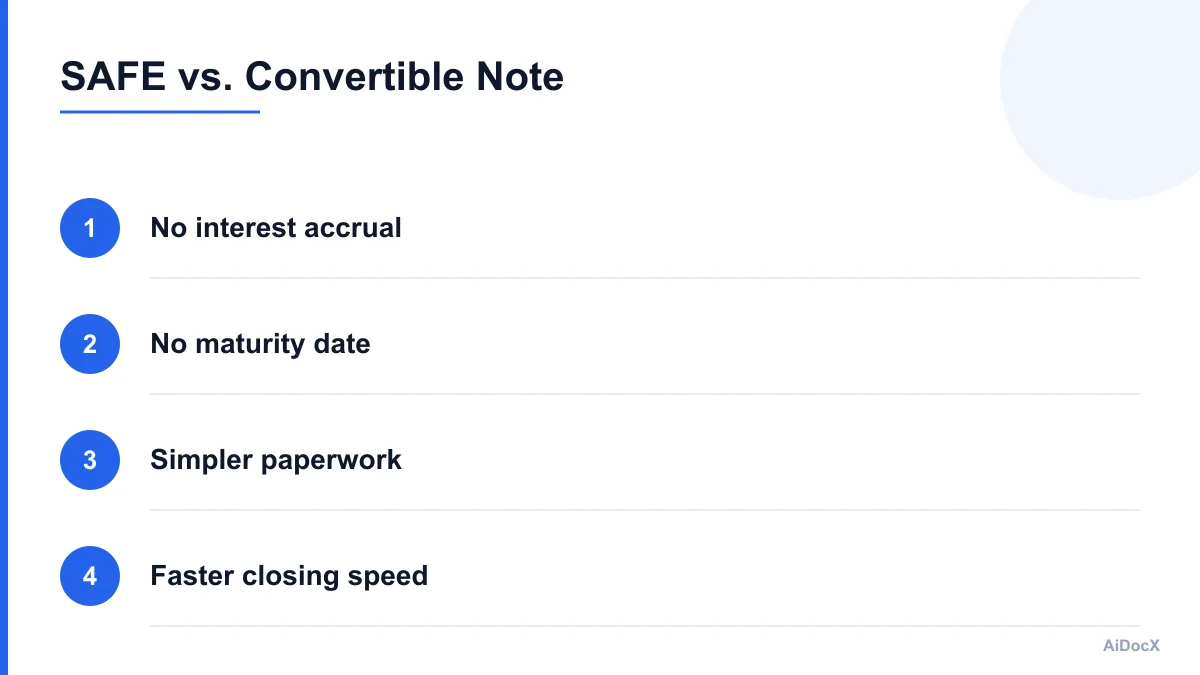
A SAFE is a warrant-like instrument that gives an investor the right to receive equity in a future equity financing round. Unlike a loan, it is not debt. It does not accrue interest, and it does not have a maturity date requiring repayment. Instead, it converts into shares of the company’s most favored stock (usually Preferred Stock) in the next qualified financing round.
The core value proposition of the SAFE is its simplicity. In a priced round, you and the investor must agree on a pre-money valuation, which is notoriously difficult for early-stage startups because there is little financial history to base the number on. Disagreements on valuation can kill a deal. With a SAFE, you agree on the amount of money the investor is putting in, but you leave the price per share for later. The investor gets a discount or a cap on that future price as a reward for their early risk.
This mechanism aligns incentives. Founders don’t have to convince investors that their company is worth $5 million today when they might be worth $20 million in six months. Investors get upside protection through the terms of the conversion, ensuring they are rewarded for being early.
Why Founders Choose SAFEs Over Priced Rounds
The decision to use a SAFE instead of a priced round is rarely about preference; it is often about survival and speed. In the competitive landscape of 2026, where capital efficiency is paramount, the advantages of SAFEs are substantial.
Speed to Close Time is money. A priced round can take three to six months from term sheet to closing. A SAFE can be signed in days. If you have an angel investor ready to write a check, a SAFE allows you to accept that capital immediately without waiting for a full legal process. This speed is crucial for maintaining momentum, paying key hires, or extending your runway.
Lower Legal Costs Priced rounds require extensive legal documentation, including a Stock Purchase Agreement, Rights Agreement, and often a full set of corporate governance documents. SAFE agreements are standardized and short. While you still need legal review, the cost is a fraction of a priced round. For a pre-seed startup operating on a tight budget, saving $10,000–$20,000 in legal fees is significant.
No Dilution Uncertainty In a priced round, you issue shares immediately, which dilutes the founders and existing shareholders right away. With a SAFE, no shares are issued until the conversion event. This means your cap table remains clean until the next round. You don’t have to worry about the administrative burden of issuing stock certificates or updating cap tables for every small angel investment.
Flexibility in Fundraising SAFEs are particularly useful when raising from multiple small investors. Managing a cap table with dozens of individual shareholders who are not yet investors in the company can be messy. SAFEs keep these investors in a "pool" that converts simultaneously, simplifying the cap table management until the Series A.
Key Terms in a SAFE Agreement
Understanding the mechanics of a SAFE is critical. While the document is simple, the terms you negotiate can have a massive impact on your future dilution. The two most common terms are the Valuation Cap and the Discount Rate. Some SAFEs include both, creating a "Pro Rata" or "MFN" (Most Favored Nation) structure.
Valuation Cap
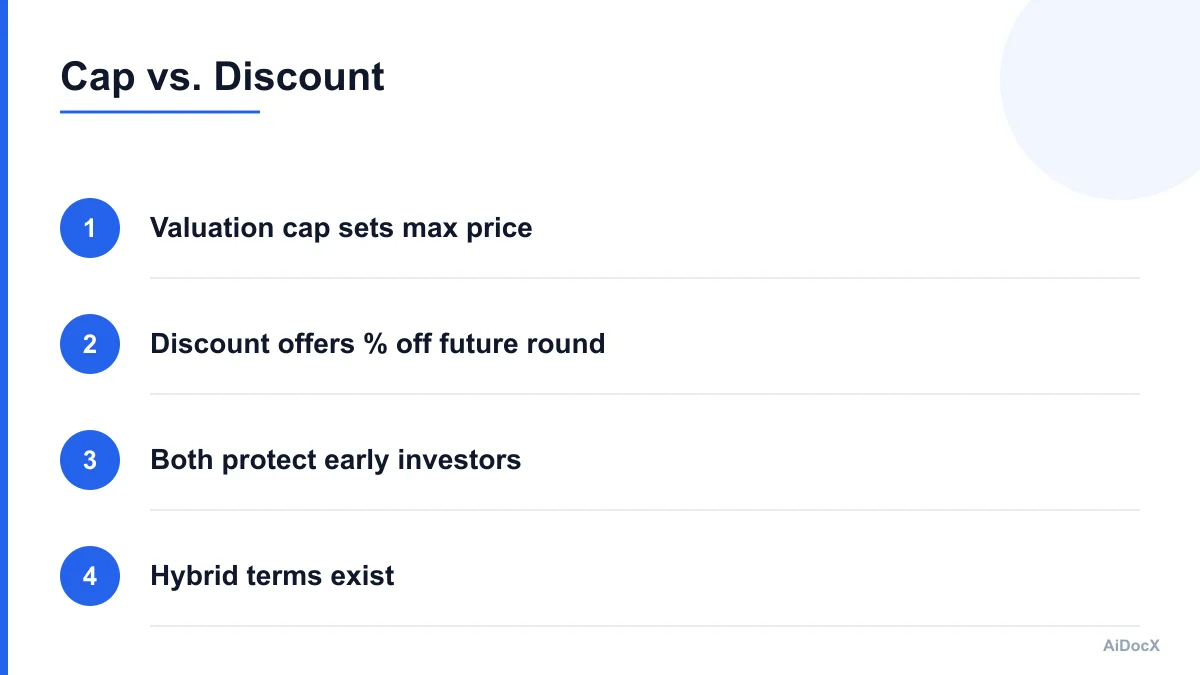
The valuation cap sets the maximum pre-money valuation at which the SAFE converts into equity. It protects the investor by ensuring they get a lower price per share if the company’s value skyrockets in the next round.
- Example: You raise $1 million on a SAFE with a $10 million cap. Later, you raise a Series A at a $50 million pre-money valuation. Your SAFE holders convert as if the valuation was $10 million, not $50 million. This means they get five times more shares than if they had converted at the Series A price.
- Impact on Founders: A lower cap is better for investors but more dilutive for founders in the next round. A higher cap is better for founders but may make the deal less attractive to investors. Setting a realistic cap is essential. If the cap is too low, you may struggle to raise the next round because early investors will demand excessive equity.
Discount Rate
The discount rate gives the SAFE holder a percentage discount on the price per share paid by new investors in the qualified financing round.
- Example: You offer a 20% discount. In the Series A, investors pay $1.00 per share. Your SAFE holders pay $0.80 per share.
- Impact on Founders: Discounts are less dilutive than caps if the company’s valuation grows significantly. However, if the valuation stays flat or grows slowly, a discount can be more generous to investors than a cap.
Pro Rata Rights (Most Favored Nation)
Many SAFEs include a "Most Favored Nation" (MFN) clause. This means if you issue SAFEs with better terms (lower cap or higher discount) to later investors, earlier SAFE holders can amend their agreement to match those better terms. This protects early angels who sign first but allows you to adjust terms for later rounds without renegotiating every prior agreement.
The Conversion Mechanism: When and How Equity is Issued
A common misconception is that SAFEs convert automatically the day you raise money. In reality, conversion is tied to a specific trigger event, usually a "Qualified Financing."
What Is a Qualified Financing?
A Qualified Financing is defined in the SAFE as the first equity financing round in which the company sells equity securities for aggregate gross proceeds of at least $5 million (though this number can be negotiated). Until this event occurs, the SAFE remains a warrant, not equity.
If your company never raises a Qualified Financing, the SAFE does not convert into equity. Instead, it may convert into equity upon a liquidity event, such as an acquisition or IPO. Some SAFEs also include a "Change of Control" provision, where the SAFE converts or is cashed out if the company is sold before a Series A.
The Conversion Process
- Trigger Event: The company closes a Series A or Series B round that meets the Qualified Financing threshold.
- Calculation: The conversion price is calculated based on the SAFE terms (Cap or Discount).
- Issuance: The company issues shares to the SAFE holders.
- Cap Table Update: The cap table is updated to reflect the new shares.
It is important to note that the SAFE does not give the investor a seat on the board or voting rights until the conversion is complete. This keeps the governance structure simple during the pre-seed stage.
Common Mistakes Founders Make with SAFE Notes
While SAFEs are standardized, founders often make critical errors in how they negotiate or manage them. These mistakes can lead to excessive dilution or damaged relationships with investors.
Setting an Unrealistic Valuation Cap
The most frequent mistake is setting a cap based on hope rather than data. If you set a $20 million cap because you want your company to be worth that much, but the market values it at $10 million in the next round, your early investors will convert at a huge discount. This can lead to significant founder dilution and resentment. Conversely, if you set the cap too low because you are desperate for cash, you may fail to attract serious investors who see the cap as a sign of poor judgment.
Best Practice: Research comparable startups in your sector and stage. Use a combination of traction, team pedigree, and market size to justify your cap. Be conservative. It is better to have a slightly lower cap and a happy investor than a high cap and a deal that falls through.
Ignoring the MFN Clause
Founders often overlook the MFN clause, thinking it’s just boilerplate. However, if you issue a SAFE with a $15 million cap to an angel, and then raise from a VC with a $10 million cap, the angel can demand their cap be lowered to $10 million. This can drastically increase the dilution for the founder.
Best Practice: Be consistent with your terms. If you must offer better terms to a later investor, communicate early with earlier investors. Some founders negotiate a "MFN expiration date," meaning the MFN right expires after a certain date or after a certain amount of capital is raised.
Confusing SAFEs with Convertible Notes
While both are early-stage instruments, they are legally distinct. Convertible notes are debt instruments that accrue interest and have a maturity date. If the company doesn’t raise money by the maturity date, the note becomes due and payable. SAFEs are not debt and have no maturity date.
Best Practice: Stick to SAFEs for early-stage raises in the US. Convertible notes are more common in Europe or for specific cross-border structures. Using a note when a SAFE is appropriate adds unnecessary complexity and legal cost.
Not Updating the Cap Table
Because SAFEs do not appear on the cap table as shares, founders often forget to account for them when calculating dilution. This leads to surprises when the conversion happens.
Best Practice: Maintain a "Capitalization Table" that includes a section for "SAFEs Outstanding." Track the amount raised, the cap, the discount, and the date issued. This allows you to model dilution accurately as you approach the next round.
How to Structure a SAFE Round in 2026
Structuring a SAFE round requires a strategic approach. You are not just selling equity; you are building a foundation for your company’s capitalization. Here is a step-by-step guide to structuring your round effectively.
Step 1: Determine Your Raise Amount
Calculate your runway. How much money do you need to reach the next major milestone (e.g., product launch, first $100k MRR)? Raise enough to get there, plus a buffer. Raising too little forces you to raise again too soon, which is expensive and distracting.
Step 2: Set the Valuation Cap
Work with your advisors or legal counsel to set a cap that is aggressive but realistic. Consider the following factors:
- Traction: Do you have revenue? Users? Partnerships?
- Team: Are you ex-FAANG? Do you have domain expertise?
- Market: Is the market growing?
- Comparable Deals: What are other startups in your space raising at?
Step 3: Choose Your Terms
Decide between a Cap, a Discount, or a Hybrid.
- Cap only: Best if you expect high growth.
- Discount only: Best if you expect modest growth.
- Cap and Discount: Offers flexibility and is often preferred by investors. The conversion price is the lower of the two.
Step 4: Use Standard Forms
Use the standard Y Combinator SAFE form (Extended or Extended Pro) as your base. These forms are widely recognized by investors and legal teams. Deviating from the standard form can raise red flags and slow down the process. Only negotiate terms that are critical to your business.
Step 5: Draft and Sign
Once you have agreed on terms, draft the agreement. AiDocX drafts a SAFE agreement with the right valuation cap and discount terms, then routes it for e-signature so a founder can close a check the same day it's agreed. This speed ensures that capital is secured before the investor’s interest wanes.
Managing Investor Relations with SAFEs
SAFEs are not "set and forget." You must maintain good relationships with your SAFE holders. While they do not have voting rights, they are still shareholders in the company’s future.
Communication
Keep your SAFE investors updated. Send quarterly updates on progress, challenges, and milestones. This builds trust and makes it easier to raise the next round. Investors are more likely to participate in the next round if they feel informed and valued.
MFN Notifications
If you issue new SAFEs with better terms, notify existing holders immediately. Provide them with the new terms and ask if they want to amend their existing agreement. Prompt communication prevents surprises and maintains goodwill.
Conversion Preparation
Six months before your expected Qualified Financing, start preparing for conversion. Gather all SAFE agreements, calculate the potential dilution, and prepare the cap table. Work with your legal counsel to ensure the conversion process is smooth and compliant with securities laws.
Checklist for Closing Your SAFE Round
Before you sign the first SAFE, ensure you have completed the following steps:
- Calculate Runway: Determine the exact amount of capital needed.
- Set Cap: Research comparables and set a realistic valuation cap.
- Choose Terms: Decide on Cap, Discount, or Hybrid structure.
- Select Form: Use the standard Y Combinator SAFE form.
- Legal Review: Have a lawyer review the final terms.
- Cap Table: Update cap table with SAFE details.
- Sign and Store: Use e-signature and secure digital copies.
- Notify Investors: Confirm receipt and next steps.
Conclusion
The SAFE note remains the most efficient tool for early-stage fundraising in 2026. It allows founders to raise capital quickly, with minimal legal cost, and without the burden of pricing a valuation before the company is ready. By understanding the key terms, avoiding common mistakes, and structuring your round strategically, you can build a solid foundation for your company’s growth.
Remember, the goal of the pre-seed round is not to maximize valuation, but to secure the resources needed to achieve product-market fit. A SAFE helps you do that by aligning the interests of founders and investors around future success, not present uncertainty.
If you are ready to close your pre-seed round, streamline the process. AiDocX drafts a SAFE agreement with the right valuation cap and discount terms, then routes it for e-signature so a founder can close a check the same day it's agreed. Take control of your fundraising timeline and focus on what matters: building your product.
For the wider picture of what individual investors actually sign, read our angel investment agreement guide.
Ready to automate your documents with AI?
Start free with AiDocX — AI contract drafting, meeting minutes, consultation notes, e-signatures, and more in one platform.
Get Started FreeMore from AiDocX Blog
Affiliate Agreement Template (2026): Protect Your Business When Paying Commissions
Free affiliate agreement template for 2026: key clauses, FTC disclosure requirements, affiliate vs referral agreement compared, a worked example, and a copy-paste version.
James September 22, 2026 11 min
AI Receipt Generator (2026): Create Professional Payment Receipts in Seconds
Generate professional payment receipts with AI in seconds. Receipt vs invoice vs credit note explained, the fields to include, a worked example, and a copy-paste template.
James September 22, 2026 9 min
Bill of Sale Template (2026): Free Generator for Cars, Trailers & Personal Property
Free bill of sale template for 2026: the fields to include, state notarization rules, federal odometer disclosure, a worked example, and a copy-paste version.
James September 22, 2026 10 min